The Listening Palace: How to Get More out Of Conversations, and Become a Better Listener

Being a better listener is a key skill for nearly anything you want to do. The better you are at listening, the better you can be as a friend, a partner, a colleague, and so on.

But listening is hard. We’ve all got a lot going on. Ideas pop in and out of our heads, and we often feel like we’re just South of where we need to be — we’re not quite caught up. As a result, our minds are rarely still, empty, at ease. When our minds aren’t at ease, we do a terrible job of listening. When we do a terrible job of listening, we end up doing a terrible job of thinking as well.

So here’s a trick you can use to improve your listening. It involves using your the psychological tools that have been shown to be most effective for memorization: visualizing and spatial thinking.

The Listening Palace Trick

The next time someone starts relaying information to you, get yourself into a mode of thinking much like what world memory champion Alex Mullen (and many others, as well). It’s called the memory palace. Below is a cool infographic on the concept.
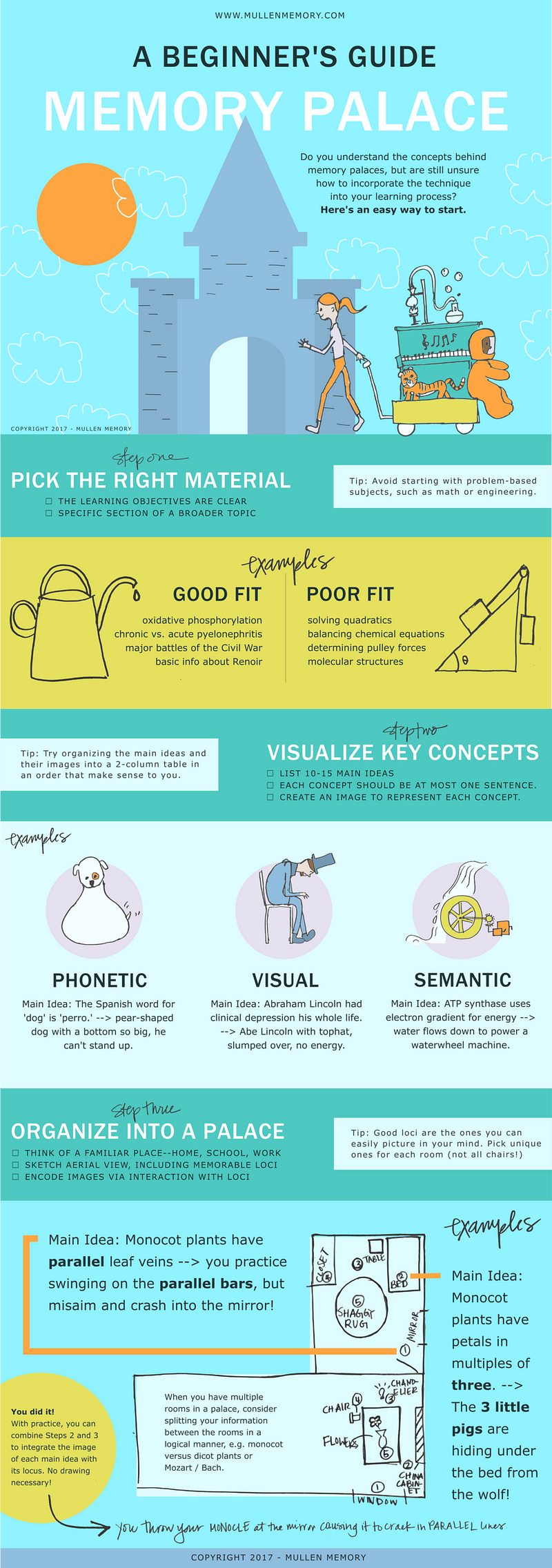
The basis for the trick is simple: use your mind’s ability to spatially separate and retain things in order to store information for later use and retrieval. Place bits of information in different parts of a place you’re familiar with (like your home), and recall what is in each room.

This technique works wonders for people in competitive memory competitions, where lists of names, numbers, or words are thrown out for participants to memorize and spit back out. In fact, that’s where it became popular.

But listening comprehension is a whole different ball-game. Most people are not talking to you by reading from a list of the important information they want you to retain. They speak in stories, they think out loud, the double back and change their stories mid-stream. It’s not easy to listen and comprehend.

What I’m suggesting is to use that for listening — staying focused on what someone is saying, and pulling out the vital information.

How To Do It

The first thing to do in order to more effectively listen is to figure out what the purpose of the conversation is. In a lot of cases, this can be done before the conversation takes place. There are a few main reasons why a conversation is going to happen. Someone either wants to:

  • make you aware of something
  • get your feedback
  • get you to do something
  • vent/think through something out loud with you

Once you have figured out what the purpose is, you can place that purpose in the main entrance of what I’ll call your “listening palace”. It’s the place you want to get through after all of the wandering through the palace. Once the conversation starts, envision that main point right there in front of the door, ready to go outside.

As the other parties speak, and bring up other points or people, put those things in rooms of the palace. When people are described during the conversation with adjectives, place them in the room acting out that adjective. The same is true when you hear about two or more people having had an interaction. Place them in a room with each other, interacting.

As the conversation yields more points, includes more people, and reveals more ideas, arrange them in the various rooms. Also, try to place them closer to or further away from the front door based on how vital you see them to the main point of the conversation (which can also change).

The great thing about doing this while you listen is that it then helps you to come up with really good clarifying questions. As you visualize information and try to couple it with other information, or place it in relation to other information, you’ll naturally have questions about how it comes together. Ask those questions, and get clarity. It can be supremely helpful.

A Conclusion

One of the best way to learn, process, and remember new information is to hook it up in a relevant way to information that you already grasp very well. When it comes to that type of information, few things are better understood and retained than spaces you’ve lived in for years.

As humans, we have a very vibrant faculty of spatial memory. When you leverage that spatial memory to retain and process new information, it becomes very powerful. You can focus better, become more inquisitive, more engaged, and ultimately, smarter.

It takes some work, like any habit. But when you do it right, using a listening palace is a pretty neat trick to get more out of your conversations with others.

Did you find value in this piece? Consider subscribing to my weekly newsletter — Woolgathering. It’s one email per week, with interesting stuff to ponder, from me and from around the web.


Have We Become Too Cheap for Our Own Good?

On Value and Money in the Digital World

I buy very few apps and subscribe to very few services. For any given app or service that I stumble across, I’ve found that my first question is: is it free? The other day, I caught myself in this very train of thought. I was a bit disgusted.

An entire team of people poured their time and effort into making this. Another team is pouring their time and effort into maintaining it. They’re just asking that the users pay for that. It’s how business has been done since business began being done. So why do I find myself being so damned unwilling to shell out 5 bucks per month to use this software that I’ve already admitted would provide me value?

I’m not a cheap guy. I regularly buy coffee — just black coffee — at a price approaching $4 per cup. I am more than happy to pay a premium for a decent sandwich, or a gourmet salad. I regularly tip 20% at a minimum. So why am I so hesitant to shell out $5 per month for a piece of software that is already part of my workflow?

I’ll tell you why: I’ve been conditioned to be cheap about non-tangible things.

If I can’t touch it, feel it, eat it, drink it, drive it, or any of that, I get a bad case of alligator arms when it comes to shelling out money for it. I get the sense that this is case for many of us in the young gen-x, old millennial cohort. And I understand it.

We grew up in a time when even the most advanced pieces of software came from pieces of tangible stuff. You bought Nintendo cartridges, Microsoft Office came on CDs. You went to the store and looked for a CD, found it, and purchased it — with money. But then the internet became capable of supporting the transfer for software from place to place with little physical evidence that any such transfer took place. It barely takes any time, and a few small icons on the screen indicate that anything has moved from anywhere. It’s all vapor.

Furthermore, there is just a glut of digital stuff. For every song, app, or service that charges a fee, there is either (a) a competing one that is free or (b) a service that allows you to get it for free that isn’t difficult to obtain and learn.

And from where I stand, that’s the crux of the issue. When what I gained is — for all intents and purposes — a vapor of the senses, I still have a hard time assigning value to it. And when there is so much of whatever I’m looking for, so many alternatives, and almost always a free one — I have little incentive to pay any price for something digital. The invisible hand is moving me, and its middle finger is stiffly extended to those doing digital work. Me? I get a bunch of options for free mind-mapping applications. As a consumer, I have little incentive to change how things are.

I know this is not how it should be, but I’m sure people who make apps and try to charge for them know exactly what I mean. Ditto for people who write for money (or try to). For as far as we’ve come, and as much as we’ve innovated, our sense of value seems to be lagging sadly behind.

I’m not sure how to remedy this, but I get the sense that it’s going to have to start with those who have never handled a compact disc, or used a CD-rom drive. This flash-generation will have to smuggle value into the elusive and ever-accelerating transactions for software. They’ll have to then teach us how to do it.

That’s the funny thing about value. Sometimes we have too much faith in ourselves that we’ll realize it when we see it, and act accordingly. But right now, our faith has far outstripped reality. Here’s hoping we find a way to get back in sync.

Did you find value in this piece? Consider subscribing to my weekly newsletter — Woolgathering. It’s one email per week, with interesting stuff to ponder, from me and from around the web.

The Power of Powerlessness

The more I read online, the more I find myself bombarded by writing that focuses on empowerment. But it tends to do so in the same way: by insisting that we have so much more power over our situations than we think — that our destiny is ours to shape; the world is effectively our oyster.

But I am not sure how empowering this really is. I think that anyone who has lived more than a few years on their own can attest to the fact that there is an awful lot that it is clear we don’t have power over. The world turns daily, and quickly, in a direction we did not determine. It will not stop and start to accord with our wishes. When we don’t see that, it can be very disheartening. When we do, see this, we realize our powerlessness.

But here’s the paradox: the only way to feel truly powerful is to fully grasp how powerless we are. When we understand how small our sphere of influence is, we are empowered to do those things that will truly have an impact.

That sphere of influence basically begins and ends with us. On a few occasions, it can extend to those we’re close with — to family, friends, and coworkers. But it only extends that far if we exercise power over ourselves. It may sound selfish, but the most important and effective work you can do to be empowered is on yourself. When you have ultimate power over yourself, you have a power that very few others have. When they see that power in you, you gain respect and admiration. With that comes the power to affect real change.

The problem, though, is that it’s really hard to gain that kind of power over yourself. Our minds are so active and instinctive — racing around and working based on conditioned habits — that we can rarely sit alone with our thoughts and effectively shape our focus and attention. It’s why listening effectively is difficult. It’s why doing difficult focused work is difficult. It’s why there is such an interest in spiritual practices of all sorts — because they heavily emphasize this kind of work on oneself.

But it all begins with realizing how powerless we are. With that realization comes liberation. We are free to start from zero and make incremental progress toward working with the ebbs and flows of life — rather than against it. We are free to work with our minds to make them more skillful — rather than against them. We are then free to become powerful — and all because we admitted we were powerless.

Funny how that works, right?

Did you find value in this piece? Consider subscribing to my weekly newsletter — Woolgathering. It’s one email per week, with interesting stuff to ponder, from me and from around the web.

Nothing is Meant to Be, and That’s Awesome

From time to time, I hear someone say that something was “meant to be”. More often than not, I hear it as it pertains to a relationship — that two people were meant to be together. For many people, that somehow seems to impart a higher status to a relationship, or people in it. But honestly, I have never understood that.

I have been in a few relationships — some short and exhilarating, one long and ultimately debilitating. I believe there was love there at times. But it did not last. And that brings me to why I don’t believe we should use the phrase “meant to be” — at least not as it pertains to relationships.

I am married, and have been for almost 7 years now. It’s awesome, and I am completely happy. But here’s the thing: it’s not a sweeping, fairy-tale, every day is passionate romance relationship. It’s a “this is a committed partnership that will stand the test of time because there is mutual respect and faith in one another” relationship. To me, that is way more romantic.

You see, the thing about a committed, respect-filled relationship between equals is that it takes work. It takes compromise, daily renewal of commitment, and the honest willingness to improve yourself for the sake of serving someone else. A wind-swept, passion-fueled obsession where the parties are bound by fate? I just don’t see how that’s better.

I don’t think we’re meant to be with anyone. And I think that makes every lasting relationship that much more special. The fact that no one is meant to be together, but that two people decide to put their all into one another — and to sustain that — to me, that’s inspiring. Two people who are just bound to be and stay together? I’m not impressed. Sorry. Maybe I’m just weird.

I believe in romance, in romantic gestures, and in passion. But I believe those things come not from outside — from whatever force makes it such that two people are supposedly meant for each other. I believe true romantic gestures, and passion through the years come from something built with care by two people. We build our relationships. We add on, maintain, and decorate them. When we understand them this way, we can take more pride in them.

I believe in romance, but it’s a more nuanced and mindful type of romance. It will never be as flashy as the fiction written about it, but that no longer bothers me.

Did you find value in this piece? Consider subscribing to my weekly newsletter — Woolgathering. It’s one email per week, with interesting stuff to ponder, from me and from around the web.

The Illusion of “Outside Your Comfort Zone”

A Brief Thought on Some Incomplete Advice

The prevailing advice seems to be “the key to success is to keep stepping out of your comfort zone”. But I wonder about this sometimes.

Human beings seem to crave comfort and security, by our very nature. In fact, human beings have done, and continue to do a great deal of things just to achieve and maintain comfort and safety. They work jobs they would never normally work, they take risks they would probably not otherwise take, and they spend hours and days planning to ensure that when the chips fall, they end up safe and comfortable again.

Safety and comfort are indeed the destination. While the means to get there may at times require that you step out of your comfort zone for little bit, if there were no possibility of comfort and safety at the end of the journey — nobody would take it.

Now, this is not true of every single action we take. We will do small things that may not look to provide us either safety or comfort. But we do those things inside of a larger framework where we do or will feel comfortable and safe.

I guess that’s why I cringe when I read what I would consider incomplete advice about personal growth — that the key is stop chasing comfort and security. I think that’s short sighted and probably harmful. If people did not chase stability, safety, and comfort, the world would be a scary and incomprehensible place. We’d all be Heath Ledger’s Joker in The Dark Knight — just randomly doing terrible things — just wanting to watch the world burn.

If I had to venture a guess, I would file this under premature theorizing and oversimplification. Someone heard a piece of advice that sounded great and had seemingly good explanatory power. They ran with it. They got a shiny new hammer, and everything looks like a nail.

I will continue to pursue comfort and safety. So will you. So will anyone you know who isn’t mentally ill. The question is not whether that is true, but how that guides your different decisions. It probably shouldn’t drive your short-term decisions, but it should drive your long-term decisions.

A lack of safety and comfort in the short term can be beneficial. But at some point it becomes detrimental. In short, leaving your comfort zone is just like going to work each day: you should do it very frequently, but once you start spending all your time there, it’s problematic.

Did you find value in this piece? Consider subscribing to my weekly newsletter — Woolgathering. It’s one email per week, with interesting stuff to ponder, from me and from around the web.

The Hunger of Our Time

“To achieve anything, you need a burning desire.”

-Napoleon Hill

I read the book Think and Grow Rich about 2 years ago. It was about the time that I began writing the kind of stuff you’re reading right now. In it, one of the founders of the modern self-help and positive psychology movement, Napoleon Hill, talks about the passion and desire that are necessary in order to succeed.

Since then, I have read countless pieces and seen countless talks by people wax poetic about hustle, tenacity, and hunger. They pine for people with passion, gusto, balls, and passion. They talk about how much of that is the very seedbed of success.

I hear all that, and I wonder. I question. I am skeptical.


The word Taṇhā is the Pali word that means “hunger”, “desire”, or “longing”. For buddhists, Taṇhā is at the root of the most pervasive and paralyzing problem of humanity: suffering. We suffer because we have desires, hungers — we lust after things, feelings, and people. And we don’t get them. And as a result, we suffer.

I find myself hungering for an awful lot of things — from big to small. I want another piece of pizza, I want a better title at my job. I want more subscribers to my newsletter, more recommends on Medium, a bigger house, and so on, and so forth.

If there is a such thing as a collective consciousness — a zeitgeist — and if it indeed changes throughout time, I wonder how the collective consciousness of our age compares to previous ones.

I suspect that there is much more desire inherent in our time. Because of that, I suspect that there is more suffering lurking in our collective consciousness as well. If it hasn’t already manifested itself, it will.

I worry about this for myself, and I worry about it for others. I especially worry about it for my children. My daughter is almost 3. My son will be born in 2 months. What expectations will be embedded into them — without their consent — as they come of age? What pressure will be built into their spirits? What will keep them from being happy with what they have? What will they be told is not good enough, to force them to keep on hungering, keep on desiring?


I am not against wanting to do something with one’s life. Everyone has it within them to find their own purpose — to set goals and work toward them. But everyone also exists in an environment flooded with the desires and expectations of others.

When the noise of others’ desires drowns out the noise of your own spirit, the purpose and meaning you assign to your life ceases to become your own. When that happens, it becomes nearly impossible to enjoy your journey. Your focus comes not from within, but from without. You rely on the fire of others for warmth, rather than building your own. It becomes exhausting.

The hunger of our time is not our own, but that of others. No matter how much we feed others’ hunger, we will never feel satiated ourselves.

Did you find value in this piece? Consider subscribing to my weekly newsletter — Woolgathering. It’s one email per week, with interesting stuff to ponder, from me and from around the web.

The Curiosity Quadrant: Becoming Smarter Through Strategic Ignorance

One of the very first classes I took in college began with the professor saying something like this:

If you leave this class with more questions than answers, I’ll have done my job. I’ll have given you all you need to keep learning — curiosity.

It was in this way that I came to understand that one of the most important qualities that anyone can have is curiosity. That genuine curiosity — the kind where you truly yearn to understand something — has to begin with admitting some lack of knowledge. In order to really become more intelligent, you have to sincerely admit that you’re ignorant.

When I began teaching several years ago, I used the same line at the opening of each semester of Philosophy 101. Some students loved it, and some thought it was lame. They wondered how I would help them become equipped for the knowledge economy without giving them any answers.

Axes of Ignorance

I informed the incredulous students in my class that they were taking me too literally, but no seriously enough. I was going to arm them with knowledge, and expertise, but those don’t come in the form of answers.

There’s a paradox at work here: the more of an expert you become in some field, the more questions you tend to have about it. I think that this has something to do with the relationship between the awareness of ignorance, curiosity, and enthusiasm.

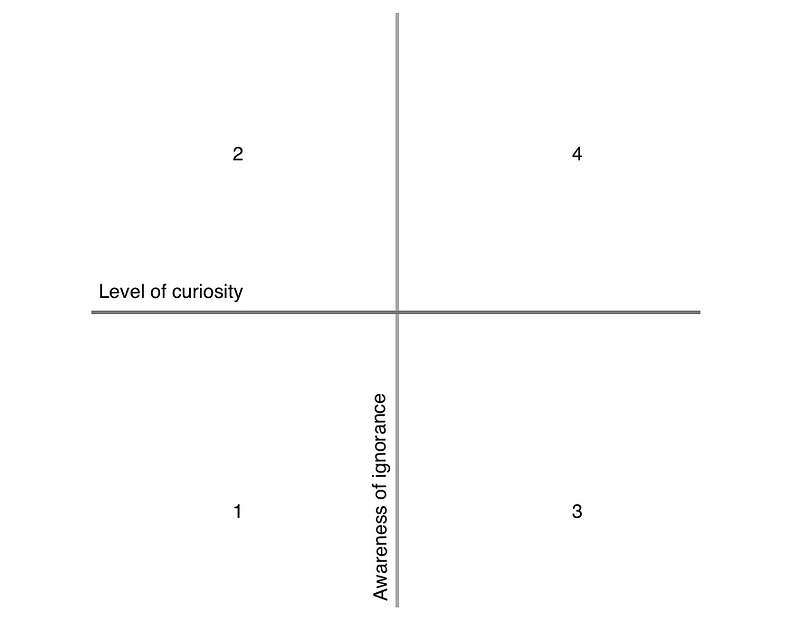
The x-axis represents your level of curiosity, from not at all curious, to intensely curious.

The y-axis represents what I call your “awareness of ignorance” — meaning how well you know your deficiencies in knowledge, or how well you know what you don’t know.

Throughout your life, you’ll find yourself in one of the 4 quadrants regarding any given topic:

  • Quadrant 1: Unknowingly ignorant, and not very curious 
    (i.e., don’t know what you don’t know, and don’t care)
  • Quadrant 2: Knowingly ignorant, but not curious 
    (i.e., you know what you don’t know, but you don’t care)
  • Quadrant 3: Unknowingly ignorant, but curious 
    (i.e., you don’t know what you don’t know, but you care)
  • Quadrant 4: Knowingly ignorant, and curious 
    (i.e., you know what you don’t know, and you care)

We start our lives in quadrant 1. We don’t know what we don’t know, and we don’t care. Slowly, we begin to understand that we don’t know how to do all sorts of things that adults are doing: walking, talking, grabbing things, etc. We’re then in quadrant 2. Once armed with that awareness of our ignorance, we develop curiosity — we care about getting to know those things. We find ourselves in quadrant 3. We then seek to learn them. But by that time, we become aware of so many other things we don’t know. We find ourselves in quadrant 4.

We repeat this process for every new subject we stumble upon. It’s a repeating cycle.

Get Out of Pac-Man Mode

This is important because becoming smarter is not actually done by way of being a mental Pac-Man — just looking to gobble up a bunch of bits of facts and data. Getting smarter is most effectively done when it’s approached by looking at what you are ignorant about — what you don’t know. There is a point at which that list of things becomes large enough that you want to start slimming it down, and you become curious about one of them.

But here’s the kicker: the more you end up learning about a subject, the more you end up realizing you don’t know about it. In other words:

the most productive search for answers actually results in more questions.

The process then becomes:

  • awareness of ignorance
  • curiosity
  • questions
  • some answers
  • more questions
  • repeat

Things brings me to the most exciting (or disheartening, depending on your view) thing about knowledge and learning. If I’m right about this question-yielding process, the quest for knowledge is about crossing the y-axis, into quadrants 3 and 4. That means that learning is about first admitting ignorance, and then becoming curious. It also means that teaching involves the same things.

Maybe this is a n0-brainer to some of you. But I wonder how often we forget to approach both learning and teaching in this way. How often do we begin reading a book or article by listing things we don’t know, and then questions we’d like answered? How often do we finish reading by doing the same thing? Probably not often.

But why? Aren’t we curious enough? No. We’re still in Pac-Man mode — still looking for the next bunch of facts to gobble up. After all, we want to show off how many books and articles we read, right?

Like anything else, learning is actually more in the prep-work than the actual ritual — more in the practice than in the game. That means that learning is more in the stoking of curiosity about things than in the collecting of information. It’s more in contemplating the questions and the longing for answers than in the reading of the books.

So let’s try to admit how ignorant we are, get curious, and get learning.

Did you find value in this piece? Consider subscribing to my weekly newsletter — Woolgathering. It’s one email per week, with interesting stuff to ponder, from me and from around the web.

Less Passion, More Compassion

The Case for a Different Set of Entrepreneurial Traits

I hear the term “passion” quite a bit these days. I hear people talk about themselves and others as “passionate” as if it is the trait to have. I read advice on how to find and pursue your passion. In the same way that they used to say “sex sells”, passion also sells.

But for all of this passion we’re buying and selling— I wonder sometimes; have we lost sight of something more important? It’s a word that is closely related to passion — in fact your just need to add three letters at the beginning of it. I’m talking about compassion.

Why do I believe we might have sacrificed compassion as we have adopted passion? Primarily, compassion involves patience. Those who are truly compassionate are extremely patient. But when we lose patience — with people, processes, or things, we lose compassion. It happens slowly at first, but once it begins, it becomes an avalanche.

Don’t believe me? Try an experiment.
Tomorrow, when you wake up, give meditation an honest go for 5–10 minutes. Really just sit and observe your thoughts, but do your best to keep yourself from grabbing on to them.

It’s helpful to think of thoughts and feelings as taxis driving by, and stopping to pick up fares. You don’t have to jump in them if you don’t want to. So try not jumping in. Stay where you are — just watching the taxis come and go.

Once you’re finished, venture outside into the world and go about your regular day. Drive in traffic, get a coffee during the coffee shop’s peak breakfast hour. Go into work and check your email. But all the while, pay attention to one thing in particular: how quickly you form expectations, and how much your feelings — both physical and psychological become hooked to those expectations.

Once you venture into the world, expectations fly fast and furious. They can and do become part of your everyday mental processes. In traffic, you expect people to move quickly, you expect lights to change. When they don’t you get frustrated. At the coffee shop, you expect some level of service, you expect people to move in line, and you expect hot coffee if that’s what you ordered. When those expectations aren’t met, you get frustrated.

Every day we form a thousand expectations, and every day, a thousand more are not met. So every day, we feel the building frustration of a thousand let-downs. Sure, there is always the pleasure of all of the expectations that are met, but when those don’t outweigh the pain of unmet ones — we feel uneasy and tense. We withdraw, or lash out. We become less patient, and thus less compassionate.

Each time we take on another goal, another project, and develop passion for it, we pin our more of our happiness to expectations being met, progress being made, and whittle away even more patience — even more compassion. We sacrifice compassion for passion. We work hard and play hard, but we also become hardened.

I am not saying that we shouldn’t pursue projects and goals passionately. What I am saying is that we need to temper our passion with compassion. We need to temper our expectations with patience. Things will routinely not turn out how we expect or desire. We need to not only get used to that, but learn to accept it — and roll with it.

The crazy thing is that in the long run, compassion may actually be more helpful to you than passion. Compassion requires patience, restraint, and open-mindedness. It requires that as many views and facts as possible be taken into consideration. Talk to any entrepreneur who has been in the game for longer than a few booms and busts, and they will tell you: those three traits are key in long-term success.

Passion is fine, but as this world keeps turning, let’s not overlook compassion. Aside from helping you to be a good person, it might just make you a great one, as well.

Did you find value in this piece? Consider subscribing to my weekly newsletter — Woolgathering. It’s one email per week, with interesting stuff to ponder, from me and from around the web.

What Your First Question Should Always Be

Before you write something to inform others about a given topic. Before you tell someone your opinion on a topic. Before you go into a meeting where you have to negotiate or report out. There is one question you will need to ask and really meditate on:

What don’t I know?

It’s not so that you can stress yourself out, lose confidence, or prepare for failure. Rather, you ask yourself this question so that you don’t overextend yourself. So you don’t present too strong an argument, and so that your reputation, your project, or whatever it is you’re looking to strengthen with what you’re doing doesn’t take a serious hit.

The urge we tend to have in order to make ourselves look good is to have all the answers. We want to be able to keep talking, and tell people things that we think will make them see us as experts. But in reality, asking a good question will make you look exponentially smarter than making any statement will.

I have a kind of mentor at my job, and while I don’t report to him, we work on a lot of projects together. There is a mantra that he repeats often: How can you use the information you have to your advantage? It’s a great question to think about, but it’s only half the story.

The other half of the story is this: how can you also use the information you don’t have to your advantage? The easy way to do that is to use your lack of information to ask skillful questions. If you don’t know something that you think would be really useful to know, simply think of a way to ask the question while showcasing what you do know.

So long as you are genuinely interested in finding the answer to your question, and really listen to the responses you get, you should do well in gaining both knowledge and credibility in your interactions.

Underlying all of this, is to two things:

  • intellectual honesty
    Knowing what you know, what you don’t, and being open to changing your stance based on learning new information.
  • humility
    Being willing to admit to others that you don’t know things, that you’re curious, and that you think they know more. Then being willing to ask for information and instruction from them.

Being intellectually honest and humble, and acting out those traits with others goes a long way — longer than trying to show how much you do know. You might end up realizing something that seems kind of counterintuitive:

Being smart rarely involves knowing a lot of things, but rather, being able to effectively identify what you don’t know, and understanding the best way to gain that knowledge.

Did you find value in this piece? Consider subscribing to my weekly newsletter — Woolgathering. It’s one email per week, with interesting stuff to ponder, from me and from around the web.

Youth, the Secret of Life, and Other Alchemy

I was talking to a colleague of mine yesterday, who is about to turn 50. He was regretful about the fact that he grew up too fast. He said that when he was a kid, all he wanted to do was get older, so he could do all of the things that that adults were doing — the things that seemed so cool to him as a child. So when he became an adult, and experienced the anxiety, uncertainty, and expectations that come with it, he looked back on a youth that he seemed to have let slip by him.

I sympathized with him, having heard this kind of thing before — also from someone older than me. But I could not empathize. I had never shared his feeling, his desire to grow up. I still don’t, even though I am myself a grown-up. And though I felt bad for not having shared such a common experience, I also feel very fortunate to have dodged a bullet.

The bullet that I dodged was the bullet of missing out on my youth. It’s something that I have seen so many people lament about. They pine for a youth that they feel they weren’t able to fully appreciate — because they were so hell-bent on obtaining the supposed treasures of adulthood. Having found those treasures to be largely composed of fool’s gold, they have turned their gaze backward, wondering if they missed the real treasure — and feeling a sneaking suspicion that they did.

I suspect that my reason for having dodged the bullet of misspent youth was that at least as it regards youth and its nuance, I learned a subtle and fine art. It was a kind of phenomenological alchemy that I have tried to deploy in other areas of my life. It’s a kind of alchemy that turns both the mundane and the painful into gold. It’s called appreciation.

Happiness vs. Appreciation

When I was 10 years old, my parents informed me that by the time I turned 11, we would be moving to the suburbs. We would be moving away from the intimate city blocks that I had come to know like the back of my hand — away from my friends, my school, my favorite parks, and family close by. A summer that by all rights I would have just let unfold like all the others became a summer that I had to carefully and masterfully handle, in order to extract all of the joy and future memories that I could.

In previous years I was merely a diner in the kitchen of my youth, enjoying the meal of a youthful summer. This year I had to become the chef as well. I had to both carefully prepare the meal, plate it, and present it in the best possible way. Only after that could I sit down to enjoy it. It was at that time that a very subtle but very valuable truth occurred to me:

Appreciation is not something that just comes to you. It has to be carefully prepared for, nurtured, and cultivated.

Developing appreciation for something or someone — especially things or people in your life — is actually a very involved and demanding endeavor. It takes effort and concentration, contemplation and mental space, to develop an appreciation for something.

But here’s another important thing that I learned from my youth:

Appreciation is not the same as joy, happiness, pleasure, or any of the other positive emotions. Appreciation is a relationship that involves many other emotions and thoughts— both positive and negative.

You can appreciate a warm, light-hearted dinner with friends where everyone enjoyed themselves and had wonderful, warm conversations. You can also appreciate when your first love broke your heart by breaking up with you in order to date your good friend — and the months of agony and self-doubt that followed. Both of those appreciations are the same, but they involve all sorts of different, opposite feelings.

Experiential Alchemy

I have always tended to follow the model of the optimist : look for the sliver lining, find the good in people, smile through the pain, etc. And though much of that model works to create a positive mindset, it still leaves much to be desired.

The optimist may well have it right that we need to always look for the positive, but inasmuch as she instructs us to only look for the positive, she is missing something valuable.

There is power in the negative, and we should not shy away from it. We should feel negative about some things. We should look at our situation — at times of loss and defeat — and say “this is terrible, I feel terrible”. Those feelings are instructive. Those feelings can be the seeds of appreciation.

This should not surprise us. We should be aware of the necessity of lows in order to accentuate the highs. We should be aware of the fact that life necessarily involves the good as well as the bad. Pleasure can’t be what it is without pain to contrast it. Joy cannot be what it is — and as important as it is — without sorrow against which to compare it.

The Test

A life of only joyful and pleasurable feelings — if not impossible — would simply seem devoid something necessary: those negative experiences to round it out. Yet we seem to forget that as we stumble through life, and we keep grasping for the joy and pleasure, while pushing forcefully away those negative experiences that come hurtling toward us.

Somewhere in there, we have to understand how to relate to all of these experiences, and figure out what a truly good life really looks like.

So here’s a test I’m proposing. It’s a test that if you can pass, perhaps you really understand a good life in a non-superficial way — you have the right balance. Think of your most negative experience you’ve had— one where you felt at or close to your personal bottom. If you can look back on it and appreciate it, then you are doing okay.

Appreciating it means acknowledging that it was bad at the time — that you felt bad, perhaps you were ready to give up. But you can also see how it has helped shape you into who you are today. Assuming you like who you are today, you can appreciate what all that pain and sorrow has done for you.

Those feelings never change into positive ones; they remain painful — that’s why they were so instructive. However, they changed you in a way that now serves to give you joy and pleasure. That’s appreciation. And truly, the more you can appreciate, the more you can live. Because a life filled with appreciation is a life fully lived.

In Conclusion: Staying Sharp vs. Cutting

Eventually, I did turn 11 — in the middle of that fateful summer. Within 6 weeks, my parents had sold our house and moved us to the suburbs — exactly as promised. I would begin middle school as the new kid. But under my belt, I had a summer that I could honestly say I appreciated as it happened. That in turn was the cornerstone a greater awareness I gained of how to appreciate youth, and thus how to appreciate my lived experiences in general.

I think that as we age, there is a sharpness to our faculty of appreciation that tends to become blunted. I’m not sure how it happens, and I’m not sure that we ever can get it back. But I take comfort in the fact that even a dull knife can cut, so long as you’re careful and calculated. So that is what I am trying to do: become more careful and calculated in my appreciation. It involves being present. It involves being still and silent more often. It also involves expecting and desiring less.

Come to think of it, perhaps it is expectations, desires, and future planning that blunt our faculty of appreciation. When you grow up, you have to plan, and you have to grapple with expectations — both yours and those of others. Try to shake them all you like, but such things will always be heavier as you age than when you were young. That’s just how it works.

Aristotle once said something like you are what you habitually do. I guess for the most part, this holds true, but I think there is another formulation: we are what we habitually appreciate. In one formulation, I am a writer. On the other formulation, I am so much more. For obvious reasons, I prefer the second.

Did you find value in this piece? Consider subscribing to my weekly newsletter — Woolgathering. It’s one email per week, with interesting stuff to ponder, from me and from around the web.



At the Writing Cooperative, our mission is to help each other write better. We’ve teamed up with ProWritingAid to do just that.

A Few Useful Things I’ve Learned — No Fancy Title

credit: Pok Rie

  • There is a difference between having an opinion, voicing that opinion, and acting on that opinion.
    Everyone is entitled to their opinion. But opinions should be handled with care. We must understand that an opinion merely possessed is easy to remedy — you can change your mind. But an opinion voiced or acted upon is much more difficult to remedy.
  • Doing a lot, and quickly, is overrated
    The person who does 10 things quickly, and with little thought, often ends up:
    – not needing to have done 5 of those things
    – having to fix or take back 3 of them
    – being unsure in retrospect about 2 of them
  • Thinking big often means acting small
    In fact, those who ACT big are often actually thinking small. They’re reacting to the latest and loudest things. They’re grabbing on to trends, trailing indicators, and reactions. 
    Thinking big means knowing that everything big begins small, and that only smaller, well thought-out actions over time will win sustained, repeatable results.
  • Feelings are results, too
    It happens all the time — metrics are not met, promises are not kept, or results are not delivered. But the way you are able to make someone feel about you and your efforts — even when you don’t deliver the results — can make all the difference. This means that you are responsible for much more than meeting expectations. You are responsible for making your customer, partner, or whoever feel genuinely good — even when you couldn’t come through for them as promised or expected.
     
    This doesn’t mean you can half-ass it and just charm your way out of it — people tend to be able to sense that pretty easily after it happens once or twice. Rather, you have to come by the trust and good will honestly — by being forthcoming, honest, and genuinely caring about those you serve. There’s no trick to it.
  • Everything in moderation — even moderation
    Sometimes, you have to be passionate, other times reserved and detached. If you are always down the middle, unexcitable, cool and collected, you’re basically almost a robot. Moderation also needs to be moderated. A full life will include ups and downs — and honest reactions will mirror those ups and downs. 
     
    For the most part, try to keep your cool. But cool is not really meant to be kept forever. You should get excited sometimes, sad at other times. That is how human life works. Don’t pretend you can completely transcend it — you wouldn’t really want to anyway, it would be terribly boring.

Did you find value in this piece? Consider subscribing to my weekly newsletter — Woolgathering. It’s one email per week, with interesting stuff to ponder, from me and from around the web.

Ethical Business Conduct for the Rest of Us

Something simple to help wade through some terrible times

I’ve been in the business world for nearly 10 years now. Not enough to call myself a vet, but enough to have been in various kinds of interactions with a sizable cross-section of people. In that time, I have heard a lot of talk about ethics, integrity, and good company culture. I have also seen and heard a lot of unethical stuff, things that lack integrity, and betrayals of good company culture.

Since my background is in ethics (in that I did my graduate work in philosophy, focusing on ethics), talk about business ethics always caught my attention. When it did, I often found myself underwhelmed by the substance of such talk. There was little of it. I saw a lot of slides with way too many bullet points. I heard a lot of talks with abstract and general principals that focused on community involvement, charitable donations, customer service, and employee benefits and perks. What I rarely hear is solid, actionable principles that are given to the people of a company, and not just slipped into marketing material.

After all, I don’t care how high your charitable contributions are as a company, or how many nap pods the people at your company have access to — if shady things are happening in the day-to-day interactions between your people, none of that stuff amounts to anything. What matters is that there is a clear simple principle or set of values that your people know and understand how to follow in all of the business — both internal and external — that they conduct. Without those two things, any talk of ethics and company culture is utterly empty.

Start With the Ground Level

I don’t want to sound too harsh with regard to companies that are trying to be ethical. I don’t think that their respective hearts aren’t in it — far from it. What I think happens, though, is that there is an initially clear idea from a top-ranking person at a company, and it gets mucked up as attempts are made to get that idea down to everyone else. It happens all the time, in various arenas.

The thing about ethical conduct is that it’s not like meeting huge sales goals or conducting complex global initiatives. Ethical conduct is done at the level of the single person — sitting at a desk, making decisions on behalf of a business. It then spills over into interactions with colleagues, clients, and citizens. It can certainly have high-visibility, global effects — but it never starts that way. So the way that ethical codes of conduct have to be derived and delivered must respect the level at which such codes must be deployed: the ground floor — the level of the single person.

A Simple Kernel for Nearly All Ethical Codes of Conduct

Here’s a simple suggestion for a kernel of a code of ethical conduct. It is actually powerful enough as is to stand on its own, and also powerful enough to apply to non-business settings.

The scope of this kernel has to do with making decisions, because that is where businesses must focus their ethical codes of conduct the most. They need to be able to have their agents deploy their code of conduct quickly and easily — even if the decision itself is complex and takes a long time to make — especially if that is the case.

So here it is:

Make each decision as if you had to honestly and sincerely explain it in front of each person that is expected to be affected by it.

What The Principle Is and Isn’t

The goal of this principle isn’t to define right and wrong actions. It also isn’t fool-proof. Will it yield perfect results every time? No. There will be total sociopaths who will be perfectly okay telling a roomful of people exactly how they’re screwing them over. But I don’t think those people are the bulk of the problem .

Often times, it’s the people on the fence — the people behind the scenes who push the buttons and pull the levers — who push through the questionable stuff. They receive orders, they make plans, the execute. They are just trying to get by, keep their salary, and take a few weeks of vacation each summer. They end up doing some harmful things because they don’t have a check in place against their thoughtlessness.

The simple, overriding idea here is that if you’re about to make a decision, you should take a step back and ask yourself: If I had to sit down with everyone this affects, and explain the decision to them honestly, would they be able to accept it?

Notice that the question isn’t would everyone be happy with it? It’s also not would everyone agree on whether it’s good or bad? That kind of question would almost always yield an answer of “no”. The question is about whether people would be able to accept it — given that they, like you, are people who have to make tough decisions, too.

Here’s my disclaimer: I have found this way of thinking to be supremely useful for me. I have passed it along to some people that I mentor, and it seemed helpful. I’m not building a complex bullet-proof theory of business ethics here, I’m just offering up something that I have seen to be missing from most of the business decision-making process to which I have been exposed.

Take it with that grain of salt.

Did you find value in this piece? Consider subscribing to my weekly newsletter — Woolgathering. It’s one email per week, with interesting stuff to ponder, from me and from around the web.

The Benefit of Single-tasking and how to Get Yourself to Do It

credit: SplitShire

To this day, I still see job descriptions that list “multitasking” as a preferred or required skill. It boggles my mind.

Aren’t we past that? Don’t we know better by now? Isn’t asking for multitasking as a skill for today’s jobs a bit like asking for a knowledge of bloodletting as a skill for doctors?

The Drawbacks of Multi-Tasking

There is a well-established pile of evidence that multitasking is actually counterproductive.

…the power of multitasking is a myth. Human beings are, essentially, single-core processors. We can’t effectively check our email, listen to someone asking us for feedback on a project, and take notes simultaneously. We can do it, sure, but everything suffers. Juggling tasks divides your attention, increases the time spent refocusing on important tasks (making you less productive), often gives people the impression that you aren’t completely focused on them (because you’re not), and robs you of a powerful focus you could be directing towards a single important task.

But wait, it gets worse! Multitasking is also harmful to your physical and mental health, and reduces your decision-making ability:

Multitasking is a brain drain that exhausts the mind, zaps cognitive resources and, if left unchecked, condemns us to early mental decline and decreased sharpness. Chronic multitaskers also have increased levels of cortisol, the stress hormone, which can damage the memory region of the brain.

So, multitasking…still something you want to keep trying to perfect? Fine, but don’t be surprised by burnout, errors, and missed goals.

How to Single-task

There is a better way: single-tasking. I’ve come to embrace it recently, after becoming totally frustrated with trying to do 5 different things every time I sat down at my desk. I would tense up and get equally nervous about each of them, which means I was 5 times as stressed and 20% (yes, that’s 1/5) as productive. I can’t believe I did it for so long.

What helped me turn the tide and just start single-tasking? I changed the way that I looked at my time. Rather than looking at it as a something that just happened, I looked at it as something that I spent — or chose to use in certain ways, and not others. Basically, I chose to look at my time like money, and though I’ve only been doing it for a little while, it has made all the difference.

Think About Time Like Money
You can’t buy a $20 shirt and $20 pair of pants with the same $20 bill. Each of them costs $20, and there’s no way to magically condense that. We seem to accept that basic truth for money, but somehow think that we can skirt around it as it relates to time. But that’s just silly. If 2 projects each require about 2 hours of focused concentration, we can’t use the same 2 hours to do them both.

When you think about it, time is actually even more valuable than money, because it’s more scarce. Theoretically, you can increase how much money you have coming in each month, each year — and most of us do. But you can’t do that with time. We’ve got a fixed amount of it each day, month, and year. Rather than add time to your day, the best you can do is decreased how much of it you allocate other things, as you bring on more to do.

As with any resource, if you can’t somehow increase how much of it you have, the only choice you’re left with is to manage the hell out of what you do have. That means you have to budget. That’s right; budget your time.

Track Your Time Like You’d Track Your Money — Diligently
As anyone familiar with budgets will tell you, before you can effectively budget, you need to get your arms around your spending habits. The better you know where your money goes, the better you can work to manage it. The same holds true for time. The problem is that most of us have only a vague idea of where our time goes. That was certainly my problem.

Enter Toggl — the online app that lets you track your time by task, project, and client. It’s agile, it creates reports, and editing entries and categories is easy. Plus it’s got an easy to use mobile app. But enough about that, I’m not necessarily pitching for Toggl here — it’s just an app that I found useful. You can use whatever you like.

I began tracking my time just over a week ago, and what I found was astounding.

The biggest benefit of tracking my time was that it almost immediately stopped my monkey mind from being that source of constant self-distraction. It used to be that every time I began working on some project, I’d think I have to check my email, to make sure I take care of this, or that or ooh, I just thought about this thing I have to check out on Wikipedia really quickly. But now that I click on a time-tracking entry before I begin working on something, it is much easier to remind myself that I am supposed to be working on this thing — not anything else. And I tend to stay focused on that thing.

I’m checking emails much less often. I’m more likely to tell co-workers that I can come by to see them in 15 minutes, or to set up some time to meet with me (my calendar, as it happens, is now up to date). My focus has increased dramatically, and thus I’ve gotten more done toward bigger goals.

In short, because I’m giving whatever I do a name and an amount of time invested, I am much more invested in it when I’m doing it. I am spending my time on something, rather than letting it slip by unaccounted for — there is a difference. I’m singularly focused on what I’m doing, when I’m doing it, and thus I’m reaping the benefits of single-tasking — all because I’m now accountable for each minute and hour spent.

Did you find value in this piece? Consider subscribing to my weekly newsletter — Woolgathering. It’s one email per week, with interesting stuff to ponder, from me and from around the web.

Trains, Cars, and Bicycles

credit: David Gubler

On Strategy and Rebellion

A big initiative comes down in an email proclamation from the VP of my company. He needs a report on this, that, and the other by the end of the week. Everyone immediately fires off their emails detailing what we need to do, and when. My already crowded inbox becomes more unsightly.

I see these reactionary emails and I get angry. I want to grab my co-workers and scream “don’t you realize? This report isn’t going to change anything! It’s just gathering data to try to get someone far away from everything a little semblance of control!” I stare at my screen, just ready to fire off an email about how I’m simply not going to devote my time to this worthless busywork.

But I stop myself. That train has already left the station, I think to myself. And though that’s a cliché, it’s actually quite on the nose.

Three Vehicles

Lately, in moments of of greater clarity, I have begun to ask myself whether the things coming at me are freight trains, cars, or bicycles.

Trains you can’t stop. You can’t alter their course, no matter how slowly they seem to be going. Their momentum dictates your relationship with them. You either jump on and go where it goes, or you stay where you are.

If you throw yourself in front of it, you get crushed quickly and easily. The conductor, no matter how much they’d like to stop to spare you, can do very little but plow through you, and keep moving with little lost momentum. You ruin yourself for the possibility of future ventures.

Cars you can affect, but only slightly. Your ability to alter their course depends on how much the driver cares about you, compared to their vehicle and destination. You can hold your hands up and stand your ground all you like, but if the driver is not paying attention, or simply doesn’t care much about you — that’s no good for you. If you manage to alert the driver early enough, and they have the reflexes and agility to swerve. You may just survive unscathed.

If all else fails, you can jump and throw yourself into the windshield. You can probably derail the vehicle, but at substantial cost to you.

Bicycles you can stop fairly easily. If it’s going fast and you try to stop it, you can get hurt, but probably not badly. If it’s not going fast, you can have a direct impact in a fairly short amount of time.

The rider can only go so fast, and has very little momentum behind her. Even if she wanted to plow right through you, much of her momentum and direction would yield to your applied force.

The Question to Ask Yourself

In each of our lives, we encounter trains, cars, and bicycles —and perhaps some variations of each (motorcycles?). It’s important to ask yourself which of these you’re facing in moments of anger, frustration, and rebellious angst. Are you staring down the tracks at a barreling freight train, or are you in the path of a leisurely bicyclist? Then adjust your attitude and strategy accordingly.

Don’t get the wrong message, freight trains like cars, can still be stopped. You just need 3 things: time, distance, and communication.
You need time to plan how to stop or divert it.
You need distance to ensure that you’re not thrown into fits by how impending a collision is.
You need communication to relay your message to slow down or divert.

You also have to ask yourself if this train wasn’t at one time a car or a bicycle. Most of them started out that way.

We have to remember that the train’s conductor has to get to work somehow — probably by car. They probably also have to get from their car to the train. They probably walked.

Lastly, we must keep in mind that eventually, even a speeding train reaches its destination — which means it slows and stops. And when that happens, where will you be?

The difficult problems in life 
Always start off being simple. 
Great affairs always start off being small.

— Tao Te Ching

If you like this piece, please consider subscribing to my weekly newsletter — Woolgathering. You can get more valuable stuff like this — once per week in your inbox.

Leverage the Difference Between “Doing” and “Getting Done”

Here’ a quick exercise. Think of the most productive person you know. Now answer the following question: are they doing a lot of stuff, or getting a lot of stuff done?

Yes, you read the question correctly. It may seem like I’m being redundant — asking the same thing twice. But I’m not.

You see, there is a difference between doing and getting done. Knowing that difference and leveraging it is the key to being truly productive.

When you’re doing something, you’re engaged in work. You’re active, you’re relating to something, and you’re focused on it. If you do it right, you’re losing yourself in it. Some call it — in its ideal state — flow.

When you’re getting something done, you’re not necessarily doing anything in particular. The president of a company might get a lot of stuff done, but she’s not doing the doing — that’s not her job. Her job is to make sure the stuff gets done. She owns the results — not necessarily the work that gets them.

That’s also true for you — or for anyone who is trying to be more productive. Whatever your intended result is in your work — that’s where the value is. Any work you do in order to get that result is either stealing your time and effort away from other results you’re after or adding value because you enjoy it or benefit from doing the work itself.

Being productive starts with separating the things you want done from the things you want to be doing. And it continues as you realize that in order to get a lot of stuff done, you can’t attempt to do all the things yourself. That’s a key distinction, but one that many people who desperately want to be productive fail to realize.

Do What You Want to Do, Get the Rest Done

One of the worst things you can do is to spend time and energy forcing yourself to do tasks that you just don’t naturally gravitate towards — when there are other tasks that you do. What if you could do almost entirely the things you enjoy doing, and still get the other things done? Wouldn’t that be awesome?

It is possible. You can probably do it even more than you think. Take your to-do list, and next to each item, write either “+” or “ — “, based on whether or not it’s something you like doing. If you’re ambivalent, and can’t decide, put a “ — “ next to it. Here I’m stealing a page from Greg McKeown:

If it isn’t a clear “yes”, then it’s a clear “no”.

Once you’ve marked a plus or minus next to each of your tasks, sit back and bask in the glory — you’ve just made your first DRR (Delegate, Renegotiate, Reevaluate) List!

Delegate, Renegotiate, Reevaluate

With a list of the “ — “ tasks in hand, start looking at ways you can unload that stuff. Essentially, there are 3 ways to go about this:

  1. Delegate the stuff that you can ask others to do
  2. Renegotiate the tasks you’d rather not do
  3. Reevaluate whether this thing on your list really needs to be done

Delegate
Make no mistake delegation is an art, and the more skill you have in it, the more productive you can become. As always, someone else has said it better than I can:

Even “Super You” needs help and support. There is no shame in asking for assistance. Push aside the pride and show respect for the talent others can bring to the table.
And, remember that there is no such thing as a single-handed success: when you include and acknowledge all those in your corner, you propel yourself, your teammates and your supporters to greater heights.

If you’re savvy enough to realize that delegation can actually be a compliment to someone, you’re well on your way to being a productivity superstar. Seriously — if you sincerely ask for someone to help you by doing something for you, you convey a very serious form of respect for that person. You trust them and their skills enough to ask them to help you with something.

Renegotiate
Everything you have on your task list is a commitment. Either you’ve committed to someone else that it would get done, or you committed that to yourself. In either case, when you face a list of things you’d rather not do (even if you want to see them done), you are looking at commitments. The question then, is which of those commitments can you renegotiate.

Renegotiation allows for all kinds of tactics and maneuvers. This is where you can get pretty creative. You can trade tasks you dread for ones you like, tough ones for easier ones, etc. But best of all, you can just plain ask if this is something that can be done on a longer timeline (i.e. later) — or better yet, whether it needs to be done at all.

Reevaluate
I am dead serious about that last option. Some things on your to do list may not need to be done at all.

I have carried many items on my task list over the years that seemed so necessary at some point, and after a while became less so. At some point, I asked the big question: hey, does this still really need to get done? I continue to be surprised by how often the answer is some form of “no”.

The point is, being productive also requires that you be able to understand what really needs to be done, done to the extent initially demanded, or done within the initially requested time-frame. All those things end up being moving targets, and being productive requires you to be able to keep your aim true throughout that movement.

In Conclusion

We’re only as productive as our ability to discern between what we really want done vs. what we really want to be doing.

Did you like this piece? Consider subscribing to my weekly newsletter — Woolgathering. It’s one email per week, with interesting stuff to ponder, from me and from around the web.
Hanlon’s Razor: How to Avoid Common Missteps in Judgment

credit: Chad Miller

On becoming more restrained, and thinking more clearly in the face of adversity

I was at the local doughnut shop the other day. At the early hour I was there, it is a favorite hangout for retirees. They get a doughnut, some coffee, and they sit at one of the dozen tables in the place, discussing everything from the latest gossip to national politics. From time to time, if I have to wait long enough to be served, I’ll hear some real gems.

On this occasion, I got to hear something that gave me pause (and I’m paraphrasing):

Of course they’re saying there’s no evidence of wiretapping. All of those reporters are being paid off by Obama people!

Pushing aside the particular absurdities of the claim, it commits an error that I have found very pervasive lately — both in political discussion, and in general: people are constantly assuming organized, intentional action, when ignorance, disorganization, or confusion are a simpler and more likely explanation. Thinking that way is a violation of a sound principle of better thinking: Hanlon’s Razor.

What Hanlon’s Razor Is

Simply put, Hanlon’s Razor is this:

Never attribute to malice that which can be adequately explained by stupidity.

The origins of the principle are a bit unclear, but supposedly it appeared in 1990 in a collection of aphorisms and principles maintained by the early computing community called The Jargon File. The principle in question has been attributed to a man named Robert J. Hanlon, of Scranton, Pennsylvania. Some attribute it to earlier authors, such as Shakespeare, Arthur C. Clarke, or Margaret Thatcher’s press secretary, Bernard Ingham — who all recorded very similar suggestions in prior years.

Perhaps a more complete summary of the spirit of the razor comes from a post on the online community LessWrong:

Never assume malice when stupidity will suffice.

Never assume stupidity when ignorance will suffice.

Never assume ignorance when forgivable error will suffice.

Never assume error when information you hadn’t adequately accounted for will suffice.

Why Hanlon’s Razor is Valuable

Whatever the exact origins, the principle is sound because it aids in better thinking. Better thinking aids in better judgment and decision making. Better judgment and decision making aid in better action.

Hanlon’s Razor is and effective check on a tendency that we humans have: to quickly judge that something bad that happens to us is the result of an intentional evil action. This kind of thinking is mistaken for 2 reasons:

  1. Intentionality of the robust kind we assume is rare.
  2. Evil intentionality is even rarer.

Broadly speaking, even when something bad happens to you that you know someone else did — don’t assume that it was done to you specifically, or that the person meant anything by it.

Think of any time someone has cut you off while you’re driving on the road. The usual reaction is to judge that person to be an asshole, inconsiderate, and terrible. But most of the time, that person was barely aware of you or anyone else on the road near them. They were acting out of ignorance, not intentionally to cut you off, but merely to get where they were trying to go.

Your judgment does nothing but make you angry, and thus more likely to do something quick and ill-conceived yourself.

Using the Razor to Your Advantage

Hanlon’s Razor has at its heart another guiding principle that is very helpful in strategy: don’t assume intent of any kind — just deal with facts. More precisely, deal with what has been perceived — not with what you or others have inserted into your analysis of what you’ve perceived.

As an example: you met a someone at a conference recently who seemed very interested in working with you on a project. She didn’t have a business card, but you typed her email in your phone, and went on your merry way. You type of a long and detailed email about how you can offer value to the project, and express your willingness to move forward ASAP — strike while the iron is hot!

She doesn’t respond.

You email again, asking if perhaps you were moving too quickly, but that you still want to work on the project you were both excited about.

Again, no response.

You send a third email, saying that perhaps you guys should go your separate ways, as clearly, there is a mismatch in the enthusiasm for the project.

The next day, you receive an email from her, but not in reply to yours. The subject reads: “I was hoping to have heard from you!”. The email address is one letter off from the one you’ve been frantically emailing. Whoops!

Rather than looking merely at the facts, you assumed you knew the cause of your not receiving emails. You further assumed intentionality — that your would-be collaborator was ignoring you. You took two steps too far, and lost time and traction because of it.

Here are two hard and fast maxims to help you avoid making the mistake above.

Whenever someone’s presentation of “the facts” includes the word “because” — be skeptical. No bare facts ever include a “because”.

The less you assume you know, the smarter you become.

The more you can avoid jumping to conclusions in your thinking, the better off you will be. Hanlon’s Razor is but one reminder of one species of overreaching we do in our thinking. Being restrained in judgment and action will pay off in the long-run. You will tend to let emotion enter into your decision-making less often. You’ll remain curious, which is key in being a skilled learner. It also can’t hurt your reputation.

If you like this piece, please consider subscribing to my weekly newsletter — Woolgathering. You can get more valuable stuff like this — once per week, in your inbox.

A March Madness Manifesto

credit: Christopher Hanewinckel-USA TODAY Sports

Why the NCAA Basketball Tournament is My Favorite Event of the Year

It is officially my favorite time of the year: March Madness — the NCAA Men’s Basketball Tournament. Ever since I was a young boy of single-digit age, I have loved March Madness. It is everything that makes sports great, all in one crazy, two week event. 68 enter, 1 leaves. It is crazy until the end. But as with so many things I love with feverish zeal, not everyone is convinced. So here is my official manifesto: The March Madness Manifesto.

The Road is Long, Rocky, and Unforgiving

There are 351(ish) NCAA Division 1 men’s basketball teams. More continue to trickle in each few years, each representing (ostensibly) the entire student body at an institution of higher learning. They battle it out throughout the year, at first visiting schools they have rarely or never played against. As January rolls around, they settle into their respective conferences — there are 32 of them — to play each other and jockey for position.

As early March approaches, each conference (with the exception of the Ivy League) holds its tournament, the winner of which is automatically in the NCAA Tournament — no matter how bad their season has gone up to then. These tournaments promise a mad scramble of crazy plays, buzzer beaters, and upsets — almost every year. The end result is 32 guaranteed teams entering the big dance of 68 teams. The other 36 teams — the “at large” teams — are decided by a selection committee, which is perhaps my favorite part leading up to the tournament.

The NCAA tournament selection committee is made up of athletic directors and other administrative people in the NCAA. They pour over the records and stats of the teams near the top of the heap, and decide who deserves to be in. It’s subjective, and not without faults, but it maintains an air of mystery and excitement in the weeks leading up to the tournament. It allows for endless speculation and arguments. It makes otherwise inconsequential games really fun to watch.

Then, some Sunday in mid-March, the committee gathers and lays out the bracket, which is revealed to the public in dramatic fashion. They rank the teams they have chosen from 1–68, and place them into four regions. Then the madness begins. Here’s why there’s no better sports event in the country.

Underdogs Rule — as A Rule

Once the 68 teams are chosen to face off, the lowest seeds (16) play the highest seeds (1), and it goes down from there, with the 2 seeds playing the 15 seeds, until you get to the 8 seeds playing the 9 seeds. One would think that the highest seeds would pretty much always win, but that’s only been a given in one case: the games between the 1 seeds and the 16 seeds. A 16 seed has never beaten a 1 seed, though there have been a few close calls. Other than that, there have been a few 15 seeds that beat 2 seeds (in fact, it happened twice in the same year, on the same day!)

And these underdogs don’t just win one game by luck, they have made deep runs in the tournaments, upsetting all of the oddsmakers’ projections. Two great cases come to mind:

  1. The George Mason University team made it to the Final Four in 2006 — as an 11 seed. Technically, that means there were roughly 40 teams that had a higher probability of making it over them. They plowed through 4 of the nation’s best teams on their way to being the lowest seeded final four team in history.
  2. The 2013 Florida Gulf Coast team became the only 15 seed to make it to the Sweet 16, beating #2 Georgetown and #7 San Diego State — both teams by decent margins — and looked super fresh doing it. This was the first year the team was in the NCAA tournament, and they floored everybody — both because they played so well, and because they pulled off alley-oops and dunks that you rarely see in the big dance. They were having fun, and as a result, they were fun to watch. I still haven’t had as much fun watching games as I did watching them handle Georgetown and SD State.

Last Second Antics and Comebacks are the Rule, Rather than the Exception

With 63 games going on in such a short period of time, and each one meaning so much to so many, the players tend to just leave it all on the court. So when it comes to crazy comebacks and last-second “unbelievables,” the tournament always delivers.

Case in point: what is perhaps the craziest comeback in tournament history — the one that proves that it truly isn’t over until it’s over. In the play-in game — to decide which of 8 teams will enter the official 64-team bracket — Brigham Young University was down by 25 points with less than 20 minutes to play. They came back to win. It was crazy.

On the other side of the spectrum, there are the numerous nail-biters — the games that are tied most of the way or see numerous lead changes. They come down to the last seconds, and those last seconds are where the magic happens. The paradigmatic example of this is Christian Laettner’s literal last second shot in the 1992 regional game between Duke and Kentucky. The game was a nail-biter the whole way, and high-scoring, to boot. With 2.1 seconds remaining in overtime, and Duke down by one, they had to inbound the ball from full court. Somehow — seemingly by magic — the ball got to Christian Laettner, allowing him to sink what is referred to as simply “The Shot.” Duke went on to win the championship that year.

You can run all the numbers and use all the prediction methods you like — and people sure do — but it has proven to be thus far impossible to predict winners accurately in the tournament games. In large part, that’s what is so fun about it. It is many things, but always unpredictable. We know there will be upsets, but it’s always a question of who will do it — and it almost always comes from an unlikely team, in an unlikely way. Once that happens, some teams that people have picked to go deep into the tournament end up gone — the brackets have been busted.

In nearly every year, 99% of brackets have been “busted”, and are no longer perfect after just the first day of games. It just gets worse after that — but also way more fun to watch. No one has ever — at least to the knowledge of the public — made a perfect bracket. In fact, in 2015, Warren Buffet offered $1 billion to anyone who could pick the perfect bracket. This year, he’s offering any Berkshire Hathaway employee (or employee of one of its subsidiaries) $1 million a year for life if they pick a perfect bracket through just the sweet 16 this year. With one day of games done, and more upsets bound to happen today, it looks like Buffet will get to keep his cash. But that will never take the fun out of trying — at least not for all of us involved in office pools. We all try our best to predict the winners, but in the end — just like in the tournament itself — the underdogs often end up with as good a chance to win as the favorites.

My Love Affair

Every year now, for the past 5 years, I prep for the Madness by pulling data on each team — as much as I can get. It goes into a spreadsheet, and I try to figure out the best way to compare stats: effective field goal %, turnover rate, 3-pointers attempted per game, fouls per game, and on and on. In the end, I spend so much time doing that, and never perfecting it, that I pick half with stats and half with my gut. By the end of the second day, my bracket looks like a 4-year-old could have picked just as well. But I friggin’ love it.

I will continue to try to find the secret sauce, to search for the method that will help me predict the upsets that no one else sees, and give me an edge in picking the brackets. I know that my chances are infinitesimal, but somehow, that motivates me even more — because wouldn’t it be crazy awesome if I did it?

Long after my bracket has no chance of winning the office pool, I still love watching the games. I almost always root for the underdogs. It’s just so much fun to watch them take it down to the wire and win it when they weren’t supposed to.

Ultimately, there is a larger phenomenon at work: sports is the last bastion of entertainment that is truly live and unscripted. Reality TV has now perfected the air of suspense, shock, and crazy outcomes on live TV — but it is all predetermined. When The Voice or Survivor airs, someone knows who has won — it has to be that way in order for the show to happen. But in the games we watch, it is literally unfolding in front of our eyes. No one has inside knowledge, no one knows how it’s going to end. It is literally as real as it gets. I guess for me, when 80% of the players are just college kids — like I once was — most of whom will just go on to live a life much like mine, it’s fun to see them participate in something so crazy and awesome.

It’s madness, and I’m mad for it. Let’s play some ball.

If you like this piece, please consider subscribing to my weekly newsletter — Woolgathering. You can get more valuable stuff like this — once per week in your inbox.

How to Cultivate an Effective Gratitude Habit

credit: Piamen Agov

How to Be More Thankful by Default, and Reap the Benefits

There is all sorts of evidence to support the claim the gratitude is good for us. Those who practice gratitude tend to be both mentally and physically more healthy. They tend to be happier. The list goes on. In short, having that attitude of gratitude is key in cultivating a richer life — in the short-term and the long-term.

Most of the things I’ve read about gratitude tend to speak of it in the abstract. The tips center around the attitude of being grateful itself, rather than focusing on the potential objects of gratitude. That makes it harder to actually go from being pretty ungrateful to an attentive and appreciative person. Allow me to give an example.

Let’s assume that you’re a busy, distracted, stressed, person who is genuinely interested in cultivating gratitude. You read somewhere that you should start recording things you’re grateful for every day (keeping a gratitude journal), and that will help you become more grateful and mindful — so you try it. You sit down at the end of your busy day, and you fill in the stock answers: you’re grateful for your significant other, your friends (who you haven’t called in months), and your health. Boom, you’re done.

But here’s the problem: gratitude lists like that are just going through the motions, and will hardly ever work because they are flowing in the wrong direction. In order to cultivate gratitude in a mind that is used to being busy and preoccupied by the day-to-day happenings, you need to meet it on its own terms: the specific, day-to-day things.

Get Specific About Your Gratitude

A good post on practicing gratitude at Happify lays out the principle of specificity quite well:

The best way to reap the benefits of gratitude is to notice new things you’re grateful for every day. Gratitude journaling works because it slowly changes the way we perceive situations by adjusting what we focus on. While you might always be thankful for your great family, just writing “I’m grateful for my family” week after week doesn’t keep your brain on alert for fresh grateful moments. Get specific by writing “Today my husband gave me a shoulder rub when he knew I was really stressed” or “My sister invited me over for dinner so I didn’t have to cook after a long day.”

This works better than “I’m grateful for my family” because it speaks more directly to how our minds work. Your mind may visit the realm of abstract concepts like “my family”, but it doesn’t live there. Your mind lives in the realm of experiences — sensations, feelings, moments. That’s what it understands. When you train it to realize gratitude for those things, you can then become more grateful overall.

I have recently begun trying to practice gratitude, and I’ve done it by not only going more specific (as illustrated above), but also more mundane. I focus on the everyday interactions between myself and others. I am thankful that the server at the burger joint I went to last night kept asking us if we needed anything. I’m thankful that my co-worker took the ball on answering that email that I was having trouble figuring out how to handle. I’m grateful for the work ethic of the people who got up even earlier than I did to plow the roads in my neighborhood yesterday.

Find the Hidden Things in the Process

As I have begun to get specific about gratitude, I have realized that so much of what we have to be specifically grateful from to day to day is hidden from us. There are entire networks of service and support that — when they’re working as intended — are meant to be virtually invisible to us.

Think of the traffic lights, water, natural gas, and cell phone service. All of these things take thousands of labor hours, maintenance, execution of intricate processes, etc. People work hard to hold up this complicated world we live in, and we’ve largely gone numb to it. The task of specific gratitude, then, should be to start becoming re-sensitized to all of the support that we each receive every day. It’s there; you just have to become aware of it.

Once you begin to take on the mindset of specific gratitude, you should begin to see many of these hidden things. You’ll start thinking in terms of the chains that link it all together. You buy some eggs at the grocery store. The eggs got there by an air-conditioned truck, which was driven by a dedicated driver, who picked it up from a farm where a family wakes up every day to ensure the health of the hens. That family, in turn, relies on roads, irrigation, seed providers, and fertilizer manufacturers on a daily basis.

Acknowledge People as Ends, Not Means

A key part of the whole process of specific gratitude is realizing that in most cases, the things we should be grateful for are things that are done by people. People exercise their efforts and abilities to do the things that help to make life better for so many of us each day. When we begin to look at things in this way, a few things happen:

  • we become more patient, because we understand all that is involved in everyday things
  • we become more understanding, because we see the complexity and amount of coordination involved
  • we begin to see people more like they see themselves — that is, as ends, rather than as means to our ends

This last point is important. So often, we see other people as mere means to some end that we’re chasing. The barista making your coffee, the clerk scanning and bagging your groceries, the mechanic working on your car’s radiator. Our interactions with those people is so often distorted by why we’re interacting with them — because we want them to provide something to us. But those people are not merely the services they provide — means to our ends. They are ends in themselves. As the philosopher Immanuel Kant put it:

In the kingdom of ends everything has either a price or a dignity. What has a price can be replaced by something else as its equivalent; what on the other hand is raised above all price and therefore admits of no equivalent has a dignity.

The more we begin to see other people as more than the services and products they provide to us, the more we can truly be grateful for what they do for us. To me, that is the end-game of gratitude practice — seeing each person as a full person — over and above what they do for us. When we do that, the unfair expectations, the lack of understanding, the impatience — all of that falls away. That’s powerful stuff.

If you like this piece, please consider subscribing to my weekly newsletter — Woolgathering. You can get more valuable stuff like this — once per week in your inbox.

The OODA Loop: A Tool for Better Decision-Making

credit: USAF

How to Hone Your Mental Engines to Make Better Decisions

Success depends upon previous preparation, and without such preparation there is sure to be failure.

– Confucius

Preparation is key for doing well at whatever it is you’re trying to do. It’s why athletes practice, actors rehearse, and writers read. The reason preparation is so critical is that it conditions your mind and body to perform in situations where others are not so conditioned. But the real power in preparation lies in how preparation makes you more likely to perform well.

Preparation makes us perform better by shortening the time it takes for us to go through a process that we automatically go through anyway: the OODA loop. The OODA loop is a four-step process that frames the actions we take every day:

  • Observe
  • Orient
  • Decide
  • Act

Preparation takes the form of going through the first 3 parts of the loop, so that when it comes time to act, you are more likely to do the right thing, and do it well.

And therein lies the trick: have the observing, orienting, and deciding done as thoroughly and as far in advance as possible. When you do that, the action is much more likely to flow naturally and with ease. It provides a real advantage.

Whether you’re developing a retirement savings plan, or buying lunch, you’re using the OODA loop. Even when you’re doing things as automatic as grabbing a drink from the fridge or driving the same route to work as you do everyday — you’re using the OODA loop. It’s a proven model, and when we use it to an extent that matches the importance of the actions we’re taking, it works remarkably well.

And that’s the trick here: take the process that you already use for very automatic actions, and make it work well for more important, strategic, and long-term actions. Again, that takes place in the first three parts of the loop. So here’s the breakdown:

Observe

Observing is the part of the loop that deals with taking in data. Think of arriving at a party. You get there and look at who’s there. Do you see anyone you know? Is it loud, or quiet? Are people already buzzed, or still kind of stiff? Are people wearing their shoes, or not?

Observing is all about just finding all the information you can — not about making sense of it — that comes in the next step.

We should always be looking to get more data, and always be suspending judgment about what it means. Just get as much unadulterated information as you can. This requires being present, open-minded, and vigilant.

Orient

We orient ourselves when we take the data from the observation phase and make sense of it. Orienting is important because it involves a lot of mental machinery, and any of that machinery that is out of whack or improperly used can cost you.

Part 1: Mental Models
The way we orient ourselves is primarily by using mental models — ways of thinking about data, placing them in narratives, and embedding them into our judgements and actions.

Using the right mental models, and abandoning the wrong ones (like biases and logical fallacies) is key in orienting yourself properly. This is where doing a thorough OODA loop is beneficial even after decisions have been made. Mental models inform your entire worldview, personality, and thus relationships and skill sets. Refining those models changes you for the better.

Part 2: Mental Rehearsal Drills
Part of the orientation phase also involves mental rehearsal drills. You effectively orient yourself by thinking through the mental models you’re working with. You look at the data, think through possible actions, and come up with a plan.

Mental rehearsal drills are a very effective way to do this. Depending on the action you plan to take, the type and extend of the rehearsal will vary . But the point of a mental rehearsal is to go through a rehearsal in your mind what might happen during the real thing. It effectively orients you for a future context, so that you are not as surprised or “off your square” when you’re going to be expected to do the doing. Again, you’re shortening your reaction time, and allowing for sharper on-the-spot thinking by observing and orienting beforehand.

Say you’re going to buy a car at the dealership. The way to orient yourself is to do a few things, so that when the salesperson shakes your hand and tells you that they’ll have you driving that car off the lot in no time — you’re ready to get the best price.

  • research the cars you want, and the prices being paid for them
  • know the other promotions going on at other dealerships
  • make a ranked list of what negotiables: which things are you willing to give for others?
  • think through at least 3 different conversations that you could have with the salesperson, and really get yourself a feel for how those could go.

The point of the rehearsal is to narrow down the list of unforeseen outcomes that you experience. If you have even mentally anticipated something, you’ll be more prepared than others when it does happen — which means you’ll be less shaken.

Decide

The output of the orientation is options, which is the fuel for the decision portion of the OODA loop. There can be as few as 2 options, or as many as 50 (or more!) that need to be decided between.

When the action is grabbing a drink from the fridge, the first two steps are done quickly and with little awareness — but they still happen. For the third part — decision — that’s also done quickly because you already have a set of preferences. You feel like having some beer, and you only have one kind in the fridge; decision made!

For higher-stakes decisions, this stage is going to be more important, and it will rely heavily on the work done during the first two phases. This stage can involve all sorts of things to work with the observations and orientation that you went through. But the goal is a choice among options that is the best hypothesis you have.

This part is important. You are making a hypothesis — a best guess given the data — which is like a law of nature. You’re essentially saying “if I take this action, then this outcome (which is the one I want) will happen”.

It’s important to see it that way, so that you can close the loop in the next part: action.

Act

Action is not really the final part of the loop, though it is a very common mistake to see it that way. The action is basically a test of the hypothesis you made in the decision portion of the loop. And because it’s a loop, it needs to continue, so you’ll need to record data on how your hypothesis held up to a test (action) and — you guessed it — feed it back into the loop.

Take your action, record the outcome as data for your next observation loop, and repeat the process. Keep observing and orienting with the intention of making an even better decision next time.

Seeing your action in this way — as a test of your best hypothesis — will do wonders for your humility, and enable you to learn much better from experience. And as we all can attest, experience is one of the best teachers.

The Key Is to Shorten the Loop

The OODA loop works. We see that evidence everyday when we take the same route to work, and don’t even have to think about it. We are barely awake, we’re thinking about everything else but driving, and we still make all the turns, and arrive to work in one piece. That’s the OODA loop having done its job. The Observation, orientation, and decision have been done long ago, as has the initial action (your first few drives to work). Now, the action can be taken without having to devote time or energy to any of those other steps.

In the same way, doing an in-depth OODA loop before you do something very important — like buying a new home, or pitching for funding to some venture capitalists — makes the action you’re about to take that much more likely to succeed.

Preparation is key to succeeding. Preparation comes in the form of a detailed OODA loop. So spend time going through that loop as you look to do important things in your life — it should serve to make your decisions much better. And your actions should follow suit.

If you like this piece, please consider subscribing to my weekly newsletter — Woolgathering. You can get more valuable stuff like this — once per week in your inbox.

What Productive People Know that Others Don’t

Productivity is Undeniably Spiritual

Sometimes, I let my mind wander. I let it go wherever it wants, without trying to control it. If I’m being honest about it, I don’t really initiate it, it just happens. When it does, it appears to the onlooker like I’m just staring off into space. But really, I’m digging.

I’m digging for some pearls of truth. I’m digging for a better understanding of myself, and for a better understanding of reality — and how I fit into it. I’m paying attention to the tumultuous sea of my desires, emotions, and thoughts. It continues to happen because my mind just does it. I continue to let it happen because I always find value in it.

Believe it or not, this wandering, this gazing off into space, helps me to be more productive. It took me a while to realize why, but lately I’ve stumbled upon something about the phenomenon of productivity that I feel motivated to share.

When it comes down to it, productivity is a spiritual endeavor. You can try all the hacks, tools, and tricks that you like, but none of it will make you more productive unless you do the spiritual work to make it meaningful.

What Do I Mean by “Spiritual”?

When I say that productivity is spiritual, all I mean is that whether or not you are productive over the long term has a lot to do with the deepest part of your sense of self.

It’s not some part of your brain that neurologists study. It’s not the neurons and gray matter that’s pretty much the same for everyone. It’s not objective and public in nature. It can’t really be studied in a lab.

It’s individual, private, intimate. It’s drenched in specific desires, emotions, and pieces of inseparable identity that are undeniably you.

You know that feeling you get when you embrace the person you love most after a long absence? Could you ever convey that to someone else with mere words — exactly as you feel it? Probably not.

How about your deepest burning desires, your sense of purpose, your secret longings? Again, no review of the current psychological literature will give you or others insight about just what that feels like to you.

But that’s the part of ourselves that matters more than anything in being a productive person. When you tap that deep longing for purpose, meaning, and fulfillment, you get a motivation that surpasses what any kind of life-hack or new morning routine alone provides.

In fact, any cute new hack or ritual is only going to help you be more productive if it reaches down and touches that part of you that fuels your deepest sense of purpose.

Productivity = Purpose + Patience

Productivity is only superficially about getting a lot of things done. At a deeper level, it’s about doing the most valuable things you can. This may involve only doing a few things, rather than a whole bunch. At times, this may feel like you’re less productive than you might want to be. But you need to be okay with that.

That’s what separates the sprinters from the marathoners in the world of productivity — a tolerance for slow times, speedbumps, and roadblocks. Those who get frustrated by the various impediments to the speedy checking off of to-do lists are just not mature enough yet. Productive people have patience. They are not forever on the lookout for tricks and hacks.

Why are productive people so patient? It’s because they’ve done the spiritual work. They have a sense of purpose that far outstrips any short-term metrics or momentum.

Take a Long AND Wide View on Goals

The most productive people take not only a long view on goals, but also a wide view. What this means is that they are patient about getting to where they’re going, but they are also inclusive in what constitutes the destination of their journey. They are willing to stop and ask themselves: did I actually want to get something slightly different than I initially thought?

Productive people are willing to revise their goals based on new information. They are willing to question their vision, rather than blindly raging toward some specific desire they formulated long ago.

I have said that productivity is spiritual, and this wide view of goals is part of that. Your sense of purpose, and your drive for fulfillment are not about specific things. So when you try to tie them to very specific careers, specific metrics, and specific accomplishments, you do yourself a tremendous disservice. You become obsessed with something that my no longer present you with any value — it merely becomes a fixation without value. I could thing of nothing less productive than blindly chasing an obsession.

Learn to Care

At the end of the day, I think we have to adjust what we mean by the term “productive”. Much like Solon said of happiness — that we should “count no man as happy until he is dead” — perhaps we shouldn’t count anyone as productive until they’ve lived their lives. Upon looking back, we can see if there has been real value added — if a purpose has been fulfilled. Otherwise, it was just so much busy work.

But you can know that you’re on the right track. If you care about what you’re doing — not as a means to an end, but as a genuinely necessary component of living your life well — it’s hard not to be productive. I think that’s what we’re talking about when we talk about passion. It’s really just caring deeply about what you do. And honestly, that’s a spiritual thing. No psychological theories can give that to you — it takes real spiritual work on your part.

Perhaps you too will let your mind wander. And if people accuse you of doing nothing but staring off into space — defy them to join you for a minute. They might just find something valuable there.

If you like this piece, please consider subscribing to my weekly newsletter — Woolgathering. You can get more valuable stuff like this — once per week in your inbox.