In Our Rush to Be Great, Let’s not Forget to Be Good

image credit: Marlith (Wikimedia Commons)

We are, for the most part, trying to get better. There is a real and thriving improvement culture that is pervasive in nearly all industries in the global business world. Most large companies have a continuous improvement department or initiative in place. There are thousands of books and multimedia publications on becoming better: gaining more expertise, becoming more efficient, making moonshots a reality, and so on. Every day a blogger pops on to the scene writing about personal and professional improvement.

I am all for getting better. In fact I write a lot about ways that I’m trying to be better, and ways that I think may help readers become better. But, there is a but here.

I think that every once in a while, we need to remember that in our rush to become better, we should not lose sight of something that is crucial, and arguably more important: being good.

What is the difference? Glad you asked. I will throw it over to 18th century philosopher and rock star of moral theory, Immanuel Kant:

The will, Kant says, is the faculty of acting according to a conception of law. When we act, whether or not we achieve what we intend with our actions is often beyond our control, so the morality of our actions does not depend upon their outcome. What we can control, however, is the will behind the action. That is, we can will to act according to one law rather than another. The morality of an action, therefore, must be assessed in terms of the motivation behind it.

You can do great things, but that does not make you good. Actually, doing great things, and being great at something, often proves to be a barrier to being good.

So while the path to greatness is complex, difficult to navigate, and may require that many steps be taken, many books be read, and many courses be taken — the path to being good is simple: have a good heart now. While you can’t choose to be great now and make it so, you can choose to be good now, and make it so.

You may have done terrible things in the past, you likely did them because you acted out of hanger, fear, or hopelessness — even temporary spats of those things. But now — in this moment, you can act out of peace and good will. That makes you good — no matter what anyone else may say.

We should all have goals and strive to be great at something, and to live a great life that others will remember. But that is hard-won victory that takes a long time (probably a lifetime) to achieve. But you can achieve goodness right now. You just have to get your heart right.

To me, that’s a liberating feeling. I hope it liberates you too. Keep working on being great, but right now, be good.


Did you like what you read? Click here to sign up for my email newsletter. Never spammy, never more than 1x per week.

What If You Invoiced Yourself for All of Your Time?

credit: https://www.flickr.com/photos/lindenbaum/

Would You Pay for All of the Line Items?

My wife owns a company, which at the moment has 2 employees — herself and me. She also writes about freelancing on the web. So, when we’re not talking about what’s for dinner, what chores need to be done, or where our child is (seriously, she was just right here a second ago!)— we talk about the murky business of doing freelance work. And it is really, really murky.

What makes it murky is that it’s often so hard to figure out what things are worth. It’s a wild west out there, with some people who do great work and others who just do…work. And the prospective clients who are receiving pitches only tend to see the number of dollars that each are asking for their work. In many cases, money talks more loudly than anything else.

The talks my wife and I have about pricing her work have got me to thinking about, well, what I always tend to think about — personal productivity. A key part of personal productivity is time management. The better you can manage your time, the more of it you have. The more time you have — then theoretically — the more productive you are, because you can slot more tasks into that time.

While talking about pricing work for a prospective client, inevitably the conversation gravitates toward the question of how much money will be made per estimated hour of work. Doing that is key in deciding which jobs are worth chasing, and which aren’t — which clients are worth keeping, and which ones are a drag on earning potential. To find that out, I’ll usually just ask some probing questions about the job in order to tease out potential line items, and how long they would take. It’s standard itemization, bringing time and money together into one central bit of text.

Go Invoice Yourself

All of this breaking down of work got me to thinking — what if we were to invoice ourselves for the activities that we did each day? Would you agree to pay for each line item on your own invoice?

To me, the self-invoice seems like an awfully effective way to motivate yourself to make better choices about how you spend your time. Think about it. If you received an invoice with the following line items, would you pay it?

  • 25 min — watching “neck and back cracking videos on Youtube”, with headphones in.
  • 35 min — going down Wikipedia wormhole, through the following entries: Steely DanMichael McDonaldBilly CrystalOliver StoneScientologyCults
  • 25 min — reading through chain of comments on Facebook stemming from a really idiotic and baseless “crooked Hillary” meme by an old high school friend. May have responded in a purposely sarcastic and provoking tone to one comment.
  • 35 min— looking through that old Livejournal account where I swear I wrote a killer sonnet about Zoot Suits that was totally hilarious. It’s here somewhere…
  • 25 min — copywriting
  • 55 min — unexpected snack/watching an episode of Stranger Things

I believe the answer would be a firm “no”. Now that’s not to say that there is no value in watching Stranger Things. I believe there is value in that — and other activities what would undoubtedly pop up on a self-invoice. But, the challenge is when these things are done during time that you had allotted for work, rather than leisure.

Schedule Time…Especially for Play

What’s that you say? You don’t really allot time for work and leisure? That’s actually part of the problem. I am terrible at this, but ever since I read Neil Fiore’s The Now Habit, I have understood just how important setting aside time — especially for non-work stuff — can be.

Most of us who have a lot to do find ourselves acting as if we’re stealing time when we do leisure activity. We’re essentially sneaking it in, so we feel guilty about it, thinking I should be doing this other project. When that happens, we lose the benefits of play and leisure because we don’t allow ourselves to feel okay while we’re doing it. What that does is to make us want even more leisure and play, because we failed to get the full benefit from our last session. The cycle often continues for a while.

Two Invoices

So, while the example invoice above is one that you’d probably never pay if someone else gave it to you under the pretenses of work, perhaps it would be just fine as example of a play invoice.

So perhaps a great way to start keeping yourself accountable for your time is to make two invoices: a work invoice and a play invoice. The former is for stuff that you’re doing with your projects — both for others and for yourself. The latter is for stuff that you do to take a load off, stay sane, and recharge — you know, to actually enjoy some semblance of a life.


Did you like what you read? Click here to sign up for my email newsletter. Never spammy, never more than 1x per week.

Hacker Noon is how hackers start their afternoons. We’re a part of the @AMI family. We are now accepting submissions and happy to discuss advertising & sponsorship opportunities.

If you enjoyed this story, we recommend reading our latest tech stories and trending tech stories. Until next time, don’t take the realities of the world for granted!

It’s Just Practice

credit: Stougard

Some Thoughts on Why the Small Things We Do are So Valuable

Those in the English-speaking Buddhism community have a word that they use to talk about their spiritual habits: “practice”. So when you hear a dharma talk or read something by a Zen Buddhist (and probably a Buddhist in general, come to think of it), they’re likely to talk about “your practice”. Most often, the context is that of meditation, or mindfulness more generally.

The possessive pronoun “your” is placed in front of the word on purpose because each person’s practice is individual. Sure, there are some basic tenets of general practice that everyone should follow. But even if everyone did the same basic tasks and had the same basic habits, everyone would do them in a slightly different way.

But the truth is, the notion of a practice is much wider — it’s as wide as you allow it to be. The only requirement of a practice is that it be sacred — sacred to you, that it be purifying, and that it contribute — in some (very) small way — to the well-being of the world. Interestingly the smallest purification of yourself often makes a substantial contribution to the well-being of the world.

I’ve come to really like the word “practice” because it is so unassuming. And because it’s so unassuming, it’s also powerful.

You could use the word “ritual”, but that sounds too stuffy, and it sounds like everything has to be just so. You can use the word “habit”, but that sounds like a tool, not valuable in and of itself, and only appreciated as a means to some prescribed end. But practice — practice is humble, it admits of imperfections, in fact it assumes and welcomes imperfections. As an imperfect human being, I can most definitely get behind that. We should all be practicing. We should all have a practice, because we should all be trying to do better.

What Makes a Practice?

What makes something a practice is not that you do it all the time, or that you have certain way of doing it. Those things play a part, but they’re not the essential element of a practice. What makes a practice powerful is sacredness. You have to see the thing you do as a sacred thing, meaning that it means more than just whatever is going on on the surface level. I’m not sure what more to say other than that. You feel what is sacred. When you view a thing as sacred, you revere it, you draw emotion out of it, it breathes new air into you when you participate in it.

Whether it’s meditation, prayer, exercise, writing, making tea, or feeding a disabled loved one — keeping a practice, or ritual, sacred is really all you need. You can build nearly anything from just that. You can build a really good, peaceful life from that. You can use it to push yourself to be better, or to anchor you and keep you from wandering off. It is equally good for both purposes, and many others.

One caveat, though (and there’s always one of those): whatever the practice is, it can’t be something harmful. Plenty of drug addicts and alcoholics have a practice or ritual, but it’s destructive and harmful — to themselves and others. However, as many in recovery end up learning, that practice was actually a faulty means to the same end as a healthy one. They end up finding peace in a “replacement” practice — one that really gets them closer to that place they were seeking in their most destructive practices before.

Practice Makes….Life

The thing about how the Buddhists use the word “practice” is that they actually end up using it as another word for how we we live generally. Your life becomes an extension of your most sacred practices. As Will Durant famously said (in explaining Aristotle’s idea of character), “we are what we repeatedly do.”

A good life is built by good practices. Good practices are built on a foundation of holding things sacred, often the most little of things. So what do you hold sacred? What do you revere? How’s your practice?

Thank you for reading.

What Old-School Manufacturing Can Teach New-School Entrepreneurs

credit: Cory M. Grenier

A Short Essay on the Value of Your Time and Attention

In order to make a living, I work a day job in a decidedly un-sexy industry that is not the tech industry. In fact, I work in an industry that could not be more of an opposite of the industries that I see people posting about all over the internet. I work in the industrial manufacturing and distribution space — as a mid-level manager/salesperson for a firm that supplies hardware to manufacturers — two thousand miles from Silicon Valley.

It is an interesting space to work in, because it straddles the line between the new, data-driven, fast-paced, technology-loving workforce, and the old-school, structured, antiquated industry that is industrial manufacturing. It has also taught me a lot about value, costs, and good business practice — more than the tens of thousands of words I’ve read about startups and entrepreneurship have ever pretended to teach me.

Part of my job consists of placing orders with parts manufacturers for parts that our customers (also manufacturers, but of complex assemblies) need in order to build their products, and ensuring that the customer gets those parts in time to build. Time is of the essence. Space is of the essence. Costs are tracked relentlessly. And those costs are as well understood as can be.

The Break-In Fee

Which is why when I call a parts manufacturer to expedite an order we placed with them, one of the things I can expect to hear from them is that there is a break-in fee. The break-in fee is a fee that manufacturers charge when they have to interrupt the job they’re currently doing in order to start another one at an accelerated rate on the same machine.

The reason for the break-in fee is that there are only a finite amount of machines with which they can build, and only certain machines can make certain products. There is also a finite amount of available labor that is non-overtime labor. Because of those restrictions, manufacturers have to be very strategic in scheduling their production, and once they have a workflow and schedule, every interruption has knock-on effects to other orders to which they’ve committed. Every knock-on effect has a cost.

I’d like to make that more abstract, in order to convey the lesson that I think people doing knowledge work can learn here. Establishing a workflow and scheduling work enables better quality work, and for that work to be done more efficiently. When workflows and schedules are interrupted, quality, efficiency, and timeliness are degraded and costs to those doing the work mount until the normal workflow and schedule resume.

Why the Break-In Fee Works

In most cases, when a parts manufacturer quotes me a break-in fee, it’s expensive. When I pass that cost along to my customer, most of the time they don’t see the cost as worth it, and they adjust their production schedule to ship later. This often happens after I have received emails and calls telling me just how urgent and critical it is that we deliver parts much sooner than the original promised date.

So what does that tell us? It tells us two things:

  1. People will try to interrupt the workflows and schedules of others, so long as it costs them nothing to do so.
  2. When people understand the costs of their demands, they are far less likely to make unreasonable ones.

For those of you who work for yourselves — whether you own a business or you freelance — remember that interruptions in your workflow and schedule cost you. Attention and focus are your machinery, and your materials. As with machines in a manufacturing facility, your mental capacity is limited — as is your time.When you your process and machinery gets interrupted, that costs you.

So when demanding clients drop you “urgent” emails that they claim require your immediate attention, remember that even looking at the email costs you. Then ask yourself if you are being compensated by this customer for that cost. If a client tries to drop a project on you that disrupts your other work, ask yourself if you are being compensated by them for the cost of that.

Now, you will not go far by quoting a break-in fee to clients left and right. That’s not good for building relationships. However, you should try to take into account the kind of disruptions you can expect, and quote your services accordingly — from the beginning. This way, when you are being disrupted, you can rest assured that you are being compensated for your true costs.

We Forget to Breathe

Between my freshman and sophomore year of college, my first long-term relationship ended. It was the first relationship I was in where the “l” word was exchanged. I wasn’t heart-broken by any means, and neither was she. We both made a half-hearted effort to keep up a long-distance relationship for two semesters, 60 miles apart. When I returned home for the summer, we quickly realized that we weren’t built for spending a lot of time together.

Regardless, the experience caused me to return to school in the Fall in a kind of self-examination/self-refinement mode. For whatever reason, that meant combing through the university library and checking out a translation of the Dhammapada — one of the primary texts of Buddhism. That transaction set the tone for my relationship with Buddhism, and perhaps the most useful thing that I have learned — your breath is your link to this life.

We Do It, But We Don’t

Buddhist meditation is based on being conscious of your breath. I have always appreciated this as an outstanding summary of life itself. We are always breathing, but we’re not always breathing the way we breathe when we’re conscious of it.

Try a little experiment. The next time you’re feeling angry, anxious, stressed, or whatever, remind yourself to take 3 breaths and let them go. The moment that you initially got to take the first breath, you’ll realize that you were barely breathing. The breath was shallow, contorted, and suppressed. Once you become conscious of your breath, and that takes center stage in your consciousness, the feelings that have begun to take hold recede, become less severe — they loosen their grip on you a bit. You become centered again.

The more you stay with your breath, the more you realize that breathing, like living, is something we do, but we don’t do. Breath — like life — happens whether we hold the reigns or not. But like riding an energetic horse, when we fail to take the reigns and drive, we give up control, and just go where the wild horse takes us. That’s no way to live.

When we make it a point to breathe consciously, we make it a point to live consciously. Being conscious of your breath allows you to then be conscious of how your body feels, of what kind of thoughts and emotions are swirling around your mind.

Taking time to center yourself in your breath gives you the reigns to drive your body and mind — if even for a few seconds. Even those few seconds can make all the difference. Just like a wild horse, all you need is a few seconds to change the direction the horse is facing, and you can make a drastic change in your destination. That is all you need — a few seconds here, a few seconds there. Ultimately, you’ll find enough solace in those seconds, that you will turn them into minutes, or more. At least that’s how it has happened for me.

We Forget, And That’s Okay

You will forget to breathe, all the time. And that’s okay. We all do; we all will. You will consciously breathe much less often than you consciously do it. That is also okay. It’s always just one thought away. It’s your little trick, when none other are available. It’s the one thing you can always remember. It’s the one thing that will always make a world of difference. It is the victory that is always at hand, and where you are always the favorite.

You will forget to breathe today. And that is great, because it feels so good to remember that you can breathe. And when you do it, it feels like nothing else does.

Improvement, Not Success

image credit: Rob Farrow

I’m tired of seeing the word “success” or “successful” in the titles of blog posts, Medium articles, newsletters, and podcasts. There, I said it.

It’s not that I don’t think people should chase goals, hustle, take risks, and make sacrifices. We should do those things. They are a pathway to growth. Notice that I said “growth”, rather than success. I have a feeling that we’ve been conflating those two terms. Just search the term “success” or “successful” on Medium, and see what pops up.

Most of the pieces that use the term “success” or “successful” are merely trying to give advice about how to improve. The problem is that that more subtle message gets drowned out by claims about “success”. Because, what if this one thing that Elon Musk and Bill Gates do doesn’t make you successful by the year’s end? You probably feel like you failed, and not in that sexy way, where you still have backing from other VC firms for your next startup — more like that way where you feel like everyone is doing better than you.

The Right Goal

I hate it when people succumb to the pressures of a wayward society — one that prioritizes status above virtue. So when so much emphasis is placed on success, rather than improvement, I cringe. I cringe because I don’t think that’s the right goal. I don’t say that because I think success is a mirage or because I don’t think people can achieve it. I just think that success is a goal in the same way “being awesome” is a goal — it’s nebulous, poorly defined, and nobody will define it in the same way twice. That’s probably why it’s so easy to use “success” as a kind of pseudo-clickbait word. Everyone likes the sound of it, but no one can really tell you what it is.

So how about we aim for a different, more practical goal: work on being better. Not better than anyone around you, or better than some media icon, but better than you were yesterday. Look at the things that others have told you you need to work on them, develop a simple plan to do better at them, then do it.

Stop for a minute or two each day and see if you are doing better — even by a little bit — especially by a little bit. It’s those really small changes — the ones that are hard to perceive day to day — that will ultimately lead to sustainable growth. And sustainable growth is the only kind of growth we should be interested in. 10x growth is likely not sustainable. 10K to 10 billion in one year is likely not sustainable. What is sustainable is that you were able to be less impatient today than you were all last week, that you made those around you feel more appreciated than you usually do. Because you know the simple way that you did it, you stand a better chance of sustaining it.

At the end of the day, if you made any kind of gains — be it monetary or otherwise — but you can’t sustain and build off of them, you gained nothing. You didn’t grow. It was a blip, and you’re none the better for it.

Not Always “More”

One more thing to keep in mind: sometimes, improvement is not done by addition, but by subtraction. Scratch that, many times, improvement is done by subtraction. The fewer things you focus on, the more likely you are to make sustainable progress on those things. The less complicated things are, the more likely you are to stay engaged.

The pursuit of more is a vacuous one. Improvement and accumulation are not synonyms. We can, and do, grow by avoiding accumulation of things, money, jobs, and other things. We improve by simplifying, eliminating, purifying.

I am not aiming to be successful — whatever that means. I am just aiming to be better, because I know that means. Come join me.

The Most Important Relationship In Your Life

And How to Make it the Best it Can Be

We hear a lot these days about whether a person is an introvert or an extrovert. Books and articles abound about how to figure out which one you are, what the strengths are of each, and how to leverage them for success — mostly in the context of business.

But while whether one is an introvert or an extrovert is important, it’s only half of the picture when it comes to the important relationship dynamics in one’s life. Introversion and extroversion have to do with how one relates to others — interpersonal relations. But how one relates to others is just part of the picture — it’s just one kind of relationship. What about the other relationship, the most important one? I’m talking about intrapersonal relationships — or how one relates to oneself.

I hope that doesn’t sound crazy. If it does, that’s actually a big part of the problem. Read on.

How Do You Treat Yourself?

How often have you found yourself feeling angry, and out of sorts, but not at another person, or group of people — you’re just angry? You’ll find it manifest in sarcastic jibes at friends and loved ones, or in your just being short with people who clearly don’t deserve it. It’s background anger — like ambient noise, but emotional. You may be so used to it that you don’t even notice it’s there — because it’s how things have normally been for you for a while.

The anger usually comes from your having failed to meet expectations that you’ve placed on yourself. Even expectations that others have placed on you won’t hold a candle to the ones that you’ve internalized yourself. The funny thing is that in many cases, we take external expectations that others have of us, and internalize them — often without bothering to ask if they’re fair to us. Also, we often magnify the stakes of these expectations; we hang the hat of our very personal worth upon them.

These internalized expectations are often far from realistic, which is what makes them so harmful. And those of us who are actively engaged in self-improvement (be it through reading books and articles, taking classes, or other means) tend to have the most unrealistic demands of all. We have a lethal combination: we are great at being critical of ourselves, we are passionate about improvement, and thus we place high expectations on ourselves — ones that we passionately hammer into our subconscious minds.

So when you (unsurprisingly) fail to meet those unrealistic demands that you’ve placed on yourself, you create a cognitive dissonance — a space between how you perceive you should be and how you feel you actually are. Anger, sadness, anxiety, and the related negative emotions are a result of that. You feel a distance between who you expect yourself to be, and who you are. It’s a real and palpable existential divide that lies at the heart of so much of our daily angst.

How you treat yourself is ultimately how you treat others

The relationship you have with yourself is the foundation for all of the other relationships in your life. However you relate to yourself sets a precedent for how you relate to others. If you tend to harshly judge and blame yourself for even small things, you will likely do that for others — especially those close to you. Think of it this way: the worst way that you treat yourself is going to be the way you treat others in your life by default when you can’t put on a show.

How to Treat Yourself Better

1. Journal Regularly

Seriously. Write down your feelings — not your judgments about your feelings — but just how you’re feeling. All of us have some terrible thoughts, impure thoughts, crazy thoughts, from time to time. It’s important that we acknowledge those thoughts and feelings, then realize that those thoughts and feelings are not who we are.

We are not our thoughts and feelings, rather who we are is based on how we treat the thoughts and feelings that pop into our minds.

If we calmly acknowledge our emotions and choose let them flutter about until we can choose our next actions, we are wise and calm people. If we allow our fresh and harsh emotional reactions and random thoughts to drive our behavior, we’re doomed.

Journaling regularly helps to create distance between your reactions and your actions, between your emotions and your choices. But be sure to use almost entirely first-person language (“I feel that” “I had this emotion…”, etc.). Avoid making judgments about others — how they feel, what their desires and motives are, and the like. That will keep the focus where it needs to be, on you.

2. Don’t Identify With Your Thoughts

You are not the thoughts you think. You are not the emotions you feel. Those things pop into your mind, and you then choose how to relate to them, but they are not who you are. Realizing this can be difficult, but it’s the first step in developing a sense of yourself as a being to be loved and nurtured.

Yes, that’s right, you need to love and nurture yourself. That is not selfish. In fact, to really love and nurture yourself is necessary in order to really love and nurture others in any sustainable way. If you beat up on yourself, and deny yourself love and understanding — while trying to love and nurture others — it is only a matter of time before you have an emotional cave-in. And where does

3. Work a 4th Step

Of the many things that alcoholics and drug addicts can teach us, chief among them is the concept of a searching and fearless moral inventory. It’s an effective way to gain insight into the things that you need to focus on in order to become a more peaceful person. It’s important to note here: the goal is not to be “insanely successful” or to “10x” something or other. The goal is to be at peace with yourself. Nothing else worthwhile is obtainable without that goal being accomplished.

Being at peace with yourself is difficult. It requires a lot of initial work, and a lot of maintenance. It requires changing your disposition from being critical to being compassionate — to yourself and to others. The 4th step in AA and NA is a great model for anyone who wishes to get a better grasp on their emotional life. There is a great worksheet that I found, which is an excellent guide for doing a fearless and searching moral inventory. If nothing else, it provides a great prompt for journalling (see suggestion # 1).

If All Else Fails

If all else fails, remember this: at the end of the day, you are all you really have. Everyone and everything in your life is subject to the forces of decay and death; they can leave well before you do — in one way or another. But you are stuck with you for the rest of your life. The more you understand, accept, love, and nurture yourself, the better your life will be.

It’s difficult work, but I can think of fewer things more worthwhile.


Did you like what you read? Click here to sign up for my email newsletter. Never spammy, never more than 1x per week, always worth a few minutes of your time.

Your Work is Never Done

20180623 typecast pt1

An Essay on Creativity and Craft

About 14 years ago, as a fresh-faced undergraduate, I stumbled across the Tao Te Ching. It’s a classic of the Eastern philosophical canon, and if you haven’t read it, you should. And if my endorsement isn’t enough, consider this: most translations weigh in at fewer than 75 pages. It’s a quick read the first time around, but you will find yourself coming back to it again and again.

One of the themes in the book is one that actually isn’t unique to either it or the Eastern philosophical tradition: things are not what they appear to be. There is a deeper aspect of the reality we swim through — beyond the hollow descriptions that we so clumsily affix to the world we know. So the labels and roles that people self-apply and that others apply to them, are likely not the real story. More interestingly, the instruments we use to do our work — whatever that work may be — are also more than they appear to be.

The Instruments You Use

Consider a pencil. A pencil has a role that has been assigned to it: make marks on surfaces. The other end of it is an eraser. The eraser’s assigned role is to take away marks. Essentially, the roles are for the tip to create and the eraser to destroy. Most people who pick up a pencil use it in this way. But consider what happens when you change the assigned roles. Use the eraser to create white space, and use the white space to make an image.

This isn’t a new idea by any measure — artists have been doing it for years. But someone had to do it first. Someone had to look at the pencil and think perhaps the eraser is not exactly what it seems. More simply, someone had to understand the agreed upon role of an instrument and change it. The destructive became the creative. Things were changed forever.

So what instruments in your life and work are going unexamined? What things are arranged in such a way that you haven’t thought to look at their roles differently? At a higher level, what do you perceive as the role of your work itself?

Think about it: the best creative work is itself an instrument. It is an instrument for change, an instrument to evoke a reaction, to arouse emotions previously hidden —both in persons and in society as a whole. But each piece of work does this in a different way, by tugging on different heartstrings. Which heartstrings are you looking to tug?

Your Work as an Instrument

The work you do does work itself. It works on the thoughts and feelings of those who come into contact with it. The things you create also create. They create new movements and conversations. They stir emotions and animate passions. That all starts with whatever instruments you pick up, and how you choose to use them. This is not limited to music or visual arts.

Words, too, are instruments. The word “clearly” has a different sound, and evokes a different reaction than “unequivocally”. Choosing one over the other makes a difference; it changes the work. It changes how it is perceived, whether or not it persuades, what it moves the reader to do. The syntactical symphony adopts a new, perhaps richer tone as a result of the linguistic instruments you choose to employ.

All this is to say that so much in the creative process is about asking questions, and trying out new and interesting answers to those questions. When the question is what is the role of the instruments I’m using? the new and interesting answer can merely be: whatever the role, I’m going to try changing it.

You might fall flat on your face(and I’m sure it wouldn’t be the first time), or you might just catch a tailwind that pushes you to create that inspiring and innovative piece. You just don’t know until you begin trying things out. But doing that requires courage; it requires openness. In our best moments, we exhibit both of those traits. And the more we can exhibit those traits, the more we can push others to do the same.

We tug some heartstrings. We push some envelopes. We think outside of boxes. And so on. All of that can come just by asking the right questions — by blowing up the right traditions.

It’s Never Done

The truth is, our work as creatives is never done. But don’t take that statement at face value. It doesn’t mean that we need to keep working. It means that we need to be conscious of the fact that the words we write and the images we create never stop working themselves. They never stop impacting others. They never stop inspiring, moving, motivating, infuriating, saddening.

In so many ways, our creations are like children. We do our best to shape them and prepare them to be out in the world, but they have their own spirits that we can only watch take flight. It’s exhilarating, but it’s also frightening. It’s empowering, but it’s also eviscerating. It is the only way I would choose it to be.

Kill the Buddha, Kill Your Teachers

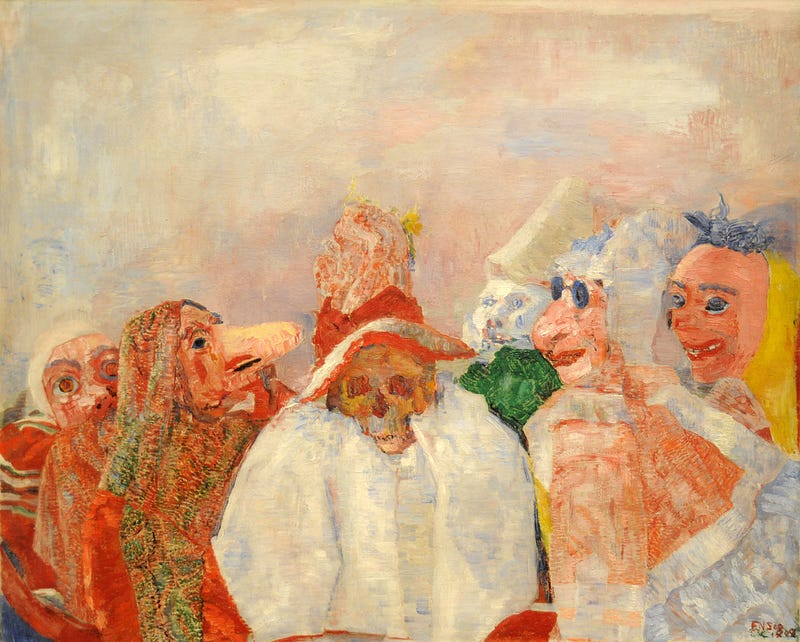
James Ensor “Masks Confronting Death” — image credit

And Other Subversive Advice for Doing Great Things

Imitation may be the sincerest form of flattery, but it can also the best way to get good at something.

When I was in art school — my first oil painting class — we had a project in which we were tasked to reproduce a masterwork. I chose to copy James Ensor’s Masks Confronting Death. I spent hours upon hours doing it, and though I hated and feared painting for years before that, spending time copying a great work melted all of that fear and hatred away.

This is a common practice in art education — hone your technique by imitating the greats. It works because it takes your mind out of the taxing and turbulent creative ideation zone and solidifies your mechanics. More than that, it works because when you’re done, you realize hey, I can make something great; I have the skill.

Once you have that confidence, you can go on to the fun stuff: ideation. Because whatever idea you come up with, you now know that you have the mechanics to give it life. This holds no matter what your chosen mode of expression — writing, design, sculpture, landscape architecture, you name it.

Begin with Idolatry, End With iconoclasm

Almost all of us begin our creative journey with a certain kind of idolatry. We have heroes who we emulate and imitate — to varying extents. We hold them in high regard, and in doing so, we end up inadvertently holding ourselves in low regard. We tell ourselves — often unknowingly — that we can’t do what those greats do.

So this practice of imitation can help us work through that idolatry. You sit down and make something great that has already been made. You solidify your mechanics. You prove yourself to yourself. You literally answer — for yourself — the question of how your idol did that great thing.

With that out of the way, you can now walk among the giants of your field with the confidence of essentially being one of them. You can look at the work of the greats, and rather than asking how they did it, you can ask:

How would YOU have done it? How will YOU do your own thing?

Now you’ve moved on to the stage of iconoclasm — taking apart the greats. Killing your idols.

There is a favorite quote of mine about this subject from Zen mythology, attributed to master Linji:

If you meet the Buddha, kill the Buddha; if you meet the patriarchs, kill the patriarchs; if you meet an Arhat [enlightened one], kill the Arhat; if you meet your parents, kill your parents… in this way, you attain liberation.

Obviously, this quote is hyperbolic, but the point is meant to be strong. There is no room for idols in creative work. Sure, proper reverence of great works and their creators is admirable — but only for a time.

To paraphrase from a wonderful speech by John Waters, the true job of a creator is to wreck what came before. That means there is no room for looking on slack-jawed at great work, and worshiping those who did it. We can only waste so much time on that kind of idolatry. We need to quickly move on to the iconoclasm. We need kill the buddhas, kill the patriarchs. That is our real work to be done.

Technique, Schmechnique

If you’re not a master of texture like Chuck Close, or don’t have the finger agility of Yo Yo Ma, fine. Find a different approach — how you’d play different notes, make different brushstrokes, write different stories. Hell, you may not even use a brush at all. Yes, strong technique is a part of making great things, yes, but technique is not a narrow, well-defined thing.It begs to be questioned, overhauled, contorted — especially when it stands in the way of expressing something truly great.

Each artist has their own technique, but it’s only a means to an end. Thomas Kinkade was a great technician. Proofread Bot is a great technician. But neither have sparked a revolutionary fire in humanity with their firm grasp of technique. Remember: Jimi Hendrix couldn’t even read music. Technique as we knew it was a hurdle over which he chose to jump, and we wouldn’t have it any other way.

That doesn’t mean you shouldn’t invest in honing your technique, but it does mean you shouldn’t let being unskilled deter you from letting it rip.

In summation: Find your idols, briefly admire them, and kill them. Kill them beautifully and passionately, technique be damned.

The Miyagi Method for Better Creative Work

Order is a concept that I don’t see often discussed when I read about creative work. And I guess that makes sense. After all, think of the stereotypical creative genius. What comes to mind? A frazzled, disorganized, scatterbrained mess, right? Order is often the last thing you associate with creative genius. However, order has a lot to do with great creative work — in two distinct ways.

The Order of Operations

The first interpretation of order is about how you do what you do. It’s about process. So when you look at the order in which you do things, look at your process. What’s your first step? What signifies the end of the first step and the beginning of the next one? How strict is the process?

Furthermore, why is this your process? Why start the way you do? Is it because that’s the way you’ve always done it? Is there just momentum behind this process, rather than reason? All of these questions are worth asking when you’ve fallen on tough creative times.

Don’t get me wrong — having a process is important. It’s an important thing to ensure consistent output, quality, and especially to prevent the paralysis that comes with having an idea, and having to think about how to bring it to life. When you have a set process, you know just what to do to get from inspiration to completion — you can just get into a groove, and work on cruise control.

But there is a problem with being in a groove and working on cruise control. You see just cruising, in a groove, is good only if the groove is headed in the right direction — toward a worthwhile end. If it isn’t, that groove isn’t helping you; it’s hurting you. It becomes a barrier that makes it hard to pivot and try something new — it’s resistance, and it can be a killer.

But let’s carry the driving analogy a bit further. If you spend all of your time on cruise control, feet off of the gas, hands touching the wheel only half-heartedly, could you be a little rusty when it comes to actually driving — being aware of where you’re going and where you are? Could it be that you’ve come to rely on process to carry you — in an unhealthy way?

Sometimes, it may just be that your process — which was once a silent partner in your success, but is now a silent burden.

Order and Disorder

The second interpretation of order is the order or disorder in which you create. As creative types, many of us leave the rest of our world in disarray. It has become part of the stereotype of creatives. There’s nothing inherently wrong with this. After all, focus belongs on what is important, whatever the task at hand is. Obviously, the task at hand is creating, not tidying up, right?

Well, not quite. I hate to go all Mr. Miyagi here, but there really is no isolation when it comes to what we do with our minds. When we gather stray papers, clean out the garage, or vacuum and wash the disgusting kitchen floor, we may think we’re doing something unrelated to creative work. But like Mr. Miyagi shows Daniel, these things are only unrelated insofar as we think they are. They often involve arrangement, categorization, and other tasks that are not meaningfully different from creative mental work.

So I do tend to side with Mr. Miyagi here, in two important ways.

First, clutter, filth, and disorganization can have a crippling effect on us, psychologically. This is especially true when things aren’t going well — and especially when it comes to your work. A messy set of surroundings contributes to stress, as well as drawing focus away from important things.

Secondly, even if we think we’re really not bothered by disorder around us, just the activity of creating and applying order to things can spark creative thinking. It requires you to look at the external world and interact with it in a way that relates your mental constructs to it. There is interaction; your mind having an effect on the world around you, and the world around you affecting your mind. This is important interplay; it shouldn’t be underestimated — it’s a model for what creative work can be: changing and being changed by the world.

Keep Moving and Keep a Wide Scope

It jut might be that creative minds are like sharks — we must keep moving, or risk something akin to creative death. It’s likely not quite that bad, but you get the idea. Maintain your nimbleness by keeping your movement going. This doesn’t mean to maintain a fevered pace or run around like a headless chicken. It means that you need to stay fluid, nimble, and in practice. You need to keep thinking, keep wondering, and stay at the ready.

It also helps to keep a wide scope. Never allow the scope of your creative work to be just the typing of words, the putting of paint on paper, the arrangement of pixels, etc. It is so much more than that. As I’ve stated before, the bulk of your creative progress is not in your output— it’s in the realm of ideas.

We make progress in our creative work when we solidify our grasp on the ideas, emotions, or truths we are trying to convey or express. While the physical product of our work on that front is a representation of that work, it’s not the work itself. So don’t discount your equivalent of waxing on and waxing off as unrelated to your creative work. It too, is creative work — and in doing it, you make progress, whether others see it or not.

The 3:1 Principle for Radically Better Communication

A Trick to Talk Less, But Say Much, Much More

When was the last time you learned something while you were talking? The answer to that question is very likely never. The learning happens after you shut your trap and someone else begins talking.

I’m not saying that every person is baring their soul and telling the truth when they speak (that is obviously not the case). What I am saying is that when others are talking — even if they’re lying — you can learn something (even if what you learn is that this person isn’t trustworthy); when you are talking, you can’t.

With that in mind, I would like to introduce a simple rule I stumbled upon that can help you do this better: take a 3:1 approach to restraint in speech. The rule has 3 aspects to it, and all 3 are listed below.

1) Wait three beats after someone else speaks before you begin to respond.

2) When you do speak, aim for a 3:1 question to statement ratio — ask 3 questions for each statement you make.

3) If you do make a statement limit it to 3 sentences in support of 1 main idea sentence.

1. Wait 3 Beats After Someone Finishes Speaking Before You Speak

When you’re in a conversation, and someone else finishes what they are saying, wait 3 beats (1…2…3…) before you start the process of responding. I don’t mean that you should have your response ready and then wait 3 beats before you let it out of your mouth. I mean wait 3 beats before you begin mentally putting together your statement.

There are three key benefits of waiting three beats before speaking.

  1. It ends up limiting how often you speak, which usually boosts your credibility. You’ll find that when you have to wait a little longer after someone speaks to put in your two cents, you’ll end up speaking less often. Others will jump in just after you normally would have, or the person who just finished will speak again. At first this may be frustrating. We all want to be understood, and it seems like putting in our two cents is the best way to accomplish that goal. But as time goes on, you’ll find that some of the things you would have said. if you were able to jump in and speak right away, were both not useful and perhaps not even your real opinion. That leads to less self-contradiction, less noise around you, and can really only increase your credibility when you do end up speaking.
  2. It gives you time to gain the most benefit from what has just been said by others, and formulate a brief and meaningful response to what has been asked of you. Telling is not selling. You’ve probably heard that before. If you want those you converse with to understand and believe you, then you’re doing some kind of selling. One thing you’ll notice in waiting 3 beats is that people will tend to have one or two more things to tack on after you think they were done speaking. That information can tend to be very useful, especially in a business context, because it’s often something that is said as a reaction to silence — something the person didn’t have time to run through preparation and their filters. That kind of information can be the most useful kind — especially when it comes from those you’re trying to get something from.
  3. It establishes some distance from your impulsive emotional thoughts, and allows for a more calm and collected style of conversing. Some exchanges can pluck the chords of emotion, and you have probably experienced the negative fallout from saying something too quickly because you felt such a strong emotion pushing you to speak. Taking 3 beats allows you to put a little distance between your involuntary emotional reaction and your intentional action of speaking. In most cases, the less that your response is serving your immediate emotions, the better. Now, 3 beats may not be enough to totally cool off before responding, but as long as others are in the conversation with you, it might be enough to let someone else make the mistake of getting worked up and blurting out something they’ll later regret.

Part 2: Aim for 3:1 Question to Statement Ratio

When you do speak, prioritize asking questions over making statements. A good experiment to try is to aim for a 3:1 ratio of questions to statements — 3 questions for every 1 statement.

It is worth noting that this 3:1 ratio is not meant to be used all of the time, but rather a approach to try, so that you can learn more information and change your disposition. Obviously, if everyone went around doing this all of the time, our conversations would look like an episode of Whose Line Is It Anyway? — that is to say, pretty ridiculous.

In terms of a little clarification, try to make the questions open-ended (i.e., not answerable by “yes” or “no”), and try to make them the kind with answers you don’t already know. The purpose behind this part of the 3:1 rule is to condition you to be more inquisitive, and slower to think you have the answers. Developing that kind of nonjudgmental, curious disposition is a useful tool — both professionally and personally. (thanks to David Smooke for bringing this to my attention)

Asking more questions in this way can do a few things. First, you’ll be getting to know more about those you work with or live with, and will also help them to warm up to you more (so long as they sense that you’re listening). People tend to feel better about those who seem interested in them, and there is no better way to show interest than to ask more questions.

Secondly, you might just find yourself realizing just how much you don’t know, as you receive answers that contradict your current opinions. When I first began to ask questions in this way, I was amazed at how much a house of cards my current structure of supposed “knowledge” was.

We carry around so many assumptions with us on a daily basis — ones that are flat out contradicted by the facts. What is worse, we quite often act on them.

Finally, in racking your brain to come up with more questions, you will likely find yourself asking better questions — the kind that get people thinking; the kind that can open your and others’ minds to more creative solutions to difficult problems. In short, asking more and better questions can help you and others come up with more and better possible answers — or at least reveal to you no shortage of other avenues to explore.

Part 3: Aim for a Maximum of 3 Supporting Sentences and 1 Conclusion

If you do make a statement, limit it to a maximum of 3 sentences in support of 1 main point. Think of it as an argument with a maximum of 3 premises and 1 conclusion — “I think X, because: this, that, and the other reason.”

I like to call this the “Bullet Principle”, because following it will have you speaking more like you would speak if you were reading off bullet points (but hopefully with the emotion and tone of someone doing more than just reading!).

There is a reason why bullet points are used so often in presentations and textbooks : they are effective. Bullet points present bite-sized, discrete pieces of information that your mind can glom onto. They give the mind definite footholds in a mountain of information. If you can harness the power of bullet points in your thinking and speaking, you can focus listeners’ attention on what you are really trying to say. You can also focus your own attention on a clear, linear, and orderly presentation of your thoughts, rather than losing yourself in your audience in an unordered and winding narrative.

While thinking in terms of bullets and arguments, you may also find that you end up speaking less often, as you can’t really find the 3 premise, 1 conclusion format of what you want to say. Some of the things you might be aching to say during a conversation might actually have little to support them. Holding off on saying them might not be the end of the world, and it might just save you from saying things that you just haven’t thought through enough yet.

The Benefits

Because I wouldn’t recommend advice that I haven’t followed, I’ll regale you with an anecdote about my experience with just the first part of this 3:1 approach.

I’m usually inclined to speak early and often in meetings. I used to think that this was a strength of mine, largely because I was doing well in my job. But because I’m always interested in doing better, I gave this approach a try, beginning with the waiting 3 beats approach. I was amazed at how many times I didn’t get the chance to speak because others were speaking so quickly. But I was also amazed at how little value came when people piped piped up quickly. I got in a few points, and kept them succinct. I left pleased with how the meeting went.

A particularly talkative coworker of mine, who happened to be on the board of directors, took note and commented to me that I was unusually quiet. I responded that I didn’t have anything to say. He challenged me that I usually had a lot to say, to which I responded “well, I do usually talk a lot, but was I really saying anything?” That may be a bit of a cliché, but it has stuck around for a reason.

And that’s the thing. When people are making statements right and left, how often are they really adding value to the conversation? How often are we talking, but not communicating anything? I think the answer might be quite a bit more than we think.

The Practical Case for Mercy

image credit:

On Giving Others a Chance

I grew up going to Catholic school, despite the fact that my parents were not very religious. I did the altar boy thing, I went to confession, I learned the rosary prayers — the whole kit n’ caboodle.

As I got older, my belief and involvement in the church waned. One thing from my Catholic days stuck with me: mercy. Mercy in the face of repeated wrongdoing. Mercy in the face of ignorance and arrogance. Mercy again and again. For my money there were never enough other cheeks to turn.

As I adopted a more nuanced spiritual stance, that attitude stuck with me. I always retained the belief that people deserve mercy, which means forgiveness and second (and third, and fourth) chances.

Why do I believe this? Is it because I read it in the Bible at a young age? No. I’ve shed plenty of beliefs that were foisted upon me as a child. Is it because I found an intricate and airtight logical argument in favor of it? Not quite. No, I believe in mercy because I find that everyone is chasing after some form of happiness for themselves, it’s just that some people can be severely misinformed about just how to get it.

Give People a Chance

None of us knows it all — or even most of it, for that matter. We are just giving this life our best shot, and we all fall short from time to time. And we fall short in different ways. We all started with different strengths and flaws. Some of those flaws are more accepted by society than others, and we pay different prices because of that.

But I’m not here just to go on a diatribe about doing the right thing for it’s own sake; as noble as that would be. Rather, I’m here to suggest that in this case, being merciful — giving others a chance — is going to help you out too, time and time again. So give others a chance, and watch what happens.

A chance to speak

Give others a chance to speak, before you do. Yes, your voice is important,but you would be amazed at how much people will come to respect your voice if you don’t use it at every single opportunity. Instead, practice some restraint, and allow others to speak — to voice their beliefs, concerns, and desires.

At the very least, this will allow you the opportunity to gain valuable insight into your social environment, and to develop strategies and plans based on it. At most, it could help to grow your personal and professional network of relationships. Listening is good for that sort of thing, you know.

A Chance for Your Friends to Prove Themselves

We all, by and large, wish to feel understood — especially by friends and those close to us. Any good leader knows this, and you don’t have to have the official position of a leader to actually lead people; you can do that from below. In fact, sometimes, that’s the most effective way to do it, because you’re basically just letting good people do great things.

Let those close to you have chances — many of them. This is not to say you should be a pushover, rather it is to say that you should aim to be strong and confident enough to not let your emotional reactions to being let down dictate your actions at every turn. Always allow people to work to gain back trust. It need not be easy for them, but it does need to be reasonably achievable.

A Chance for Your Foes to Prove Themselves Wrong

When dealing with those who we are up against — whether in business or in personal contexts — we often feel the need to win battles by winning an argument. Often times, we will express this need by launching into monologues or arguments, where we assert our position — our feelings.

But you would be surprised by how often you can win by simply letting the other side defeat themselves. Let the other side talk, and talk, and talk. Allow uncomfortable silences — which they will often impatiently fill with more speaking.

More speaking means more opportunities to contradict oneself, which provides a near-effortless victory for you. It is like allowing an opponent to swing around their too-heavy sword until they eventually hit themselves with it or become exhausted. You end up winning without having to even draw your weapon.

A Chance for Better Understanding

Giving others the chance to speak also provides you with something valuable: better understanding. If you allow others to speak, and you really attempt to listen, you can gain a better understanding of both that person and your broader environment. Even if they blatantly lie to you, that tells you something about your relationship with that person. That is valuable information indeed.

A Chance to Do the Right Thing…or the Wrong Thing

Too often we try to do everything ourselves, rather than enlisting help because we are confident that we can get things done, and get them done better than if we delegated. But we do this at a cost — the cost not of allowing others to realize their potential. If we never allow others to do the right thing, and to do well, we lose an opportunity to get valuable help and gain valuable allies. We also inadvertently shortchange people in their personal and professional development. And why? Because we fear inconvenience? Because we fear having to do a little extra work?

As a culture, we applaud risk-taking, and rightly so. No risk, no reward, right? But this applause seems reserved only for taking risks by doing more yourself. But what about taking a risk by asking others for help? There’s still risk there. Others could fail to meet expectations, cheat you, sabotage you. That’s real risk — just like the risk you face if you try to do something yourself. The reward, however, is much better than the reward of going at it alone. You end up with a new ally. You have effectively doubled your power to accomplish things.

The Most Creative Thing You are Already Doing

And you thought you were struggling…

By now you probably don’t have to be reminded that focusing on breathing is at the root of re-calibrating yourself — both body and mind. This is the main principle that underlies pretty much any form of meditation you may undertake. That’s because it works. The great thing is, it’s an easy principle to put into practice — you can do it right now.

Just breathe deeply — try it. Feel that? You will likely feel a wave of something like relaxation come over you — perhaps just for a second or two. It is the quickest and most accessible way to reset yourself. Especially when your mind has become like a sports car in mud — engine going at several thousand RPMs, wheels spinning in the mud, going nowhere.

Breathing as a reset is no secret. People have been doing it for centuries — millennia even. Thousands of articles have been written about the simple act of consciously breathing. And why not? Breathing is the most fundamental expression of yourself. It is the quickest, most accessible way to re-express and re-assert what you are — here and now.

But breathing is more than just mindfulness. Breathing is the fundamental act of both destruction and creation. You are — in the act of breathing in then out — destroying what you were, and creating what you are now. In the reverberations of the day’s noise, I think we all fail to remember that.

You’re Creative by Nature

The fact is, we’re constantly creating — creating ourselves in each moment. Real creativity comes when we realize this and capitalize upon it — when we capture that creative act and express it at a higher level — in prose, poetry, music, or images. In a way, we are chasing the dragon that is never more than a breath away. There is comfort in that, so take comfort in coming to understand it. You are a creative person — with each and every breath you take.

There is a wonderful quote from one of my favorite books, Not Always So by the late Shunryu Suzuki:

Usually our society works in a superficial, frivolous way. The controlling power is money or some big noise. Our eyes and ears are not open or subtle enough to see and hear things….Those who are accustomed to big noises may not notice, but we can communicate without talking so much. We may not always be smiling, but we feel what others are feeling. Our mind is always open, and we are expressing ourselves fully.

We communicate so much without even trying to communicate. We do it by simply breathing and relaxing — just being where we are in a certain way.

You’re Never Not Working

So often, I end up scolding myself for not putting my head down and slaving away at whatever concrete piece of work I’ve pushed myself to do. By doing that, I rob myself of the real power of just expressing myself as a conscious, breathing human. I rob myself of the natural expression that Suzuki talks about.

There is so much to observe in oneself and in others, as we all go about the business of existing — from day to day, from moment to moment. Even when there are strict parameters of how we ought to do the work we’re doing, we exhibit creativity and variation — most of the time without even realizing it.

By now, you’re probably used to reading articles confirming that you need to ramp up your creative efforts, and suggesting how to do that. This piece of writing rejects that notion. I’m saying that you need to realize that you are constantly creating and expressing — even when you’re not technically working. So take comfort in that. You are never not doing creative work, so long as you are coming to know and express yourself more fully. And this can be as easy as consciously breathing.

I sincerely believe in the need to give ourselves and others a break — to go easy, and assume that we are (for the most part) doing the best we can. This is not to say that we shouldn’t push ourselves and others to do better. Rather, we need to strike a balance between complacency on one hand, and a drive to do better on the other.

Just Mind the Swings

We often swing from a helpless frustration one one side — to a mad dash to shove ourselves and others into excellence on the other. Neither is good. Neither will work. But as obvious as it sounds, we tend to forget that in the practice of living. We get anxious, fearful, angry, and desirous. We quickly and clumsily grasp at straws — looking for the comfort of short-lived gains. They give us little real benefit.

Just because I’ve written about all of these pitfalls doesn’t mean I’m any less susceptible to them. I struggle with mindfulness, as I am sure you do — as everyone does. The real mistake is thinking you can somehow transcend this struggle. You will never do that. Realizing that it’s a struggle, and realizing the need to re-calibrate yourself? That’s the real victory — the real transcendence.

And that can be as easy as consciously breathing—right here and now.

Give Way to Your Worst Impulse

c/o: 20250320-USDA-OSEC-TEW-049

A piece of unintuitive advice

Every day, I catch myself thinking something that I know I shouldn’t. Someone cuts me off on the way to work, and I immediately think terrible things that I dare not repeat here. I see someone with a bumper sticker or pice of clothing bearing some slogan, and I immediately write them off as a person. After finishing a few drinks at a party, I think about another, edging toward full-on party mode, on a Tuesday night. Though these are not the worst impulses I have, they’re all related to that part of me that formulates the worst impulse — that selfish ever-grasping impulse for more — for power, for pure, unbridled expression of whatever emotion I happen to be feeling.

I live 99% of my life — as I’m guessing you do — suppressing this worst impulse. I try to be generous, kind, and practice restraint. That is fine; it’s what we should be doing most of the time. But only doing that is actually not good for us. It effectively ignores the deeper issue. If we ever wish to be better people, we need to address those parts of us represent our worst impulses. We need to set aside time to do exactly the opposite of what we spend most of our days doing. Perhaps we can actually gain something if we give way to our worst impulse — at least for a little bit.

Get to Know Your Id

Freud theorized that there are three parts to the human psyche: the ego, the superego, and the id. The Ego and the Super-ego are the parts of the psyche that have been influenced, modified, and restrained by the outside world — incorporating values and norms in order to create a personality in accordance with the balance of civilization. The id, on the other hand, is that raw, wild beast within each person, operating on impulse, instinct, and unadulterated passions.

It’s that id that, since we so wish to control it as adults, we can’t afford to write off. Yes, it is the germ of our worst impulses, and is the driving force behind exactly the actions that we shouldn’t take, but ignoring it while we stifle it is no way to live.

In fact, we ignore or worst impulses at our own peril, and perilous it is. Ignoring your worst impulses is like ignoring the clunking sound coming from your car. You can get by for a while doing it, but eventually, whatever is not working properly will have implications, and you’ll have to address those at some point. If you don’t, everything will eventually grind to a screeching halt — leaving you stranded on a dark roadside.

Diagnosing Yourself

So take a tip from diagnosticians and use the unsavory goings-on in your psyche to figure out the nature of the problem. Like you would follow that bad sound in the engine of your vehicle to figure out where the problem is, take a look under the hood of your mind and follow those unsavory thoughts. They have a basis; they are likely a reaction to something. They didn’t just spring up from nowhere.

But in order to effectively diagnose and treat, you have to sit and observe. You have to sidle up to your id, watch it as it does its thing, without judging it or trying to do anything to it.

You know where this is going: mindfulness. You’ve likely read it in every self-help piece out there, and are probably sick of hearing about it, but there’s a reason it’s ubiquitous these days — it works. Mindfulness is the state that ideally we should all be in as often as possible. There’s nothing fancy about it; it is merely the state of being present in the current moment, and being aware of what’s happening in your mind.

From mindfulness comes the ability to embrace any thought or feeling that pops up, and the the ability to follow it down the rabbit hole to find where it comes from.

Be a Gardener of the Mind

Once you’re down the rabbit hole, you switch from being a mechanic to a gardener. You examine the garden of the mind, infested and overrun with weeds — thoughts and feelings you’d rather not have there. Then you begin the work of pulling out the weeds, tilling the soil around the good stuff in your mind, and cultivating desirable thoughts and feelings. But like gardening, mindfulness takes continuous work to cultivate a bountiful yield of good stuff. You have to be vigilant about identifying and rooting out the stuff you don’t want in your mind.

But, what we often fail to realize is that in order to root out something — be it plant or habit of thought — you have to first grasp it. Think about pulling a stubborn weed. The grip has to be firm, but still a bit loose. If it’s too tight, when you attempt to pull out the weed you will tear it where it meets the ground. The root remains, just under the soil, and the weed grows back — within days, keeping the already strong root as another weed grows. If that happens enough, you will have to dig into the soil, down to the bottom of the root system, and remove the whole thing using a more laborious process.

All of this applies to rooting out aspects of your psyche as well. Fear, anxiety, sadness, anger — they often have deep roots in the fertile soil of the mind. To really get them out, you have to take hold of them and dig to where they have roots. That means taking hold of those negative thoughts and emotions.

That means digging into the soil of your mind — the deep soil that hasn’t seen daylight in years. It means taking care to make sure that you get to the deep roots of the negative thoughts and emotions, carefully taking them out. More than anything, it means devoting time and attention to your own mind, and how it works.

But once that work is done, any future weeds are easily extracted. Being even somewhat mindful, you’ll notice when an unsavory thought pops up, and it will be easier to gently remove. I won’t lie. I’m not there yet — few people are. But it’s something to aim for.

Just know that your worst impulses are not who you are; they are just weeds in your mind’s garden. So get your hands dirty, and see if you can grow something great.

The Next Obesity Epidemic

How Information Bloat is Endangering our Mental Fitness, and What We Can Do About It

It is old news that in recent years a staggering amount of people have become obese. From 1990 to 2010, the amount of adults who are obese in the United States alone increased a staggering 57%. Other developed countries have seen a similar increase, as well.
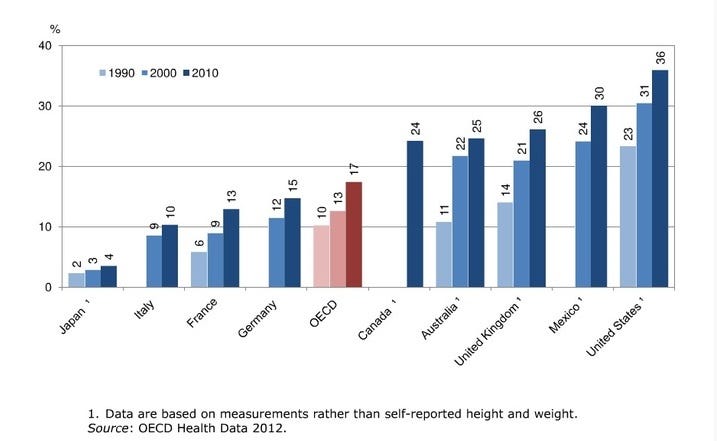
Fig 1. Obesity rate increases over 20 years.

Among the factors cited as a major contributor to this drastic increase in obesity is the sheer volume of food that is now readily available. That is exacerbated by the decreasing nutritional quality of that food.

While food manufacturers feverishly increased the quantity of food they produced and marketed, the nutritional quality decreased. The more beneficial macro-nutrients a piece of food has (healthy fats and quality proteins), the more costly it is to make — and thus to buy and consume. The result is that the easiest food to make, to buy, and to eat are the worst foods for us. As a result our diets became more unhealthy over the past few decades, as we began to consume more food and food of poorer quality.

Fig. 2 — The makeup of the American diet

Interestingly, a similar trend to the one in food consumption has occurred in the production and consumption of information. The internet has created an environment where not only is it easier to publish and push out information than ever before, but an entire industry depends on more content being published and shared every minute of every day. And in the true style of hyper-growth capitalism, that content is exponentially growing.
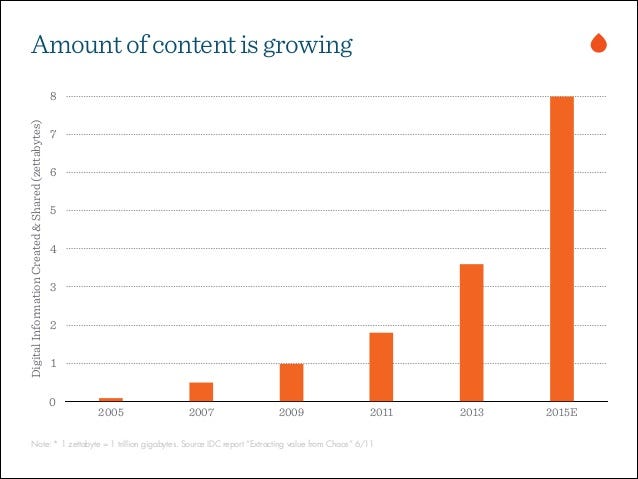
Fig 3 — The Exponential growth of content

As with food, the easier it has become to publish information, the more the quantity has increased and the quality has decreased. So what do you suppose has happened to our information diet? I fear that it may be mirroring our food diet.

Information Overabundance, Cognitive Obesity

Many people have this odd opinion that there is no such thing as too much information. A veritable avalanche of businesses are built on this premise — peddling services to help keep you up to date on all the things to know, and throwing even more “things of interest” at you by the second. But why do we have this attitude toward information— that one can never have too much?

But consider how much time we spend consuming information these days. Also, consider how much more time we spend consuming it than we used to. The chart below illustrates how much more time respondents in a survey spent consuming media this year than the previous year.
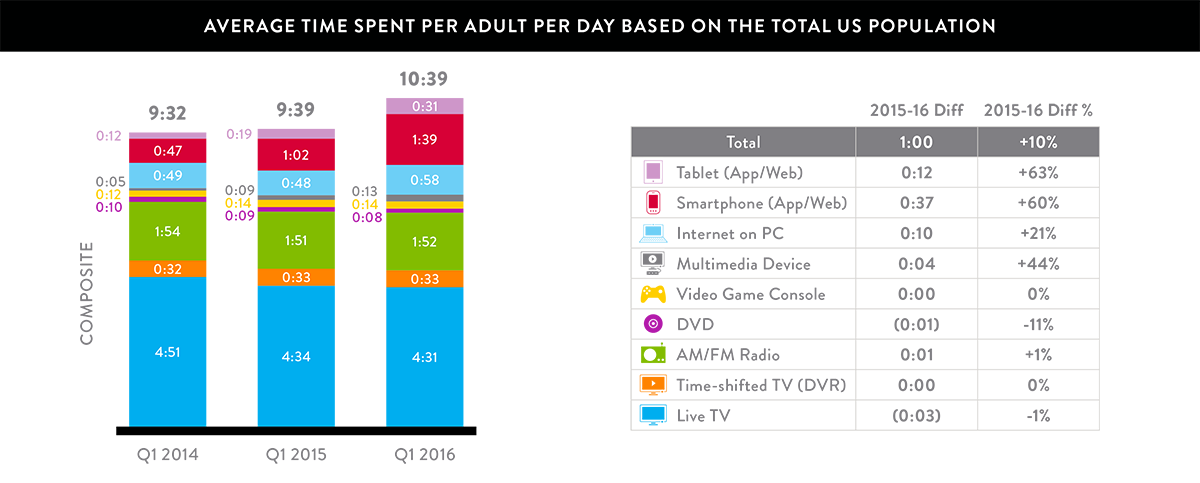
Fig 4 — The time spend consuming information. credit: Nielsen

That’s right, in one year, we have increased the amount of time we spend consuming information by 10%. But how much of that additional information was quality content? See below:
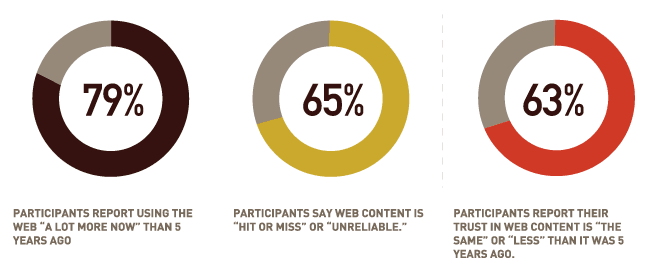
Fig 5 — Trust in content. Source: http://contentsmagazine.com/articles/reconsider-the-source/

If 63% of respondents trust web content less than they did 2 years ago, imagine what that trust index could look like given the exponential increase in content (see Fig. 3) that we continue to see? It’s a grim picture, indeed.

Cognitive Load

I use the term “mental obesity”, but a better term would be excess cognitive load. A piece from the Nielsen Norman Group says it best:

Just like computers, human brains have a limited amount of processing power …When the amount of information coming in exceeds our ability to handle it, our performance suffers. We may take longer to understand information, miss important details, or even get overwhelmed and abandon the task.

Just how bad can a heavy cognitive load be?

  • Several studies have associated a heavy cognitive load with an increase in errors.[1][2][3][4][5][6][7]
  • A heavy cognitive load has also been shown to increase stereotyping, and generalization errors. [8]

In a word, a heavy cognitive load can make us mentally unfit — fatty and easily out of breath when it comes to intellectual tasks.

So, what are we as information consumers to do? The onus seems to be on us to become more intellectually fit than our predecessors, but with the glut of mass-produced informational junk-food, just how do we do that?

Perhaps we can take this food analogy to its logical conclusion. Take the advice of nutritional science, and apply it to information consumption: take smaller bites, chew for longer, and savor and digest.

Take Smaller Bites

An effective way to sift through all of the writing online is to take small bites of anything you think you might want to read. This is the equivalent of taking a small bite of something — in order to try it. Scan the entire piece for headings. Try to figure out what the piece is trying to say, and look for sentences that convey interesting or useful information.

Also look for spelling and grammar errors. Often times, if I see more than a few, I stop reading. Chances are, someone else is making the same points, but actually knows how to write well. If I’m interested in the topic, I’ll spend a few minutes finding a more well-written piece on that topic. Is that elitist? I don’t think so. I just don’t want to give my attention to someone who didn’t bother to try to effectively communicate to me. The only exception to this is personal stories and eyewitness accounts.

Attach your attention to the information. This can be anything from saving an article to your “read/review” stack, or just getting it in a psychic space that marks it as something you’re going to really look at. Don’t gum up the works with a heap of stuff you wouldn’t look at twice on a stack of paper publications.

I keep a “read/review” list in my huge Workflowy document, with links to stuff I plan to actually look over. I try to save only things that I know I will spend more than 5 minutes reading and thinking about. There’s a famous rule that governs behavior like that — stick to it.

Chew For Longer

You’ve probably heard — from time to time, and from various outlets — that chewing your food for longer is better for you (on numerous levels)? Well the same holds true for processing the information. Take and process the information that you have “bitten” off. This process should take you longer than you think it should — just like chewing food. Really swirl it around your mind for a while. Just as you’d let a really good piece of food move around your mouth to hit all the sensory parts of your tongue, so should you let all of the parts of your mind touch the information you’re now processing.

What does this translate to when it comes to information? There are a bunch of things. You can take notes. Systems like Zettelkasten or Cornell Notes can be helpful for taking notes and organizing them. Other useful systems (and related applications) abound. A really neat blog that goes deep into keeping and taking notes can be found here.

Either way, “chewing” over information longer will do two things:

  1. Help you to better process information, so that it becomes embedded in your body of knowledge, accessible, and thus useful (and isn’t that the goal?).
  2. Prevent you from consuming fluff or things that won’t end up enriching your knowledge base.

Savor and Digest

This is the part that should take the least amount of time, but only if you have a mature and effective organizational system. Think about it this way. When you’re swallowing food, you’re starting the process of having your body use the food you’ve just processed — you’re now making that food useful. When processing information — learning — it should be no different. You’re now passing along that information to that part of your mind that will store it as knowledge for you to use. Swallowing the information you’re learning involves two main things:

Verifying that you really do know it The best way to do this is by testing yourself, which I’ve found is most effectively done by having to teach or present it to someone else that doesn’t know about the subject at all. I taught philosophy at a community college for over 4 years, and I learned more about philosophy in that time than I learned in my entire time in graduate school.

It is well known that having to teach others something forces you to get a better grip on things. You may think you know something inside out, but when you have to explain it to others, you realized that you don’t. This is especially true when you have to teach things to people who don’t know much (or anything) about your subject. A favorite quote of mine, attributed to Albert Einstein, captures this truth perfectly:

“If you can’t explain it simply, you don’t understand it well enough.”

Organizing the information This part involves making the information readily accessible, and ready for updates, emendations, further analysis, and other reviews. It is also a way to ensure that this chunk of new knowledge finds its way into the web of your current knowledge as a connected piece. If you can’t connect what you’re now learning to what you already know, the chances of you really grabbing a hold of it go down dramatically.

The amount of “content” on the web will likely continue to increase exponentially for the next decade (or more). As this happens, it’s important to ensure that we adopt practices to guard against cognitive overload, and the stress that comes with it.


15 Years Later, the Goal is Still Peace

Right?

The morning of September 11, 2001 was clear, quiet, and warm in Northern Illinois — the way most Americans remember it. The phone in my dorm room woke my roommate and I at about 8:30am CST. It was my roommate’s friend on the east coast, urging him to turn on the news. As I jumped down from the top bunk, rubbed the sleep out of my eyes, and put my glasses on, I stared perplexed at thick, black smoke pouring out of the Pentagon.

The newscaster narrating it had no idea what was happening, I was effectively listening to someone sort out a tragedy in real time. As the day went on, and the events became clearer, it was apparent that this day would come to serve as the dividing line in the life of everyone in my generation. Everything that came before it was prologue, and wading through the unfolding chapters would become our war — the one that Tyler Durden had told us a mere few years before that we did not have, but felt we needed.

I had just begun my Freshman year in college when four commercial airliners were used to bring down some of America’s most visible structures 15 years ago. I had spent my middle school and high school years becoming thoroughly liberal in my political worldview, and college was only going to cement that for me — I was sure of it.

The Aftermath: Anger and Fear

That October, I spent the bulk of my great uncle’s birthday party arguing with him that were we acting too quickly and too recklessly in bombing Afghanistan.

He disagreed, and insisted I get the f*@$k out of his house, to boot.

His take on the situation was much more quintessentially American. “Kill the sons of bitches!” he opined.

I reiterated that the “sons of bitches” were hidden amongst numerous other innocent wives, sons, and daughters that were not responsible for what had taken place in New York the previous month.

That detail was lost on him.

It continues to be lost on many of my fellow white Americans with whom I interface on a daily basis. To them, there really is some homogenous group of muslims, with some complexion in between white and black, and they all hate our values — free speech, fast food, guns, Jesus, reality TV, bikinis, driving, take your pick. They just hate us for those things, and we need to stop them from attacking us. My refrains seem to only stir up muck in their simple world — muck that they’d rather not mess with.

The Tempering: Years Gone By

15 years ago, I had harsh words for those who would suggest we both carpet-bomb overseas and close our borders. I was an 18 year-old with some strong white guilt manifested in a chip on my shoulder. Woe to the conservative who would step to me espousing the three Cs: Capitalism, Christianity, and Closed borders. To me, those folks were dead wrong, and because of that, they were assholes. Good riddance to ‘em.

These days, I have thankfully been tempered by the passage of time. I own property, I have a spouse and a child. I have people who I would kill and die for, and I pay taxes. But temperance has not resulted in a shift. I want my wife and child to be safe. I want my home to be my refuge. But I still cannot jump on the bandwagon of those clamoring for anything but peace and openness.

I often hear the phrase “guns don’t kill people, people kill people”. I believe that view is overly simplistic. People do kill people, and guns make it easier to kill more people more quickly and more thoughtlessly. I wonder if the same holds true of religions: religions don’t kill people, they just provide a cloudy, esoteric justification to those who do. I include Christianity in that statement. Perhaps this is too dismissive, too sardonic, to cynical. I have seen beauty in religious practice, in faith, and in the community of ritual. I will never dismiss the potential for faith and worship to bring out the best of humanity, but I will also never dismiss the propensity for those things to bring out the worst in us, as well.

Our Curse as Humans

That is our curse as humans. We have all this fear and all this passion, and on so many occasions, we let it flow into the wrong actions. The group from Hamburg that used 4 planes as weapons had let that fear and passion flow into killing and destruction. My hope for the rest of us is that we don’t allow our fear and passion to flow into the same places. My hope is that we have learned how self-defeating that is, how detrimental to peace and prosperity that is.

To be clear, I am not saying that nothing should be done. I am not saying that we should find ISIS operatives and just hug them until they cry and apologize. What I am saying is that we should take some time to think about how we react to tragedies and attacks— all of us. Our words are more impactful than we often think, and our actions have impact much farther than we ever understand.

So whether our words and actions are viewed by tens or by millions, now is the perfect time to slow down and think them through. There is no merit in being the first to react to a tragedy. There is an infinite amount of merit in speaking and acting with extreme care.

For the vast majority of us in the world, the vision has always been peace; we have just been disagreeing with each other as to who is included in that vision. We are free to continue to shape this vision as we see fit — it is both exciting and utterly terrifying. But let us not allow that terror we feel inside to manifest on the outside.

The goal is still peace. Never forget.

Actually, It’s Not Passion You’re After

The virtues of a new creative era

We hear a lot about passion these days. Everyone is passionate about this, or has a passion for that. Life coaches and personal development authors push people to find their passion. But I’ve always suspected that passion is not what gets us to do our best work — our boldest stuff. Passion, after all, isn’t really a virtue. It’s a vice — and a pretty bad one. Crimes of passion — not considered a good thing.

What everyone is after, then, is that creative virtue that makes you do those bold and creative things that move the needle.If there are such things as creative virtues, certainly chief among them is courage. But what exactly is courage, and how do we as creatives practice it?

Aristotle thought a lot about courage — about the virtues as a whole, actually. His big idea on the subject is that every virtue is really just a middle ground between two extreme traits. Courage then, is the middle-ground between being cowardly and being rash or foolhardy. When you shy away from every challenge, every peril, you are cowardly. When you throw yourself at everything with abandon, you’re rash — acting stupidly.

Courage is Not Passion

Most people mistakenly think that rashness — the willingness to jump headlong into anything — is courage, and that may be why there’s so much ink spilled these days telling us that that failure is a good thing. People have been misidentifying courage for centuries, and they’re just now finding out what it really means.

When you act courageously, you act with a tempered zeal that makes failures merely another obstacle along the path. Courage means throwing it all in the ring when you truly believe that you’re doing the best you can. In that sense, you never really fail, you just don’t get where you set out go. But you either collect yourself, get back up, and keep going, or you die.

In either case, the failure won’t bother you.

But courage requires a little wisdom, lest we act merely out of unchecked passion. That is more reflex than action — hardly laudable and not at all brave. Here’s Aristotle:

Thus they are not brave because, driven by pain and passion, they rush on danger without foreseeing any of the perils, since at that rate even asses would be brave when they are hungry. (Nicomachean Ethics, Book III; Sec. 8)

So real courage requires both knowledge — of what the risks are and what the rewards can be — and passion — for the path you’ve chosen to pursue. There is no courage in choosing not to think deeply about what you’re trying to do — in just making something hastily and tossing it out to the world. Likewise, there is no courage in the tedious and endless work of “perfecting” something, always fearful of letting it go, because it may not be an overnight success.

Courage lies somewhere between those two.

Courage Means Pursuing Hard Truths

When a creator invests herself in her art — in creating something — then how the creation is received should matter very little. That willingness to create with disregard to who will care and how much, is true courage. Prince had it. David Bowie had it. Basquiat had it. Unfortunately, we no longer have them. But we have their legacies — lives of courage as creators.

Again, this does not mean being insensitive to matters of taste and to the wider philosophical discussions taking place in the world. Quite the contrary. Great artists are well aware of the deep conversations of their audience — they’re knee-deep in exploring those things in their work. But they don’t incessantly intrude into those conversations, and especially not as a way of checking their work to see how much people will like it.

Another thing we see in Aristotle regarding courage is that courage is related to knowledge. It’s as if when one is more connected to the truth, courage should come more readily. I don’t say easily because I don’t think courage is ever easy — that would probably be contradictory.

I’ve said before on numerous occasions that the artist’s work is work toward realizing, revealing, and expressing truths. It would make sense, then, that the more you as a creator are creating work that reveals a truth, the more courageous you need to be. Not everyone is prepared for the the truth. The truth is often uncomfortable. The truth is often downright painful. But the truth — as an artist — is your mission. Because of that, your mission will not be easy — and you have to be courageous.

Courage Does NOT Mean not Compromising

I think it’s naive to believe that artists shouldn’t compromise. It’s short-sighted. Compromise is an essential part of human growth. If you want to grow as a human, you must compromise. If you want to grow as a creator, you must compromise. The difference between sell-outs and geniuses is not whether they compromise (they both do), it’s what they compromise, and why.

Creators are taking part in an ongoing conversation, and a conversation is only a good one if the participants allow their minds to be changed by the conversation. So, if you’re really taking part in the conversation as a creator, you’d better stay open to compromising. That doesn’t mean compromising something you really believe in to sell more work.

What it does mean is being willing to listen to feedback that may initially clash with your vision and viewpoints. Because guess what: your vision can and should change over time. You can and should evolve over time. Doing so requires careful thought, introspection, and continued work.

So get to it.

We Should All Work in Food Service

DSC05974

How the “Worst” Jobs Can Make Us All Better People

I was at a sandwich provider the other day — a well-known national chain whose employees are known as “sandwich artists”. I stood in line, holding my 2 year-old daughter, waiting patiently for my turn to tell the artist what kinds of sandwiches I wanted and exactly how to prepare them.

The woman in front of me was already taking part in that very process. She had some very specific requests. She needed (not wanted — a distinction that she made painfully clear) lettuce, tomatoes, pickles, and olives on one half of the sandwich, but not the other. What really seemed to matter was that the pickles could not touch the other half of the sandwich — which had to be kept intact as a foot-long for some reason.

There were a few more ludicrous requests, but you get the picture. At a few points during the truly ridiculous barrage of requests — when something was not done enough, or overdone — the woman was audibly and visibly frustrated. Her tone became aggressive, and her treatment of the sandwich artist became worse. Meanwhile, a line of people built up behind her as the lunch rush began.

Among the thoughts that crowded into my mind, one in particular stuck: I don’t think this woman has ever worked in food service before. That prompted me to think wouldn’t it be beneficial to nearly everyone if every person entering the working world had to work a food service job at some point in their life?

I think that the answer is clearly yes. I can think of five main reasons why. I’m sure there are more.

You learn to let others be right

We’ve grown enough as people to recognize that no, the customer is not always right. But, often times, acting as if they are is the best way to defuse an otherwise tense situation. This skill translates directly to pretty much any business you might enter. From the world of tech startups to established global conglomerates, difficult people abound. Dealing with them elegantly and with dignity is an art that will serve you well.

You gain exposure to most kinds of people

People from all walks of life and all types of background dine out or pick up fast food. Working in food service will — unless you’re exclusively working as a server at Spago — expose you to a wide range of characters. Not only will their ethnicity, religions, and socioeconomic statuses vary, bu their idiosyncrasies, preferences, and weird habits will too.

Having to cater to all of those preferences as part of your job becomes a great crash course in how to be agile and agreeable to a wide range of people. It should be no mystery as to how that will help you in any given career.

You learn to be out of control and bombarded by requests — and make it work

Heaps of articles have been written about how overwhelmed knowledge workers have become. There’s email, meetings, other messages, and so on. All of them can be a tremendous time-suck because they bombard you with questions, demands, FYIs, and other things to make you feel out of control of both your time and attention.

Well, lack of control, and time and attention theft is all in a day’s work in food service. Priorities are shuffled, agendas are torn up and re-written. Metrics are adjusted. The only constant is change, and often very quick change. Developing a mindset that can work and be productive in that kind of environment is something pretty much any employer would see as a strength.

You learn to serve, and be motivated to serve

Nowadays, everyone wants to be a leader, right? Maybe not everyone, but surely everyone who calls him or herself an entrepreneur does, right? There is a school of thought which believes that great leadership is based in being a truly effective servant — meaning you make sure that your people have what they need in order to be productive and effective.

It just so happens that food service work involves finding out what the customer would really like, and getting it for them. Sometimes — when done really well — this can take the shape of getting customers something before they even realize the want it. What a neat trick for a leader to have — being able to anticipate and deliver what his or her people need.

Most importantly, you learn to respect food service workers.

I have seen a lot of people be very rude to food service workers, mostly with little reason for it, other than just not getting exactly what they wanted. I will give those rude people a little slack because perhaps they assume that like themselves, food service employees are compensated well, go through rigorous training, and have managers that really work to help them develop and flourish. However, if they had worked in food service at some point, they’d be able to look back and realize that is by and large false.

Sure, there are places to get a burger where there is a great culture, good training, benefits, and a healthy employee environment. But there are a lot of companies that are just trying to stay profitable, and whatever bodies can fill the positions to make that happen are the ones they’ll throw a little bit of money at.

So, parents of children who you are hoping will go to the Ivy League or found their own unicorn startup, rather than using your connections to get them an internship at 16, toss them into the pit that is your local fast food joint for a year. If they really dig in for that year, they’ll learn some things — things that will make them better at whatever career they choose, but also better people. And isn’t that what we’re all after anyway?

Make Your Procrastination Work for You

Don’t worry, you will.

A little trick for all of us whose mantra is “later”

Your Problem

Almost everyone procrastinates. Perhaps it is part of human nature, and some just do it more than others — but it is almost always a negative phenomenon. It usually manifests in the same way. You begin working on some task, usually a larger one that requires a lot of thinking and/or decision-making. Within a minute or two, your mind is wandering, and before you know it you have 50 tiny little tabs open in your browser. You’ve lost your way, and you’re no closer to being done with the task that you started.

Luckily, I’ve found a little trick to help you leverage this irritating tendency to let your mind wander, and turn in into something beneficial. Actually it can really provide two beneficial things: humility (we all need a little of it sometimes) and intelligence.

The DKL

The trick is this: construct a “Don’t Know List” (DKL for short). Take about 5 minutes and write a list of some things that you just don’t know. Start with things that are way outside of anything you could be expected to know for your job and your normal daily life. Here’s an example:

I don’t know anything about the Nitrogen Cycle.

I really don’t know about the Nitrogen cycle. I know it has some role in soil quality, farming, and the environment in general. But I don’t know how it works, what the benefit of nitrogen is, or what a beneficial level is in soil. Having this item on your list will keep you from spouting off as if you know about the nitrogen cycle, and keep you from embarrassing yourself in front of some savvy farmers.

Okay. Let’s go with a less benign example:

I don’t know anything about the Iran nuclear deal.

Working With the List

Once you get 5–10 things on this list, you might begin to feel as if you’re some kind of dunce. After all, look at all the things you don’t know! Don’t fret; that’s actually a good thing. We can all use a little humility, as we’ve been reminded going back over 2,000 years. Humility can often garner more respect from others than showing off how much you (think) you know. This “don’t know list” can help you to begin your practice of being more humble. That’s an instant effect, enjoy it. Now on to actually using the list.

Now that you’ve got your list, take some time to go through it and cross out the things that you are not interested in getting a deeper knowledge of right now. You can do this simply by just asking yourself: would learning about this thing now have a foreseeable positive impact on my life in the next 6 months? If you don’t immediately answer “yes”, then cross it off the list. You can always come back to it at some other time, if it pops up again. Try to limit the remaining items to no more than 3 things.

With your now smaller list of things you don’t really know, put the phrase “learn about” in front of each on a new, clean list. The next time you’re doing some other task, and start feeling that old wanderlust, itching to open a new tab on your browser, open up the DKL list, and just google something related to the first term. Then just go from there, and record bullet points of things you learn under that item in your DKL list. Keep going until you get tired, or until you begin to realize that the task you put off to do this task really needs your attention again. You just may learn a thing or two.

A great place to start the DKL list is as a stack of notebooks in your Evernote account. Just make a notebook for each item on the DKL list, and use that notebook to begin taking notes as you go on your inevitable excursions through Wikipedia, Wolfram Alpha, and other mainstays of cyber-vagabonds. You might catch yourself developing a serious interest in one of the items on your list, as evidenced by the building up of links and bullet points under it. Keep it up!

Reap the Rewards

I would suggest taking a look at your DKL periodically. There’s not set time to do this, but maybe shoot for every few months. Look at the items and ask a similar question to the one you did at the start: do you see a continuing value-add in your life by keeping this as a thing to develop knowledge about? For all the “no” answers, file them away. For all the “yes” answers (hopefully just one), keep it live, and sweep away the others (or other).

After that, start the process over again. Avoid becoming an DKL hoarder, and keeping the same few subjects on the list. Why do I say that? Simple — familiarity breeds contempt. The more the items on your DKL seem like projects or structured work, the more likely it is that you’ll stop using them as your procrastination outlet. Then before you know it, you’re reading about Disco Demolition Night on Wikipedia (true story, it happened to me recently), and you’re wondering how you got there.

So keep your side-interests fresh. Use the DKL. Become more humble, and become a better procrastinator.

Happy Labor Day

If you’re in America

Today was Labor Day — and many of you probably won’t be reading this until it’s no longer Labor day. That’s okay with me, because I just wanted to reach out and say something tangentially related to the holiday, but that is hopefully evergreen.

Don’t work too hard. Seriously. And I think each one of you — if you’re honest with yourself — knows what “too hard” means. Your time and attention are like money, in that you need to have some left over for things you didn’t anticipate. Except, you can’t make more time and attention; you have what you have, and that’s it.

I’m not telling you this because I follow the advice, and I can show you how to do it (with my free e-book, and courses that are just $29 each!). I’m telling you this because I work too much. I work at a jobby-job, and write an egregious amount here on Medium. I leave really no time and attention for anything else. So everything that wasn’t scheduled or anticipated trips me up, freaks me out.

Whatever you think about labor unions, their original purpose was to make sure that our lives did not just disappear into work. The least we can do is just think about that.

That’s all I’ve got.

Godspeed.