On Being Stuck, And What We Should Do About it

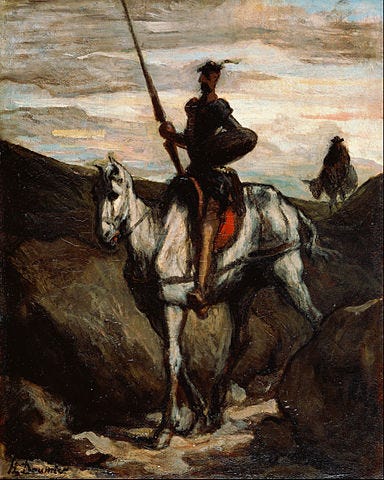
“Don Quixote in the Mountains”, Honoré Daumier (source)

Stay Stuck, and exploit it. Seriously, hear me out.

The Existential Crisis

Creative types and knowledge workers will no doubt have experience with the term “stuck”. They will also likely shudder at its mere mention, or at seeing it in print. Negative connotations abound for this term, and it’s no wonder; it often represents the onset of severe stress and torment. When you’re stuck, you get frustrated, angry — things don’t get done. It is just plain bad.

But let’s not overlook that there is something very existentially important about being “stuck”, even in the narrow sense of writer’s block. In fact, writer’s block is probably the paradigmatic example of being existentially stuck. I mean, here you were, chugging along, typing away, pouring your heart on to the page, and then…screech! You’ve just suddenly stopped. Now you’re not moving — you can’t move, and it leaves you riddled with anxiety.

A helpful way to think about being stuck is this: your existence has a certain momentum and direction. When you are stuck, and don’t know what to write, or how to communicate something, it’s an example of either of the following:

(a) not being in control of your momentum or direction — like a galloping horse over which you have no control, or

(b) momentum has ceased, and your horse trots in place as you are not sure which direction to go. And even if you choose one, you’re not sure if you can start the trot toward it — since you have lost momentum.

But don’t fret. To put a spin on an old, tried and true phrase:

Stuck happens. Deal with it.

Everyone gets stuck from time to time. And as any died-in-the-wool optimist will tell you about failures, the best thing to do with your “stucks” is to use them. Sadly, I don’t see too many people suggesting that. It’s as if some people — by the grace of the creative muses — stand in place for mere seconds being stuck before being once again adorned by that bright light of inspiration and drive. So much the worse for the rest of us. But surely it is not like that. I think the problem is a problem of perception. We tend to think that movement is good, period. We chase momentum because momentum makes us feel like we’re getting somewhere. I think that’s wrong-headed.

Less Speed, More Direction.

I think we who take pride in creating and ideating can get in the habit of paying attention to the wrong things. We get obsessed with keeping up movement, even when we’re not sure where we’re going. But if we can switch our perspective from one aspect of the creative force to the other, perhaps being stuck will not be so bad — in that we can escape it having learned something valuable about ourselves, and about good ideas.

What I mean is this:

I see around me (and within me) a tendency to be obsessed with momentum, as opposed to direction. I see too many people interested in (and writing about) merely moving — and moving quickly — but with little attention paid to the direction of the movement.

On a long view it doesn’t matter how fast you arrive somewhere if it’s not a place worth going.

We should be okay to sit in our “stuck” state and ask ourselves if maybe it isn’t a blessing in disguise. If no overt outside force stopped our momentum and caused us to be stuck, perhaps something within us — that secret part of us that knows deep down who we truly need to be (our Aristotelian “final cause”, perhaps) — is what stopped us. If that is the case, then we truly ignore that at our own peril.

But, if we are really as thoughtful and creative as we pretend to be, we should not ignore our horse as it trots in place upon our becoming “stuck”. What we should be doing is asking what stopped us, and upon finding the answer, learn how to better tackle that opposing force as we begin to ride again.

What’s Wrong With Inspirational and Personal Development Writing on Medium

I write in the personal development/productivity/inspiration space. That’s where I feel I can contribute, but more importantly, it’s what attracts and keeps my attention. But it’s riddled with writing that is both technically bad, and also just wrong-headed and harmful. I was bombarded by two examples of this yesterday. Both articles in The Mission, both with a large quantity of recommends. Both with a despicable underlying premise:

Almost everyone is hopelessly mediocre, and the author of this piece has secrets to help you be one of the awesome few.

Check them out, if you have the time, but my critiques below should provide you with the important points:

Exhibit A:

https://medium.com/the-mission/8-ways-billionaires-and-elite-athletes-perform-at-the-highest-level-cd7f97082f5e

The middle-ground has all but dissolved, leaving you in one of two positions: among the leading few or mediocre many.

Wow. Thanks for creating a totally false sense of urgency based on utterly not data other than something you briefly felt as you read an interview with Elon Musk. How utterly inspiring!

Success has never been so attainable, thus making many of us spoiled and lazy. But the following eight strategies are intended to shake up your approach, challenging you to work and live at a higher and more conscious level.

There we go, not only are you either one of the few winners or a total loser, but also it’s easy to be a winner — you’re just spoiled and lazy! In what way is this helpful? What is this drivel?! I just can’t imagine how this makes people with real struggles feel as they read this. Blech.

But wait, the very same author who claims that it’s so damned easy and simple to succeed then says the following:

However, life (and chess) is messy and complex, and every situation calls for a more contextual analysis.

Oh, okay. So let me get this straight: If I’m not a billionaire, I’m one of the unwashed masses who will amount to nothing. Also, because it’s easier to succeed than ever, the fact that I’m not a success is due to my being spoiled and lazy. But also, life is messy and complex. Every situation calls for more contextual analysis. However, that won’t stop the author from totally not performing that contextual analysis, and claiming to know that you’re mediocre, and that it’s really easy for you not to be. How transcendent!

And because yesterday must have been Treat Your Readers Like Vermin Day, a similar article that contributes very little to the discussion begins in much the same way.

Exhibit B:

https://medium.com/the-mission/8-ways-billionaires-and-elite-athletes-perform-at-the-highest-level-cd7f97082f5e

We have so much potential to design the life we deserve. So much potential when we spread our wings. So why are we so mediocre?

Really?! I love this assessment — especially because it has no supporting data, and is also so utterly universal in its claim about everyone. I don’t know about you, but being called mediocre by the author at the beginning of an article makes me not want to give him or her my time. Apparently, over 600 people disagree. I guess I’m just wired differently.

You will never regret any important decision you make if you don’t let fear drive your actions. Every important step of your personal growth and path to personal freedom was built by risk-taking actions. Fear is death.

This is a bold claim, and worrisome. Plenty of people act not out of fear, but out of hunger, ambition, and drive. They take risks — big ones, and end up hurting others. I would hope that these people regretted those actions, and the damage they caused. The author would have you believe otherwise.

I know that the author probably just didn’t think through this very general proclamation, and that’s fine — so long as a bunch of people don’t read it and take it to heart. But I can see that many people did read it, and many of them probably took it to heart. When they do that, they can tend to forget that life is about more than just taking a bunch of risks and clawing your way to the top. Life involves things like caring for others, avoiding being self-centered, and cultivating satisfying personal relationships that aren’t based merely on business pursuits.

I am all for writers pushing and motivating people to reach their full potential, but the writers who wish to do that must remember two things:

  1. Don’t paint humanity with such a broad brush that you make everyone who’s not “crushing” it look like they’re failures. There are billions of people who are doing their best. Calling them mediocre is insulting, rude, and makes you look like a jackass.
  2. Life is about more than reaching your own personal business goals. Being a kind, generous, and thoughtful person is a very large part of what life is about.

Whenever I write, I try to keep those things at the front of my mind. Maybe that’s why I’m “mediocre”, right?

Thanks for reading! Please consider subscribing to my once-weekly newsletter — Woolgathering. No spamming, no promotional emails. Just one email per week with a few interesting things to think about.

Why Startups Need Philosophers

Image by Frank Duveneck

And Need Them Badly

“Philosophers have hitherto only interpreted the world in various ways; the point is to change it.”

-Karl Marx-

When I first elected to take up philosophy as a vocation, I was 19 years old. My reasoning was sound (for a 19-year-old): I loved reading and writing about philosophy, and I aimed to make doing it my career. The problem is this: with few exceptions, the only way to do this is to stay in the academy — teaching the subject as a professor, and performing the requisite academic duties as well. When I was 19 I was quite cynical about the business world, so the prospect of segregating myself from it seemed perfect. I craved the insular environment of the academic setting, and I looked forward to spending my entire working live in a scholastic Shangri-La.

For reasons that I’ve addressed elsewhere, I recently closed the door on that career path, after a long and arduous bout of soul-searching. But as I began my career in the non-academic world that I had initially viewed as an interim affair, I came to ask myself if I really couldn’t bring my scholastic tendencies into the business world.

Going Public

There have been movements aimed at bringing philosophy into the public, aimed mostly at counseling or otherwise educational or therapeutic purposes for individuals, with some tangential mention of being involved in business. I firmly believe that philosophy can and should play this part for individuals — that’s why many philosophers did their work in the first place.

What I want to advocate, though, is for a bigger push — by philosophers — to integrate philosophical thinking into businesses. Specifically, in an age of startups, socially conscious firms, and the emphasis of both “culture” and “core values”, I believe that the business environment is ripe for the insertion of philosophers among those consulting and strategizing for and with them.

When a business is beginning, often times its struggles are existential in nature. Consultants can come in and teach you the finer points of agile, scrum, kanban — you name it. Accountants can come in and teach you how to make sure you don’t lose track of your money. But precious few can come in and tell you what your business is really going to be at a deep level.

But that’s the kind of stuff philosophers are trained to do. They look for essences. They probe, pull apart, and split hairs. They are trained to be skeptical until something like certainty and precision are reached.

I don’t recommend this “big push” out of the clear blue sky; I’ve been living it for the past 5 years. Around the time I completed my MA in philosophy, I took a job at a small(ish) company that does industrial supply, engineering, and logistics — which doesn’t sound like the most welcoming of such a seemingly esoteric discipline as philosophy. But lo and behold, a half-decade later, and my having moved up in the company is a direct result of my having employed the tools that I smuggled in from my training in philosophy.

Hire Some Philosophers

Philosophical training allows for a certain kind of speculation (what Alfred North Whitehead called “speculative philosophy”). Speculation is characterized by its freedom. But in every discipline, speculation, and the characteristic freedom is usually limited by whatever the foundational principles are of that discipline. Philosophy, on the other hand, really has no foundational principles. In fact, its modus operandi involves questioning the foundational principles of all of the other disciplines.

It would seem, then, that those who are heavily steeped in philosophical practice in the academy are more likely to employ that kind of foundation-free speculation — the kind that takes no idea or limit as set in stone. This is where innovation is most likely to come from.

Outspoken philosopher Samir Chopra recognizes this as:

…the inability of philosophizing to limit itself, for these boundary policing acts are grounded in philosophical maneuvers and that which requires such an engagement must be philosophical in some shape or form. The act of claiming to be–or not–philosophy is a philosophical claim, and must be dealt with as such. This is why philosophy remains indispensable to science, for instance, even when its practitioners reject philosophical influence or provenance.

Descriptions like this of philosophy abound. If anything characterizes philosophy as a discipline and a practice, it is the refusal to accept dogmatic thinking — to accept what other disciplines assume to be true. There is no agreed upon approach to coming up with a theory in philosophy, but there is an agreed upon reception of any theory: ask questions and attempt to falsify a given theory. When done properly, this isn’t antagonistic in nature, merely an attempt to make sure that any theory offered up is backed by sound reasoning.

To recap: philosophical thinking rests on two core principles:

  1. There are no boundaries or limits to what can be explored, questioned, and theorized about — nor are there limits to how.
  2. Each new idea is addressed on its own terms and held up to rigorous questioning.

Does this ring a bell to those in the business environment? It should, it’s practically a description of the ideal brainstorming practice. Brainstorming is embraced by so many businesses because it leads to innovation (when done correctly). Innovation is more highly valued now in the business world (or at least more talked about) than ever before, so if philosophy breeds the kind of thinking that leads to innovation, it seems that those who do philosophy well have a leg up on innovation.

You Are Doing Better Than You Think You Are

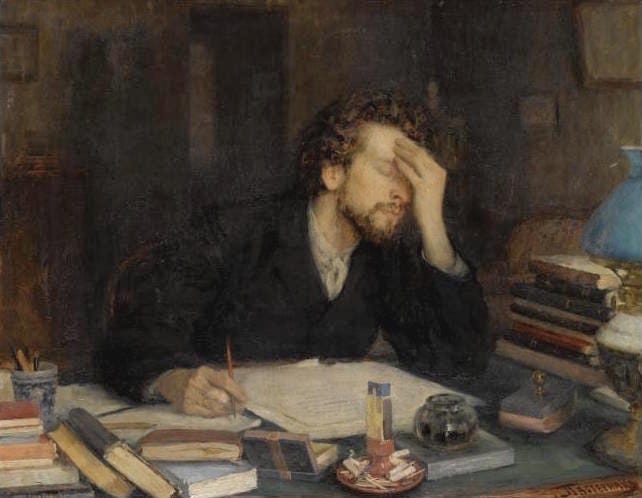
“Throes of Creation” by Leonid Pasternak

Your progress is not on the page

If you’re writing online, and you’re anything like me, you probably care about how many people see your work. You also probably care about how many people publicly like your work (recommends, likes, retweets, etc.). You probably also read work by authors who publish what seems like an endless stream of stuff, all of which gets a lot of public likes. You think to yourself: they’re making progress, but me, I can’t even publish regularly.

I used to think this. In my worst moments, I still do. But as I’ve begun to write more (not necessarily publish more, just write more) I’ve learned something. There is a difference between the media and the message (despite what Marshall McLuhan may have said).

As a writer, I’m not doing typography; my words are not the object of my pursuit. I am trying to convey a message, and if that message is good enough — if it’s one worth conveying, I should be able to delete sentences and paragraphs in the service of conveying that message. But of course, I am weak. Each of my sentences is a unique and beautiful snowflake; each my only child, who I cannot bear to let go.

This is a symptom of a larger, misguided attitude about progress in art or creative work. We often think that what we have on paper, on canvas, or what has been published, represents the only progress we’ve made as creatives. That is simply not true.

The real progress that an artist or creator of any kind makes is largely invisible. It is the progress of thought — the evolution of ideas, and it takes place through and manifests in the final product, but that is not where it lives. It lives inside the mind of the artist.

More specifically, progress lives in that space where the artist’s mind conceives of the world — where it makes sense of the world. This is why those who fetishize output and the crossing off of tasks are often confounded by the radical creatives tossing out hours of work and spent materials, only to tear it up and start again. They mistakenly think that the real progress lived there — in those deleted words, in those shredded canvases. Again, they are wrong.

I say all of this to reassure you that deleting paragraphs, erasing or drawing over lines, getting rid of slides, etc. is not deleting your progress. It is adding to it. You can add by subtracting, and sometimes, the process of eliminating can be even better for your work than any kind of additions you could ever make.

That is why this piece is short — because I just have this one thing to say, and I think it’s very important.

If you know someone who’s struggling with their creative work, share this with them — not because I want credit for it, but because I want them not to feel as bad as I used to. There are those who have published millions of words, or put out hundreds of songs. That’s fine for them. That doesn’t mean you aren’t making progress.

Keep at it.

Greetings, followers!

So, this week, I decided that aside from publishing my stuff in others’ publications, I’d make my own publication as well. I’m glad that you have hopped aboard my train.

I’m not entirely sure what this will be, yet, but I hope that it’ll be something that you find valuable. That is my overarching goal — to bring value to those who read my writing. I aim to do this by exploring interesting ideas, and offering my take on them — at least my take at that particular time.

If you have any thoughts about things you’d like to see me put in print, feel free to drop me a line.

Thanks for hopping aboard!

Innovation Through Ignorance

What a dead Zen master can teach us about thinking outside the box

c/o Pixabay.com

If you gathered all of the core values of the fastest growing companies in the world, you’d be hard pressed to find one that doesn’t include innovation. And for good reason — when companies innovate, they gain the ability to do more and do better with less. It is no wonder, then that those people who can provide innovative ideas and solutions are highly valued in the marketplace. The more that businesses embrace a lean operations philosophy, the more they will value innovation. It is truly a skill for all seasons.

But how does one become an innovator, how does one make up that great idea that can really turn everything upside down? Is it an inborn trait that some people have, while others just don’t? Not really. It’s actually just a matter of the right mindset. Like any skill, getting into the mindset is not easy. But getting into that mindset doesn’t actually involve any research or learning.In fact, quite the opposite is true. If anything, it involves unlearning. There is a name for it in the Japanese Soto Zen tradition: shoshin.

Shoshin

The word shoshin is used to signify what the late Shunryu Suzuki called “beginner’s mind” . It describes one’s attitude toward something when they first encounter it. It is like the mind of a small child — full of curiosity, ready to learn, explore, and absorb. It also describes having a basically empty mind, meaning that there are no presuppositions, judgments, or things to cloud a fresh take on something.

For those of you whose major in college was something that you enjoyed studying, think back to your first class in that subject — the first time you cracked open that book. It seemed like the possiblities were endless, and there was so much to explore. That’s the feeling associated with shoshin. In your “beginner’s mind” there is quite a bit that you don’t know. But you really don’t know what you don’t know; that is, you are ignorant to what you have yet to learn. Though that may seem like a disadvantage, it’s really not. Here’s the best relevant pull quote from the man himself:

If your mind is empty, it is always ready for anything; it is open to everything. In the beginner’s mind there are many possibilities; in the expert’s mind there are few.

-Shunryu Suzuki-

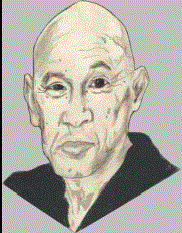
Shunryu Suzuki (c/o Wikimedia Commons)

What’s great about the beginner’s mind is not just that there are many possibilities, but also, there are basically no obstacles.

I’ll say that again; in the beginner’s mind, there are basically no obstacles.

To translate this to more business-friendly terms, if you want to truly innovate, you have to adopt the beginner’s mind in how you approach problems and projects. When yo do that, you abandon the obstacles you’ve stopped at before, and you can ask yourself if they were really ever in your way, because the way might be totally different than you thought. Here’s a suggestion on how to get into the beginner’s mind mode.

Using Shoshin to Problem Solve

First, target a problem or project that you really want to blow open and innovate. For any meetings you have about the project, drop the existing agenda, and set one objective that contains the verb “understand”. An example of this would be “Understand what the customer is looking for in this software.”

The reason why “understand” works so well as the meat of an objective is because it forces you to adopt the beginner’s mind, and empty of all the answers that you think you have. From there, you can ask questions — a lot of questions — and listen (really listen) to what you get in response.

The culmination of this process should be a new understanding of the problem you were trying to solve. This shouldn’t be something you actively crafted, rather it should find its way into your mind (which is conveniently open and empty). Though this sounds like a passive process, and like any old person off the street could do it, it is not. Give it a whirl in your next meeting.

Go into a meeting about a subject that you know a great deal about, and try to just listen, and understand the concerns and problems of others, without drawing from your own assumptions or judgements. It is profoundly difficult to keep the “standard noise” out of your mind. So there is nothing passive about obtaining an empty mind; it’s hard work, and few ever really master it.


Did you dig this? Great! I don’t think I have to remind you to hit the green heart below and recommend it (but I guess I just did). Did you NOT dig it? Cool, leave me a comment to let me know what you think I got wrong, missed, or how I could improve.

Please, Stop Calling it ‘Content’

How We Devalue Our Work, Simply by What We Call It

source: pixels.com

I write on the internet almost everyday. I don’t make any money doing it, but I do enjoy it immensely. However, my wife makes her living writing and designing on the web. Because of that, I know firsthand how valuable words and pictures are for a business’ internet presence. I also know how much work goes into making those two things — especially when they are done well.

As I have become more familiar with how valuable words and design are, and how difficult they can be to craft, I have come to dislike more and more the word that we’ve adopted to describe it: content.

Yuck. Content. Just reading it on the page is disheartening. How abstract. How utterly uninformative. How lazy.

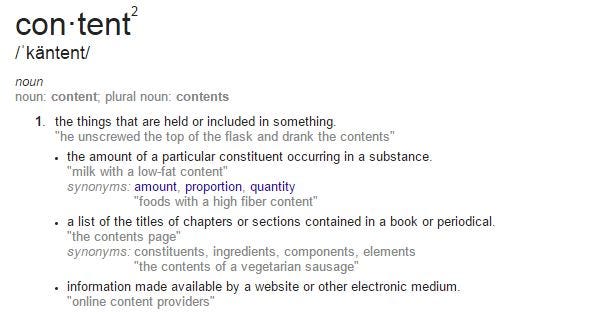
Why is it that we’ve chosen that word to talk about the creative work that is essentially the backbone of every good website? Just look at the definition of the word:

Those first 3 definitions are the classic, pre-internet 2.0 definition of the word. They’re all vague. And that’s the point. “Content” basically means “whatever stuff is there, filling up the empty space.” In that sense, it doesn’t seem to indicate anything of value — just filler. That’s how our continued use of the word ‘content’ has begun to change how our work on the web is treated.

Vagueness Devalues

Imagine that you are at an open-air market in a foreign country. A vendor presents you with a jug of liquid, indicating that it’s for sale. She doesn’t speak English, so an interpreter asks on her behalf what you’d be willing to pay for the contents of the jug. “It’s some oil,” he says. How much do you think it’s worth?

Without any other information, you’d likely assign a low dollar value to it. You’d be right to do so. The way the object was described is vague, uninformative, and thus pretty much forces you to value it much less.

Now imagine that what was in the jug is actually a rich and robust first-press extra virgin olive oil, that the seller in the market worked very hard to make. The olives are of the finest quality, and were grown over years of meticulous cultivation. But all those years of work, and all of the expertise and knowledge it took to produce it has been reduced to a few generic words by a marketer who just wants to sell the product quickly.

Content — The Marketer’s Weasel Word

To me, “content” is a weasel word, if I’ve ever seen one. Observe:

A weasel word is an informal term for words and phrases aimed at creating an impression that a specific and/or meaningful statement has been made, when only a vague or ambiguous claim has been communicated, enabling the specific meaning to be denied if the statement is challenged.

So let’s look at how well the term “content” fits that definition of a weasel word:

  • Is it a word? Check.
  • Is it aimed at creating an impression that something specific and meaningful has been communicated? Check.
  • Is it in reality just vague or ambiguous, enabling the specific meaning to be denied if the statement is challenged? Check.

The third bullet is the most damning. We creators have allowed ‘content’ to be increasingly used as a weasel word to describe what we do. It allows for companies to pay bottom dollar for words and pictures for their site because, hey, it’s just ‘content’! They’re not asking for art here, just content — some stuff to fill in that empty space; just some stuff one notch above lorem ipsum text to drive more clicks per page.

And that’s exactly what they’re getting, which means that’s exactly what we are getting. That’s what’s flooding the web — page after page of it; text and pictures that are just barely hashed out, and exist as filler, awaiting you to click through to the ads.

But It’s Just a Word, No Big Deal, Right?

Am I making a mountain out of a molehill? I mean, ‘content’ is just a word, and words are basically harmless, right?

Wrong.

Words have power, real power. They move people to action, they inform how people perceive things — as good or bad, valuable or worthless. We, as people who deal in words for a living, should be painfully aware of this. And since perceived value becomes real value, it’s easy to see that words which make people perceive something as less valuable end up making that thing less valuable in the marketplace. So, calling design and copy on the internet “content” is effectively a way to devalue what it really is.

Calling it ‘content’ is like calling a cask of painstakingly crafted and carefully aged wine ‘liquid’. It is vague, shortsighted, and damaging.

It should be no surprise, then that in the time that the word ‘content’ gained popularity as the term du jour, we’ve begun to witness a race to the bottom for quality writing and design. We see website copy that is sloppy, plagiarized, vacuous, or all three. Clickbait titles link to pages that are nothing but ad copy with little to no style or substance to them, and everyone is bidding lower and lower to produce it.

We do more than “create content”. We mindfully structure stories, pensively pen persuasive prose, and produce powerful poetry. We delicately string together stunning visual tapestries. We slice, dice, and seamlessly assemble cinematic experiences. This is not just content; it is our heart and soul. Perhaps a word more representative of that is in order. Better yet, perhaps one word is too few.

I leave it to the creators to decide.

Godpseed.

Hacker Noon is how hackers start their afternoons. We’re a part of the @AMI family. We are now accepting submissions and happy to discuss advertising & sponsorship opportunities.

If you enjoyed this story, we recommend reading our latest tech stories and trending tech stories. Until next time, don’t take the realities of the world for granted!

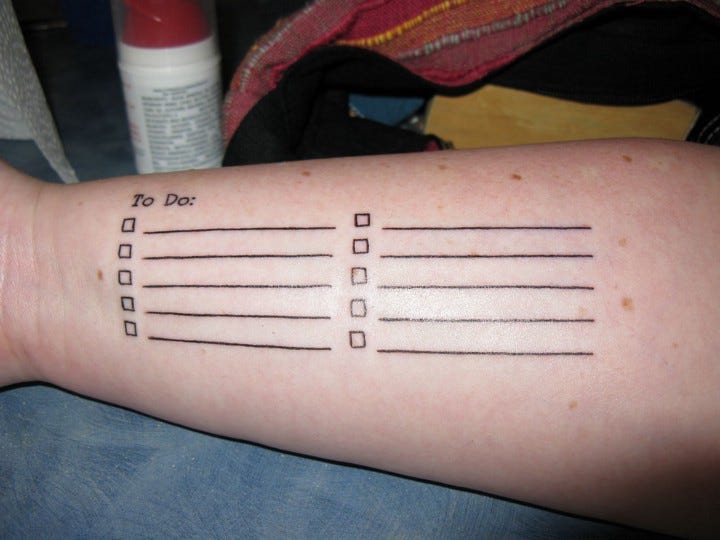
How to Think About Your To Do List

Some people get REAL about productivity (courtesy of Wikipedia commons)

A slight twist on your perception can help you do more, and do better

About 3 years ago, I finally sat down and read David Allen’s seminal work on productivity Getting Things Done. It would not in fact be hyperbole to say that it changed my outlook entirely. But the change took a while to really sink in. You see, I had been searching for a system for a while. I was always busy, but never completing the things that I wanted to complete. I was never short on ambitions, but I was always short on plans to realize any of them. Enter GTD.

Down the (Productivity) Porn Wormhole

Throughout the year after reading the book, I became obsessed — as I am wont to do — with productivity porn. I tried numerous task managers, reference file programs, folders, pens, notebooks, and so on. I put up the famous GTD flowchart on my cubicle wall at work, assuming that the magic contained therein would sprinkle upon me as I diligently continued my totally reactive work routine. That, of course, did not happen.

Fast forward to the present date, 2016, and I am finally starting to get it. I’ve abandoned all but 2 pieces of software for managing projects and storing information. I’m done looking at programs that promise more and better productivity and organization. What I’ve realized is this:

while a system for handling and organizing your goals, tasks, and information is important, the most important thing for getting things done is your perception of what needs doing.

No More “Have Tos”

Think of it this way: do you have things that you have to do, or things that you get to do? Really think about that question. Notice the way it’s not worded. It’s not asking if you have things you want to do. Nobody wants to call up customer service to dispute the weird charge on their credit card. Nobody wants to buy stamps so they can finally mail out that thank you note for the gift they got 4 months ago. The question is what do you get to do, and the things you get to do are more positively framed than the things you have to do.

This is no hack, or trick, or gimmick. It will take work to change how you perceive your list of tasks and projects in this way. In fact, it will take you going through all of the open loops in your life and relating everything back to your actual goals to effectively change your perception.

However, once all of your open tasks are related to projects that are clearly part of reaching some goal you do really aspire to, everything on your list becomes something you get to do. Waking up in the morning to then check your open tasks becomes like a mini-Christmas morning! You unwrap the list and see all the things that — when done — will take you a step closer to getting you where you’re aiming to go.

At that point, you’re not merely getting things done — you’re getting to do things! And isn’t that so much more fulfilling?

Sometimes, It’s Simply a Matter of Work

No Hacks, Tricks, or Tips Will Do It

credit: pixabay.com

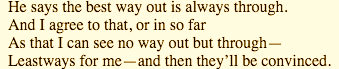
There’s a quote from a Robert Frost poem that I really like — but it’s not the one you may be thinking of:

from “A Servant to Servants” by Robert Frost

You can hack, disrupt, and innovate all you like, but at some point, those approaches cease to further the cause of creating stuff. In many cases, though, the following holds true:

It is simply a matter of work.

You can take this as a simple platitude that merely passes along the conventional wisdom of the Protestant work ethic, but you do so at your own peril. Unravel it a bit, and you can find a more useful prescription for helping push along your creative endeavors.

The Art of Craft

Brian Eno, one of the two mad geniuses behind the Oblique Strategies once said:

“Craft is what enables you to be successful when you’re not inspired.”

The key word here is craft. It conjures up the image of that unsexy work — the drab and sometimes monotonous tasks that you just get through, the work that tends to be uniform and codified in your workflow. It’s not the spontaneous, exciting work we often associate with creativity and inspiration. But, it is the foundation of creative work. The actual ideation — the creative portion of creative work, where one literally makes something up, is exhilarating, exciting, it pulls you along on a journey. But as most of us know, it comes in fits and starts — it’s not consistent.

The point is this: your creative process will not always be an exhilarating downhill glide of inspiration. Sometimes it will be drudgery, and sometimes drudgery is what is needed. You have to get used to, and fully accept impermanence. Just like you have experienced bursts of mad genius and easy creative momentum before — and they have passed — so will this lull. But it only passes if you keep moving. Craft — so-called drudgery — is what keeps you moving, keeps you focused on your thing (whatever that may be), so that you keep making progress. But make no mistake, it is work, and it is difficult — both difficult to do, and difficult to motivate yourself to do.

A Way to Keep Moving: The Idealanche

So in order to motivate yourself to keep working and boost your creativity, here is a modest proposal:

I call it the idealanche (please, hold your applause).

Here’s how it works. Please wear the proper safety equipment. For your next available working hour, focus only one one fresh, new document, and just churn out ideas. Feel free to cross off bad ones as you churn out more. Also feel free to elaborate a bit in a note under each bullet point, but don’t begin actual work on any of the ideas. The point of this exercise is to build momentum, and to create a log of ideas, to prove to yourself that you’ve still got it (whatever it is that allows to complete things). And guess what? This is as true an example as you’ll find of the craft of creative thinking!

But there’s a catch about the idealanche: it must be on a blank page, a new document, a new note, etc. It can’t be part of a notebook, or a new portion of an existing document or outline. You need to clear your mind of any other ideas or preconceived notions — you need as clear a mental space as is possible.

Don’t treat this prescription as relying too much on tools, or an example of productivity porn (getting obsessed with tools and methods, rather than just getting things done). Recognize this as a serious treatment of a simple condition: we humans are fragile when it comes to thinking creatively. So much affects us, and we have to take steps to combat those effects that just don’t serve our mission.

Guard the Horizon

We so often get blocked because we as humans are sensitive to the influencing power of other ideas and objects. It doesn’t mean we become controlled by them, it just means that they crowd themselves into our mental horizon, such that we have to look around them just to see what we’re trying to focus on.

No one is exempt from this; it will always be the case, so long as humans have minds that resemble the kind we know homo sapiens sapiens to have.

The real power that we ought to seek is the power to notice when something crowds into our mental horizon and be able to clear it out as quickly as possible.

Some things — thoughts, ideas, inclinations — will always be there, and most of us will never notice many of them, but they are there. They affect us. They are the reason that we get creative blocks, get confused, feel oddly anxious, fail to fall asleep, and numerous other psychological pains. This is what the buddhists refer to as dukkha, and it is the very basis for their particular worldview.

So, like the buddhists, we need to acknowledge the root of the problem, and work to ensure that we effectively work against it. This, then, becomes your craft, your work. You get up, and ensure that the mental horizon is as clear as you can get it. Obviously, the best tool for this is meditation, and not (unfortunately) coffee and your Facebook feed. I sense that if you’re reading this, you already have an inkling that this is true.

For me, the writing of this post began with something like the idealanche, on a plane to Boston. I felt completely un-creative, sitting in a cramped airplane seat, the gentleman next to me snoring and twitching, and my back hurting from my odd position. But, the craft portion of my creative workflow pulled me through. I just started listing ideas and stayed on the page, working through until I had a list that was good enough to start. This piece of writing is not going to be my best — not by a long shot. In retrospect, it may not even be good. But I actually did the work. The momentum is preserved, and I became just a bit better at clearing out the mental horizon, which will serve me well as long as I live. Here’s hoping that you discover the same thing.

Godspeed.

Thanks for reading! Please consider supporting my writing via Patreon. You’ll get some cool exclusive stuff for it.


An earlier draft of this post lives at my legacy blog: Your Fool Laureate.

Hacker Noon is how hackers start their afternoons. We’re a part of the @AMI family. We are now accepting submissions and happy to discuss advertising & sponsorship opportunities.

If you enjoyed this story, we recommend reading our latest tech stories and trending tech stories. Until next time, don’t take the realities of the world for granted!

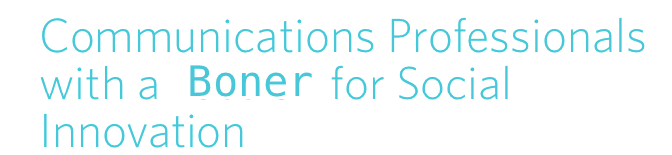
In Which I Replace the Word ‘Passion’ with ‘Boner’ on the Web

Because I have a “passion” for poking fun.

An old piece of writing lore says that Mark Twain once claimed that the word ‘very’ was unnecessary in most writing. He apparently said the following:

Substitute ‘damn’ every time you’re inclined to write ‘very’; your editor will delete it and the writing will be just as it should be.

Unfortunately, this seems to be purely lore, and apparently Twain put it in writing. Rather, it was a newspaper editor named William Allen White who gave the advice.

But you don’t really care about all that, do you? I understand. You came here for the ‘boner’ that I promised in the title — and I shall deliver.

The Rules of the Game

So here are the simple rules. Please don’t break them if you choose to respond below, or tweet along, so that this piece stays classy.

  1. Find an article, bio, or headline that prominently features the word ‘passion’.
  2. For each occurrence of the word ‘passion’, substitute the word ‘boner’.
  3. Either text or a modified screenshot is fine.
  4. Omit as much identifying information as possible (author, company name, etc.) out of respect. The exception would be public figures with celebrity status — because dealing with this kind of jib-jab is part of their job description. Also, they’ll probably never see it anyway.

Here are a few examples to get you rolling:

Exhibit A

Exhibit B

You won’t believe #2!!

You get the gist. Have a little fun, but be respectful. The aim is to point out one thing: just like the word ‘very’, the word ‘passion’ has been used almost to death. Consider this the stake in its passionate heart.

A.B.L — Always Be Learning

But not in the ways you might think

This!

Today, I just felt the compelling need to say the following:

Always be learning — always.

Even when you feel like you’re not “getting anything done”.

Even when you feel like you’ll never really get what you’re trying to learn — especially when you feel like that.

Even when you feel like so many people know more than you. Even more so when you hear someone else say that they know more than you.

Even when it would be easier to just coast on through the day. Especially then.

Even when you think you know enough. Especially when you think you know enough. That’s when you need learning the most.

The disposition to learn is humbling, cleansing, purifying. It serves you and it serves humankind. It can and does make the world better.

Always be learning.

I’m not saying to always be reading. I’m not saying to always be taking courses online. I’m not saying to read my blog. I’m not saying to listen to this list of “enriching” podcasts. There are plenty of pieces (especially here on Medium) telling you do those things.

What I am saying is to always be learning. Learning can be done in so many other ways. Every conversation you have, or overhear. That’s a learning opportunity. Every moment of quiet introspection — observing the thoughts and feelings that arise. That’s a learning opportunity. Every floor you sweep, every dish you wash — there is ample opportunity to learn.

Whatever you are doing, it can be done better. It can be more enriching. However you are doing, you can always do better. Not just for you, but for those you serve — especially for those you serve. Learning is not so much self improvement as it is world improvement.

If you are always open to learn, you will always be agile, always be flexible, and always be getting better — at whatever it is you’re doing.

Always.

Hacker Noon is how hackers start their afternoons. We’re a part of the @AMI family. We are now accepting submissions and happy to discuss advertising & sponsorship opportunities.

If you enjoyed this story, we recommend reading our latest tech stories and trending tech stories. Until next time, don’t take the realities of the world for granted!

10 Aphorisms for You

Because the Internet Loves Lists, and I’m Lazy

credit: Pixabay.com

  1. It is literally impossible to do both of the following things (a) Pick yourself up by the bootstraps; (b) Be self-made. That being the case, don’t be so cocky as to claim that you’ve done either, or suggest that others do so.
  2. Everyone is pursuing what they view as good for them— some form of happiness or alleviation of their suffering. Don’t make the mistake of seeing others’ motives as bad or evil. At best, it shows you to be ignorant and superficial. At worst, it denies you the benefit of gaining a true understanding of your fellow humans.
  3. You should be able to learn something from each person you converse with. It is not only enriching for you, but the purest form of respect for the other person.
  4. If you believe that you haven’t made any mistakes by the day’s end, you’re either forgetful, lying to yourself, or simply not trying.
  5. 95% of the time, the following will be true of any email, text, phone call, letter, tweet, post, or meeting: it can wait. Things will be fine without your immediate attention and reply to it.
  6. A simple trick to weed out pathological liars: they are the ones claiming to know all of the answers.
  7. Art exists because merely speaking the truth doesn’t convey the full gravity of it.
  8. Almost always say 50% less than what you feel like saying at the time, with one exception: when you feel like telling someone how much you care about them.
  9. A plan is essential to have, if only so that you can easily recognize how much and how often things don’t turn out according to it.
  10. Do not confuse Simple with Easy. The simplest things are some of the most difficult ones.

A Cool Little GTD Trick I Found

It’s even cooler if you use WorkFlowy.

I’ve been an adherent of GTD for a few years now. I’m stumbling to use the system rigorously, but I certainly buy in.

That being said, anyone who’s trying to really do GTD likely understands that the weekly review is the most important part of the process. Without the habit of a weekly review to keep track of all the stuff you’ve collected and processed, your GTD system becomes something that stresses you out more than it helps you do things.

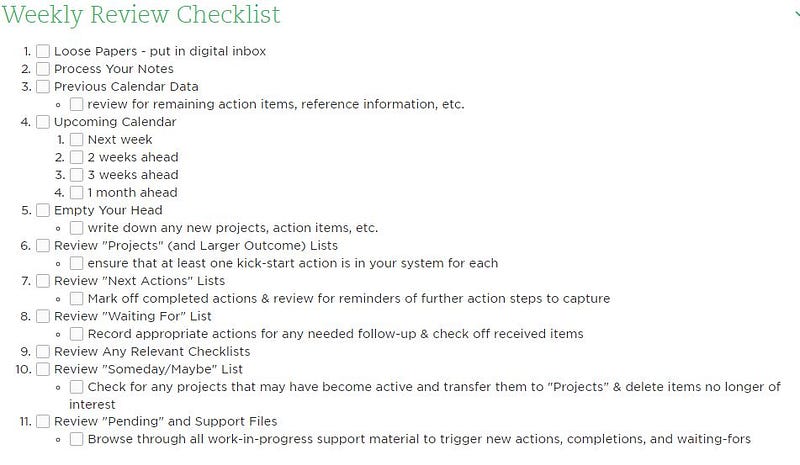
If you’ve done a weekly review before, you know that the checklist for one looks something like this (though it varies a bit from person to person):

It is daunting. And you really should do it every week.

What’s worse is that step 6 — reviewing projects, and ensuring that each has a next action in your list of next actions can be very tedious. The challenge that I’ve found is checking whether I have a next action for each open project in my list of next actions. There are a lot of each of them — there can be hundreds of each, in fact. If only there were an easy way to associate the two.

Enter My Little Trick

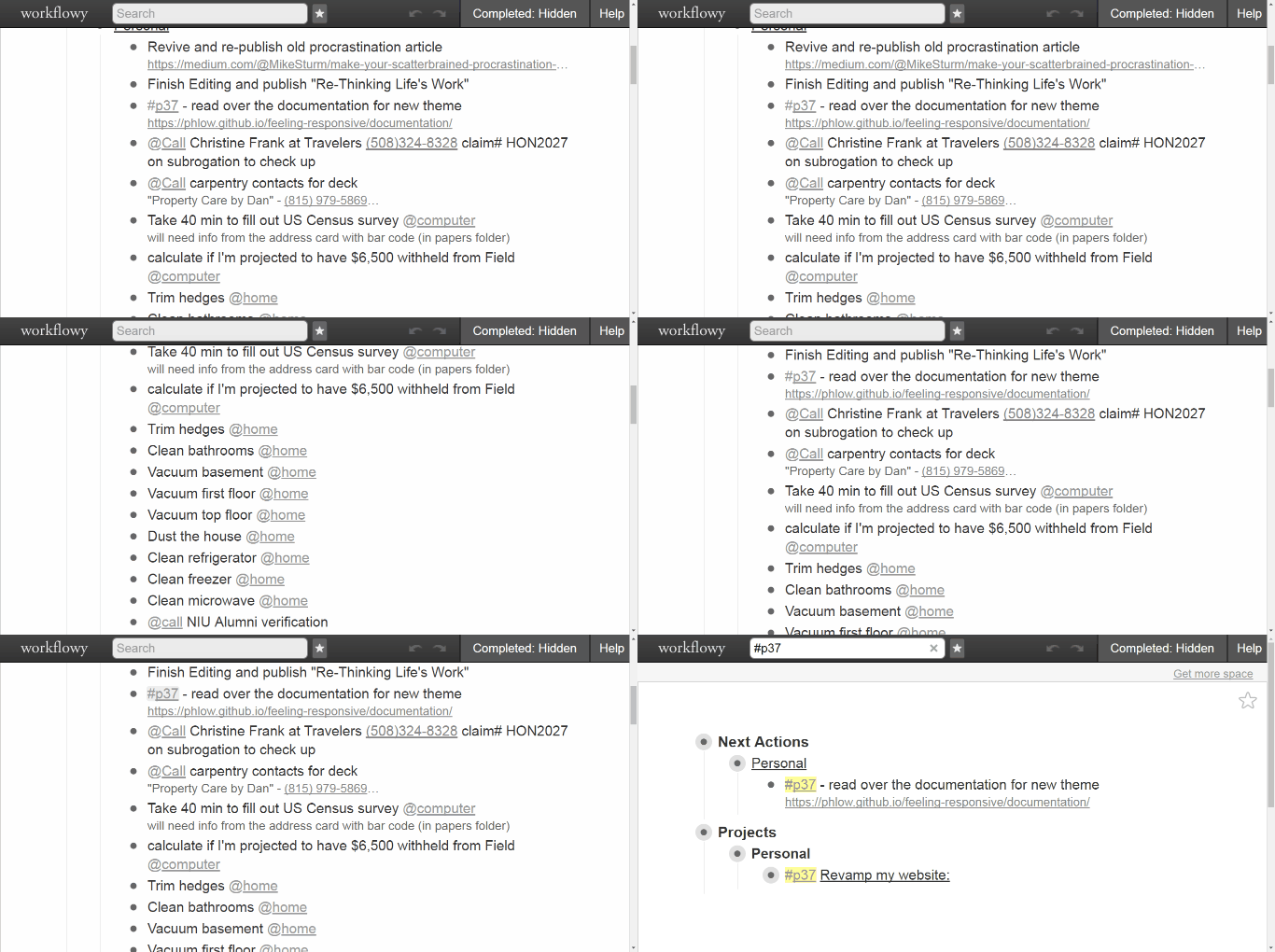
A hashtag and a number. That’s it. That’s my trick.

Any time I put a new project on a list of mine, I put a hashtag with a number in front of it. I started about two weeks ago at #1, and now I’m at #37. After being on vacation for a week and returning to the office, I suspect I will be surpassing #60 by week’s end. For each action item that is part of a project, I put the # and project number in front of it.

What this does is make running a GTD system much easier on 3 fronts:

  1. I can open my list of projects and just run through it numerically. No more looking at a given project and having to scan through the hundred or so action items I have open to find a match.
  2. My reference files (digital, mostly) now begin with the # and number scheme. That makes it super easy to find project support material, as well as store it as reference when the project is completed.
  3. I use Workflowy, the wonderful list manager created by Jesse Patel & company. I’ve used it for a few years now. When you use a # in front of a word or single number, it becomes a hyperlink. If you click it, it’s like an automatic filter that only shows things with that hashtag sequence. That makes my weekly review and project management much more fluid.

the hashtag filter in action

Pretty cool, right? I just thought people might appreciate it.

You may go about your day.

Rethinking the Concept of “Life’s Work”

A New Way to Think About the Dreams We Chase
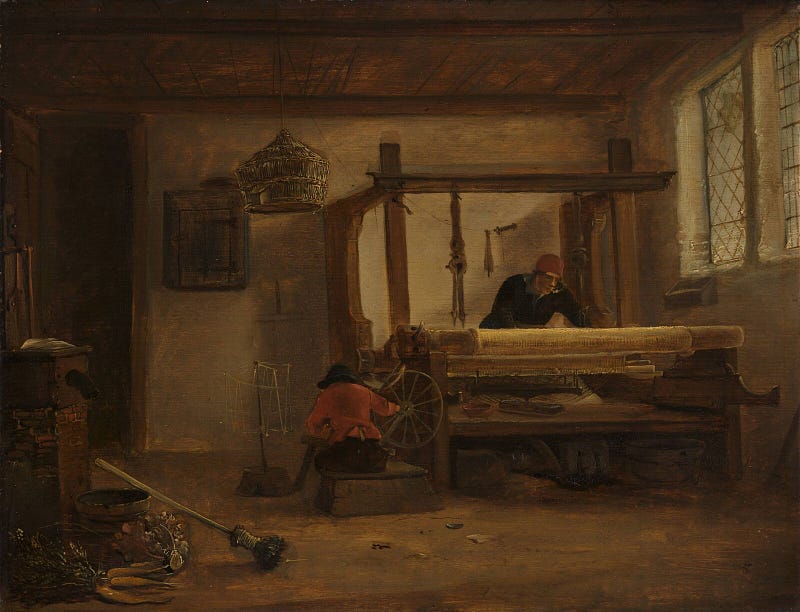
“A Weaver’s Workshop” by Cornelis Gerritsz Decker

I grew up with an ideal in my mind that the best thing I could achieve was landing a career doing what I love. It is no mystery where this came from. My father worked for almost 40 years — for 12–16 hours per day, at a job that he hated. He impressed upon me that I must do whatever I can to make sure that I didn’t fall victim to the same fate he did — that I find a job that invigorates me, that isn’t even really work because, well, I love doing it.

I Had a First Love

I originally thought that art was my way to do just that. I had been drawing since I could remember doing anything. I devoured comic books (figuratively speaking, of course) and each time I finished one, I’d rush to my little table and draw the heroes and villains I had just read about. This continued (albeit in a more mature form) as I went through high school, but during that time I began to really embrace more scholastic and intellectual subject matter. I began really enjoying the critiquing of art — the examination of themes, concepts, and ideas. I began procrastinating on my own work, turning in technically shoddy pieces, and explaining away the shoddiness with flowering, interpretive prose.

By my senior year, I had a “portfolio” to turn in to the College Board that was truly lacking. The only area in which I shined, according to the feedback from the board, was the essay explaining my portfolio. Simply put, I didn’t have the time or energy to waste on doing what I supposedly loved, but I could devote plenty of time and energy to putting words together to explain it. I should’ve learned something from that, but I was 17, so I just applied to the visual arts program at the state university I planned to attend, and enjoyed my summer.

Once at said university, I began to feel completely outclassed by the people in the illustration program. From the introductory drawing classes, to the 2D and 3D design classes, I was out-shined every time we put work up on the big board to review. The only time that I didn’t feel out-shined was when I was talking or writing about the ideas and concepts surrounding works of art. I received numerous compliments on my critiques and insights, but because I still was so sure of my chosen path, I ignored what they could have shown me about my real aptitude.

But No Love Lasts

Given all of that, I shouldn’t have been surprised when, after the final exam in my very first philosophy course, the professor made it a point to follow me out of the room and chase me down to talk with me. He noted that while I was not great at attending class regularly (and here I thought I’d fooled him), he saw a lot potential in me, and suggested that I pursue philosophy as a major. Had I not already been on the verge of failing my illustration classes, the message might have fallen upon deaf ears. Days later, I decided to change course, and formally declared philosophy as my new major.

I proceeded to fall in love with philosophy, and because I really wanted to continue doing it, I looked for the well-trodden path which most lovers of the subject used in order to make a living out of it. That path is to get a master’s degree, a PhD, and become an academic. So in starting to take that path, I narrowed my vision for myself, and made my success contingent upon walking that exact path. I began work toward my master’s degree, and dreaming of PhD programs. I set myself up to only be professionally fulfilled, and only do great work, if I followed that single narrow path. As I look at back at this process, which I engaged in almost without regard to its implications, it is now so very evident how wrong it was.

By indulging this dream, I really gave myself a shortcut to severe disappointment.

I essentially crafted an ultimatum for myself: either do exactly this one thing that I believed was the only thing that would make me happy, or be miserable at any other job.

So when — for financial reasons — I made the decision not to pursue a PhD, I found myself hurtling toward months of doom and gloom as I drove to my regular jobby-job, which I had convinced myself that I hated. But then a funny thing happened as I came to accept the detour from my original route to happiness: I realized that my focus had been too narrow — way too narrow.

Don’t Let “Love” Blind You

Where I thought I had been setting myself up for success, I was really increasing the probability that I would fail. After all, good jobs in academia are becoming fewer by the day. Good academic jobs in philosophy even more so. So when my financial situation demanded that I turn down 3 funded offers to do doctoral work in philosophy, I initially felt a wave of regret and sadness at having lost my shot at doing what I love. But at the behest of my wife (always the voice of reason at my side), I began to re-frame this loss. She asked what it was that I so loved about being a philosophy professor.

I replied “I love thinking about interesting problems, teaching others how to try to solve hard problems, and writing about hard problems.”

She said “Okay, but do you have to be a professor to do those things?”

I didn’t have a ready answer, but it quickly became clear to me that the only correct one was an emphatic “absolutely not!”.

In hindsight, I should have let myself benefit more from hindsight. After all, I had been down this road before, holding on to such seeming certainty about art as my “life’s work”. But the whole time during which I felt that “certainty”, there was a better fit for me lurking just behind the veil.

If I had been honest with myself from the start, I would have admitted that (as a kind of hero of mine once proposed) what I was really interested in were sharp tools and interesting problems. Fortunately for me, those two things are everywhere, and perhaps in even greater supply outside of the ivory tower. I don’t need a fancy postgraduate degree or permission from academic journal editors to explore these problems. I could begin writing about the persistent interesting problems in any arena I choose, today, right now. All I had to do was give myself permission to think differently, to think more openly, and to shed the cognitive anchors to which I had hoisted my entire self-perception.

The lesson I learned is this: it is important that to lead a fulfilling life, you do what you love to do. However, you must be as inclusive as possible in defining what that is.

Open Wide and Dive In

Think about it: jobs appeared after people started pursuing their passions, not the other way around. So if we act as if jobs are these static things that existed prior to hopes, dreams, and passions, we’re going about things in a backwards way. If you shape your passion and your interests to fit an existing job, you are short-changing yourself, and cutting off opportunities that may just be the in-roads to your real life’s work.

Take your interests, your obsessions, your enthusiasm and curiosity, and shop them around. Do it with an open mind, at whatever job you can shoehorn your way into. Embrace the hustle, look for interesting things to work on, things you may even know nothing about. Get yourself in a bit over your head, so you have to learn, and learn quickly. Then take a step back, and look at what you’re doing now that really moves you. If you do this right, you can begin to realize your broader passion — the more eternal, overarching thing that drives you.

You could also fall flat on your face. And if you do, good on you; I pity the person who has not been fed the wholesome and rejuvenating fruit of mistakes. Feast on the mistakes you make, and rise from the table, armed with the knowledge you’ve gained from them. The younger you are, and the more narrowly you perceive your path toward your passion, the more this advice applies.

There is, at the day’s end, only one real mistake you can make, and that is to act in fear of making mistakes. Mistakes always have lessons — lessons as specific as procedural changes and as transcendent as your life’s real meaning. Look for all of them, and really look at them. It could mean the difference between merely working all your life and doing your life’s work.


Did you dig this piece? If so, please consider supporting my continued work. I’d greatly appreciate it.
Hacker Noon is how hackers start their afternoons. We’re a part of the @AMI family. We are now accepting submissions and happy to discuss advertising & sponsorship opportunities.

If you enjoyed this story, we recommend reading our latest tech stories and trending tech stories. Until next time, don’t take the realities of the world for granted!

Is All Our Hard Work Killing Our Future?

Why we shouldn’t overlook how important leisure is to our species.

credit: S'Estanol a vista de pájaro

A little while ago, I finished Sapiens by Yuval Noah Harari. It is quite good, and I recommend that anyone interested in history — in the vaguest sense of that term — read it. It’s a really fun read.

We Used to be Kings

One point that Harari brings up — kind of in passing — is that humans in the Paleolithic era worked much less on average than we do today. This comment came along with the statement that people of that era were much more dexterous, more skilled, and more knowledgeable about their natural surroundings than we could ever hope to be in the modern era. They were constantly interacting with the land, with its flora and fauna. Because of that constant interaction, they developed a deep knowledge and dexterity, simply because it was integral to not only living well, but merely staying alive.

What happened in the millennia that followed included two main milestones in human development: the agricultural revolution, and the industrial revolution. The former revolution preserved some of humans’ connection to the environment, but made a trade-off, in which we gained more specific connections to only a portion of land, and with a select few crops. We very gradually lost our connection with wildlife, and domestication began. Thus our default relationship with animals became more like one of owner and commodity — seemingly, a regression.

Have We Fallen Off?

As humans began learning how to produce and persevere surplus food via crop yields, the time that we used to spend on leisure began to be filled by work — work to produce more crops. The hunger for surplus was only fueled by the industrial revolution, which saw amazing advances in tools and processes. These advances were fueled by the new and exciting discoveries of the post-renaissance thinkers and scientists.

What I think goes unnoticed, or at least unnoted, is that so many of the discoveries that fueled the advances leading to the industrial revolution came because humans had leisure time. Even poor peasants had leisure time — time to think, reflect, and make intellectual headway.

The way we produce things, along with the push for growth following the industrial revolution has made leisure time all but the least affordable of luxuries. The poorest among us have little time for true leisure, and the rich often do not allow themselves much of it now either, lest they fall behind in their ambitious goals. It has become fashionable to always be busy, and downtime where one is simply relaxing is often viewed as wasted time.

So What?

My thought is this: I am worried that the amount of energy that we are throwing at working, and all the creativity that we are throwing at our jobs, we may be losing out on the benefits of leisure. Leisure — time with no expectations attached and no inherent goals — allows for play and free-thinking. It allows for learning for learning’s sake, and for the exploration of curiosities.

The benefits of leisure are not just ours, but they also (and perhaps more importantly) belong to future generations. After all, it takes many generations before the benefits of our leisure now can culminate into true innovation and advancement down the line.

I fear that we have been riding the wave of previous centuries’ leisure time dividends, and that our rate of return is thinning out, as we allow ourselves less and less to invest.

In short, I fear that at least for the past few decades — maybe centuries — we have been working too much. I fear that we’ve been working on the dreams that were realized due to the the leisure time of previous generations — that we haven’t put in enough of our own leisure time to dream and create. Sure, we’re disrupting other industries, but it’s all in the same paradigm.

New paradigms need that sweet, sweet leisure time — away from the forces of the market and the shareholders. The question is, are we prepared to take that time?

Liked what you read?

What Water Has Taught Me

You Find Lessons in the Strangest Places — When You Look

“Puddles”

I have been on vacation all week, which has allowed me to spend a lot of time with my two year-old daughter. Yesterday, we were playing a game that she likes to call “puddles”. The game consists of me turning on our hose and letting it loose on our driveway. To the untrained eye, our driveway appears pretty flat for most of its width, until it slopes down toward our neighbors’ yard. It appears that way, but once water begins running down it, you can begin to see that such flatness — such uneventfulness — is not the reality.

In reality, there are several crevices where water ends up traveling, which reveal that the surface is more uneven than meets the eye. But beyond water’s ability to reveal what is not superficially noticeable is water’s intense perseverance. It is infinitely agile and patient. When I put my foot in the way of the larger preferred path down the driveway, the water collected around the sole of my foot and then slowly diverted.

I continued obstructing it, even kicking the collected pool back toward the hose from whence it came. Once the momentum that I gave it was exhausted, the water proceeded to come back in the same way toward my foot. One of us was going to give way, and I quickly realized that it would not be the water.

Now, it was a hot day, and sunny. My driveway is blacktop. So arguably, I could best the water by merely spreading it around and letting the hot sun evaporate it. But calling that a win would be shortsighted on my part.

The water would appear to have left behind our duel, but it would continue its journey as vapor — using the leisurely momentum of the atmosphere to continue its journey. It would then end up somewhere else, perhaps its initial target of the neighbor’s lawn, and the soil underfoot, as falling rain tomorrow.

Here’s the Thing About Water.

Water never relents. It yields, but it never relents. Even when it appears to have relented, and to be still, it is prepared to move — at a moments notice, quickly through a newly opened path. Water also easily gives way. Whatever obstacle is placed in front of it — it stops in its path.

When large rock is dropped in a body of water, it moves itself briskly to accommodate it — no resistance, no struggle. Intense movement for seconds — maybe a minute. But then, serenity prevails. The wind may drive it to and fro, but in the end, it is serene once again.

Water is patient. Wherever water is going, it will get there eventually, and it proceeds there without ceasing.

So…

So what does this mean? Honestly, there’s a lot of things it could mean.

In one way, reality is like water. It flows where it’s going to flow. It carries everything along with it, whether those things want to go or not. Fighting it is largely futile, but leveraging it can yield tremendous power.

In another way, we should be like water. Loose and fluid enough to conform to our environment, but persistent and strong enough to carve out our own space and get to our intended destination.

I don’t know. You tell me. I just thought it was interesting.

I am Not The Pancakes — Neither are You

or How I am Learning to Not Be a Defensive, Stammering Buffoon

I Was a Pretty Good Cook, But…

Eight years ago, I moved into the one-bedroom apartment of the woman who would go on to become my wife. I had presented myself as a man who liked to cook, and considered myself good at it. My wife presented herself as a woman with a very particular pallet. I was sure that — as had been the case before, the mere fact that I was a man in his twenties who could whip up a decent meal, and liked doing it — would put me over the top on the lovability scale.

But then, one morning, I decided to surprise my lady with pancakes. I had never made homemade pancakes before. You can see where this is going. I will spare you the gory details. Suffice it to say, it was a gory mess — literally and figuratively. That was the first time I recall actually doing what we refer to as “losing one’s shit” in the honeymoon of our relationship. It was bad.

During that fight I revealed what is perhaps my most long-enduring character flaw: I am hopelessly on the defensive. That’s what anyone close to me sees, but that’s not the disease, it’s merely a symptom. The disease is that I view my work and my credentials as indicative of who I am as a person. I am what my job title is, what my income is, how many followers I have, and of course, how good the pancakes I make are.

It Turns out I’m Just a Man

So naturally, when the pancakes I make are commented upon by the intended diners (negatively), my mind flies into defensive mode. I have to explain (man-splain?) how the perception of my pancakes is wrong, how they’re just like the ones I saw at so-and-so restaurant, how the lighting in the kitchen must be playing tricks with the color of the flapjacks, and on and on.

This happened again recently, and my lady life partner and I took the discussion up to the higher level. I claimed that I just feel like I’m always being questioned. Her admonishment to me was simple:

I am not the pancakes I make. I am not my job title. I am not the work I do. I am a person, more complex than any of my achievements or failures.

For so long, I avoided agreeing with this. But doing so is probably the best thing I can do at this point. I can’t latch my self-worth and self-esteem to random projects, jobs, and flour-based breakfast foods. Doing so is a surefire way to ensure that I fell terrible about myself regularly — that I feel I need to defend myself constantly — that I’m scrambling to prove myself to the world. I shouldn’t have to do that. Very few people should. But I know many do. So perhaps if this piece of writing is for anyone aside from me, it is for them.

I am not the pancakes I make. I am also not myriad other things I do or fail to do. Neither are you.

Thank You

Greetings, creators! I know that it has been a while since you’ve received a letter from us. I can’t promise that the frequency of the letters will change (though, would you want such a promise? You probably receive enough emails as it is).

That aside, I just wanted to reach out and — on behalf of the editorial team at The Creator’s Path (basically David King and myself — say thank you.

Thank you all for helping to make this publication one of the top 100 publications on Medium. David tweeted about it a few days ago, when we were #98. Now we’re down to #103. So this “thank you” comes with a caveat — we need you to help us get back up in the top 100.

I am here at The Creator’s Path because I believe in what it is about. I want to keep it around for a while — keep it relevant — and I hope you do too.

So, if you know someone who would appreciate what we do here, ask them to follow us. Shoot them a link to one of your favorite pieces on the publication. If you aren’t already a writer for The Creator’s Path, email a link to your best piece that fits our model, and if it looks good, we’ll welcome you aboard.

Godspeed,

Mike Sturm

The 10 Commandments for the Next Generation of Content

Here’s hoping for a better bunch of words on the internet.

photo credit: The 10 Commandments

By now, nearly everyone reading this is aware of the term “web 2.0″. It describes an internet that consists mainly of user-generated content. The first time I heard this, it excited me. The idea of regular old folks like me creating the world wide web, one virtual brick at a time seemed really cool. As it turns out, I was pretty shortsighted on that. What I envisioned as a cool discursive assemblage buttressing a globally connected society has turned into an amorphous blob of disguised and deceptive ad copy — mostly done for free.

But I have a dream.

I have a dream that this amorphous blob of drivel that we now call “content” will soon die a fiery death — making way for a collection of more well written, relevant, and helpful stuff. Come dream with me.

I grew up loving to write. And because I loved to write — and also to read — I very quickly learned to revere good writing. I gained a respect for the best practices of writing — things like: don’t use sentence fragments in non-dialogue writing. Be as clear as you can be. Make your sentences flow, as much as possible. Don’t talk down to your audience. All of these things that, to me, seem like entrance-level stuff to do (or not do) as a person writing words for others to read.

It appears, though, that the sweet sentiments that I have about the written word are something I see torn to pieces by so many pieces of “content” on the internet. What is worse is that this style of “writing” is the kind that the ad money seems to be encouraging the most. It pains me. Because of that, I’ve drafted the 10 commandments for what I’d like to call content 2.0 — the next wave of the written word on the internet. My hope is that version 2.0 blows the old version out of the water. Call me a dreamer.

  1. Thou shall worship no other gods except for good sentence structure, good grammar, and proper punctuation.
  2. Don’t idolize other writers and their styles. You have your own voice. Write until you find it, then use it.
  3. Don’t swear for the sake of looking “edgy” — we’re past that.
  4. You don’t need to publish every single day. Quantity means nothing. There’s enough content on the web.
  5. Honor the good writers who came before you, and the good ones writing now.
  6. Write as few listicles as possible.
  7. Value your writing. Value it enough to not let others make money off of it while you do it for free.
  8. Thou shall not steal. Try to be original. Try to give a fresh take on things, rather than regurgitating the theme du jour in a listicle.
  9. Be charitable in your writing about others, as much as possible. Don’t be sensationalist and incendiary. Give others the benefit of the doubt as much as possible.
  10. Write for insight, for sharing knowledge, or for benign self-expression. Don’t write merely for recognition.

I wonder how websites would look if we followed these. I wonder how Medium would look if we all mostly followed these.

I may be dreaming, but I know I’m not the only one.

The Wisdom of Groucho

For all of my intellectual scavenging, I’ve yet to find his equal.

I studied philosophy for over 10 years, taught it for 4, and almost made it my career. In that time, I’ve stumbled upon some great quotes that convey essential wisdom for living.

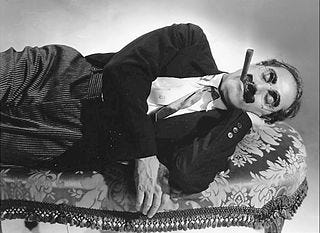
None of them have matched the quotes that I’ve seen attributed to Groucho Marx. His words— more than the other famous philosophical Marx — have informed a lot of my worldview today (for better or for worse). Here’s my list of favorites:

  1. “Learn from the mistakes of others. You can never live long enough to make them all yourself.”
  2. “Humor is reason gone mad.”
  3. “The secret of life is honesty and fair dealing. If you can fake that, you’ve got it made.”
  4. “Politics is the art of looking for trouble, finding it everywhere, diagnosing it incorrectly and applying the wrong remedies.”
  5. “Those are my principles, and if you don’t like them…well I have others.”
  6. “If you’re not having fun, you’re doing something wrong.”
  7. “I’m not crazy about reality, but it’s still the only place to get a decent meal.”
  8. “Blessed are the cracked, for they shall let in the light.”
  9. “While money can’t buy happiness, it certainly lets you choose your own form of misery.”
  10. “I intend to live forever, or die trying.”
  11. “Life is a whim of several billion cells to be you for a while”
  12. “Time wounds all heels.”
  13. “Before I speak, I have something important to say.”
  14. “If you find it hard to laugh at yourself, I would be happy to do it for you.”
  15. “Everyone must believe in something. I believe I’ll have another beer.”