The Real Secret of Productivity

It’s not what you think.

Productivity. It’s the buzz word of all buzzwords. It is that dragon that we all chase — day after day. It’s the subject of thousands of articles on hundreds of sites. An ocean of virtual ink has been spilled on the subject. But most of this ink assumes that everyone is clear on what productivity is, and why it is good. Lately, I’m not so sure that this is the case.

I’m not sure that it’s clear to everyone what productivity is. I’m also not so sure that it’s clear why productivity is a good thing. So here are a few thoughts.

First of all, productivity doesn’t exist in a vacuum. Being productive is not an isolated virtue, good for its own sake. It’s only good if one is productive in the realm of something that ought to be produced. There is no sense in being productive for productivity’s sake. After all, I could be super productive in the realm of grass blade counting, but is there any good in my being productive at that? Probably not.

The focus of productivity talk has to include being productive at the right kinds of things. But how do we determine what the right kinds of things are? That is where a lot more thinking is needed, and paradoxically, where we need to be a lot more productive.

The REAL Secret

If productivity is simply producing more of whatever thing you’re working on, then the real secret of ultimate productivity begins to surface.

The real secret to being more productive is to select the right thing to produce.

With that “secret” in tow, you may find yourself feeling both liberated and scared at the same time. Liberated because you are free from the shackles of the things you worked diligently at doing more efficiently — but weren’t quite sure about. Scared because you’re totally free. You are now free to decide what your real priorities are — what you really ought to become productive at. And you’re free to go and do it!

Knowing that secret is half the battle, but winning half the battle doesn’t (by definition) win you the battle. The real nitty-gritty comes when you sit down and decide what the real priorities are. That itself takes a lot of time and energy, and it will involve asking yourself really challenging questions.

Selecting the right thing is hard, but a good tip is this: select the thing for which focus and intense work comes easily. This is where a quote from Shane Parrish at Farnam Street:

you will know when something is worth your time because it will be engaging to you and focusing at those moments should feel almost effortless. Inversely, if you constantly find your mind wandering and you’re struggling to maintain your focus, it’s probably time to reassess how you are using your time.

Essentially, to get productive you’re going to need to get rid of a lot of stuff that doesn’t engage your full attention. Below are three tips I’ve found that can help in this process.
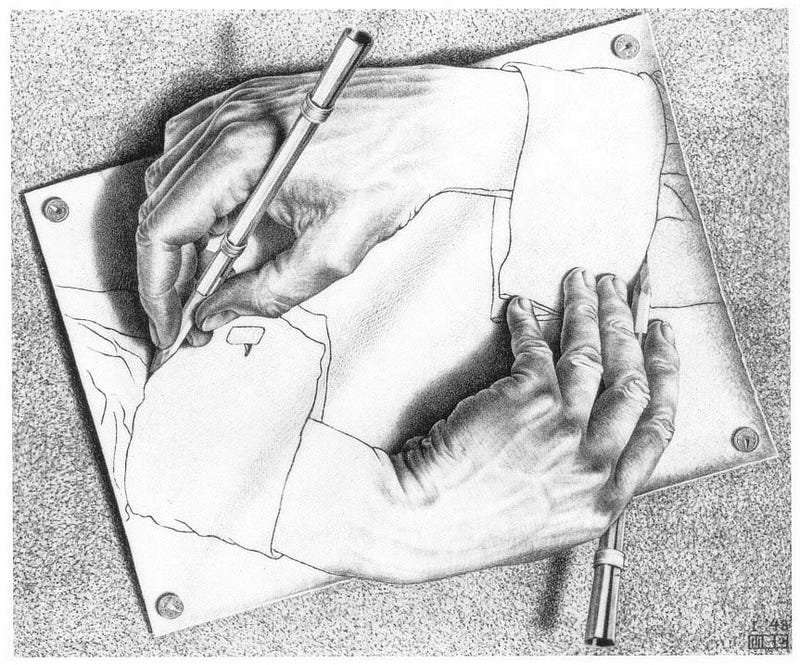
dude, that’s soooo meta!

How to do Meta-Productivity

  1. Abandon your assumptions: Go into your session of hard soul-searching without any assumptions about what your priorities are — what’s really worth getting done. The more you assume you know, the less you’ll notice when you search your feelings for your priorities and your values.
  2. Don’t fall for the sunk cost fallacy: The sunk cost fallacy basically says this: just because you’ve already spent a lot of time and energy doing task X, don’t think that means you need to see it through to completion. If getting X done doesn’t contribute to a worthwhile goal of yours — cut it!
  3. Think like the therapists on Hoarders: If you manage to not fall for the sunk cost fallacy, you may find yourself ready to cut a lot of things out of the scope of your normal productivity push. That may be scary. You may have developed some kind of attachment to a lot of the work you find yourself doing, or just scared that things may fall apart if you abandon that work. But so much of that emotional involvement is a kind of productivity hoarding. So treat yourself like the hoarder (of tasks) that you are, and take a cue from the show with the same name. Perform an intervention on yourself, and fearlessly ask why these things are on your plate, and *gasp* what happens if they come off of it. For a really great walk-through of how to do this, see Greg McKeown’s great piece at LinkedIn.

With that daunting journey out of the way, you should have a fairly clean plate in front of you. But if your plate isn’t clean, at least the stuff that is on your plate is stuff that you’re excited to start getting done. Then, finally, you can roll up your sleeves and get to work.


If you appreciated this piece, you know what to do — recommend it! Also, follow me for more stuff like it. I try to publish nearly every day. The operative term being “try”.


What Business is Really All About

It’s the best, most sustainable business plan. Always has been, always will be.

Obligatory business picture, courtesy of pexels.com

Across divides of language, culture, customs, and best business practices there is one thing that remains at the bedrock of any solid organization. It is the one thing that will — no matter what your product or service is — be the essential element of why your company is valuable. It is what customers yearn for, and what competitors strive to do better.

That thing is help.

You can sell people or other organizations any product — an app, server space, a machine, or just plain money (in the form of financing). You can create a marketing campaign that highlights the great things about your product, a list of the people or companies that have used it, and ratings from all sorts of satisfied customers. But it all has to speak to the same thing: how it will help.

Everyone has challenges — whether personal, professional, or spiritual. When a product, service, or person clearly shows that they can help with said challenges, and they deliver, the sky is the limit.

This is probably not a revelation to anyone. But at the same time, I don’t quite see it in the talk about scale, burn rates, IPOs, and other talk around the bonfire of business. That makes me a bit sad.

Your business should help people, or it likely won’t survive. Founders and executives should help people gain a foothold in business, learn the ropes, and find their talents. To that end, business — at its best — is about lasting relationships. It’s about lasting relationships with customers who trust the businesses they partner with. It’s about loyalty and service to employees, even when reciprocation is uncertain. It’s about lasting ties to, and service of the community — as far out as that community may go. It is help and relationships all the way down.

Again, this should not be a surprise. This is what life in general is all about. Why think business is any different?

When is Your Routine Perfect?

Yes, routines are integral to performing at a high level, but how do you know when to stop tweaking your routine?

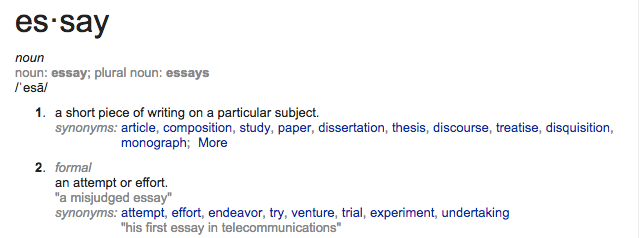
Here’s a disclaimer for the reader: unlike many other articles in the genre, I’m not going to claim that I have an answer to the title question. Rather, this is an essay — in the truest sense of that word. It’s an attempt, a venture, a trial.

In Greg McKeown’s seminal book Essentialism, he illustrates the importance of a routine for high-performers by telling the story of the routine of 8-time gold medalist swimmer Michael Phelps (bear with me, it’s wordy

Two hours before a race Michael Phelps would conduct the exact same warmup swim every time, in the exact same order. After the swim he would dry off, put on his headphones and sit on the massage table. Always sitting, never lying down.

From this point forward he would not speak to his coach or anyone else until after the race was over.

At 45 minutes before the race, he would get dressed for the race. At 30 minutes before, he would go to the warmup pool for a 600 meter swim.

At 10 minutes before the race he would walk to the ready room and find a place where he could sit alone. He would place his goggles on one side and his towel on the other.

When his race was called, he would walk to the blocks. He always approached the blocks from the left side. He would dry the block every time, perform the same two stretches in the exact same order always with the left leg first. Then he would remove the right earbud.

When his name was called he would remove the left earbud.

Phelps also had a routine for what to think about every night before going to sleep, and the first thing in the morning when he awoke.

He called it “watching the video tape,” and it was a visualization of the perfect race in slow motion. Every detail from getting on the blocks, to every stroke until he won the race.

During practice, when his coach wanted to challenge him he would simply say, “push the video tape.”

So, by the time Phelps started a race he was more than halfway through a routine in which he had been successful every step of the way. The race itself was simply the final step of a flawless performance.

This is a powerful testimony on how important and beneficial developing a routine can be. But if you’re anything like me, you already buy into this — so that’s not the issue. The issue is, you find yourself constantly tweaking your routine, and you’re not sure when to stop. When is your routine such that it will deliver Phelpsian results?

That’s what I’m unsure of.

You see, I’m a tweaker. I adopt cool systems that I hear about, and I tweak them. It’s what I do.

When I first read David Allen’s Getting Things Done, my first order of business was to try every task and project management software out there — tweak all of the settings, use different options. This would go on for weeks, and I’d never end up getting anything done.

Obviously, that’s no good. But say I’ve got a routine as strict as Phelps’s above. I’ve got it timed and precise. Only I don’t have any gold medals. In short, what if I have a solid routine, but I’m just not moving up in the world as fast as I’d like? What then?

Does my routine need to be tweaked? If so, in what way? And if I spend too much time tweaking my routine, won’t that just sabotage my efforts to achieve my goals?

I’m really wondering. Since it’s doubtful that anyone reading this is insanely successful, I’m interested in hearing from anyone currently struggling with this. As you try to build a routine, how do you know when to stop tweaking?

Do You Even List, Bro?

Before you get all proud about getting a bunch of things done, take a minute to ask yourself a few questions.

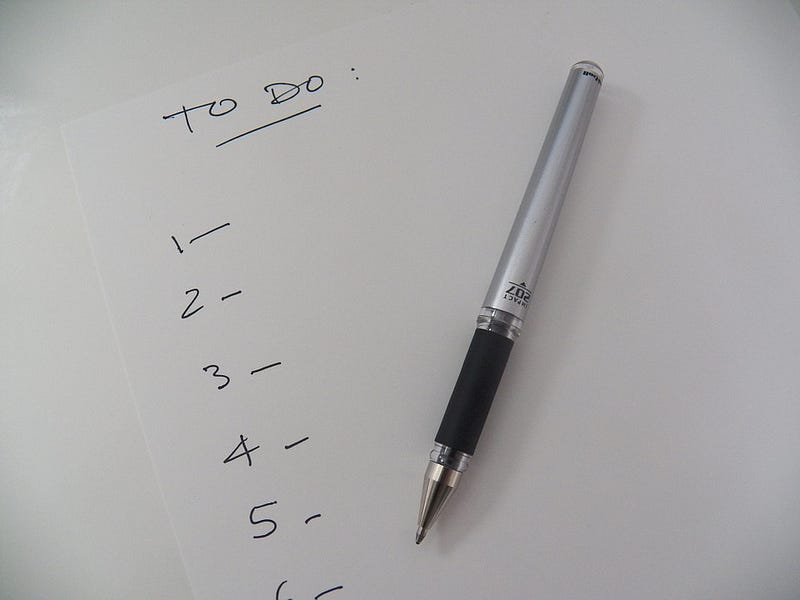
There is much ado about to-dos.

If you’re like me, you have a list of “next actions,” which you’ll undoubtedly use as your yardstick to measure how angry you should be at yourself at the day’s end. That list has all sorts of actions on it, from sending follow-up emails, to spending time updating a quarterly report, to thinking about how to handle a tough demand from a key customer.

Nice List…

Years from now, archeologists will look through our fossilized “to-do” lists and marvel at just how productive we all were. How could they not? I mean, you sent thirty-five follow-up emails that one day in June. Look how many meeting minutes you pushed out the team! You “worked on Q3’s report presentation” every day that one week in October! Holy smokes!

You caught the snark, right?

Yes, it is important to cross items off of your list — I won’t deny that. But crossing a bunch of items off of a list (or several lists) is not what productivity is all about. In fact, too much focus on that actually undermines productivity. Why? Because productivity is not about getting a bunch of things done; it’s about figuring out the best things to do, and taking the most efficient route to get them done.

That’s it — that’s all there is to being truly productive.

That means that you can get 50 things done today, tomorrow, and the next day (for a grand total of 150 things in 3 days, you beast, you!!) without being productive. Crazy, no? If the 150 things you crossed off your list are not attached to worthwhile goals of yours, you were unproductive.

An Admonition

We hear a lot these days about the dangers of getting sucked in to checking our phone too often, or about notification overload. We hear about the way that our brains react to things like re-tweets of our stuff, recommends on Medium, or Facebook likes. It can be dangerous.

But what I don’t hear about (and maybe I’m looking in the wrong places) is a similar danger with what obsessively checking stuff off of a list can do to us. After all, that feeling of crossing something off as “done” can be addicting — so addicting that we lose focus on why we have stuff on our lists in the first place.

Is it on your list because it will add value to your life or someone who deserves it? If the answer is no, perhaps it doesn’t belong on your list.

If you find yourself doing a bunch of things without intuitively understanding how they fit in with the goals of your life, that’s a problem. Furthermore, if you don’t have an intimate familiarity with what your overall goals are — but know all of the tasks you need to do today — that’s an even bigger problem.

I’ve written about this before — there is virtue in being able to understand how all of the tasks and projects on your plate fit into the box of your overall life goals. If you can’t see that fit, then you may just be busy for busy’s sake — and that is the antithesis of adding value.

TL;DR

If you have a to-do list, each action on there should be one that you can very quickly connect to an overall life goal of yours. If you have more than a few items that don’t match that description, getting them done is not being productive.

Better Leadership in One Simple Principle

Distilling Good Leadership Down to its Spirit.

When I left academia and entered the business world, I thought that I would need to accept every project I was given. I thought that doing this would ensure that I stayed employed and moved up in the company — whatever company it was. Almost 7 years later, I have realized that this is a mistake — but hey, at least it’s a fairly common one.

I am now a team leader. I manage a small team of 6 people, and have strategic goals that I am responsible for achieving. Because of this, I have realized that as a leader, there is something that I need to have at the front of my mind as I delegate to my team:

time and attention — the two most valuable resources in knowledge work — are finite, and must be managed accordingly.

I need to make sure that I know this about the people I lead, but I also need to make sure that those who lead me know it as well. It means that I need to pay keen attention to how each of my people work — how long they can stay in deep focus, how much walking around they need to do in order to get back to square, and so on. This is harder, of course with remote direct reports, but it can be done. It needs to be done, or else the true job of a leader is incomplete.

I have realized that a true leader has one job: to find out what her people need in order to fully realize their potential, and do all she can to make sure they get it.

Everything should flow from that principle. This includes making sure that people’s time and attention are being effectively used, but not overextended. Some of the best people you could work with will not tell you when they are being overworked until it is too late. You need to position yourself to be tuned in to sense that, and act accordingly.

But it’s about more than just making sure that your team is not overextended, it’s also about making sure that your team has space to think creatively and think strategically. This means making sure their mix of work is not sabotaging their development.

For about a year and a half, I had been promoted to a managerial role, given strategic projects, and expected to lead. But I was also saddled with day to day customer service tasks as well — the same ones my direct reports had. The rhythm of my days ended up being one driven by urgent e-mails and calls, tasks needing to be done by the same day, and reminders about strategic work I needed to be doing. It meant that most of the work I was doing was essentially handling interruptions. As many are familiar with now, there are significant costs associated with this — having to switch from so much tactical work back to strategic work. One kind of work ends up suffering, and it is usually the strategic work. It kept the pace of my development slower than it would have otherwise been.

That is the price that leaders can pay if they don’t keep in mind their people’s mix of work. You can lose people who could bring strategic value, because you’re keeping them on tactical work. Some of the most promising people working under you will not complain until it’s too late — they’re either burned out, or they’ve begun looking elsewhere. You’ve lost them either way, and it’s a bad loss to endure — very difficult to come back from.

All of this is to say that leadership should be about the people you lead first and foremost. When it is truly about them, it will have to be about developing them to their fullest potential. That means making sure that you make the most of the finite time and attention they have.

It’s difficult, sometimes murky work, but it’s some of the most rewarding work that one can do.

A Little Hack to Make Your Day Go Better

A Simple thing I try to do sometimes. It makes my day go better — by orders of magnitude.

credit: Mishu

How did you decide what to do today?

Some of us made to-do lists as our literal first thing upon waking. Some of us beat our heads against the wall while downing 3 cups of coffee — just to get the blood flowing to our brain. Then we looked at our emails and got swept away. Others were woken up by screaming children and followed them around all day picking up whatever mess was made — all in an attempt to keep up some semblance of order.

Many of us feel like we don’t make decisions about what we do each day, but we do — every single one of us. In many cases (perhaps the majority) we simply decide to let go and forfeit the right to decide what to do. We throw our hands up and let the day take us where it will. Often times, that is when we feel the most stressed — which is weird because usually we think of having to make a bunch of decisions as really taxing.

Take heart, friends. This happens, and will continue to happen here and there. The problem, though, is when things go this way on most days. That is when you begin to feel like you are not yourself. You live each day feeling like you’re not making progress, and thus you end up feeling like you’re out of touch with yourself. Maybe you haven’t even dissected the feeling that deeply — you just feel off.

It’s Goals All the Way Down

In a perfect world, you would wake up every day with a well-defined goal or set of goals already written down somewhere. Your day would then be structured in a way where your to-dos all work toward said goals. This doesn’t have to be high-level. Whatever your goals are, this holds true. Here’s an example:

Goal: Get child to school on time and in a condition ready to learn.

Like many goals, this one has a parent goal and many child goals (no pun intended). The parent goal is probably something like raise a well-adjusted, intelligent, loving child. The child goals are even smaller things you’re looking to do in order to make that goal happen. This can get pretty granular, like: find both shoes before the kid gets downstairs, so it doesn’t take twice as long to find them.

If you’re the person getting the kid (or kids) ready for school today, things will either all fall into place for you or they won’t. The world turns despite your plans, and the chips fall where they may. Often times, that is what makes us feel good or bad about that part of our day.

This often extends to the entire day — regardless of what else we end up tackling. We end up hitching our wagon to circumstance — how we feel about the day becomes dependent on how things unfold. The same then becomes true for how we feel about ourselves, because how we feel about ourselves is so often dependent upon what we feel we’ve accomplished.

That’s a perilous choice because things have to end up just so in order for you to feel good about yourself and what you’ve done. Avoid this as much as you can. You can be proactive — even just a little tiny bit. It will make all the difference in how you feel about your days, and ultimately, about you.

Here’s My Humble Suggestion

Take a few minutes (literally, a few minutes) and align whatever you anticipate today with your overall goals — as much as possible. The best way will always be by committing this to writing, but even just thinking about it in this way should help you feel better.

You’re not changing anything in terms of what you’re trying to do. You’re not making a classical “to-do list” of things that you feel you need to accomplish. That is often a great way to end up feeling bad about yourself at the end of the day, rather than the beginning. What you are doing is crafting a lens through which to view your day — one that has a much better of chance of making you feel some semblance of control, direction, and progress.

It can make all the difference in the world.

My Crippling Addiction

Hearts — little green hearts. But they’re just the symptom…

The visual manifestation of a big problem

I have a confession: I am addicted. I go to bed thinking about them. I wake up craving them. Wherever I am, I scrounge around compulsively, in case some have popped up. I can’t help myself.

I need little green hearts. Recommends. “Recos” the kids on the street call them.

Ever since the ship of Medium took off, with me on board, I’ve been aching for those green hearts (didn’t they used to be black? Never mind — no time for that now). That pleasure center of my brain throbs whenever I see that little green dot next to the bell on the Medium app on my phone.

Oh sweet, sweet recommend heart. When I see how many I have in the morning, I’m glowing — until I realize it’s not enough! I need more!!! And so it goes — the latest symptom of an ongoing sickness that I’ve had for a long time. Might you have it too?

It’s an addiction — a dependence on validation. I’ve had it since I was a child, and I’ve never outgrown it. Those green hearts are now just a visual representation of that intoxicating feeling that I’ve spent so much time and energy pursuing. It is right in front of me — hour after hour. I am as validated as the number next to that little green heart. That is how good I am.

In All Seriousness…

Here’s my worry: I worry that Medium’s recommends may be bad for me — really bad.

I want to write to better myself. I want to write to help others. I want to share my experience, and flesh out my thoughts and feelings. I also want people to read what I write. That has caused me to write stuff I might not otherwise write — to overreach, to make click-baity titles just to grab in readers.

I know I’m not the only one, either. I see it all over.

I also see pieces specifically written with the aim of teaching others how to get more readers. Very little of the advice is about writing better material; it’s essentially about using tricks to get people to click on a piece. That’s not what I want deep down.

Even if I were to get a bunch of readers and recommends by using the “tricks for clicks” approach, it’s not sustainable. I would end up in one of two positions:

  1. Forced to write the exact same stuff that got people to click in the first place, so I can keep them clicking.
  2. Writing better stuff that I want to write, but losing readers and recommends.

I don’t like either situation. So what I need to do is take some advice that my lovely (and wise — suspiciously wise) wife once gave me: write stuff that you think is good and that fits you; the rest will come in due time.

My writing may have catchy titles at times, and other times it may not. But my effort must remain on ensuring that I’m writing for the sake of the material, and not for the sake of how many people I want to read it. There are ideas I care about: creativity, wisdom, self-improvement, productivity, mindfulness, etc.

Part of me knows that as long as I devote thought to those and find interesting things to say about them, people will (eventually) read what I write. If I can be so bold as to suggest: try to do the same thing, folks. So long as you do, I don’t think you can lose.

Do We Need the News Every Day?

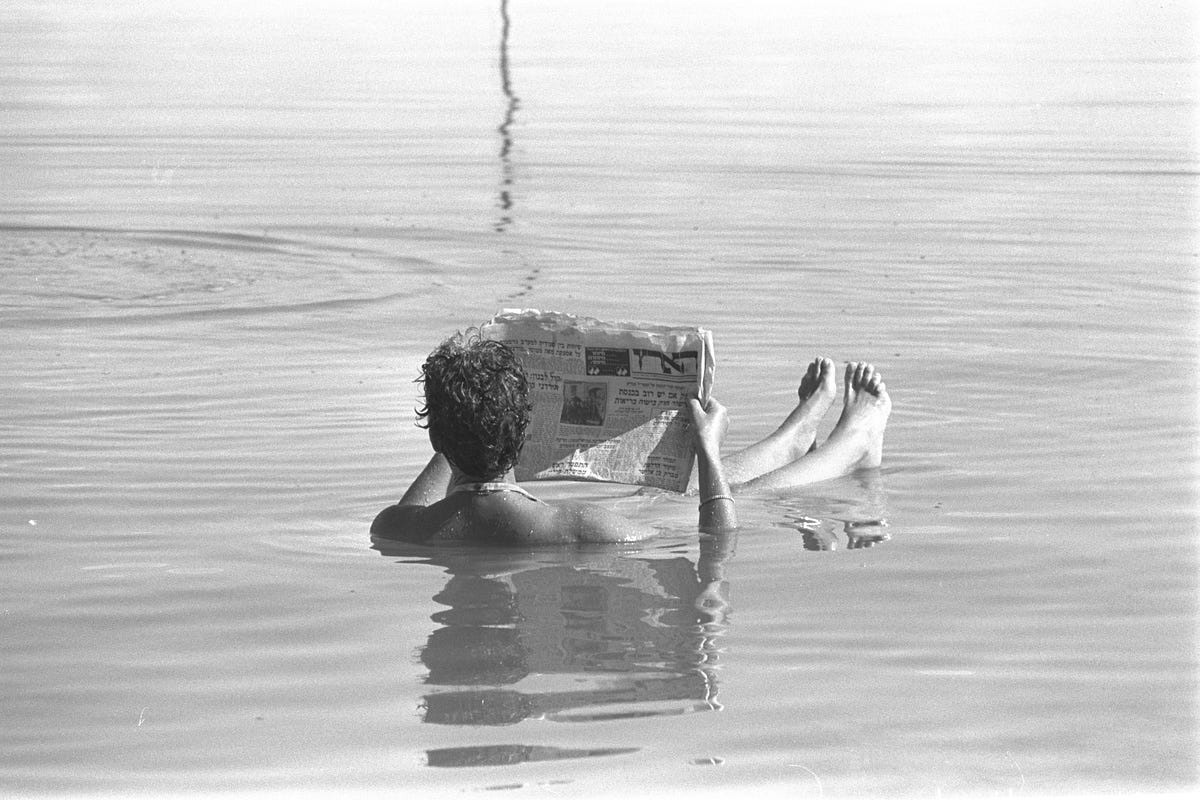
We’re afloat in a dense sea of news.

I don’t read the news daily anymore. There I said it.

Okay, I don’t really mean that I don’t read the news at all, and I don’t mean to suggest that whoever reads this piece shouldn’t either. That kind of brings me to my point, as it happens.

You see I do read the news, a little. I’ve limited myself to literally Quartz’s weekday email bulletin, and whatever few minutes of NPR I hear during my morning routine (not technically reading, though).

I used to make following the news a priority. I used to value knowing the ins and outs of current events — the political issues of the day, the big goings on. To me, being up to date and in the know about the broader world around me was tantamount to being a compassionate and caring cosmopolitan, as my liberal education had suggested I become.

Then I became a husband, a father, and I closed the window I had left open to a life in academia. To state it more bluntly, my focus shifted.

Don’t get me wrong; I still care about what’s going on in the world. I still have strong political opinions. I still think that what is happening in the corners of the globe is significant.

However, I no longer think that my knowing about each little wrinkle in the stories, as they unfold, is important. For 99.9% of us, knowing those things probably isn’t important. In reality, those wrinkles, presented in so many articles, blog posts, and tweets, are of relatively little importance — even to the broader story of which they are a part.

There’s just way way too much noise bombarding us today for me to even muster up the energy to keep up. There are thousands of outlets publishing news stories, analysis, and opinion pieces pushing each other against the gates of our collective attention each day. They report contradicting facts, contain outdated information at publication time, or just don’t really report anything at all.

But for those who hoped — as I at one time did — to be “in the know” about current events, all that work trying to “keep up” is enough to buttress an acute case of FOMO. It can get to a point where one’s morning coffee is barely half guzzled before the wave of panic washes over: “what am I missing out on?”

You’re Not REALLY Missing Anything

Here’s some relief: I don’t think you are missing out. Okay, that’s a little oversimplified of an assessment. You are missing out on the intelligentsia’s version of gossip (on a global, geopolitical scale), but you’re not missing out on two key things that you should care about: understanding and wisdom.

To be connected with and aware of the transitory goings-on of current events is to have knowledge of small, discrete facts. That is what I would estimate 97% of news outlets concentrate on. But any connection to those things quickly fades. It is not understanding or wisdom; it just isn’t that valuable.

After all, knowing that there were 681 heroin-related deaths in Illinois in 2014 is somewhat useful, but quickly becomes dated and less relevant, as days pass. Knowing that the State of Illinois made severe cuts to mental health programs in the years preceding this mortality spike is a bit more valuable. But in order to find out the latter, you’d have to wait for stats to be gathered, and reports to be written. For clearer understanding, patience is required.

Understanding is valuable, and thus, it takes much longer to gain than mere knowledge of factoids. So rather than consuming news and spreading links and commentary on Twitter and Facebook like a madman (or madwoman), allow some time to pass. Seek out researched and vetted narratives about the issues written well after their inciting incidents have come to a close. (Longform is great for this, by the way. They also have an app!)

This is not news (pardon the pun). Government agencies, academics, and think tanks have all followed the same model. The 9/11 Commission Report wasn’t released until July of 2004. The Financial Crisis Inquiry Commission didn’t release it’s report until January of 2011. That’s a 3 year lag on both occasions.

But that’s the point. To get what’s valuable from information, one has to distill it. As anyone in the business of distillation can tell you, it’s a time-consuming and intricate process. The more you rush it, the poorer the quality of what you end up with.

So far as the the flow of information goes, there are 3 currents that any storyteller can grab onto when conveying information:

  • The Lower Current: fluctuating, changing, different from one day to another, turbulent and hard to keep track of.
  • The Higher Current: the long-term trends, little change, and what change there is is marked by its slight nature.
  • Highest Current: unchanging, universal truths. Truths about human nature, truths about the universe, etc.

Get To the Top Currents

All of the day’s discrete stories and factoids of longer-running sagas play out in the low current of information. There is turbulence. Things change from day to day, and uncertainty abounds.

Here, you can speculate, guess, and give conditional predictions, but at best, you’re presenting small and disconnected pieces of reality. Whatever story there is, it’s disjointed and clunky because it’s current and unfolding. No good, coherent, insightful story is ever the result of merely conveying what is happening in front of you in real-time.

A valuable and coherent story is the result of distance between the storyteller and the temporal location of the story — the time and place it happened.

That distance allows for reflection — for the storyteller to grab various theoretical lenses through which to view what happened, to try to make some sense of it, and put it in context.

That distance is only obtained by floating up to the highest current — where the moral of the story lives. It is not an easy journey to float up there, but it is well worth it.

Would it Kill Medium Publication Editors to Actually Edit?

source: pixabay.com

I tend to give the benefit of the doubt — whether that be to people or organizations. There are a lot of ways to drop the ball on various things. Goodness knows I’ve found many of those ways in the projects I worked on. I get it. There are ins, outs, what-have-yous.

But what really grinds my gears is when someone purports to be in a position of authority or judgment, and then ends up not doing anything at all to exercise that authority or judgment. I simply can’t abide by it.

Case in point: publications on Medium. I won’t name names, but there is a publication that I have submitted to recently — one where I am a writer for said publication. They have accepted a decent amount of my submissions. There have been a number of articles where I submitted, waited, and they have simply never replied. But guess what, editors: there is a button that says “don’t accept” at the bottom of the article submitted. You can reject an article if you don’t want it in your publication. So if you don’t accept or reject my article, and it’s been days, I can only assume that each of your 15 editors collectively decided to not look at it, and it’s gotten buried in the stack.

The aforementioned “don’t accept” button

Was the problem that one editor liked it, one didn’t, and two were kind of iffy on it? Does it have to wait until next week for your editorial staff meeting — the meeting that the 7 pieces published today didn’t seem to have to go through? Is there a Slack channel where the editors are picking over my work, and thus can’t possibly get back to me with a decision just yet? I am quite sure none of these things happened. In all likelihood, a few editors read it, and just didn’t accept it for whatever reason — probably never communicating with another about it. Hell, it’s just one article, and it’s not even by a Medium heavy-hitter. Who cares, right?

To me, that is why Medium is not currently in the best shape to be a legitimate platform for publications to launch. It’s not clear that editors are held to any standard whatsoever. There appears to be no nudging toward professionalism for editors — which makes sense, because anyone can technically be one. I guess it’s my bad for having expectations of professionalism.

Am I butt-hurt that I received no response for my pieces? Eh, maybe, but if I was, it’s faded by now. I am merely calling for editors who read over a piece and decide not to publish it in the publication to at least reject it. It’d be nice to receive an email or DM via twitter to let the author know why it was rejected, but I won’t make the mistake of asking for the moon when a night-light will do for now.

Dear Medium: I Just Want to Write and Get Better At It, Can You Help Me?

I’m just here to write, man.

I waffle on what exactly it is that I want to do with my writing. I like the prospect of writing online — I get quick feedback, and honestly, that often establishes and keeps momentum. However, I am afraid of what writing online might be doing to my writing.

When I was in high school, right at the turn of the century (wow, that makes me sound old!), I was taught to become a better writer by circulating my writing amongst willing peers and getting feedback. Doing that in 1999 usually meant that you physically handed a few pieces of paper to a friend or two in your class, and following up later. The feedback was usually detailed, substantive, rich, and hopefully honest. I’m sure that much of the online community that revolves around writing, like Medium, is meant to replicate this process, but scale it. I’m just not quite sure that it works.

The feedback from Medium is mainly recommends — people pushing a little heart button at the bottom of your article. Related to those is the stats of views and reads. Simple logic would dictate that the more views, the better your title, the more reads, the better your initial paragraph, and the more recommends, the better your piece is as a whole. Perhaps there’s more to it than that, but I’m not sure what that would be.

I’ve been writing on Medium with any kind of regularity for just over a year now, and sometimes it seems like something is missing in that feedback set I outlined above. I see a lot of pieces recommended by hundreds of people that seem outright click-baity and repetitive of stuff you find on widely-read inspirational/productivity sites. I see pieces that have very similar titles and content both getting high quantities of recommends. But, I also see good pieces of writing getting a decent amount of recommends. It leaves me wondering how I can get better feedback about my writing, and how I can get better — not just more popular — as a writer through Medium.

If I just relied on what I see most recommended, I think the first lesson I’d learn would be a title with numbers and buzz-words in it. To me, that’s not better writing per se, that’s just swindling. Maybe they’re the same thing — I don’t know. The other lesson I’d learn is to use very small paragraphs — one sentence ones, even. That seems to get people’s lazy eyes moving down a piece. Again, I’m not sure that’s better writing. The third lesson I’d learn is…I’m not sure, actually.

I guess the missing piece for me — and I promise I’ll end this stream-of-consciousness rant, then — is this: can I get feedback on my piece from people, especially if they didn’t like it? Just seeing that 150 people viewed my story, but didn’t read it, and that 50 people read it but only 12 recommended it…I don’t know what to make of that! Why didn’t they read it? Why did they read it through, but not recommend it?

Yes, I get a dopamine surge every time I see that notification alert in the Medium app, or the little green circle with a number in it on the site — I’m only human. But what would really help me out is some constructive criticism. I know that other writers feel this way too, but I just don’t know how to best push that forward here on Medium.

Thanks for thinking this through with me. I’m done now.

Let’s Stop Calling it “Racism” and Call It What it Really Is

It’s Oppression. So let’s call it that — and stop giving the #alllivesmatter crowd ammo for their rebuttals.

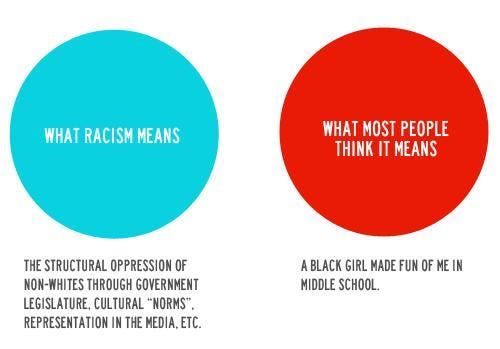
image credit: Julia Craven (https://curlycrayy.com/2014/09/29/reverse-racism-isnt-a-thing-yall/)

Like many bleeding-heart liberals who were born Caucasian in America, I spent a decent amount of time this weekend reading and gathering information about the terrible tragedies in Minnesota and Louisiana. I spent some time nodding in agreement, and some time shaking my head in shame as well.

But as I read through the various digital Molotov cocktails hurled from one trolling group of ignoramuses to another, a thought occurred to me:

How much time, effort, and frustration could be saved if blacks and white progressives stopped referring to the problem as “racism” and started referring to it as “oppression”?

The reason I say this is because ultimately what I see and her from the ocean of semi-rural, mostly right or center-right leaning white mouths that surround me is something like this: “hey, it’s also racist when black people are marching for affirmative action, and they’re insulting white people, and I didn’t own slaves, and I work hard and….” I usually stop listening around that point. But you get the picture.

Please forgive them, for they know not what they do. They fail to understand that the problem we talk about when we talk about racism is not merely an idea, viewpoint, or single action. It is not a cute little bias held by some people wearing white sheets or swastika armbands. It’s not about what some individuals say on the internet or in comments sections on local news sites. (note: no comment is ever worth reading in those comments sections)

What is really at issue is the systemic and selective oppression of an entire race, and exploitation of their disadvantage. The after-effects of it continue to operate in all areas of society today. They would still be felt for some time even if every on-black person magically stopped having conscious and unconscious biases about black people. The momentum of that kind of long-running oppression takes a long time to slow. But sadly, few non-blacks (and likely some black folks as well) fail to realize that.

White dudes in the comfort of their Herman Miller Aeron chairs can post all the YouTube videos they like about white people who have died, and all of the racist things that random black people have said. They may be successful in proving that there are racist folks of both skin colors. But they will never be able to show that there is a systematic oppression of white folks by a system run primarily by people of color. The evidence just isn’t there.

So, friends, the next time you find yourself writing or speaking about racism, use this simple hack: replace the term “racism” with “oppression”. If you like, you can dress it up a bit and used “institutionalized oppression with centuries of laws and norms behind it”. I would estimate that many of your least fruitful arguments about racial justice will be prevented from starting. You can thank me later.

Tonight, I Looked Up at the Stars

For the past few decades, I’ve lived in areas where there was enough light pollution to effectively drown out the stars in the night sky. But last Fall, my wife, daughter, and I moved out to what is almost a rural township. There is an interstate about 3 miles away, and a main road about 5 miles south, but otherwise, no light to speak of at night.

Tonight, for the first time since we made that move. I went out on my back deck and just looked at the starts. There was no wind, no clouds, and the temperature was just between hot and cool. There was nothing to distract me from just looking and absorbing the night sky. There was also nothing to keep me from receiving the message it sent me.

I am really small. The anger I felt that I overcooked the burgers tonight is small. The dissatisfaction I feel with the email I saw come in from a big customer while I was on vacation is small. The past year has been small. There’s just so much out there going on. Each light is a hot, loud, reaction — a crashing together of elemental gasses. There is so much space between me and them. I know, with certainty, that I will never reach most of them. I will never know much about any of them. They outnumber me. They outnumber my worries, my fears, my angry rages. They will persist when I am gone. They will persist when the last person who remembers me is gone.

I won’t pretend to know what that means. There is no conclusion to draw from it — not yet, anyway. I just felt small in comparison. But for some reason, that felt comforting. I felt like nothing was that bad. I felt like the fact that I could just go and look at the starts tonight, then go back in my house and go to bed — that’s really great. On the timeline of history, I think not so many people have been able to just go out on their back deck, look at the starts for 5 minutes, and go back in, to the comfort of their soft bed. For those that can, try it some time. It’s pretty nice.

That’s all I’ve got.

Good night, cosmos.

Dat First Cup, Doe

An Ode to the Morning Person’s Little Helper

Credit: Hot Coffee on a rainy day

Every morning when I wake up, you’re there. Sure, you take a little coaxing to come out of your shell. You need to be warmed up, stirred, and caressed into waking up. But when you do wake up, you stir in me all sorts of wonderful ways.

There is more to you than just oils, diterpines, and antioxidants. You represent more than just a vehicle for the world’s favorite stimulant. You are potentiality incarnate— hot black potentiality, steaming right into the air under my nose. I inhale, and go from 0 to 60.

When my lips touch you, you always give, never ask or take. You are an undying font of inspiration, optimism, gumption. You nudge, ever so gently, but oh so effectively — even if I do not end up going anywhere.

Our time together is short, but we make the most of it. Me — the reluctant early riser. You — the eternal source of hope and newness each day. The sun may get all the credit, but in my world, you kick the day off in the dark well before that lazy ass celestial body is even beginning to rise and shine.

You, first cup, you anoint the day with glory — though often it may quickly fade. For that perfect few minutes, all is manageable, all is in order, all is right. The feeling will fade, but so does everything. Should not I continue to partake in you, so you can remind me of that impermanence? Such will be my excuse, a way to justify my lustful fumbling through the dark hours.

As the day closes, I lament on all that was not done. But I grin slyly, looking forward to our time together in but a few short hours. I will emerge from slumber, resembling a hibernating bear. You will be there, waiting, for our dance to begin.

I will let you lead. I insist.

What Self-Help and Inspirational Writers Might Never Want to Admit

Some people aren’t free, and aren’t successful — and no amount of books, articles, and seminars will change that.

America’s Independence Day has brought with it a slew of self-help/inspirational drivel having to do with “freedom”. I saw a few pop up in my feed, and even read a few. Meh.

Today, though, one popped up in my feed with a title that I couldn’t resist:

https://medium.com/higher-thoughts/if-we-only-knew-where-our-true-freedom-comes-from-e324bdb2f10a

If only!

Ellison swings for the fences on this one, as he boldly proclaims:

It doesn’t matter who gets killed, how many get killed, or what happens as the result of the killing.

Whether we win or lose the war, our human experience — the thing we’re fighting against other humans to change — only really changes when we reach deeper levels of understanding/consciousness. The only thing that’s keeping us from those unreached levels of consciousness are the barriers of thought we’ve stacked up in our very own psyches.

This reminded me of a similar thesis from man-about-Medium, Benjamin P. Hardy about why so many others are not also growth-hacking their unicorns, and whatnot:

Wealth, optimal health, incredible relationships, deep spiritual maturity are all available to you. But you have to pay the price to have these things. The primary obstacle in your way is how you feel about what you need to do to have these things.

So, the takeaway seems to be this: you are holding yourself back — no one else.

Perhaps this isn’t the takeaway that was meant by either of the above authors, but it’s not hard to see how someone reading their articles in need of help would leave with that conclusion.

If I didn’t know any better, and I believed these guys, I would feel pretty terrible about myself. Unfortunately, I know that it’s not that simple — nothing is.

The simple fact is: a lot of people are not as free as others — by no fault of their own. They were born with fewer resources, they were born into an ethnic or societal group that faces all sorts of (insidious and complicated) barriers to flourishing. They don’t have a network to rely upon, or the innate bedrock of basic social skills to build one. They are not just a few habit-changes away from becoming the next successful entrepreneur. Reading Think and Grow Rich will not give them all they need to really realize all of their dreams.

There is just so much that I read — especially here on Medium — which seems to ignore those facts. There is this implicit guarantee that all you need to do is change your mind, and you can lift yourself out of the muck and mire, and up into prosperity. It’s Horatio Alger all over again. And it scares me.

I’m scared that a whole new generation of people reading these books and articles will take the bait. But I’m not scared for them — they will be largely white, upper and middle class, and able to do okay for themselves. I’m scared of the attitude they may develop toward those who live in nearly inescapable poverty and oppression. I’m scared that those who stay steeped in self-help and positive psychology literature will come to believe that those who are poor and oppressed are somehow the only ones responsible for it. That belief is utter bullshit.

Oppression and injustice abound. They are the result of systems that emerged from years of antiquated bigoted statecraft and unbridled exploitative entrepreneurship. The residual is a globalized system that makes it much, much easier for those who are at least one of the holy trinity: white, straight, or male (bonus if you’re all three, like me!). Don’t get me wrong. No one is waking up with the stated aim of keeping things this way, it is just something that has stuck around, so long as the profits and growth kept happening.

My point is merely this: it’s not everyone’s own fault that they aren’t doing well in life. Some people were dealt a terrible hand, and no amount of Sydney Banks or Werner Erhard literature will change that. The best it can do is inspire some people who are on the cusp of natural advantage to do better than they would have. The worst it can do is to convince a generation of readers that they need not pay attention to an unjust system because it’s pretty much everyone’s own fault that they aren’t prospering — centuries of slavery, oppression, and exploitation be damned.

You Know What? Succeeding is Actually Hard.

So can our Medium writers please just act accordingly?

The work is slow and difficult.

I’ve been on Medium for just over a year now. I try to split my time between reading and writing. I write about creativity, productivity, and generally just trying to be a better person. I try to read the same kind of stuff.

But lately, I’ve noticed two disconnects. First, there is just way too much content flying at me. It’s all about self-improvement. It likely all means well. However, it seems to just be the same stuff over and over.

Be a lifelong learner. Set Goals. Get up early and do a bunch of stuff in the morning. Take risks. The list goes on. As I’ve already noted, I’ve begun to see repetition in the subject matter of articles, even within the same publication.

The second disconnect I’ve noticed is that the tone of these articles tends to be something like this: success is easy, you do what this article says, and you’re on your way. But clearly, this is not the case, right? Succeeding in life is hard. We can agree on that, right? Also, luck plays an outsized role in how well people end up doing. There are many things that can end up snapping into place at the right time, and that can help people who working no harder than other unlucky schmucks end up getting to the next level. I just don’t see that acknowledged in many of these articles. Perhaps my feed on Medium is just broken.

Perhaps I’d just be less likely to complain, if one or both of the following happened:

  1. There were fewer self-improvement articles voiced in the second person on Medium.
  2. The tone of the self-improvement articles was more honest about how difficult and reliant upon circumstance wild success is.

How likely are these things to happen? Perhaps someone really good at statistics can help tell me that. Now that’d be an article I would read.

It’s Happened: Medium Posts Have Repeated Themselves

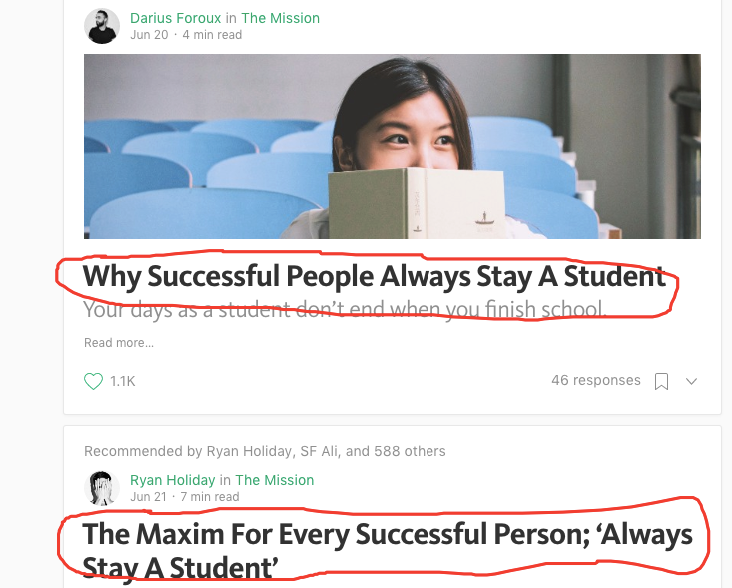
On June 20, I finally saw it in my feed. Two posts from two well-known writers popped up in my feed. They were basically the same:

Is this what it’s come to on Medium? Is this what I’ve been “missing” in the past 3 weeks or so since I’ve been gone?

Shit.

This isn’t a good sign. Maybe I was right to check out for a while. But maybe I’m wrong. Maybe this is just in the zeitgeist. Maybe Holiday and Faroux were just tapped into that jetstream of inspiration. Maybe The Mission was launching (pun fully intended) a prompt for famous internet people to pen articles on the same title — except I was unable to find it (which isn’t saying much, I’ll grant you).

Or maybe originality — or at least a frail attempt at it — doesn’t mean anything anymore. Maybe no one will read this. Check that — no one will read this.

Anyway, I was just thinking out loud. You can go back to whatever it was you were doing now.

I Gave Myself 10 Minutes This Morning

credit: pexels.com

This morning, I decided to give myself exactly 10 minutes to write — no more, no less. I would write what I was thinking, delete only typos, and keep moving. Below is what came out of that process.

There is something so magical about the first cup of coffee in the morning. It’s like a cleansing and a rebirth all at once. The sins of yesterday, which felt so real and so dreadfully heavy last night, are seemingly carried down the esophagus by that first swig of coffee. Maybe it’s the heat. Maybe it’s the acidity. Hell, maybe it’s both. However it happens, it does indeed happen. Perhaps that’s why I end up feeling so invigorated. One hand on the laptop, one hand reaching for the handle of the mug — it feels so much like the sacred rituals of a religion, but without the pretense.

These little things keep me going when I feel so tired, and somehow manage to establish momentum for the day ahead. It’s no wonder, then, that so many pieces have been written about doing things in the morning, first thing. But perhaps there’s even more to it than that.

I have just started reading Deep Work by Cal Newport, and he makes a great point about willpower. He says (and I’m paraphrasing here) that willpower is not some manifestation of character that can just be called upon at any time. It’s not something that some people always have and others just don’t. It is like a muscle, and as you use it more during the day, it gets fatigued. This is why rest is so important, but it’s probably also why that first cup of coffee is also so important. Being able to just sit and allow the ritual of the coffee to wash away the things that were weighing on me so much last night allows me to take on things today with renewed vigor. It also justifies that attitude of “I just can’t deal with this now.”

But more than anything, I think that it’s important to safeguard this time in the morning, to make sure that I use it properly. This time should be where I stretch that muscle of willpower — the one that I need to use in order to do deep work throughout the day. But I need to stretch it, not start putting it under load. That’s an important difference, because if I do the latter, I can effectively ruin the balance of my day by having fatigued the very muscle that stands to help me strengthen my body of work.

10 minutes has already gone by, and it’s amazing to see how little that can give me. Time is a very tricky resource — the scarcest resource, in fact. Even when you don’t want to use it, you’re using it — constantly. I’ve always been poor at time management, so making sure that I get the most out of the time that continues to be depleted, despite my wishes, is so very important.

Liked the article? Hit the little heart at the bottom, or send it along to someone else — perhaps as you sip your morning coffee.


Originally published at Your Fool Laureate.

Hacker Noon is how hackers start their afternoons. We’re a part of the @AMI family. We are now accepting submissions and happy to discuss advertising & sponsorship opportunities.

If you enjoyed this story, we recommend reading our latest tech stories and trending tech stories. Until next time, don’t take the realities of the world for granted!

Your Creation Is an Instrument

Part 19 of the Oblique Strategies Series

This is part of a series, running through 2016, in which your faithful fool randomly selects one of Eno and Schmidt’s “Oblique Strategies” and writes a meditation upon it. For background on the series and the strategies, please read the series introduction. The Oblique Strategies are copyright Brian Eno and Peter Schmidt


About 14 years ago, as a fresh-faced undergraduate, I stumbled across the Tao Te Ching. It’s a classic of the Eastern philosophical canon, and if you haven’t read it, you should. And if my endorsement isn’t enough, consider this: most translations weigh in at fewer than 75 pages. It’s a quick read the first time around, but you will find yourself coming back to it again and again.

One of the themes in the book is one that actually isn’t unique to either it or the Eastern philosophical tradition: things are not what they appear to be. There is a deeper aspect of the reality we swim through — meaning beyond the hollow descriptions that we so clumsily affix to the world we know. So the labels and roles that people self-apply and that others apply to them, are likely not the real story. More interestingly, the instruments we use to do our work — whatever that work may be — are also more than they appear to be.

The Instruments You Use

Consider a pencil. A pencil has a role that is assigned to it: make marks on surfaces. The other end of it is an eraser. The eraser’s assigned role is to take away marks. Essentially, the roles are for the lead to create and the eraser to destroy. Most people who pick up a pencil use it in this way. But consider what happens when you change the assigned roles. Use the eraser to create white space, and use the white space to make an image.

This isn’t a new idea by any measure — artists have been doing it for years. But someone had to do it first. Someone had to look at the pencil and think perhaps the eraser is not exactly what it seems. More simply, someone had to understand the agreed upon role of an instrument and change it. The destructive became the creative. Things were changed forever.

So what instruments in your life and work are going unexamined? What things are arranged in such a way that you haven’t thought to look at their roles differently? At a higher level, what do you perceive as the role of your work itself? Think about it: the best art is itself an instrument. It is an instrument for change, an instrument to evoke a reaction, to arouse emotions previously hidden — in persons and in society as a whole. But each work does this in a different way, by tugging on different heartstrings. Which heartstrings are you looking to tug?

Art as an Instrument

The work you do itself does work. It works on the thoughts and feelings of those who come into contact with it. The things you create themselves create. They create new movements and conversations. That all starts with whatever instruments you pick up, and how you choose to use them. This is not limited to music or visual arts. Words, too, are instruments. The word “clearly” has a different sound, and evokes a different reaction than “unequivocally”. Choosing one over the other makes a difference; it changes the work. The syntactical symphony adopts a new, perhaps richer tone as a result of the linguistic instruments you choose to employ.

All this is to say that so much in the creative process is about asking questions, and trying out new and interesting answers to those questions. When the question is what is the role of the instruments I’m using? the new and interesting answer can merely be: whatever the role, I’m going to try changing it. You might fall flat (and it’ wouldn’t be the first time), or you might just catch a tailwind that pushes you to create that innovative piece. You just don’t know until you begin trying things out.

Godspeed.


Originally published at Your Fool Laureate

Is It Finished?

Week 15 of the Oblique Strategies Series

This is part of a series, running through 2016, in which your faithful fool randomly selects one of Eno and Schmidt’s “Oblique Strategies” and analyzes and interprets it. For background on the series and the strategies, please read the series introduction.


Creative work encounters roadblocks at all different stages. Sometimes — at least for me — I’ll be off to the races with a good idea from the get-go, and rage on for several sessions with passion and confidence. I’ll make progress, I’ll keep momentum, and then I reach what I believe to be the penultimate stage. It’s that stage where I’ve got the essence of that thing I was trying to make, but it’s still rough — not ready to see the light of day. It’s not “finished”.

Next comes the polishing, the refinement, the pursuit of the perfect. The pursuit that never ends — or at least ends merely with resignation — rarely with satisfaction. It ends that way because we creatives always end up asking ourselves a question, but doing so in the wrong way:

Is it finished?

Asking this question alone is not really a strategy. Rather, asking it in a certain way is — the right way, and knowing how to go about answering it.

Ask the Same Question Differently

You can ask yourself is it finished? in two different ways. You can ask if there’s more you can add or tweak. If there’s more you need to do. If there is a way this work can be more like what it’s supposedly meant to be. Asked this way, the answer will almost always be “yes”. You can then go on tweaking until you’ve driven yourself utterly crazy, and you’ve made so many cuts and pastes that you’ve got a veritable Frankenstein’s monster on your hands.

You can also ask yourself if it’s finished, knowing that the answer is no — it will always be no. A work is never finished. You as the creator are really only tossing out an expression, a feeling. The best creative work expresses an important truth in a provocative or evocative way. It is the start of a deep and hopefully enriching conversation. The audience then continues it. It becomes theirs, not yours.

An Exercise in Paradox

I think asking this question is it finished? is an exercise in paradox. What I mean by that is this: if you answer yes, you are wrong — it is not finished. You are finished with it, but as a work of art, it is not finished. In a way, it is just beginning its life. If you answer no, then you are correct — it is never really finished — but you are then asking yourself the wrong question. You should be asking have I done my part? Am I ready to let others receive and interact with this work? Am I ready with letting this work now be theirs to connect with, rather than mine?

Your work is just the beginning of a long conversation. You start it — hopefully with a bang — and the audience runs with it. That’s why the best creative work is the kind that people keep talking about for decades. Most of that talk is debate — debate about what exactly the work is telling us, how we should interact with it, feel about it. It’s not all gushing about how amazing it is (though there is surely some of that).

Sometimes, the truth that we express in our work is too complex, too difficult to receive, and takes time to capture hearts and minds. That is okay, better it be that way than the alternative. Better your work take some time to ferment in the collective consciousness than immediately be recognized and relegated to the background — the storage area of simpler things.

You Are More than This Piece of Work

Here’s another variation on the question, which you can ask by excluding two words. Rather than ask are you finished with it? — as in are you finished with this piece, change the scope of the question.

What is the underlying idea, the underlying emotion — the message of this piece? Are you finished with that? Are you done tackling that emotion, that bit of truth? Have you said your last word on it? More to the point of getting un-stuck in your work, would it be so bad to just let this piece go? Would it be so bad to just put it out there, see what happens, and be ready to work again on the underlying concept — in another work?

I do this all of the time. So do many people who publish things on the internet. We write essays, commentaries, analyses, stories. We develop them as much as we can at one time, and we release them into the wild of the world — knowing that we’re not done with that particular idea. I would submit that those who do this end up more successful than those who don’t.

Shitty, Good, Great

In other words: don’t be afraid to put out some shitty work, so long as it’s shitty but honest. Enough shitty but honest work — when pursued with good intentions — will give way to better work. Better work gives way to good work, which gives way to great work. Before you know it, you’ve done truly great work. All this by being okay with the paradox of “finished”.

And by the way, even after you’ve done great work, it’s not finished. In fact, the more you do work, and more work you do, the more you will make your peace with the fact that it’s not finished — it’s never finished. If you still doubt this, consider the most immediate example of creative effort — yourself. You are never finished. You’re different now (hopefully better) than you were yesterday, and you will be different tomorrow. You are in progress, just as your work is.

I will close with this thought: if to you finished means no more work to be done — then you’re missing the point. That thought is antithetical to what it means to do creative work. Finished is merely a step along the way. You finish your part of a work, but as I said, it’s never finished. You are never finished — not until you’re dead or you give up. I would hope that if you’re reading this you haven’t yet resigned to either.

Godspeed.

Liked the article? Subscribe to my weekly newsletter. 1 email every Sunday — that’s it. It’s worth it, I promise.


Originally published at Your Fool Laureate.

How to Be a Non-Douchey Self-help Guru

Sell the people something worth buying

The internet is rife with self-help “gurus” — either self-proclaimed or being heavily evangelized by others. You can’t swing the digital equivalent of a dead cat on sites like Medium without hitting some listicle about the x things that successful people do that you need to do. And of course, if you even try to read the article, there’s an e-book or course you can buy.

There’s nothing wrong with wanting to build your business upon helping people live better lives. In fact that’s actually very noble. The problem is that — like so many services — if you don’t take care to do it right, it can actually hurt more people than it helps. It pains me to see people get hurt, and it pains me to see people get ripped off. It also pains me to see people act as if things are very simple and easy when they are almost always neither.

So, here’s a few things that you can do, if you’re trying to be a non-douchey self-help guru.

Admit That It’s Hard

It’s very very difficult to be successful because it entails two other very difficult things: finding a goal that will fulfill you and achieving it. Those are the most difficult things to do, and most people spend their entire lives trying to do one or both of those things, and never do them. So if you really want to help people to help themselves become successful, don’t try to convince them that it’s easy to be successful. At best you just perpetuate many peoples’ cycles of self-doubt. At worst, you make people feel inadequate and idiotic for just not getting the “simple” “secrets” to success.

I’m guessing that if you are successful — in the sense of finding a fulfilling dream and seeing it come true — you know damn well that it was difficult. I think you also know that no listicle you read or talk you saw was the panacea that launched you headlong into living the dream. Only one person’s life was really transformed by The 4-hour Work-Week, and that person is Tim Ferriss.

Admit That There is No One Habit or Trick

Let’s dispense with the pretense, shall we? Let’s agree that while Ockham’s Razor is a great principle in scientific explanations, there’s really nothing to recommend it for prescriptions about how to navigate something so complex as living a good life. Even if you can construct a single sentence that you think is the definitive advice on how to do well in life, it’s likely that such a sentence actually has a bunch of complex advice packed into it. In other words, it’s easy to oversimplify things — but it’s also really unhelpful.

Admit That You — Like Everyone Else — Are Just Trying to Figure Things Out

Even if you have — by all accounts — succeeded, and you’re standing atop the mountain, looking down at the rest of us schmucks, don’t be so cocky. Do you wake up, and your coffee makes itself? Does nothing require effort for you anymore? Are all of your thoughts and emotions totally in line with ideals? Do you never experience pain or resistance? Don’t be stupid! You are a human being, and part of being a human is pain, disappointment, and striving against resistance — to some degree. If you write as if you are somehow above these things now, I can’t imagine why anyone would be interested in reading you for any length of time. After all, how could anyone relate to you?

Maybe some people believe that you can leave behind all the valleys of human experience, and that it is possible for it to be all peaks all the time. I feel sorry for those people, and hope they quickly realize their mistaken beliefs. But I guess until then, they will be the primary spenders on self-help BS that pretends to take everyone up above being human. However, if you wish to actually be successful in helping people, and not just in taking their money, be honest about the human experience.

Don’t Just Sell “Success” — Do the Hard Work of Defining It

To me, the term success is like the term productivity. It’s been fetishized, but no one really knows what it is or why it’s good. I’ve written about this before, but I’ll emphasize the point again here. Productivity means nothing if you’re just doing a lot of stuff that’s not worth doing. The same goes for “success”. You can be successful at doing x, but if x is not something worth making happen, you’ve been successful at doing something worthless. Both concepts are vacuous on their own — without the hard part of identifying what is worth producing or being successful at.

Some might read this and say that the hard work of defining what’s worth doing is subjective, and everyone needs to do that on their own. This is only partly true. We are all involved in the discussion of what is valuable, what makes a good life, and what we should be pursuing. Sure, there is nuance, opinions differ, and we can get confused. But if anything, that just means that answers are worth finding.

So the message here is this: Sell me a vision for what the good life really is, or sell me a way to do better what I’m currently trying to do. Hell, sell me both. But don’t only sell me one and pretend you’re selling me both.

Liked the article? Sign up for my weekly newsletter.


Originally published at yourfool.com.