The Wisdom of the Granny Shot

credit: Lance King/Getty Images

How Overcoming “Style Creep” Can Help You Succeed Where Others Just Get By

On December 26, 2016, Chinanu Onuaku made his professional basketball debut for the Houston Rockets. It was kind of historic, even though he only spent 8 minutes in the game and scored 6 points.

By all appearances, it was an uneventful game for the young rookie — until about 2:46 left in the game. At that point, Onuaku was fouled, and made his first trip to the foul line.There Onuaku did something that he has been doing for a few years, but few people in attendance at the Toyota Center were prepared to see: he shot his free-throws underhand. He took two granny shots — and sunk both of them.

If you’re even remotely acquainted with basketball, you’re probably aware that nobody shoots the ball underhand. It just isn’t done.And yet, Onuaku is doing it. He’s the first player since Rick Barry — nearly 40 years ago — to do it in the NBA. But why?

That’s actually the wrong question to ask. The better question is why isn’t everyone else doing it? By all accounts, it is — once practiced adequately — a more mechanically sound way to shoot. It’s less prone to the variances in trajectory that you get with conventional one hand, overhead shooting. But don’t take my word for it, take an expert’s word for it:

The underhand throw can also minimize the drift of the ball. “A little sideward nudge at the start of the throw will translate into a big movement toward the end,” says Tom Steiger, a researcher who taught basketball physics at the University of Washington in Seattle….The underhand throw provides better stability than the overhand “because you’re holding the ball with both hands,” Steiger says. This helps players balance the subtle motor muscles in the hands and keeps them more relaxed. The movement of the underhand throw is a simple, easy-to-control upward pendulum motion. By contrast, the more conventional overhand free throw shot involves separate movements of the wrist, elbow, and shoulder that can add errors, Steiger says. “If the ball ends up rolling off one side of your hand even a little bit, you’ll miss.”

What’s Your Granny Shot?

It sounds like a no-brainer: if you want to shoot your free-throws better, shoot underhand. So why don’t players do it? Because it looks silly.

Those who chose to adopt it reaped the benefits. Rick Barry swore by it, and was an 89.3% free-throw shooter. When Wilt Chamberlain used it (briefly) he improved his free-throw shooting to a career-best 61%, including 28/32 in his famous 100-point game.

I’m not going to go in-depth on the granny shot any more here, but a wonderful podcast episode courtesy of Malcolm Gladwell does a great job looking into it.

The reason I bring this up is basically a question: What’s your granny shot? Or, put more specifically:

What thing could you be doing differently, but you’re not — all because it seems to fly in the face of style?

Style Creep

Here’s the thing: no matter what your industry, or what your practice, there is a phenomenon that I like to call style creep. It’s where a practice or a principle gets chosen for largely stylistic — but not functional or goal-related — reasons. And it’s dangerous. It can make us blind to possible advantages that we can reap by breaking with convention.

So if ever there were a way to get ahead in a sea of people trying to get ahead, maybe overcoming style creep is it. But it’s not easy. You have to be willing to mine for advice from others — advice that seems odd, un-sexy, and perhaps too old-school.

Then, you have to be willing to take that un-stylish, un-sexy advice, and be un-stylish and un-sexy by following it. Then you have to be willing to be laughed at, be odd, and be out of step. You have to do that for a while, until eventually, you succeed.

Then you can revel in your success. And as a bonus, once you show how successful your weird, uncool method is — you just might become cool after all. Now that’s pretty cool!

Know what else is cool? My weekly newsletter — Woolgathering. Subscribe and you’ll get (only) one email per week from me, with some cool ideas like this.
Hacker Noon is how hackers start their afternoons. We’re a part of the @AMI family. We are now accepting submissions and happy to discuss advertising & sponsorship opportunities.

If you enjoyed this story, we recommend reading our latest tech stories and trending tech stories. Until next time, don’t take the realities of the world for granted!


3 Principles for 2017

credit: kenichi nobusue

In case you didn’t have enough New Year’s stuff to read

The more I have written, the more I have read, and the more work I’ve taken on, the more I appreciate the spirit of minimalism. I guess sometimes, I just wish I knew what “minimalism” meant.

But let’s pretend that I know what it means. I think maybe it means to reduce the amount of resolutions for yourself in the new year. Perhaps it means reducing the amount of things on which you wish to focus. Perhaps it means not even adopting certain goals, but rather choosing principles to follow — regardless of the results you get. Luckily for us, many of the principles we could adopt end up covering pretty much every resolution we’re thinking of making.

Funny how that works, right?

I’m still adopting resolutions — ones for the eyes of my family and me only. But in the spirit of minimalism (again — whatever that means), here are 3 principles that I’ve adopted to guide my behavior in 2017.

[author’s note: like so many things that I think and write about, these are lifted from eastern philosophy — the Tao Te Ching, to be precise]

Simplicity

Be simple in actions and in thoughts, and you return to the source of being.

Too often, I wrap myself up in complex thoughts and even more complex actions. What tends to make them complex are the motivations I have for them. I want too much. I chase pleasure constantly — in food, in drink, in media. I look for more stuff I can buy to build a lifestyle. I look for the next great culinary experience. I search for the next book to read that will make me that much smarter and more well-read. It becomes too complex.

Rather, adopting the simple attitude of enjoying and caring for the things I have is what I should be doing. I can enjoy new things, but as bonuses — not as the fulfillment of long-held desires. In fact, that may help me to enjoy those things even more.

Patience

Be patient with both friends and enemies, and you accord with the way things are.

In many ways, I am terribly impatient. I can’t wait for things. I can’t wait for people. I lose my temper quickly. But in nearly every case, being impatient hasn’t done anything for me. Actually, all it has done was keep my anxiety high for a while, and kept me from enjoying what I have until I got what I want. Then I’d repeat the cycle over again.

I will have to learn to wait. I will learn to enjoy what’s here now, and not hang so much of my happiness on desires.

Compassion

Be compassionate toward yourself, and you reconcile all beings in the world.

I deserve compassion, but I rarely give it to myself. My loved ones deserve compassion, but I also rarely give it to them. We all deserve compassion from one another, because we’re all on a difficult journey, and we’re all a bit afraid of how it will turn out.

Every time I forget this (which is often), I do poorly. The more I remember that we are more often stumbling than running gracefully, the more I can be at peace.

Perhaps I can laugh a bit at how much your stumble resembles mine. Perhaps we can share pointers — punctuated by shared laughter — on how to more gracefully trip, tumble, and shuffle on to the finish line — wherever that is.

Please consider subscribing to my once-weekly newsletter — Woolgathering. You’ll receive one email per week (no more) with some interesting stuff. I think you’ll like it.

Intellectual Honesty

Rodin’s “The Thinker” — credit: Protoplasmakid

A Field Guide to One of the Most Important Traits You Can Have

Authenticity is important — whether you’re establishing your own personal brand, or just establishing yourself as a person at a party. But there is a trait that might be more important than authenticity. Without it, it’s really hard to actually be authentic. That trait is intellectual honesty.

So what does that term mean? A useful and simple definition comes by way of Jonathan Koomey:

Someone who is intellectually honest follows the facts where ever they may lead, and does so in spite of discomfort, inconvenience, or self-interest.

Being intellectually honest has never been more important, but it’s also never been more difficult. We live under tremendous pressure to not only know a great deal of information, but also to have an opinion on a great deal of it. It’s no longer enough to merely know that Donald Trump won the US presidential election; you are also expected to have opinions about it. Reserving judgment is viewed as a cop-out. But that is a mistake — one of many.

Why Be Intellectually Honest?

Why be intellectually honest? My answer is this: because it’s the right and prudent thing to do.

It’s right because forming judgments with little grounding is dangerous — both to you, and to others. Beliefs inform behavior. False beliefs feed questionable or hasty behavior. When you act on false beliefs, you take actions that you most often regret later.

It’s prudent because one of the unsung currencies in the world today is trust. When someone trusts you, they will go to great lengths for you — to defend you, to help you, to work with you, and (sometimes) to fund you. When you are intellectually honest, and people are aware of it, they will tend to trust you. That trust can be the most helpful advantage that you have.

So, how do you do it? How do you become and stay intellectually honest. Below is a list of things I’ve found helpful. It’s by no means exhaustive, but I hope it’s a start.

Learn How to Recognize and Admit When You Don’t Know

Both of the verbs here are key: recognize and admit. It’s okay to not know, even when you’re an expert — especially when you’re an expert.

You’d be surprised what this can do for you. It may end up helping you to actually come to know something because others will point you toward information that can help you gain that knowledge.

Withhold Judgment for a While

In a time like ours, it’s so tempting to make quick decisions, and to have a “hot take” about current events. Do what you can to avoid this. Wait for a bit. Read more. Ask questions. Think of more questions you didn’t ask.

Nothing closes the door on new knowledge faster than thinking that you already know. Keep that door open for as long as you can by withholding judgment, and deciding not to form a solid belief.

This doesn’t mean to not have an inclination. You can be leaning to one judgment or another, but that leaning should never be too hard. Leave yourself room to adopt a new hypothesis as you learn more.

Don’t be Afraid to Change Your Mind

This is a big one, mostly because social media makes it incredibly difficult for someone to change their belief about something. But this is so terrible a mistake on our part that it almost literally pains me. We should encourage people to change their minds, and welcome their decision to do so — not call them a “flip-flopper”, indecisive, or weak.

We should prefer that leaders, experts, and decision-makers change their minds with ease — so long as it is in light of newly discovered information and valid logic. I could not imagine a better trait for leaders to have. I also could not imagine a worse trait for a leader than the opposite — a rigid refusal to change one’s mind, despite all new information and analysis. There is literally no faster way to lose trust and credibility.

Give Credit Where Credit is Due

Let’s face it: while you may have come up with some great ideas, it is highly likely that they came to you from somewhere. Give credit for that inspiration — as much as possible. Be generous in that vein. Even if you think you came up with an idea, take a few minutes and look for other people who may have talked about something similar (Google is your friend here).

Even if your idea seems to be genuinely uncharted territory, give credit to your readers — who may be aware of similar ideas. State your idea simply and humbly. Don’t claim that it is going to change the world and revolutionize everything — let other people do that for you. Doing it yourself is just a bad look.

The point is, you’ve got to stay humble about your ideas. It will pay you back in dividends.

Did this article help you — even a little? Consider subscribing to my weekly newsletter — Woolgathering. Only one email per week, no spamming, no fluff.

The Power of Negative Thinking

credit: Derek Robinson (pixabay)

How Pessimism Might Actually Help You Achieve Your New Year’s Resolutions

Every year, millions of people (maybe billions) make new year’s resolutions. They vow to work out more, eat better, do more focused work, and various other radical changes. An overwhelming number of those people end up failing at one or all of those resolutions. I’m sure it’s happened to you — it has to me. Why is this?

Part of the problem is that we tend to get optimistic as we near the beginning of the new year. We tell ourselves that we’ll be different, better, stronger — we’ll achieve these goals. I think that in most cases, we’re so pumped, we actually believe the optimistic assessment of ourselves — and that’s the problem.

Be Pessimistic About Your Future Self

When we get optimistic about ourselves — when we think positively, saying I will achieve, I will be better — we fail to prepare our current selves for success. We assume that we’re going to be smarter and more prepared tomorrow, so we often fail to do the preparations that are necessary to make it easy for us to succeed tomorrow.

If you really wanted to set yourself up for success on a tough goal, it would actually be more helpful to view yourself negatively. If instead of thinking I’m going to wake up early and crush this workout tomorrow, you thought my lazy ass is going to look for any excuse to sleep in and skip the workout tomorrow — how would you act differently tonight?

Would you place your alarm far away from your bed, so you’d have to more fully wake up in order to turn it off? Would you have all of your workout clothes in your gym bag by the door? Would you have the coffee already ground up and ready to be made? But if you’re optimistic about you future self, you probably wouldn’t think of these things.

Make It Easy by Underestimating Yourself

The real trick to setting yourself up for success is to make things as easy as possible on yourself. The way to do that is to assume that your future self is a bit lazier, slower, and less organized than your current self. When you do that, you prepare for that laziness, slowness, and disorganization — and you make it easier for your future self to succeed.

Think about it, when you wake up and the gym back is ready, the coffee is brewing, your water and snacks are packed, and your playlist is all ready to go — there’s not much of an excuse to play hooky on your workout. After all that your evening self did to set your morning self up for success, your morning self really owes it to your past self to follow through.

When you think about it, this is a way of leveraging our natural tendency to fall for the sunk cost fallacy. Pretty clever — you guilt your future self into doing the right thing.

Further Adventures in Pessimism

Being pessimistic about your future self helps with more than just following through on resolutions. It also helps you to become better organized and more intelligent. Simply follow the principle of not trusting your future self’s memory.

I already do this about 70% of the time, and it pays dividends when I do use it, but I get some flack for it. When my wife or someone tells me something that I need to remember for future use, I whip out my phone and put it in my “inbox” to process later. Most people who give me crap about it claim that they just remember that stuff and write it down later. I challenge that “method”.

First of all, I bet that if those “remember it for later” folks tracked how often they did remember it for later vs. how often things just “crept up on them” closer to the due date, they’d be disappointed. Don’t trust your future self to remember something. You have a way to capture stuff; use it! Why place the burden on your future self to recall something? It saps your mental energy and processing power, it adds to anxiety, and it hinders organization.

And here’s a bonus with regard to goals and resolutions: the more organized you are, the more likely you are to achieve new goals you set for yourself. When you have a system that you trust to keep track of your vital information and projects, it’s much easier to keep on track with all of it. So, do yourself a favor, and assume that in the future, you’re a bumbling idiot. Then make it virtually impossible for that idiot to screw things up! It’s pretty simple.

Because You Assume You’ll Be Stupid, You’ll Always Exceed Expectations

When you’re pessimistic about your future competence and level of willpower, and you’re committed to your goals, you will work now to set your future self up to succeed. What is great about this is that each time your future idiot self takes all of the resources and organization that your past self spoon-fed it and does the right thing — you’ll feel amazing! That’s because you expected your lazy future self to be lazy and weak-willed, but look — that bastard did it after all!

This is tongue-in-cheek of course, but there is some truth to it. When you are realistic about how your mind can try to wriggle out of committments you’ve made to yourself, and you end up succeeding despite that, it’s a real victory. Those little victories over your weaknesses and defects are a real fuel for your road to progress.

So seriously, shrug off the advice of the Norman Vincent Peales and Napolean Hills of the world; think negative! It just might be the most positive thing you can do for yourself.

Did you like what you read? Please subscribe to my (only) once-weekly newsletter — Woolgathering. I promise to respect the sanctity of your inbox.

Simple, But Not Easy

credit: Luke Goodsell

When I was 23, I was pretty sure I knew more than most people. In my own mind, I was so damn wise — so informed, and intelligent. I simply didn’t have the time to waste listening to the advice of others. I was on my own path to greatness — or so I thought.

So imagine my surprise when, within a year’s time, it all came crashing down around me. I found myself way off of the path I thought I was on. I had been kicked out of grad school, I was forced to move to an unfamiliar place, with people I didn’t know. I had no job, and no money, and no idea what I was going to do with myself.

Luckily, it was at that time that I started to listen to the advice of others. There is one piece of advice that sticks with me to this day — one that I will bring up in conversation every once in a while.

There is a difference between simple and easy. Do not confuse the two.

You see, “simple” means the opposite of “complicated”. Simple means “easily or readily understood”. But what it doesn’t mean is “easy to implement”. In fact, an add-on to that piece of advice above is this:

The simpler the thing is to understand, often the more difficult it is to do.

Here’s an example. You’ve probably heard someone say “always be honest”. That’s simple. It’s hard to imagine a principle any simple than that. It’s also hard to imagine a principle that is more difficult to actually follow in practice. Think of all of the times when honesty seems to be detrimental to your goals, when it will prove inconvenient, when it will set you back. Given our usual motivations, it’s incredibly difficult to be honest all of the time.

Here’s another example: be true to yourself. That is pretty damned simple, right? Just be who you are, don’t put on airs, come to grips with your feelings, desires, and values. Be true to those things your actions. Don’t second-guess yourself, don’t be afraid, be boldly you. Again, It’s hard to think of something that is more difficult to do than that. And yet, it’s so easy to understand.

These days, I’m a lot more humble about what I know and what I don’t. I am sure that I know very little, and I try (but keep on failing) to act accordingly. I seek out all of the advice that I can get.

When I succeed at being humble, I receive more valuable insights. When I remember that the simple things I have heard about are also very difficult things, I’m a little easier on myself, and in turn, on others.

So I guess I would urge everyone to embrace the simple — for living simply holds great rewards. But whatever you do, do not expect it to be easy.

Please consider subscribing to my weekly newsletter — Woolgathering. Only 1 email per week — no spamming, no sales pitches. Just good stuff to read.

The Paradox of Pursuit

credit: r. nial bradshaw

How Chasing a Goal Can Get in the Way of Achieving It

Nearly all of us want to be better. We want to be better at relationships, better at our jobs, better at doing the right thing. For those of us that have such an impulse, it’s a blessing. But it can also be a curse. The thing is, as with many goals that we pursue, we need to be careful about whether focusing relentlessly on the goal is getting in the way of actually achieving it.

The Problem with Happiness

To explain, let me elaborate on a paradox that I learned about while studying and teaching philosophy. It’s called the Paradox of Hedonism. John Stuart Mill, in step with most Utilitarian philosophers like him, generally believed that happiness was the thing when it came to defining good. Things were good only because they promoted happiness for people or reduced their pain. That’s an over-simplification, but it gets me to my point, which is this: Mill came to understand a paradox in pursuing pleasure, which he lays out eloquently:

I now thought that this end [happiness] was only to be attained by not making it the direct end. Those only are happy (I thought) who have their minds fixed on some object other than their own happiness[….] Aiming thus at something else, they find happiness along the way[….] Ask yourself whether you are happy, and you cease to be so.

Funny how that works, right? The best way to become happy is to stop trying to be so happy. It’s a bit more complex than that, though — it always is.

It’s really about doing something for the love of that thing, rather than doing it as a means to achieve satisfaction.It’s about caring immensely about something other than yourself and your own happiness.

When you have a great time playing a game of basketball, it’s probably because you weren’t spending every second on the court thinking about maximizing how much fun you were having. When you had a blast at a party with friends, it was probably because you spent time in interesting conversation — really caring about the topic at hand, rather than focusing on making sure you made this the best party ever.

We Get In Our Own Way

In short, when you focus on obtaining happiness, you get in your own way, and happiness becomes that much harder to obtain.

I wonder if the same thing holds true for self-improvement. I wonder if chasing self-improvement as a goal paradoxically makes it that much more elusive. What if the way to get better is not by keeping self-enrichment in focus, but putting concern for others and for subject matter at the front of your mind.

Try it. Try learning a new subject matter not because “research shows that it will make you smarter and more interesting” but because the subject is interesting and worth knowing.

A slightly different question to ask yourself is this: what other things am I pursuing where I’m getting in my own way? What other goals are achieved as a byproduct, rather than by direct pursuit?

I don’t have a list in mind, but I do suspect that personal growth is on it. My takeaway, then, is this:

Perhaps we shouldn’t be so obsessed with self-improvement and growth hacking literature that we don’t take time to read ideas that are just plain interesting.

Perhaps when we do that, when we pursue interests for their own sake, when we get to know people not for the sake of networking, but because we come to care about what they do — perhaps then, we can begin to grow.

I don’t have all (or many) of the answers, but I have a lot of questions. Subscribe to my weekly newsletter — Woolgathering, and help me comb through all of them. You may just come out the other end a slightly wiser person.

Simple Writing vs. Lazy Writing

Writing and Responsibility

Writing should be clear. To write clearly, writers should strive to write as simply as possible. But there is a difference between simple writing and resorting to cheap shortcuts to make writing appear simple.

I see a lot of writing these days that consists of one sentence paragraphs. I think that many of the writers believe that such a scheme makes each sentence more powerful. They think it makes their piece easier to read for those who might be on the fence about it. I think it’s a bit lazy.

Words and Roadmaps

Writing is like driving across a state on a main highway. Paragraphs are like the towns you pass through. For the most part, you can tell when you’ve entered and left each one. The houses, restaurants, churches, and gas stations are generally grouped together. There are pretty clear boundaries. The same thing should hold true for the paragraphs you’re writing. One house and a bar is generally not a town; one sentence is generally not a paragraph. Don’t pretend otherwise.

I present that analogy because writers have a responsibility. It’s the same responsibility that you have when you’re the driver of a car, and you have a passenger. People who read your stuff are passengers in your vehicle. As such, you’re the navigator, you’re the tour guide, you’re the pilot. You are taking people somewhere, and they should never have to question if you’re lost, or whether you know where you’re going.

Tossing a bunch of one-sentence paragraphs at the readers is almost as bad as presenting them with long, meandering, circular sentences. It’s like deciding to take the “shortcut” road, only to find that it’s a winding back-road that gets you lost and wastes a bunch of time. Yes, one sentence paragraphs, one word sentences, and fragments all have their place every once and a while. None of these deviations from writing norms should be used just for the purpose of looking edgy. They should be broken for a particular purpose, but when they’re broken constantly, the purpose starts to get called into question.

Take Care

Writing is a balance between an art form and a means to an end. Words and sentences can be beautiful and awesome in and of themselves — like art. But words and sentences also attempt to convey meaning; they are a vehicle for expression and revelation. Writers need to respect the dual nature of writing, and take care to balance them.

They say that with great power comes great responsibility, but the converse holds true as well. With great responsibility comes great power. When you write responsibly, with care and concern for the craft and for your readers, your writing gains real power.

I guess I could be wrong, though. In which case:

Keep writing your one sentence paragraphs.

And your fragments.

And your weird. One. Word. Sentences.

I’d love it if you were to subscribe to my once-weekly newsletter — Woolgathering. My promise is to deliver to you a thoughtful and short email no more than once per week.

How to Pick the Right Chocolate from the Gift Box in the Break-room

Forrest Gump was wrong. There is a way to know what you’re going to get in a box of chocolates — mostly.

This time of year, at least in the US, the gift packages and treats come flying in (sometimes literally) from vendors and customers. People are saying “thank you” or “hey, how about sending some more business our way” — and they’re doing it the international language of business: food.

The most commonly used phrase in this language is the classic assorted box of chocolates. Sure, it’s a nice gesture. Most people enjoy chocolate candies. They don’t need to be cut, chilled, prepared, and they are less likely to cause guilt, due to their diminutive size.

But the box of chocolates comes with baggage — the anxiety of the unknown. We’ve all been there. You mosey on into the break-room and see a surprise box of chocolates. You’re not an animal, so you’re going to indulge. But you can’t stand the thought of biting into the raspberry creme one, or worse, the monstrosity that is the cherry cordial. You so badly want the chocolate or vanilla buttercream, the nougat, or the caramel one. But the thought of biting into the chocolate with the orange creme sends you into a bout of existential vertigo.

Fear not, friends, I have stumbled upon a very simple rule to help yo navigate through the box of chocolates:

If the candy is square and tall, you are safe — it’s bound to be a non-fruit filled candy. If it’s round, it will tend to be fruit creme filled. Try it at your own risk.

Now, some boxes of chocolates come with guides — a printed paper that shows how the treats are laid out in the box, with their shapes, and tells you what’s in them. This is great, and if you encounter a box with a guide, you can safely dive in. But it is not the common practice. The square/circle rule can help you to pick what you’re looking for in the absence of a guide.

I’m here to help, and I hope this principle has helped you. Let me know how it works for you this holiday season.

If you appreciated this advice, please consider subscribing to my newsletter — Woolgathering. It’s guaranteed to improve the quality of your inbox or 10x your money back.

What Does a “Recommend” Really Mean?

Exhibit A

Of Little Hearts and Open Minds in the Medium Community

A recent piece by Medium’s “unofficial cheerleader” — SF Ali — has garnered some attention. You can read through it, but the basic premise is this: the Medium staff reached out to him to question the authenticity of his recommendations. They believe that based on the frequency of his recommendations, and the content of some of his recommendations, he may be using some sort of software to make numerous quick recommendations, or merely hitting the green heart on nearly everything without reading it.

My man Ali was a bit miffed, of course. He’s been on Medium for a long time — reading, recommending, and commenting on a lot of people’s stuff. That includes commenting on a lot of my stuff (and I have a lot of stuff).

I can understand why he had the reaction he did. After all, recommending people’s stuff gets that stuff seen by more people. Medium’s mission is to be a platform for people to write and have that writing reach more people than it otherwise would. So what’s the problem here?

I’ll quote the man himself here:

Since I joined, I’ve been an avid reader and recommender of *everything* I came across, across the spectrum of diverse thought, especially stuff I might disagree with, including but not limited to ignorance penned by Deplorables and incoherent screeds left by Islamophobes as responses on my own stories.

I’m not sure about this approach. I love Ali’s writing, but I think his approach here is wrong-headed. So I’ve started thinking about the different ways that the little heart seems to be used here on Medium. Here’s what I’ve got so far

1. A literal recommendation

To me, a recommend means something like the following: I read this story, and I believe that it is interesting enough or I agree with it strongly enough that I recommend that others invest the time to read it.

That seems to be recommending is supposed to be basically a recommendation that others read something. So recommending nearly everything becomes the same as not making any recommendations. People check the recommends on your profile, and see enough crap that they don’t even bother. I want something different. I want the people that follow me to be able to look at my recommends and see really interesting stuff to read.

Keep in mind that this literal recommendation can — and should include stuff that I disagree with. Some of the most interesting pieces I’ve read are ones I disagree with. But that’s what makes them interesting, so I recommend them. [thanks to Aaron Charles for helping me to clarify this point]

2. Helping out a friend

You can also argue that recommending a piece is also a way to get a friend’s work out there in front of others. You’re helping people out — cheering them on. But I don’t see how that is different from saying “this is interesting, it’s worth your time to read it, followers.”

3. As a currency

Many people will recommend a comment on their own piece as a kind of “thank you for reading, recommending, and commenting”. They may also go and read one of the commentors’ pieces and comment on the latest one, or some recent one.

In that way, the little heart can serve as a kind of currency. You recommend mine, I’ll recommend yours, and so on. I would also not put it past people to have recruited others to regularly recommend their pieces to elevate stats and perhaps attract sponsors or gain subscribers. I’m not saying I think it is happening, but I’ve gotten enough followers that never read my stuff again to know that there are some fishy profiles up to something.

So which way is the right way?

Look, I’m not here to be Medium’s ethicist (though wouldn’t that be an interesting job?). But I think that the first use of the recommend is the only proper use. It’s not terrible if you recommend stuff by a friend that you don’t actually think is good or interesting, but I’m not sure it’s a habit. What’s more, I think it can mess with the whole reason why people look in their feeds for stories.

I think the third use of the recommend — as a kind of social media currency — is probably always a bad look. To me, it borders on inauthentic. When done a few times as a “thank you”, it might be okay, but again, consider the consequences. I’m grateful for people saying “nice piece, I agree!” But if I recommend enough of those, I’ve got to believe that it mucks up the algorithm.

I could be wrong (it’s happened before). But I wanted to get these thoughts out there.

What do you think? What other ways are recommends used? Are they good, bad, neutral? Comment and let’s discuss.

By the way, if you liked this, consider subscribing to my weekly newsletter — Woolgathering. One email per week to make you think. No spam or sales pitches.

How to Ask Better Questions

credit: Cherie Cullen (US Army/DOD)

And Get Smarter and More Effective in the Process

The best way to get smarter is to ask questions — a lot of them. When we ask questions, we open ourselves up to collecting more information — information that we wouldn’t necessarily get otherwise. That’s largely because when we ask questions — if we do it right — we are admitting that we don’t know, and we are removing the bias and pretense about the subject of the question that we normally carry.

Unfortunately, we don’t ask questions correctly. Most of the time, when we ask questions, we are not really opening ourselves up to the answers. Often times, we ask questions with some idea of either what we think the answer is, or what we would like the answer to be. Our questions, then, end up being more of a tool for guiding conversations and investigations toward a conclusion that we already favor. But when questions do that, we’ve effectively watered down the potency of questions — they become far less powerful. We end up being mistaken, or just plain waisting our time because we don’t bother to learn anything.

It’s not really our fault. We tend to ask questions with the goal of getting answers, and getting answers right away. It’s no different than the many things we do each day where we look for instant gratification. But like anything else, the good stuff doesn’t happen instantly, it takes time, it takes patience, and it often takes more work than the instant stuff.

How to Ask Questions More Effectively

So here’s a tip that I stumbled across to help ask more effective questions. It’s simple, but it is by no means easy.

Ask a question with the intent to ask at least a new follow-up question based on the answer you get.

When you ask a question, and someone gives you an answer, you will often get the urge to accept the answer, note it, and move on. Resist this urge. Resist it because the more professional or high-stakes the situation, the less likely the person answering your question will give you the whole truth at the outset. It’s not always that people are trying to hide things, more often it’s because they are answering off-the-cuff; they haven’t thought through an answer. They haven’t been asked for all of the information, or had it made clear what is important.

So, to make questions work more effectively try this instead: take in what the answer to the question is, and try for a few seconds to formulate a follow-up question. Here are a few easy examples of general follow-up questions that you can fine-tune, depending on the situation.

  • What makes you think that? This is a great follow-up because it makes it much easier to filter out gossip and speculation. There’s a famous motto at the C-suite that goes: “In God we trust. All others, bring data.”
  • Where did you hear that?/Who did you hear that from? Nearly everyone makes the mistake of taking what are essentially rumors and accepting them at face value. Questions about where the person heard something can get both of you to take a minute to examine the source of the information that was being passed along as something like fact.
  • Could you explain what you mean by that? (best for short expressions of opinion) I, just like many people, will often say something that sounds good in my head, but upon examination is a bit vague. Don’t make the mistake of assuming that you can tie up the speaker’s loose ends by drawing your own conclusion. Have them explain what they mean; have them make the vague more precise. That can rarely be a bad thing.
  • No, I’m not familiar with that (person/theory/event/etc.), could you fill me in? Look, we all want to appear smart, and often one way to do that is to be charitable to ourselves in the things we know about. Sometimes we overshoot (as happened in this great clip from Jimmy Kimmel), and pretend to know stuff we obviously don’t — to save face. Doing that is a surefire way to lose something in translation. Err on the side of appearing to know less than you do when you’re trying to get information from someone. It can help you by getting more information out there, and helping you make connections in your own mental web a lot better.

Questions are like a bladed weapon. When sharp and used correctly, they are extremely precise and effective. When dull and fumbled, they are useless and possibly harmful to the user.

Go forth with better questions, and ask not to get a quick answer, but to ask even more questions. The difference in your level of understanding might amaze you.

Did you like what you read? Consider subscribing to Woolgathering— my weekly newsletter. On email per week; no spamming no sales pitches.

On Survivorship Bias and the Pursuit of Dreams

credit: Pixabay

At this time 2 years ago, I was driving 7 hours to Columbia, Missouri. My mission was simple: meet with 3 professors in the Philosophy Department at the University of Missouri and persuade them to consider me for their PhD program, despite my lackluster academic record and credentials.

I Had a Dream

You see, I had this dream. I wanted to be a professor. I wanted to make my living in academia — head buried in books, taking breaks only to teach — and then back again to the ivory tower. But there was a problem.

I had made mistakes in my early 20s — bad ones. And my academic record showed that. I had gotten kicked out of graduate school due to my GPA, and had to fight to be reinstated and get my Master’s Degree. On paper, I was an academic mess. Getting into a halfway decent PhD program in philosophy would be extremely difficult.

But I had been indoctrinated with the rose-colored glasses of a dreamer. And a dream is what I was chasing.

Obstacles

Philosophy PhD programs are notoriously selective, and even if one were to get accepted into an esteemed PhD program, 2 things stood in their way. First, the attrition rate is about 50% — meaning that about half of the students who begin PhD studies actually finish. Second, the job market for philosophy PhDs in academia is terrible. Even getting a PhD means there is about a 40% chance of getting an actual full-time academic position, and less than that of getting tenure. Let’s not even talk about the salaries.

When I applied back in 2014, I already had a wife and a 6 moth-old child counting on me. I had a house with a mortgage that was way underwater. I had a HUGE student loan debt. Getting a PhD meant the following:

  • moving across the country with my wife and child with 4 months’ notice
  • selling our home at SEVERE loss
  • taking an 80% pay cut for at least 4 years by quitting my current job to do graduate work (including sacrificing health insurance)
  • likely moving across the country again with in 5 years for a job (when my child would be entering 1st grade).

And yet despite all of those things, my thought was “but I hear those stories of people who rose above adversity, beat the odds, and realized their wild dreams. That will be me!”

I still wanted to do it. I wanted to embrace the journey uphill and triumph over the improbable odds. After all, I had a dream, and I was willing to risk it all.

A Hint of the Odds

Then I began receiving the rejections. School after school on the top of my list said “no”. The 2 schools that didn’t reject me were at the very bottom of the list. One additional school made an offer because someone else withdrew at the last minute. My optimism was damaged, but still standing.

At this point my wife stepped in and asked me some questions. Specifically, she asked for the numbers. Not numbers reflecting how good I thought I was, or what professors had told me about my work.

She wanted the base rates — how likely is it for any given person to get a PhD in four years, and then land in a secure and sustainable position shortly after that.

That number was not good. It was terrible.

That led me to begin looking at the tales of those who didn’t make it. They were super-excited and optimistic at the outset, and talented — just like I was — but they didn’t finish PhD study. Or they got their PhD, only to go years without a steady job. Some were still floating from part-time gig to part-time gig — no security or benefits to speak of — living a nomadic lifestyle. Essentially poor and disappointed.

Survivorship Bias

That changed my mind radically. I realized that I had been falling prey to the Survivorship Bias. It’s that bias that we have which makes us pay more attention to the wild success stories — the ones that involve overcoming the obstacles and persevering against the tide of challenges and overwhelming odds. In doing that, we neglect to see the more numerous cases of failure. We neglect to account for and feel the impact of just how many failures there are, and how they can affect us. In cases like mine, many more people failed in their quest, and only a select few made it to a prosperous career.

So many of us fall victim to this — either in our estimation of our own odds or of others’. We believe that despite the terrible odds of moving from urban poverty to thriving wealth, it’s a real possibility for most people. It isn’t. We also believe that if we just read the right book, take the right course, and adopt the right habits, we can become successful entrepreneurs and really make it. Those odds are not good, either.

2 Ways to Avoid Falling Prey to the Survivorship Bias

Optimism is a great trait to have. But like any benefit, too much of it can be an impediment. When we’re acting under the survivorship bias, we fail to pay attention to the many ways that we can be derailed. Our confidence turns into a blind hubris — pride before the fall. We can avoid this by sprinkling a little pragmatism into our optimism, in two main ways.

  • Seek Out and Understand the Base Rate. For any journey you’re looking to take, others have undoubtedly tried. No matter how unique and hungry you think you are, you would be a fool to not even glance at the data on how many of your predecessors succeeded vs. how many failed. Especially in this age of ubiquitous data, you have no excuse not to understand the probability of success that you have. Any risk worth taking is worth understanding well. You can’t understand a risk without understanding the success and failure rates of those who have taken similar ones.
  • Adjust Your Desired Outcome. With base rates, we’re talking about large sample-size probabilities — how probable a desired outcome is for a certain group. So when you make the choice of what your desired outcome is, and what you will risk to chase after it, it would make sense to ask yourself two questions:
  1. Is there another outcome that I would enjoy as well that has a better base rate?
  2. Is there a way to chase my desired outcome that involves considerably less risk?

Let me be clear here. Chasing you dreams can be a very fulfilling way to live, but you can’t live that way and be fulfilled unless you fully realize how probable failure is. It’s a disservice to all of those who have failed before you to say “they just didn’t have my moxy, I’ll make it!”. Don’t be an ass. You’re not the first person to be excited, driven, and passionate about your goal.

Like any journey, it is perfectly fine to be bold and go for the high summit, but you need to understand the odds you face, and accept them. When you do that, you can decide whether the level of risk involved is one you’re willing to live with. If it isn’t — if failing would drive an existential nail in your coffin— I beg you to reconsider your approach. Is there a slightly different goal that is also exciting to you, but less risky? Alternatively, is there a different path toward the same goal — perhaps a longer, winding one — that involves less risk to you, where you can fail and still get up and keep going?

Far be it from me to be a downer, but I think there are enough articles that encourage blind dream-chasing. I absolutely cheer on those chasing a dream — especially those boldly doing it. But refusing to understand and accept the odds you face isn’t bold; it’s downright foolish. Don’t fall prey to the survivorship bias. Ironically, it might be what keeps you from (metaphorically) surviving.

Did you find value in this piece? Subscribe to my newsletter — Woolgathering. Once a week; no spamming, no promo emails.

5 Things About Productivity and Success that I Learned from Watching Baseball

credit: Ed Schipul

Analogies are helpful. They can help us think about things in new and useful ways. They help us to understand complex things that we’re heavily biased about by using something we have little bias about. Whenever I find a useful analogy, I try to share it. So, as I paid a lot of attention to baseball this year (to watch my beloved team win the World Series, of course), I observed some great pieces of advice in action on the field that are quite useful in life in general.

Here are a few particularly good ones.

  1. Productivity is not the same as high-volume, high-frequency output. For a batter to succeed in 1 out of 4 at bats is considered good. That means that even the best, most productive and successful batters will be unsuccessful 3 times as often as they are successful.
  2. Being active and busy is not the key to success. A majority of the physical activity in the game is concentrated in 2–3 players at any given time. The rest of those on the field are observing, preparing, and waiting. They understand when to take action, and are prepared when that time comes.
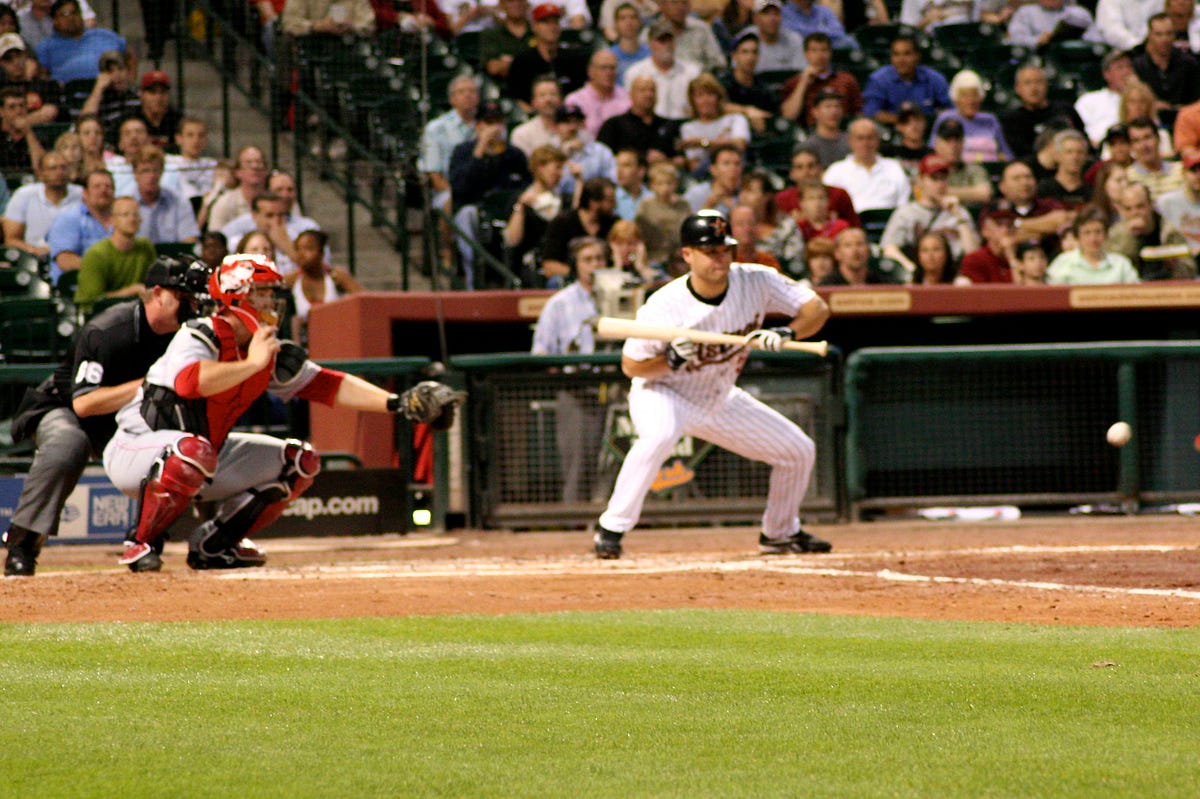
  3. The big, showy actions are rarely as valuable as the small, strategic ones. A baseball hit powerfully for 450 ft, wowing the crowd can earn the same amount of runs — or fewer — than a bunt hit 10 feet in front of home plate at the right time. One is more rare and takes a lot more strength and energy. The other requires preparation, intelligence, and timing, but little power and energy.
  4. When you act is as important as how you act. Swinging 3 tenths of a second early or late at a pitch can be the difference between a successful and unsuccessful at-bat. Time spent getting a feel for timing and conditions is time very well spent.
  5. In many cases, having the discipline to not act is more valuable than taking quick action. The best at-bats for a batter tend to involve standing and watching pitches go by without taking any action. They involve restraint from the urge to take quick and decisive action.

Liked what you read? Get more by subscribing to my once-per-week newsletter — Woolgathering. No spamming, and I won’t flood your inbox.

Hacker Noon is how hackers start their afternoons. We’re a part of the @AMI family. We are now accepting submissions and happy to discuss advertising & sponsorship opportunities.

If you enjoyed this story, we recommend reading our latest tech stories and trending tech stories. Until next time, don’t take the realities of the world for granted!

The 10 Commandments for Con-Artists

And How Honest Folks Can Use Them

Victor Lustig was perhaps one of the most successful and notorious con-artists in modern times. He was persuasive enough to con two different businessmen to “buy” the Eiffel Tower from him (which, of course, he didn’t own). He even pulled off a scam where he got Al Capone to give him $68,000 (in 2016 dollars), for failing at an imaginary investment scheme.

Lustig attributed his success to a set of principles that he called the 10 commandments for con-men. They are as follows:

1. Be a patient listener (it is this, not fast talking, that gets a con-man his coups).

2. Never look bored.

3. Wait for the other person to reveal any political opinions, then agree with them.

4. Let the other person reveal religious views, then have the same ones.

5. Hint at sex talk, but don’t follow it up unless the other fellow shows a strong interest.

6. Never discuss illness, unless some special concern is shown.

7. Never pry into a person’s personal circumstances (they’ll tell you all eventually).

8. Never boast. Just let your importance be quietly obvious.

9. Never be untidy.

10. Never get drunk.

What is interesting about these principles is that in and of themselves, they are not immoral. In fact, one could very easily cite these as a great way to conduct oneself while doing legitimate business, or even just conducting polite conversation in society. And yet, these are the same principles that allowed Victor Lustig to be so successful at conning people that he was wanted by 45 different law enforcement agencies around the world.

A clear lesson to learn here is that there really is a thin line between a strategic business deal and an epic con. That line is basically intent. If you use these very effective principles with the intent to exploit another person, you have just pulled off a con. But if you use these principles with the aim of establishing a good business relationship — with mutual benefit and sustainable give and take — then you’ve conducted a really good business deal.

In general, these principles are like any tool. They are not themselves good or bad — they are merely effective. What makes all the difference is the purpose for which they are used. If you choose to use them with an eye toward fairness, you can indeed go far. But if you choose to use them with the goal of only enriching yourself, at the cost of others, that’s what makes you a con-artist.

So the question to ask yourself is this: am I using my tools in a way that is mutually beneficial, or am I using them to exploit others? The answer you give is what makes the difference between a good business approach and simple huckstering.

Thanks for reading! Consider subscribing to Woolgathering— my weekly newsletter. I won’t try to con you, especially not into buying a national landmark.

The Unexpected Power of a Newsletter

credit: Pixabay

How Writing a Weekly Newsletter Has Helped Me Become a Better Writer, a Better Reader, and Care More About Adding Value.

A few months ago, I launched Woolgathering, a weekly newsletter in which I provide 4 main things:

  1. links to stuff I’ve written (almost exclusively on Medium) in the past week
  2. a brief meditation on an idea that I’ve found interesting
  3. 3 or so pieces that I’ve read online that piqued my interest, and
  4. a thought-provoking quote.

Eventually, I hope that this newsletter could be a small source of income for me — though never at the cost of the integrity of my writing or the sanctity of my subscribers’ inboxes.

In the short-run, however, writing a weekly newsletter has proven to be a positive constraint for me. It has forced me to write more and write better. It has also forced me to read more and better stuff.

To me, hitting “subscribe” on an email newsletter is no small thing. I see the email inbox as a sacred thing. When someone invites my work into their email inbox — like inviting me as a guest in their home — they are trusting that I’ll respect the sanctity of their inbox. That means not flooding them with a bunch of emails, and providing them with something that they’ll (mostly) look forward to reading each week. It means providing them with what they signed up for: something that will benefit them.I take that very seriously.

But beyond the benefit I hope to bring to others, a weekly newsletter has brought benefits to me as well. Here’s a few ways that has happened.

I’m Forced to be Accountable

There is hardly a more effective way to force yourself to stay on track with something than making an external commitment. Once you tell a person — or even better — 100+ people that you’re going to do something, you’ve got some skin in the game. So as my newsletter grows, I’m forced to stay on track. I have a motivation to keep writing, and to write stuff that people really want to read. I’m forced, in essence, to add value — as they say.

Now don’t get me wrong, if the pressure ever causes a conflict with other more important commitments, the choice will be clear to me. But that external commitment that I’ve made keeps me rearranging the stuff that I do every day to make room for this thing — the newsletter that I’ve promised.

Will any of my readers be heartbroken if I don’t push out this week’s newsletter by Wednesday? Maybe, but probably not. Everyone’s busy, and few are monitoring their inboxes for each and every newsletter they’ve signed up for. But the minute I start missing the promised deadline is the minute that I start slowly shedding credibility. I’d like to avoid that as much as possible.

I’m Forced to Find Interesting Things to Read

There is so much stuff published online each day. A lot of it is clickbait, or listicles with really no attempt at originality or provoking thought. But there is still so much written every day that moves thinking forward — stuff that really challenges us or reveals new ideas and mental frameworks to us. That’s the stuff that I try to find — but it’s not easy.

Having to find quality stuff to link to in my newsletter forces me to spend more time actively, rather than passively reading things. It has also forced me to look at more and different channels of information. After all, the last thing I want to do is to send a link to the same HBR or Inc.com article that every other newsletter is featuring.

So I am forced to keep casting my net as wide as possible, in an attempt to bring really writing, and really interesting ideas to the people who have taken the leap to subscribe to my newsletter.

I’m Forced to Stay Honest

Nearly every link I’ve included to sign up for Woolgathering includes a promise that I’ll only be sending one e-mail per week, and that I won’t spam or use my subscriber list as a list of leads for selling random stuff that I’m trying peddle.

As my list of subscribers grows, it would be easier for me to try all sorts of ways to make money off of it — there are courses and books about how to do just that. But doing that would betray the trust of my subscribers. The promise I have made ensures that I always ask myself the question “is the email I’m sending in line with why people initially signed up for my e-mails?”

I’m Forced to Be Helpful

There is only one truly effective business model — only one way to go to market with your thing that is sustainable and doesn’t require all sorts of unnatural maneuvers, pivots, and re-brands: offer something that really helps people.

On that note, each weekly e-mail I send is aimed at helping those who receive it think a little differently and think a little better than they were before they received it. I’m not promising disruption, life-hacking, or miraculous changes — by my estimation, those promises aren’t sustainable, and rarely ever meet expectations anyway.

I just want to provide a slightly different take on things, and some interesting material to read and think about. When done 52(ish) times per year, I think that adds up to something valuable.

I’m Forced to Find Better Tools

I love finding new and better tools to help me do the things that I do often. So now that I’m writing a weekly newsletter, I’ve been forced find the best tools to aid in making that process go as smoothly as possible. A few tools that this process helped me find are:

  • Workflowy. I’ve actually been using this for a long time as my main organizational and productivity tool. I track every project and related next action in my Workflowy document. It helps me to be more structured in my thinking and in my organization.
  • Tiny Letter. This is MailChimp’s little sibling — a stripped-down version of it that offers a simple newsletter writing interface and the ability to send emails to up to 5,000 subscribers. I love it.
  • Upscribe (beta). I recently found this tool, and have begun to love it. It allows you to embed a subscribe form right into a Medium article, so that people don’t have to leave Medium to sign up for a newsletter. It offers integration with other large newsletter apps (like MailChimp), but it also provides a very simple interface for sending out your own newsletter. I’ve been communicating with Josh, one of its main developers, and he has some cool plans for it going forward.

I think this model could work for anyone who is already writing online, and is looking for a way to force themselves to get better. It’s not for everyone, but for me, at least, it’s proven invaluable.

Hey, speaking of my newsletter, consider subscribing. One email per week, no spamming, no selling.

The Dangers of the New Entrepreneurial Mindset

In 1940, author George Orwell published a brief piece in The New English Weekly. It was a review of Hitler’s Mein Kampf. He admits that he understands Hitler’s appeal — not just as a charismatic speaker, but as the orator of something deep and true about our needs as humans:

…human beings don’t only want comfort, safety, short working-hours, hygiene, birth-control and, in general, common sense; they also, at least intermittently, want struggle and self-sacrifice, not to mention drums, flags and loyalty-parades. However they may be as economic theories, Fascism and Nazism are psychologically far sounder than any hedonistic conception of life. The same is probably true of Stalin’s militarised version of Socialism. All three of the great dictators have enhanced their power by imposing intolerable burdens on their peoples. Whereas Socialism, and even capitalism in a more grudging way, have said to people “I offer you a good time,’’ Hitler has said to them “I offer you struggle, danger and death,” and as a result a whole nation flings itself at his feet.

What Used to Pass for ‘Success’

What we used to see as “the good life” — an income, a home, security, and a place in society — just doesn’t do it for us anymore. We also need struggle, danger, and the threat of falling in valiant battle. This need can certainly manifest in positive ways — and in smaller doses. The problem is when it becomes a mode of living, when to wake in the morning is to suit up for the battle, and sleep is not welcomed, but resigned to as something one must do — but would rather not.

Having a struggle can and does fill us with life-affirming purpose — but only to a point. It can go too far, and it has in every generation, but it manifests in different ways throughout history.

In previous eras, young men have been swept up by the rhetoric of warriors and generals to join the effort to conquer this or that people, to exchange blood for glory, to put all of the other parts of the good life on the line for the elusive promise of greatness. Entire populations of men, women, and children have been swept up by the orations of dictatorial leaders, promising them the battle of a lifetime — one in which they will triumph — so long as they place their unquestioning faith and sacrifices at the feet of their fearless leader.

I do not mean to parody this feeling that people get in those situations. When tapped, that need for transcendence and glory is powerful. We’ve all felt it, most of us only briefly. But it is among the most powerful feelings we feel.

However, its power is also what makes it dangerous, because it can blind us to the terrible costs that we can incur by chasing it. We can forget that our lives are built at home, not on the battlefield — with friends and family. We can forget that while the struggle for greatness can give us a sense of purpose, that purpose is limited, and easily falls if the wind doesn’t blow a certain way. We can forget that a warm conversation, a simple meal with loved ones, or a walk outside on a particularly beautiful day provides us purpose as well.

Now We Need MORE!

The problem is this: our human need for struggle and glory is easy for others to tap into. Once they do, it becomes easy for them to coax us into one of many different quixotic journeys. I see this happening with motivational speakers, authors, and life-coaches who talk about hustle, the grind, and putting in long hours to push a business into hyper-growth.

I see it when they build a narrative of human existence that emphasizes the greatness of triumph and sacrifice, while pushing practical wisdom, restraint, and everyday experience to the side. I see it when they encourage us to see anything short of wild success as demoralizing failure. I see it happening as entrepreneurship becomes the new warrior quest for valor.

The dangers of this new mindset are only materially different, but the mindset is the same. The call to sacrifice, the promise of a transcendental greatness, the invocation of spiritual experience — it feels the same, and pushes us just as hard.

The dangers are still severe. Going on this journey, we tend put our other needs on the line, risking real losses in our personal lives. We are moved to quit jobs, withdraw from relationships, and throw away any semblance of balance. Time spent relaxing or thinking (unless you already have the coveted “passive income”) is usually registered as a loss in the ledger of the entrepreneurial mindset. That’s a harmful accounting practice to be sure.

We cannot afford to forget that life is lived in the leisurely moments, just as much — if not more so — than it is in the hustle, the grind. What is more tragic is that as more people build, sell, and close down businesses — looking back at the businesses you’ve built will actually register as less of an accomplishment than it used to be. Yeah, you built a company or two — so did your neighbor, and her neighbor. You all read the same free e-book.

The Side-Hustle of Living

We all do very similar things every day. We all wake up, we all go to sleep. In between, we make a lot of choices — some consciously, but many unconsciously. It is easy to become so wrapped up in the narrative of hustling, creating, and disrupting, that we forget how much joy we can (and do) get from the small things in our lives.

There is glory and a higher purpose in being an entrepreneur, in becoming a great brand, a thought leader, or whatever your hustle is. But don’t let your hustle, your struggle turn into what Orwell warned us about — an altar at which you’ll sacrifice all of the things that make for a really joyful life.

Did you enjoy this piece? Consider signing up for Woolgathering, my weekly newsletter. One e-mail per week, no spamming, no sales pitches.

Sticks and Stones: On the Underappreciated Power of Words

The old adage goes “actions speak louder than words,” and by and large, people seem to buy it. But I’m not sure that I do.

Actually, let me step that back a bit. I believe that actions are what is important. Actions are the things we do that affect other people. Actions move projects and people toward goals. Actions win wars, actions solidify peace, actions make and break relationships. Actions are clearly what make a life, and what make history.

But I believe that words are not separate from actions — words are actions. Writing and speech are actions — and powerful ones at that. When someone tells me their deeply held feelings, or pleads for attention in a way that is sincere and thought-provoking, that is powerful. Those words are actions that move me to feel a certain way, and then to do certain things — to take action. Words — whether printed or spoken — move people. To pretend that somehow that is not as powerful as a person physically moving about is tragically narrow-minded.

In fact, nearly any action that someone has taken that has had any impact can find its roots in words — either words that the person read or that they heard. Look no further than the Bible for proof of this theory.

The Crusades and Inquisition are a blight on the entirety of Christendom. Tens of thousands of people died from violence perpetuated by believers attempting to spread their religion across the world. But ask nearly any Christian today whether that dissuades them from practicing Christianity, and they will likely tell you that the important thing is what the Bible teaches — the words of the book. Those words outweigh the terrible actions that others have taken on behalf of the religion. The words have that power. The actions are brushed to the side.

The same is true of Islam. The words of the Qur’an — the message of peace and spiritual enrichment — outweigh the extreme and murderous actions of those who have killed in its name. The words have that power for those who spend the time with them. Believers believe in the power of those words.

These two examples are instances of a greater phenomenon — the ideal. If you look around, you can see it all over. Ideals are expressed in words, and by definition, not in actions — that’s what makes them ideals. They are not actions, but they pull us and push us more than mere actions ever could.

We live for ideals, we look to the words that put them into place to guide our entire lives. We don’t look to actions for that.

So even if actions do speak louder than words, they say a lot less, and though we may hear them, we don’t listen in the same way we listen to words.

Sticks and stones may hurt me, but words — words give me hope, purpose, and vitality. Sticks, stones, and whatever actions we may take using them will never do that.

Those who underestimate the power of words simply fail to realize something very important about the human spirit. Our spirit lives and dies for ideals — ideals forged in the furnace of words, both spoken and written. I write in order to move, I read in order to be moved.

Let’s move together, subscribe to my weekly newsletter: Woolgathering. One email per week, no spamming, no begging for money.

Writing Is Magical

I write a lot each day. About 12 hours (or more) of my day are spent hunched over a keyboard, clickity-clacking away at some email, blog post, or note. And though I have already written so much throughout my life, I always fee like two things are true:

  1. I need to write more — a lot more. In fact, we all need to write more.
  2. Writing still feels utterly magical. Which is why #1 still holds true.

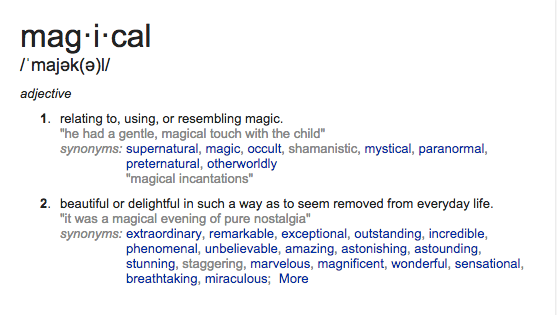
What do I mean when I say writing is magical? I really do mean magical.

The second definition — specifically the portion about being removed from everyday life — is what I mean when I say that writing is magical. When done correctly (by which I don’t mean done well), writing can transform your thoughts and feelings into something more — something powerful. That’s the magic.

Writing Reveals Meaning

We are all living a story, but we’re not all aware of the ins and outs of those stories — both our own and those of others. Writing helps you understand what is happening in your own world, what is happening in the worlds of those close to you, and what all of it means. It doesn’t happen right away — no deep understanding does.

You will have to spill a lot of ink, but if you keep doing it, you will begin to see a clearer image of things come to the fore. Your own narrative materializes. It’s a curious combination of discovery and creation. You see what was already there, but hidden. You also inject something new into the mix. You cut through the thicket to forge a path heretofore untrodden.

Writing Clarifies

My wife watches a lot of true crime shows, which means that I do as well. What I’ve learned from watching these is that interrogation is a useful tool. Good detectives will sit down with a suspect and begin chiseling away at the hard surface they’ve projected. They ask the same questions over and over — and they do so on purpose. They want the truth; they want to understand. But as any good detective will tell you, the best results come when whoever you’re interrogating feels like they can open up to you.

When you write about what you’re thinking and feeling — just like when interrogating a suspect — you will get a lot of false starts. Like someone being interrogated, you will frantically stutter through false narratives about yourself. You’ll prattle on about what you think you should feel, what you think you should want — whatever sounds good. But if you keep interrogating yourself, eventually you will open up. You will have sifted through all the emotional and intellectual noise, pinpointing the clear signal. That is magical, because understanding yourself better — especially after being confused and laying it all out — can be transformative.

Writing Strengthens

Ideas pop into your mind much like infants pop into the world: naked, weak, and unformed. And like infants, ideas need to be nurtured, they need care and attention in order to turn into what we hope they become. Writing provides all of that. It is the swaddling clothing, the feeding hand, the nurturing guide to your ideas. Writing puts your ideas into battle with reality, where only the strongest ones survive — and they are stronger as a result.

I have yet to find a time where I was stuck on how to solve a problem, or what to think about a topic, and writing about it didn’t help. The obvious reason is that writing walks hand in hand with thinking. It lays out your ideas in front of you, in real time, where you are forced to deal with them — to accept, reject, or refine them. Those ideas worth a damn stay, the rest fall away. Wash. Rinse. Repeat. What you’re left with is a stronger set of ideas, a stronger sense of self. You’re still you, but now you know better who you are.

As often as you can, as sincerely as you can: write, think, and write more. Don’t stop until the ideas do…which is hopefully never (or when you die).

Did you enjoy reading this piece? Consider subscribing to my weekly newsletter — Woolgathering. I think you’ll enjoy that, too.

Sometimes, the Answer Really is “No”

And How Not Accepting that Can Cost You

I was at a sales seminar about a year ago, when I heard a piece of advice so stereotypically salesy that I nearly did a spit-take: “you can’t be willing to take ‘no’ for an answer”. Sure it was actually not that candidly said, but distilled down, that was clearly the message being conveyed. I felt like I was being coached by Tom Cruise’s character in Magnolia.

Now, I’ve only done sales for a few years, at a few companies, but I just don’t buy this approach. I think not only should you be willing to take “no” for answer, but you should actually take that approach even further. You should accept the “no” and take advantage of it as an opportunity to teach you something about your approach, about the thing you’re selling, and about the market.

By the way, this doesn’t just apply to selling products or services for money. It applies to anything that you’re trying to convince someone of — any kind of persuasion. It’s easy advice to generalize: if you don’t hear the refusals you encounter loud and clear, you miss a great opportunity for growth — both personally and professionally.

How Did I Fall Short in Selling?

You’re not perfect. Neither am I. You should already know that. Yes, I too was heartbroken the first time I heard the news, but it’s just something we all have to live with. Somehow, though, when we get caught up in that quixotic quest to drive to drive growth in our business or product, we suspend that particular belief while we persist beyond the point of reason to just sell, damnit!

Doing that, however, has two unsavory effects. First, it can land a lot of customers who are not a great fit — ones who are skeptical and who may end up dropping whatever you’re selling like a bad habit very quickly or just never really appreciating what you’ve sold them. Second, it can keep you from understanding what you might need to change about your approach. You can fail to learn things that could make otherwise skeptical customers actually be on your side.

I won’t be the first (or last) writer on this topic to quote Simon Sinek, who said: “People don’t buy what you do; they buy why you do it. And what you do simply proves what you believe.” I’ve found this to be true for the customers who stick with you. If they have truly bought in, you won’t have to constantly work to keep them. Meanwhile, with customers who you roped in with the same old process will be looking for any reason to jump ship, or just never really be engaged.

You should always be looking to make your pitch the kind that gets customers to buy why. When it becomes clear that your approach is not working, that doesn’t mean you should double down. It means that the why isn’t clear enough. So don’t be afraid to take the opportunity to use their “no” as an opportunity to find out how your why isn’t quite getting to them — and what you can do to change that for them, or for future clients.

How is What I’m Selling Falling Short?

Your product or service is not for everyone. Seriously, not everyone wants everything, at least not now. And some people will not be ready for what you’re selling right now. It could be because they don’t have a need for it, or it could be because you need to change something about it. A prospect telling you “no” is a great way to get data on what it is about your company, product, or service that could stand to be changed a bit.

A company that refuses to change itself and what it sells is a company that stands to miss a lot of growth. This is not to say that you should go making alterations to your product or service each time you get feedback. Like I said, your thing — whatever it is — is not for everyone. But at least be willing to understand why you were turned down, so you can catalog the reasons, and look for trends that tell you something you may need to change. Many times it makes sense not to change anything — at least not now. But don’t underestimate the people in the marketplace. You do so at your own peril.

How is the Market for What I’m Selling Different than the Last Time I Made a Sale?

The worst thing you can do is to take a rejection of your sales pitch as a personal rejection. It rarely is. Remember, you’re selling to people who have various forces putting pressure on them. They have limited funds, they have expectations placed upon them for the things they purchase. That applies whether you’re selling B2B or directly to consumers.

In both cases, the biggest external factor that you need to work to understand is the market. When the market changes, it flows into the attitudes of the people who are saying “yes” or “no” to what you’re selling. It changes constantly — now more than ever, thanks to the amount of data flooding everyone’s decision-making process.

When you hear “no”, dig a little to see if perhaps that “no” was more of a “the market where your product exists has been changing, and it made me re-evaluate things.” You’ll want to understand how that happened, and take it back to either alter your product , or at least alter your approach. Again, you don’t need to change anything because of it. But refusing an opportunity to get that data is kind of shortsighted.

Always Be…Willing to Walk

The takeaway here is this: be willing to walk away from a pitch that doesn’t get you the business. But never be willing to walk away without some understanding of why it didn’t work. Being super aggressive will quickly shut the window of opportunity to find that out.

Admittedly, this is harder to do for some business models, and you won’t always be able to get feedback on a “no”. That’s okay. It’s all about two things: (a) respect the potential buyer’s ability to make a decision (b) always be willing to learn from them when they say no — and respect if they are no longer willing to be engaged.

We’re all people who just want to be happy and do a good job — whether we’re buying or selling. Remembering that will help you go far. Forgetting it is going to make things a lot more difficult.

Did you like what you read? Consider subscribing to Woolgathering, my short weekly newsletter. Thanks for reading!

There Is No Self-Improvement if You’re Not Already Pretty Good

credit: Brendan C (Flickr)

If you clicked on this article, odds are you’re interested in self-improvement — personal growth — whatever you like to call it. You want to get better at whatever it is you do, or you want to start doing something new in order to make yourself better.

You’ll find numerous articles around the web that will give you numerous tips, tricks, and hacks with the promise of self-improvement. Many of the tips are really great. Putting them in place and following them strictly can really have a great impact on your productivity, mindfulness, or whatever it is that they promise to improve.

But there’s a catch. There’s always a catch.

The more focused you are on improving yourself, and the more you consume this self-improvement literature, the higher the risk that you will fail to realize the benefits of all that time and energy.

The reason is simple: the more time you focus on what you need to improve, the more time you’re spending looking at what you’re not satisfied with. But here’s the paradox: if you only focus on what you’re not satisfied with about yourself, you give yourself very little reason to put in the effort to get better.

Why is this? Well, think about it in terms of a house. If you were to inherit the home that you grew up in, and it was in pretty bad condition, and you had the choice to restore it or sell it and avoid all the work required to get it back in shape — what would you do?

Your answer depends on how you feel about your childhood home. Did you have a good childhood? Are the warm memories attached to that house? Is it a house that you really love? Or do you just see all of the things wrong with the house, and want to wash your hands of it?

That house is an analogy for you. If you don’t feel good about yourself already, it’s difficult to muster up the energy necessary to put work into improving. Anyone who has ever skated on the outskirts of depression can attest to this.

So here’s my simple suggestion: spend some time celebrating yourself. Not necessarily a huge celebration, but just a quick pat on the back for what you’ve done so far, who you are, and the good heart you have. Just a quick thought or two while you’re driving to work, or cleaning up. Think of what you’ve overcome, think of your strength. Remind yourself that you’re a good person, that you mean well, and that you’re doing the best you can.

After that — after you’ve acknowledged that you’ve done well so far, and that you are already good, then you can get ready to throw all the work into personal growth. You can read the books, look at the courses, and start the new morning routine you read about. You can begin unleashing the giant within, and all that.

But without that first part — without a little self-love — you can’t really hope to make yourself better. So take it step by step. Give yourself a hug.

Did you like this piece? Subscribe to Woolgathering, my weekly newsletter. It’s like a warm hug for your inbox.

Learning Isn’t Collecting, It’s Connecting

credit: Pixabay.com

A Quick Note on How We Look at Lifelong Education

I’ve never been much of a collector. I have a few boxes of comic books in my basement, but they’ve all been read, and most aren’t bagged and boarded. I have exactly three pieces of sports memorabilia. All of the stamps I have are reserved for the snail mail I still have to send out. To me, acquiring a bunch of items for the purpose of having acquired them didn’t put the wind in my sails.

But this is clearly not the case for many people. There are entire industries built around those who collect — those who derive genuine joy from amassing and displaying things and multiples of things. I don’t understand it exactly, but I respect the hell out of it. It takes a lot of work.

Lists, Books, and Collectible Knowledge

Lifelong learning is all the rage these days. Blogs, ebooks, and conferences abound these days with the purpose of providing new and useful information to people. Lists of books to read, blogs to follow, and newsletters to subscribe to are constantly being published. It can be overwhelming on two fronts:

  1. Which books, blogs, newsletters, and courses are actually worth my time? I can’t subscribe to them all! I don’t have time to consume them all!
  2. What am I missing out on? Could a book on a list that I haven’t seen have been the one that changed my life and made me wildly successful? Aaargh!!!!

These are real concerns for those of us who no longer face other anxiety-inducing issues — like where our next meal is coming from. I don’t say this to belittle the feeling. I get it too, from time to time. But I recently realized something that has helped me put it into context, and become less worried about which learning resources I consume, and what I might be missing.

You see, the worries I listed above are not that different from the worry of a really obsessive collector. The concern is more about collecting bits of things (information) and not about making something.

Lumber and Nails are Not a House

That’s the thing. You see, knowledge is not something you gather and collect, it’s something you make. You forge it out of information that you have connected with principles and concepts. So no amount of reading and information consumption will make you more intelligent, if you don’t do the work of making connections, and thus creating a lasting fabric of knowledge.

I think a mistake that we often make is to view learning as collecting, rather than connecting. You collect information, but you can only gain knowledge by connecting that information.

To illustrate what I mean here, imagine that you would like to build a house for you and your partner. You get a list and put on it all of the materials you’ll need: lumber, nails, drywall, shingles, siding, etc. You order it all, as well as the tools you’ll need, and have it dropped in the empty lot where the house will be. You now have all of the pieces of the house, ready to go. But you still don’t have a house.

To have a house requires more than just the materials that constitute it — it requires the work of building. That work is the work of connecting, putting together, supporting, and cutting to fit. Through that work, the materials come together to make a shelter — something that when they were apart, they never were.

That’s basically how knowledge works. You can gather all of the relevant information, organize it in your brain, and get all the tools needed, but without the work of connecting it all, you still don’t have knowledge. All you have is a bunch of information. That’s it. You’ll be great on trivia night, but when it comes to strategy, decision-making, and innovation, it won’t serve you one bit.

So as you get your board out, and follow countless others to surf the rising wave of lifelong learning, remember — don’t seek a collection, seek connections. Therein lies knowledge, and perhaps one day, wisdom.

Seeking wisdom yourself? Try subscribing to Woolgathering, my weekly newsletter. You could do a lot worse!