The Woolgatherer’s Handbook — Selected Thoughts

The Woolgatherer’s Handbook — Selected Thoughts

Thank you for reading. This series contains excerpts from my writings spanning back 2 years or more. They represent what I consider the most useful thoughts I’ve written down and published.

My sincere hope is that you find value in these

For more stuff like this (and not just links to my articles) please subscribe to Woolgathering — my weekly newsletter.

Just because you can do anything, doesn’t mean you should.

Be judicious in what you choose to take on; if it doesn’t fit in the outline of your goals, you probably shouldn’t do it. You’ll end up with a lot of things you just aren’t doing, but now, you can feel good about not doing them.

from “Outline Your Life

You define what it means to succeed.

This is unequivocally true because success is by definition to achieve some goal. A goal is something that is set or accepted by you. Therefore, you decide what it means to succeed.

If you have set impossibly high goals, fail to achieve them, and are a miserable as a result, consider adjusting your goal, at least for now. If the goal was set externally by someone else, and your failure to achieve it keeps you up at night, you’re not off the hook — you accepted and internalized that goal. You can just as easily renegotiate that goal — if you are willing to work at that.

from “Stop Thinking There’s One Simple Trick

What Hacking Gets Us

Hacking is dangerous because we believe we are changing or bending the rules of reality, but we are not.

Rather, in many cases, we are merely shifting around the effort we think we’re saving or settling for a lower quality outcome.

from “Our Dangerous Obsessin with (Life)Hacking

On Comfort as a Motivator

I’m constantly hearing attempts at motivation that tell us to push outside of our comfort zone. To an extent, this is good advice, but it is only part of the story.

If you are constantly outside of your comfort zone, you will wear yourself out, because human beings crave comfort. Rather, strive for a new comfortable — a new normal — but do so in steps.

from “The Power of Ritual

The Light of Possibility

The struggle to change or the struggle to make peace can be the struggles that sow the seeds of great art. But fear — whether fear of failure, fear of judgment, or fear of finding out what’s really down there — must not be allowed to win. When that happens, that light of possibility for true creativity, truly inspired work, dims once again.

from “Listen to the Quiet Voice

4 Mental Habits to Help You Get the Most Out of Your Mind

Some off-the-beaten-path tricks to help kick-start a productive frame of mind

The mind is a powerful thing. The more we study it, the more we see just how much is going on in there, and just how much we can do when we learn to use it well. When we have insight into our own minds we increase our chances of being more productive, and being better people in general. That’s why mindfulness is such a big deal these days.

I’d like to lay out 4 mental habits that I’ve found to be extremely useful in my personal and professional life. They’re like mental models, but they’re more individualized. Taking on just one of these habits should prove very helpful. But if you can do all 4, you’re well on your way.

Don’t BE your thoughts

You are not your thoughts. You’re not the random things that pop into your head, or the knee-jerk reactions you feel to things. The character of a painter is not in her brushes and paints, but what she does with them. In the same way, your character lies not in your thoughts and feelings, but in what you do with them.

We forget this constantly — and it does real damage. We judge ourselves based on the myriad fleeting thoughts and feelings that float through our minds. We build a narrative of harsh judgments against ourselves. We built anxiety, impatience, and a lack of compassion. That spills over into how we treat others.

If you just took a minute to sit alone and merely observe your mind — like a people-watcher sitting on a park bench — it could make all the difference.

Subordinate yourself to something larger

12-step programs have been helping people recover from world-shattering addictions for decades. The first step in each of them has the same basic tenet: admit that there is a power greater than yourself, and to an extent, you’re at its mercy.

This power doesn’t need to be conceptualized as God — though in such programs, it often is. It could just be the swirling momentum of reality as a whole — which has been churning since long before you were born. In fact, you should try to define it as little as possible.The more defined your idea of what a higher power is, the less effective it will be in modifying your outlook and behavior.

The point in this act of subordination is to do two things:

  1. Take the pressure off of yourself — you can’t control everything — nor should you.
  2. Transform your preoccupation with yourself into awareness of others and your overall environment.

To get out of your own head, and to get out of your own way, is key to a balanced life. That starts with moving the spotlights off of yourself.

Cleanse consistently

Most of us have a lot on our plates. We get demands and requests all day long — from work and from home. That stress mounts up, even if you’re not conscious of each piece, and it has an effect on you. It is a psychological buildup — like gunk in an engine. That’s why you need to cleanse consistently.

In order to really do any kind of important work, you need to be able concentrate on it. But when you retain all of the mental residue of stress, undefined tasks, and expectations, concentration is hard to muster. So being able to cleanse that away becomes important.

Greg McKeown wrote an interesting piece where he suggests a simple exercise: sit down at your desk (or wherever), and take three deep breaths. Stay conscious of those breaths. Then go back to what you were going to do.

Just those 3 breaths can be extremely helpful to cleanse the mental gunk that keeps you down during the day. It’s truly cleansing. With a clean mind, concentration is more easily at hand. With concentration comes better work.

Work with thoughts, rather than ideas

Ideation is a big deal nowadays. Being creative and innovative is important in pretty much any role you might find yourself. Being able to come up with great ideas that change the game and solve tough problems is the best way to advance your career, and your own personal growth.

But coming up with ideas is difficult. That’s largely because of the mental baggage that we carry around regarding ideation.

Here’s a suggestion: change the directive. Rather than tasking yourself to “come up with ideas”, task yourself with something that carries less baggage, like “exploring your thoughts”.

It may sound silly, but the term “idea” carries a lot of weight — the weight of expectations, of ownership, and of value judgment. Ideas can be good or bad. Furthermore, an idea implies ownership (whose idea was that?). Ideas are expected to initiate further action(make this idea happen!).

Thoughts, on the other hand, have little of that same weight. Consider the phrase “it’s just a thought”. It’s usually brought up in a benign, less intrusive way. Thoughts just pop in and out of our heads — we’re not married to them. Furthermore, no one blames people for just having a thought.

Your mind is a sensitive thing, and it feels the difference between the presence and absence of all the baggage that words and concepts carry. It matters what words you use, and what words you use to think about things. So when you sit down, take a breath, and just search and record your thoughts — you might be surprised at how many of them you have about a given topic. Collect those thoughts now, then work with them and evaluate them later.

Go Forth and Implement

Some of these 4 habits may seem small and almost semantic in nature. But that’s exactly why they can be so powerful. The small nature of the change makes it easier to implement and sustain. The longer you sustain it, the more the benefits compound. They become part of your standard mental operating procedure. You continue to reap the benefits.

If you like this piece, please consider subscribing to my weekly newsletter — Woolgathering. You can get more valuable stuff like this — once per week in your inbox.

What Has Free Speech Done to Us?

Effective Speech in the Age of Constant Speech

In the United States, the first amendment to the constitution guarantees — among other things — that congress shall not enact laws that restrict the free speech of the people. For the past few centuries, the freedom of speech — in both spoken and written form — have been highly valued by people not just in the U.S., but around the world.

Recently, a big deal has been made about an agitator who lost a book deal about some unabashed commentary regarding pederasty. I won’t dig into the story itself (you can read the link), but the whole thing has made me wonder why we value free speech. I guess like so many of our freedoms, I wonder if it has morphed into a crutch that allows us to be utterly terrible and careless people, rather than making us better.

So here I am asking two questions:

  1. What value do we see in free speech?
  2. Does the current free speech paradigm serve the value we see in speech?

The Proposed Value of Speech

In the world of liberal democracy, freedom in general is a cornerstone value of any society. People ought to be free to live their lives in the best way they see fit — with as little interference as possible. In the case of speech, I think that the reasons that we value free speech fall into two basic categories:

  • We value the freedom to express ourselves — how we feel, who we are, and what we want.
  • We value the freedom to effectively drive change through the things we say. We want our words to matter, and to wield real power — the power of making things happen.

I think that the article of faith, especially in America, for the past 200 years or so has been that both of these aims work together. We have blindly believed that expressing how you feel and what you want end up effectively driving change and giving power to your words, and to you, the speaker. But I see very little reason to believe this.

In fact, I believe that expressing yourself as freely as possible tends to diminish the ability of your words to drive real change. To see why this is, we need to examine the relationship between speech and power.

The Dynamics of Speech and Power

Speech and power are related, but the relationship is more complicated than we often think it is.

The power of speech can come in two ways:

  • the speech is backed by physical or systemic power (laws, social structures, military, physical strength, etc.)
  • the speech itself is powerful due to its message and its delivery

At the level of everyday interactions — personal and professional — the more frequent and unrestrained your speech, the less likely it is to be effective in anything more than the short term. The less effective your speech is, the less power you retain.

Everyone has some level of power. They have the power to influence others, and drive change. That power has never been equal among people. Belonging to a certain group or class of society automatically gives certain people’s speech more or less power. But power can be gained based on how you say what you say, when you say it, and to whom.

How you deliver a message is of the utmost importance. Some people or organizations are not ready to hear a certain message. So if it is to be delivered effectively, it needs to be done with that in mind. That is where the two motives for expressing yourself work against each other.

The more your message is expression — of your feelings, desires, or other emotion, the less likely it will be received by those who have reason to fear it. Just think of how much you have gotten done by yelling and venting your frustration at people, as opposed to sitting them down, and trying to make your point calmly. The more you frame your speech as expression, the less effective it will tend to be at achieving any other goal aside from expressing your feelings.

Making Speech Work

Whenever your defense of what you say is “I have the right to free speech, I can say this if I please” — you’re closing off 80% of the probability of having a real conversation. That’s fine if you don’t want to push through change; if you’re just trying to vent. But making change, unless you already have tremendous power, requires a conversation.

A conversation requires at least two engaged parties talking on common terms, and both staying engaged. Yelling loudly over others, and not bothering to frame things in a way they might find digestible is never going to keep anyone engaged. Free speech that involves yelling slogans, taking shots at the opposition, and being unwilling to yield in order to allow conversation — that’s merely expression, not a push for change.

If you wish to have your speech affect real change, your defense shouldn’t be “I have the right to free speech, I can say this if I please”. Rather your defense should be “what I am saying is really important, and here are some reasons why it would benefit you to listen to me.”

When we fail to convey to those who disagree why they should listen to us, we show ourselves to be quite conversationally stupid. This is especially true if we think the other party is selfish and ignorant. If we really think that the other party is selfish, it’s even more important to convey why our message is important for them — because that’s what they’re most interested in!

You Either Value Your Speech or Your Cause — Not Both

Ultimately, if you’re not merely using speech to express yourself, but to promote a cause, you have to choose whether you value that cause more than speech. What I mean is this: there are myriad ways of arguing for your cause. If you really value the cause, the speech that you use to push for it should matter little.

If you really believe in your cause, you should be 100% willing to change your message — so that it is as palatable as possible to those who disagree with you. If your goal is changing hearts and minds, then using abrasive and abusive statements won’t do that. Neither will casting blame, caricaturing, stereotyping, and other tactics.

If your language is abusive and abrasive, it won’t work. So what happens is, you end up doing one of two things:

  • you end up abandoning or diminishing the cause that motivated your speech because you care more about what you said than whether it effectively promotes your cause
     
    OR
  • you end up having to use force to achieve your goals. In that case, you would have been better off to use force in the first place.

My take is this: social media has made it easy for us to favor one motivation for speech (expression), while weakening the other (conversing in order to affect real change). Because more people are seen as simply expressing unfiltered emotion, very few on the other aside care to listen.

The more everyone continue to do this, the less we listen to each other. We stop talking with each other, and keep talking at each other — yelling, as well. The chances for any kind of progress fade away.

I’m no futurist, nor am I a social scientist. But I am genuinely interested in how exactly we as people will keep communication intact. Oddly enough, the ability for more of us to speak more often seems to have done more to dismantle communication than keep it intact. But for some reason, I still have faith.

Thanks for reading! Did you dig this? Did it bring a little value to you? Subscribe to my weekly newsletter — Woolgathering. One email per week to provide a little bit of insight in your inbox.

When Goals Become Limits

How Our Ambitions Might Just Keep us From Our Potential

From the time that I was 6 years old, I knew what I wanted to do with my life. I wanted to be an artist. I would sit down at the little table in my parents’ living room every day, break out the pencils and paper, and go to town.

Art was my passion. I had laser-focus on it all through grammar and middle school. My parents fully supported me, as well.

That passion lasted clear through high school — where I enrolled in the Art Advanced Placement curriculum. It was overwhelming. I was among 25 of my peers, who were all also passionate about art. They lived and breathed it, as I thought I did.

But they were all much better at art than me.

A Goal Can Be Destructive

Every day, I’d go into art class, look at what my peers where producing, compare it to what I was making, and be totally embarrassed. My teacher obviously noticed as well. When we would all put our work up to critique as a class, mine was clearly either rushed, incomplete, or showed little polish or refinement.

One day, she took me aside to talk. She started by telling me that she didn’t think I was putting in all the effort I could on my art. She was right; I wasn’t. And I knew it. But rather than scolding me for it, and encouraging me to knuckle down and get to it, she pivoted.

She said that she thought I was really good during critiques. I offered great analysis of the work, and gave useful insights about meaning and themes. She told me that I should consider writing about art, rather than expending all my energy trying to make it.

I was wrecked. All I heard was that I was failing. My classic Midwestern upbringing told me that I simply had to work harder, keep pushing, and I’d get there.

So that’s what I did, and it got me absolutely nowhere for 2 more years.

I entered college as a visual arts major, and became and even smaller fish in an even bigger pond. Nearly everyone in my classes was more talented than I was. They appeared to spend more time on their work than I did. When we displayed our work for critiques, it was the same story for me as it was in high school: my work was below the pale.

Once again, when I talked during critiques, I could go on forever talking about themes, connections, message, and technique. I like it, and felt right doing it.

Once again, I was sent a message.
A classmate of mine — who was supremely talented — commented to me that he always enjoyed when I spoke up during the critiques. He said he loved not only what I had to say, but how I said it. He asked if I ever thought to write my thoughts and turn them into something.

I laughed, shrugged off the compliment, and moved on. Again. I was failing at my goal, and told myself to just knuckle down and keep working harder.

A Failure, and a Crossroads

My sophomore year came to a close, and my “knuckling down” efforts yielded few results. I began to fall behind in completing assignments. My grades in art classes suffered.

Finally, I hit bottom. I failed my illustration class — the class that was essentially my major. I failed it hard.

I was at a crossroads. I was failing at the only goal I had ever had. Every piece of folksy advice I could remember told me to just persevere — work harder, keep dreaming, and I’d prevail. And the fact that I just couldn’t do it made me feel terrible — in so many ways.

Luckily, at that exact time when it was all falling down around me, I received the same message that I had been given twice before. I had heard the advice twice, and ignored it. This time would be different.

My roommate at the time — who was my best friend growing up — told me that he always thought I was crazy to put a fence around myself so early. His thought was that college was for finding out what your thing is, not for cementing the thing you came in with.

It’s Not About Change, It’s About Discovery

What a thought — one I hadn’t ever considered. I changed my major then and there, and never looked back.

It took another 10 years before I realized that though I had chosen a new major — Philosophy — I didn’t have to follow the career path that everyone else was following. I didn’t have to get my PhD and teach classes at a university in order to do what has always been in my heart. That wasn’t what I was after anyway. At a deeper level, I was searching for truth, for wisdom. Then job was just a neat and clean societal construct, but only one way for me to do that.

When I decided not to pursue teaching, largely because there’s an uncertain future for it, I was forced to ask even more fundamental questions about what I wanted to do. Forced into a corner — having quit on 2 goals — I finally discovered the foundation of what had been driving me the whole time: I wanted to think and write about the fundamental truths of our reality.

Any goal that I had formulated before this discovery — be it making art or reading and writing a specific subject in higher education — had merely been a constraint. I only needed to think, read, and write. That was what moved me. That should have been the goal — to continue to be moved by the need to explore the depths of our reality, not some narrow fabrication of our social norms.

Goals Should Be Fluid

My point is this: goals can actually limit us. They can keep us from reaching our full potential. The more we laser-focus on a goal, the more susceptible we are to the kind of tunnel-vision that tunes out useful advice about how we might benefit from changing direction. That advice has made all the difference in my life — twice. Luckily for me, I was able to open up to it.

But for so many others, the advice they have given themselves is to persist in chasing their goals, no matter what. The problem is that when your goals are so specific that they don’t allow you to veer off the path a bit, they become impediments.

A goal that is too rigid and too specific is little more than a self-constructed prison. It only serves to suffocate the spirit. To really find out what it is that you need to be doing, you have to look past the things that we’ve constructed to box-in people’s visions — jobs, roles, companies, etc. You have to look at what moves you at the most basic level. When you find it, there are numerous ways that you can have it manifest — in many different jobs, roles, and places. If there is a limit, it’s nothing below the sky.

Did you find this helpful? Consider subscribing to my newsletter — Woolgathering. One email per week, with stuff you can use. That’s my promise to you.

Less, But Better

“Black Suprametic Square” by Kazimir Malevich. Credit: Tretyakov Gallery

6 Forgotten Aspects of Minimalism

Minimalism — like so many movements — began with the arts. But it certainly branched out from there. During the past few decade, minimalism has earned an enthusiastic following, fueled by the proliferation of lifestyle-based websites and publications.

The term is now used as as ubiquitously and liberally as “vintage” was in the early 2000s. It has become a favored marketing tactic to tack on the word “minimalist” to the front of its name. Of course, this misses the point of minimalism. That’s probably clear to most people with any kind of awareness of what the term means.

Perhaps the best single phrase to convey the spirit of minimalism comes from Dieter Rams, who was the Chief Design Officer at Braun from 1961 to 1995:

Less, But Better

That’s the thing about minimalism: it’s about both minimizing and maximizing. It’s about minimizing stuff and maximizing quality. It’s about getting more, but from less — about staying focused on purpose, function, and essence.

Below is a list of what minimalism means to me, as I understand it. My hope is that it helps further the understanding of a valuable way of thinking.

  1. Minimalism isn’t just about fewer material things, it’s about fewer desires, fewer commitments, and less anxiety.
    It is all well and good to adhere to minimalism regarding material goods, but if you merely replace your hoarding of material things with a hoarding of experiences (trips, gatherings, etc.) the result is the same: dissatisfaction.This dissatisfaction comes from having too many desires, and the fact that inevitably, many of them won’t be satisfied. 
     
    Minimalism has to also be about minimizing what it takes to satisfy you. That means actively working to close the gap between how you feel now and how you want to feel. This may entail getting rid of stuff; it may not.
  2. The goal of minimalism is more about quality than anything else.
    Most of the time, minimalism entails getting rid of stuff, and that makes sense. The source of a lot of anxiety is accumulation — be it the accumulation of physical stuff or the accumulation of unaddressed thoughts and feelings. So naturally, a purging operation can often be healthy. However, a continued obsession with getting rid of stuff and tidying up can be harmful and betray the spirit of minimalism.
     
    It bears repeating that the goal of minimalism is not necessarily to have less stuff (after all, less than what? “Less” is a relative term.) The goal of minimalism is to have only stuff that adds value to your life, and nothing that doesn’t. So if you become obsessed with purging and tidying, you end up with one more impediment to being at peace, because you now have a desire to be tidy all the time — which is difficult to keep fulfilling. That’s not helpful.
  3. Minimalism is about avoiding ostentation.
    Many minimalists have embraced the phenomenon of tiny houses. Extremely small houses are fine, so long as the goal is not to show off how tiny and isolated one’s house is. Also, if you have to contort yourself and your lifestyle and pour more effort into your daily life just to make a tiny house workable, perhaps that’s not quite minimalist after all.
  4. Don’t focus only on the means, and miss the end. Minimalism is not an end in itself. It’s a tool to get better quality by allowing more time and focus on fewer things. Anything else becomes a kind of minimalism pornography.
  5. Minimalism does have an aesthetic, but it’s more of an internal one. 
    Minimalism has a definite aesthetic element to it. Many minimalist designs are really cool to look at. But that external aesthetic is only a piece of the pie, and a small one, at that. Minimalism requires an internal aesthetic as well — a way of being that involves centering yourself and being focused and present. 
     
    On what? You may ask.
    On what brings value.
  6. Real minimalists probably don’t even call themselves minimalists.
    Rams didn’t often use the word “minimalism”. In fact, he didn’t spend much time at all describing his approach at a meta level. He simply laid out principles for better design, and lived by them. 
     
    In the same way, I imagine that the more time a person spends talking and writing about how minimalist they are, the less they are really being a minimalist. That’s not surprising. Telling is not showing. And talking more rarely means you’re saying more.

If you enjoyed this, please consider subscribing to my once-weekly newsletter — Woolgathering. You’ll receive one email per week (no more) with some interesting stuff. I think you’ll like it.

Why We Never Feel Successful Enough

credit: Pixabay

On the Inner and the Outer Scorecards, And How We Measure Ourselves

Of my many shortcomings, one of them is surely that I care quite a bit what other people think of me. In fact, there are times when I care too much about what others think of me. So much so, that I make decisions based on how others might view me, rather than my values or priorities.

In his book The Snowball, the oft-quoted Warren Buffett poses an interesting question:

The big question about how people behave is whether they’ve got an Inner Scorecard or an Outer Scorecard. It helps if you can be satisfied with an Inner Scorecard. I always posed it this way. I say: ‘Lookit. Would you rather be the world’s greatest lover, but have everyone think you’re the world’s worst lover? Or would you rather be the world’s worst lover but have everyone think you’re the world’s greatest lover?’ Now that’s an interesting question.

Interesting question, right? Most of us — myself included — want both of these things. We want to be smart, productive, fit, etc. — but we also want people to see us that way as well. In fact, often times, we will place way more emphasis on people thinking we are doing well, then on actually doing well.

What drives this? Well in part, our own tendency to jump to conclusions on limited data makes us think that how others appear tells the whole story. But that’s a mistake.

Front Stage and Backstage

A great illustration of this comes courtesy of Ross Grant:

Social media has made access to other people’s lives incredibly easy for us….Never before have we had this kind of ability to broadcast what’s going on in our lives to the entire world with the click of a button.

BUT WE MUST REMEMBER, what we are seeing is ONLY a person’s ‘front stage’.

Behind the scenes that person’s ‘backstage’ is no doubt just as chaotic, if not more so than ours….
As human beings, we forget this — we only see the ‘front stage’ and fool ourselves into thinking that the person who shouts the loudest about success must have a wonderful life.

I make this mistake all of the time. I am constantly looking at other peoples’ front stages, and judging my own backstage against that. Other people seem to have it together, have confidence, and float through life. But that’s their front stage. I have no idea what’s going on behind the curtain of the appearance they curate for the public.

When you think about it, it’s impossible to see your own front stage as others do. You can look at all the pictures and videos of yourself that you like, but you will always insert your in-depth backstage knowledge in your assessment. It’s like an editor watching the film she worked on. As good as it looks on the screen, she can’t help but remember how messy it all was. She’ll never see the film like the fresh-eyed audience does.

Living Internally

So we can’t really benefit from trying judge how we’re doing by looking at others. We also shouldn’t worry so much about what others think about how we’re doing. Success, it seems, is more internal than external. It’s not about whether you’re running as fast and keeping up with others. It’s about whether or not you’re hitting the mile markers that you’ve mapped out for yourself.

What’s more, when we’re making a map for our lives, we have to strike a delicate balance when figuring out our intended destination. To a certain extent, we can’t avoid relying on others to help us map out our life’s journey. But we can’t rely too much on others, because when that happens, we lose our internal guidance — which is what Buffet was talking about.

In a sense, when we live by an external scorecard, it’s like being the driver of a car and allowing every passenger to shout directions at you — and you follow them all. If you figure out where you’re going, and learn to trust your sense of direction, you need not listen to the backseat drivers. Know where you’re going, how you’re going to get there, and keep your eyes on the road. The backseat drivers can shout directions until they’re blue in the face, but you aren’t listening to them.

Yes, it’s easier said than done. It always is. But it’s important to read and write about the hard things. It is hard to live by a completely internal scorecard. It is hard to remember that what you see in public is not how people are in private. But you need to remember these things. So I’ll repeat them, in a list — because we love lists, don’t we?

  1. Live by an internal scorecard, rather than an external one.
  2. Don’t compare what people look like on the outside to how you feel on the inside.

Simple enough.

Did you find this helpful? Consider subscribing to my newsletter — Woolgathering. One email per week, with stuff you can use. That’s my promise to you.

What Most Productivity Advice Misses

credit: ISAW

I’ve been reading and writing about productivity for a few years now, and in that time, I’ve seen a lot of the same general advice recirculated in different ways. The formula tends to be the same.

In most cases, an article about productivity proceeds by assuming that you have a series of things on a to-do list, and attempts to educate you on how to do them. The problem, though, is that for most people presenting them with the how is never going to be as effective as presenting them with the why.

To take it further:

We’re never as productive as when we feel a deep, internalized push to get something done. The only way that can happen is by coming to truly care about that thing.

But caring is a tricky thing; it’s not easy to come by. You can’t force yourself to care about something, in the same way that you can’t force a willful toddler to eat broccoli that she is refusing, tight-lipped.

Rather, you have to be gentle, nurturing, and clever. You have to approach things with a kind of psychological agility. You have to ask questions, reveal motives and motivators, and leverage them. That kind of thing is a spiritual venture. All I mean by that term — spiritual — is that part of one’s life that isn’t superficial and public. It’s that deeper, private part of a person — the motivating part, where the passion and purpose come from, and where they live.

Making it Meaningful

But that’s the thing about modern approaches to productivity. It seems to me that these approaches are mostly about tools, organizational methods, or morning routines. But very little of it involves a spiritual element. So much of modern productivity advice floats atop that superficial layer of tools, tips, and tricks. And those things have their uses, for sure. We can all use those types of things to give us small boosts. But that’s what they give us over the long term — small boosts.

Even the productivity writing that isn’t about the tools and routines is about leveraging psychological findings. But the problem with that stuff is that it’s not individualized — it’s not meaningful to us as individual people. It’s just aggregated data, molded into folksy maxims about our behaviors — with hypotheses about our motivations.

So, yes, the latest “backed by research” findings might be useful. But in order to even do anything with it, you have to sit down and figure out how it meshes with your lived experience of productivity.

Just because psychologists at Stanford found that hungry people got more math questions right than people who ate chocolate cake doesn’t mean that fasting will work for you. Even if it does, how much it will work for you will depend on how you connect with your tasks, projects, and goals at a deep level. No lengthy list of tips about how to be more productive can make up for one that lacks depth.

Getting Deep

So how do you get depth? Unfortunately, that takes work. It’s the kind of work that you can’t do if you’re too busy just checking tasks off of a list, or looking at spreadsheets full of goals. It’s the kind of work that requires thinking, and the thing about thinking — truly, deeply thinking — is that we have been trained by productivity porn to avoid it, because the’re not immediate output.

Also, beyond our productivity mindset discouraging deep thinking, we also have been trained to avoid questions of a more existential bent — the ones about meaning, purpose, enrichment, etc.

Sure, there are plenty of puff-pieces talking about being authentic, and cultivating mindfulness, but the questions of what that authenticity means, and where that mindfulness should get you are left open. And very little is said about how we might go about answering them. But we have answer them. We have to find deep meaning among the piles of other things in our everyday experience. If we don’t, the things we get done won’t matter a bit.

How do we do that? How do we find the meaning? I happen to have a few ideas:

  1. Put aside the very alluring desire for immediate results. Momentum means nothing if it is momentum in a direction that’s not worth traveling in.
  2. Change your mode of thinking from thinking about the results of what you’re doing to the meaning of what you’re doing. This means thinking about how whatever you’re doing enriches and connects with you as a person — i.e., at a more spiritual level.
  3. Suspend your focus on metrics and quantifying in favor of qualitative evaluation. Focus on how tasks and projects make you feel, what they mean to you, in what sense — if any — they fulfill you.

Make no mistake. This isn’t fluffy stuff to be cast aside by driven, results-oriented people. Getting into the spiritual realm of productivity yields real results — in fact it’s the only way to get lasting results. But it takes overcoming our bias toward short-term busyness that feels like progress.

That is the hard part, but as I hope I’ve shown, it’s worth doing.

Did you find this helpful? Consider subscribing to my newsletter — Woolgathering. One email per week, with stuff you can use. That’s my promise to you.
Success Through the Positive Self-Interview

How Talking to Yourself (Really!) Can Help You Do Great Things

One of the hardest things that I’ve ever had to write was the writing sample I had to submit with applications to graduate schools. I had about 2 months to produce 20 pages of high quality academic research and writing — mostly from scratch, and on my own.

If the writing was good enough, it would be the determining factor in whether I got into a good program. The pressure was on.

Thousands of other applicants would be submitting pieces of polished writing backed by years of research and collaboration with renowned experts in the field. I had been out of college for a few years, and didn’t have that same benefit. I would need to quickly work through my ideas — very complex ones — all by my lonesome. It was a tough mission.

When You Have to Really Perform

At the time I was doing this, I also worked a full-time job, which required my attention for 10 or more hours per day. I had to sneak in time to write whenever I could. So I woke up at 4 am every weekday, and went to the local coffee shop to write for a few hours before work.

For a while, I had momentum and passion on my side. But as with anything, once I got deep into it, it got more difficult.

As I trudged along, I hit the inevitable roadblocks that one reaches when writing something with a significant emotional investment. I began getting confused about the focus of the paper. I began second-guessing my thesis. I started to move paragraphs around, cut sentences, and chop everything up.

I got lost. And the more I wrote, the more lost I became. I started getting frustrated. I wasn’t sure how to break through.

Try Something Crazy

One morning on my drive to work after a long writing session and feeling stuck, I did something a little crazy — I talked to myself.

More specifically, I began to talk out loud about what I was writing, as if I had already completed it, and was being interviewed about how successful it was. The interviewer (me) asked about the idea, what made it so revolutionary, and how I came to write something so good. And I would answer, acting as if I had written this paper, and it was so good that it received wide recognition and praise. Pretty crazy, right?

Here’s the even crazier part: it worked!

I found that not only did I start to gain clarity on my writing topic as I talked through it, but I also came up with all sorts of solutions to problems I was having. The simple act of talking about something — especially to yourself — helps you to distill complex ideas down to their essences, and solidifies your understanding of them.

But the most important element that helped me was the aspect of positive imagination that accompanied my self-interview. I wasn’t merely talking through my ideas; I was explaining my writing as if it were finished, and as if it had been successful. I was essentially interviewing myself about having done what I wanted to do.

Why It’s Crazy Enough to Work

I want to be clear that this approach is not just effective for writing. It also helps for any kind of project — personal, professional, material, or spiritual. Talking in imagined positive retrospective has a real power. It’s like tricking yourself into the mindset of someone who’s already done the hard thing you’re trying to do. The longer you talk about it as if you’ve done it already, the more you benefit psychologically.

This is also not anything new, but more of a twist on a well-tested approach to productivity. It’s really just outcome-based thinking put into action. Numerous productivity and development gurus have promoted what Stephen Covey called “beginning with the end in mind”.

Really, this self-interview method is like beginning with the end in heart and in words. You act is if you’ve succeeded already, and begin talking about it. It gets you in an accomplishment mindset, and it also helps you to better understand how you’re going to succeed from where you are now. It embeds that in your mind.

How You Can Do It

We all talk to ourselves, but the problem is that most of it is negative, and it’s only focused on the past or present. It’s also not usually out loud, and if it is, it’s more you scolding ourselves than having a dialogue. So to harness the effectiveness of talking to yourself, it’s important to change your approach.

The next time you’re by yourself — in the shower, driving somewhere, anywhere private — pretend your’e giving an interview about your success. This shouldn’t be difficult; we’ve all seen or listened to interviews. Just mimic that structure. Really commit to the part.

Ask some initial softball questions of yourself that interviewers normally would: what got you interested in the thing you’re doing? what gave you your inspiration? how did you overcome challenges to get where you are? What is your big idea, in layperson’s terms?

Continue down that path, and really spend time as the interviewee answering the questions. Mimic the confidence and sense of accomplishment that you’ve heard in interviews. Talk with confidence and enthusiasm about how you pulled it off, about your inspiration, and so on. You will likely find that this way of talking about things gets your attitude to be more positive pretty quickly.

You’ll probably hit a few stumbling blocks — especially when you try explaining your idea(s). If you’re trying to write a novel, you’ll probably stumble trying to talk about themes, the plot, and characters in simple sentences. If you’re trying to get a startup off the ground, you’ll probably stumble talking about what the simple differentiator and value proposition of your company is. That’s fine. Pause, begin again, and try to talk through it. But keep that confidence. Remember, in this imagined scene, you’ve already succeeded, you’re just trying to find the words to explain it.

Bring It All Together

For many of you, this self-interview will feel weird at first. But as long as you’re by yourself, just allow yourself to feel safe. Really invest in it. If you do, you’ll find that it works. Then you’ll keep doing it, and it will keep working. So here’s a quick summary:

  • To help get over hurdles on tough projects or goals, harness the power of talking to yourself in a positive context.
  • Pretend that you’re in an interview after having succeeded, and you’re being asked about why and how you did it.
  • Really commit to the process, and think through your answers. Don’t be afraid to pause and start over.

Does this seem too crazy to you? Well, it all depends on how much motivation you need. And really, what the hell else are you doing in the shower, or on your drive to work?

Did you dig this? Did it bring a little value to you? Subscribe to my weekly newsletter — Woolgathering. One email per week; insight as a service.

Times Like These

credit: Bill Morrow

Or: Mountain Time

It’s 11pm Mountain Time here in my hotel room in El Paso. I’m a literal stone’s throw away from where a wall will supposedly be soon built. Dizzy Gillespie’s “All the Things You Are” emanates softly from my phone’s speakers. I’m still not used to Mountain Time.

It’s times like these that I can do nothing but ponder — swimming through a Jello-dense sea of thoughts and feelings. Movement is so slow and exaggerated.

It’s times like these that I feel the profundity of life — not of events, people, the future, or anything specific — but life as its own thing. It’s unlike anything else, for both better and for worse — depending on who you ask, and when.

It’s times like these that I wonder why I feel the need to write about this hodgepodge of whatever has heaped itself into my mind. Times that I wonder if I’m actually doing anything at all as I write, or if perhaps I’m just on hand for this thing that is happening. I’m never quite sure.

It’s times like these that I wonder about writing. I wonder if it isn’t just the closest thing we have to what we believe gods do. I wonder why I still don’t believe in a soul. I also wonder why as I write this, I kind of do.

It’s times like these that I also wonder about time, and then I think about writing, and how maybe we’re throwing sentences and paragraphs as nets to capture, tag, and domesticate time. Maybe we’re all on safari.

It’s times like these that I wish there were more times like these. And that I understand that if there were, I wouldn’t care about times like these.

If you enjoyed this, please consider subscribing to my weekly newsletter — Woolgathering. I try to put some insight in your inbox, and never spam you.


The Writing Cooperative is a community of people helping each other write better.Become a member to join our Slack team, get fresh eyes on your writing, and participate in the 52-Week Writing Challenge!

No Goals, No Passion, No Problem

A Values-based Approach to Growth and Development

I see a lot on the web about goals and passion these days. Nearly every piece of writing about personal development talks in terms of goals and passion. Companies and people sell books, courses, and coaching structured around helping you realize your passion and set and achieve your goals. But something strikes me as missing in all that.

Yes, passion is useful to have. It is the driving force that pushes people toward things. But passion can be misdirected — and it often is. Nazis are very passionate people, as are religious extremists who declare holy wars. On the less egregious side, people can be passionate about metrics that mean a lot now, but matter little over the long term. So passion is really only part of the equation.

The same is true of goals; they’re also only part of the equation. Again, nazis and violent religious extremists have goals — they’re just utterly terrible ones. Lifelong underachievers and procrastinators also have goals — probably way more than most people.

As I see it, the problem with passion and goals is as follows:

  • Passion just pushes you in some given direction. The problem is, that direction can be the wrong one, and it can also change based on your whims. Passion alone is merely a powerful engine that push you very speedily in tight circles.
  • Goals are just things you want, but there’s no guarantee that goals don’t conflict with your actual needs, or the values you practice.

That brings me to the missing piece I referred to earlier: values.

Values are the things that you hold dear — that matter to you the most. They’re not goals because they’re not things you’re working toward. They’re also not passion because passion is an attitude, not a principle. Also, values require a more rational and calm approach than passion affords. A value is something you live by, and live for. It has the power to guide actions and provide the foundation for relationships. A value is what’s behind trade-offs and compromises. And if a goal or a passion conflict with a value, the value will win out every time.

What I am proposing, then, is pretty radical: toss away goals and passion (for now — you can go back to them shortly, though in a different way). Rather, adopt a way of living that is value-centric, and the rest will follow.

But what does that involve? A really great piece in Forbes by Harry M. Jansen Kraemer Jr. gives 4 principles that underly a values-based approach to life and leadership. I’ve put my own spin on his elaborations below.

  1. Self Reflection: Perform and continuously perform an honest, fearless, and searching exploration of what you really think, feel, and care about. Use it to calibrate and get your bearings. Arrange your life and efforts around what you find there.
  2. Balance: You must be able to see things from various perspectives. Open-mindedness is critical to development — personally and professionally. The more rigid you are, the more you’ll miss out on.
  3. True Self-confidence: More than acknowledging your strengths, true self-confidence is about knowing your weaknesses, and working on them continuously. The focus is on knowing that you’re a good and worthwhile person, but striving always to get better.
  4. Humility: Keep things in perspective. Your successes don’t make you superhuman, and your failures don’t make you unworthy. Treat everyone like they’re the one person you have to talk to that day. You’re just a human being like they are.

So for a while, perhaps I’ll try a new approach: no goals, no passions, just a few values to live by.

The great thing about values? Unlike goals, they don’t end — they keep informing your actions and your life. And you can feel good living by them right now — and tomorrow, and the next day. If you don’t achieve your big goals, no worries — so long as you adhered to your values.

Just a thought.

If you like this piece, please consider subscribing to my weekly newsletter — Woolgathering. I’d appreciate it.

How Priorities Really Work

credit Joseph Lalonde

And Why You Should Care

One of my favorite people on the internet, Merlin Mann, once wrote the following — which he also said on one of his podcasts.

“priorities are like arms; if you think you have more than a couple, you’re either lying or crazy.[1]”

When you think about it, this makes a lot of sense. If you don’t believe me, take it from the same guy who said the quote above:

…priorities can only be observed. In my book, a priority is not simply a good idea; it’s a condition of reality that, when observed, causes you to reject every other thing in the universe — real, imagined, or prospective — in order to ensure that things related to the priority stay alive.

Even though their influence informs every decision we make on the most tactical level, thinking about priorities happens at a strategic, “why am I here?” level.[2]

This “why am I here?” level is the important one; it’s where all the importance of any projects or tasks come from. And yet, we forget those important things constantly. We take our eyes off of the prize — so to speak. But it is easy to understand why that is.

The prize, you see, is not moving; it’s not buzzing in our ear or tugging at our pant leg — pulling us toward it. Rather, it is distant and unmoving, over the far horizon. It falls out of view from time to time, as clouds pass in between.

There are really two whys at work here, and these are not completely separate whys. The higher level “why am I even doing this kind of work in the first place?” question directly informs the lower level “why am I doing this specific thing?”

That’s why it is so damn hard to be given priorities. To really treat something as a priority is to give it a significant, prevailing existential weight. It’s the kind of weight that moves you — almost constantly. But that weight doesn’t exist for some goal unless you have run it through those two whys.

If a “priority” isn’t connected to your “why am I here?” — at least in some way — it isn’t really a priority at all. It’s a mirage. It looks like a priority, but it’s just an objective — vulnerable to being overshadowed by other actual priorities.

Priorities need to be internalized — meaning that you have to want whatever that priority is at a very foundational — almost visceral level. It has to be the kind of thing you think of automatically. It has to be the kind of thing that becomes a lens through which you view every other thing you do. It has to be the thing you think about every time someone tries to get you to commit to anything else.

You might have figured out by now that priorities can’t just be put on and taken off like a suit jacket. You have to care — really, really care — about X in order for X to be a priority.

Once you really care, everything tends to flow from there. So if you take nothing else from this piece of writing, at least take this: priorities can only be priorities if you truly, deeply care about them. That’s something that can only come from within.

If you like this piece, please consider subscribing to my weekly newsletter — Woolgathering. It arrives once weekly in your inbox and contains some interesting stuff to think about.

I Say

A Poem

Public Domain

I say
I do say
If I do say so myself.

Do you say?
Does who say?
If I say, I betray my stealth.

I am, a gamble
For lack of bettors
or just better
whether a writer, or mere typesetter.

I am, then

The best of of what the worst could be
The rest of what there used to be
The nest from which so few can see
Don’t waste your strength to get to me
Because there is no me, you see?

They say the most romantic men were genocidal
I say that most permanence is tidal
Truth, then what?
Truth, then what?!

When I say
What you say
It gets around
To you.

It does, but when?

In due time
In whose time?
Undoubtedly, a fool’s time.

The Problem With “Results” Thinking

credit: Lo (via Flickr)

“Not everything that can be counted counts.
Not everything that counts can be counted.”
William Bruce Cameron

I once had a boss who — to his credit — gave me free reign to mostly do whatever I wanted at my job. It was great, for a while. He gave me objectives once every six months, I went on my merry way, and did my thing. We met again six months later, and reviewed how I did.

In the interim, I engaged in a bunch of projects, created great working relationships with a bunch of people at the company, and learned more than I ever could had I been kept in my silo, focused on the numbers.

But during my last 2 performance appraisals with him, the inevitable “areas for improvement” came up — and the same one was in both: “being results oriented”. In his eyes, I was doing a lot of stuff, but I was not driving toward results.

He was right — I wasn’t driving toward results. But to me, that wasn’t a weakness.

The Invisible, Immeasurable Results

In my boss’s eyes, there were projects I was involved in that didn’t have immediate and direct results. There was no specific metric we tracked at the company where he could point to the number and say that it was bigger because of me. At the time, I just didn’t think that way. To an extent, I still don’t. It took me a while to figure out why, but I think I understand it now.

I have come to realize that there are both visible and invisible results. There are the ones we can measure very easily, and the ones that we can’t. For those invisible, and nearly immeasurable results, we can perceive them — get a feel for them — but they’re not exactly quantifiable. They don’t fit into a cell on an excel spreadsheet. But that doesn’t mean they don’t matter.

In fact, the immeasurable results are the ones that are often the most sustainable. Because they are gradual and almost organic, they become part of the system — whatever system that is — and they hang around naturally.

So getting Q4 sales up 40% by doing all sorts of crazy things and bending over backwards looks good in Q4 — but that’s about it. How’s the following Q1 looking, champ? How about the next two quarters ?Looks like even more back-bending if you want to avoid looking foolish, or just tiring yourself out.

Think Long-Term

I’m not arguing against aggressive growth goals for companies or people; but I am cautioning about them. The more aggressive the results you want, the more you have to understand how unsustainable they will likely be. Also, the more aggressive the goal, the more unnatural things you’ll have to do — and keep doing — in order to get there and stay there.

All this is to say that while quick and easily measurable results look good, the barely measurable changes — the hard to quantify ones — stand to bring the most benefit in the long run. I would hope that the long run is what nearly all of us are interested in. So I would think that this advice applies to most of us.

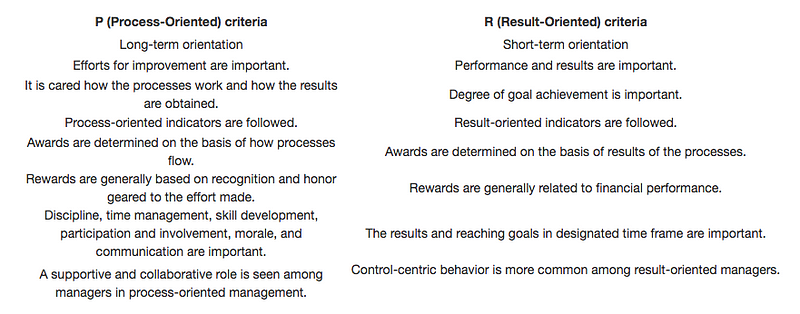
I’m not alone here. In fact, the Academy of Aerospace Quality at Auburn University has a handy table showing the differences between two kinds of management: Process-oriented, and Results-oriented. Check it out:

courtesy of http://aaq.auburn.edu/node/984

Most of this stuff comes straight out of Masaaki Imai’s beloved Kaizen writing. Focusing on the process, not necessarily the results, can actually have profound and long-lasting results. What’s more, once you get the improvement from it, you know how you got there, because you were focused on the process. The same can’t necessarily be said about results-based thinking.

This all goes hand-in-hand with thinking gradual, long-term, holistically, and carefully — and then acting accordingly. Believe it or not, that kind of strategy still works! Crazy, right?

Look, my old boss didn’t leave me without any lessons. He did help me to balance how I work, by getting me to step out from in the weeds every once in a while. But I still won’t push for results for the sake of results — knowing that they aren’t sustainable.

I focus on the process, the people, and the fairly un-glamorous things that aren’t necessarily moving the needle quickly and drastically. I like to think that it’s led me down a better path.

If you enjoyed this, please consider subscribing to my once-weekly newsletter — Woolgathering. I suspect you’ll like it.

Off Demand

credit: Tookapic on Pexels

What Happens When We Can Always Consume Whatever Media We Want, Whenever, Wherever?

I was listening to two friends talk about some of the shows that they’ve gotten into lately. House of Cards, Stranger Things, The Man in the High Castle, and so on. They are cord cutters — they don’t subscribe to cable TV, nor do they watch broadcast TV. Their media lives are lived entirely on demand.

I have cable, but by and large, my household’s media consumption is also on demand. We decide when we’re watching something, and what we’re watching, from a menu of choices. Whatever we feel like, whenever we feel like it — that’s what we consume.

My online life is much like that, too. I scroll through Twitter, look at apps like Longform, Instapaper, Medium, and Pocket. I get the stories when I want them, from the sources I want, and there are way more than I could ever read. I simply don’t have to deal with someone presenting media to me. It’s a buffet, not a meal. I pick what I want, when I want, and ignore the rest. I can go back as many times as I like. The supply is virtually endless.

The Shifting of Choice

This is the new model, and it’s been happening since the early 2000’s. Choice has been shifting from producers to consumers, and now it is almost entirely in the hands of consumers.

Consider the 1970s. There were a handful of TV stations. Albums were on Vinyl. You had to put in serious effort to consume a piece of media or art. The producers had the choice of what to present and when, where, and how it could be consumed.

The picture is starkly different 40 years later. The producers still choose what to present, but by and large, consumers control the when, where, and the how. In short, consumers control the context of consumption. As a result, cohesion and curation kind of go out the window.

Albums, shows, and films can now be watched in disconnected chunks, in different places, and in different orders. It’s the difference between a 4-course meal presented in a certain way for maximum effect on the palette, and a disordered grazing of random dishes that might have at one time been a meal.

Losing Cohesion and Curation

Lately I’ve gotten to wondering: in what ways might this on demand way of life be harming us?

We used to be presented with media. TV stations played shows at certain times, and only a few shows. Newspapers only produced a finite amount of stories — what was in the physical paper each day, and that was it. Now that I can click around to wherever I might want to go — skipping so many pieces of media — what might I be losing?

The positive arguments for on demand and media proliferation are easy to find. More media means alternative views, a more lively conversation between opposing views. More media means more choice for people, more outlets for expression, and so on. That’s what we’ve gained. But consider what we might have lost.

For one thing, I’m losing the ability to avoid confirmation bias. If I have a set view on a topic, I can search and click around until I find some piece of media that supports it. I needen’t bother taking in data that contradicts my current view. I can’t see that as anything but harmful. I think that’s not a prospect to take too lightly.

I’ve also lost cohesion and context. Cohesion means something in media and art. The album — that paragon of cohesion — is nearly already a thing of the past. There is no real order to songs anymore. The order is relative to the user — who may not even have the entire album — just the song or a few of them.

To me, that’s a tool of expression that artists have lost. They can’t even so much as nudge you to listen to a whole album in order anymore. Sure, you could always skip around before — on CDs, tapes, and vinyl — but you had to buy the whole album. You had skin in the game. That simply isn’t the case anymore.

An Analogy

If I can draw on an analogy, it’s as if media had previously been a visit to someone’s home — the producer’s. They had prepared something for you, and you would sit there and agree to engage with them for as long as you were willing. There were only a handful of other invitations that could cause you to up and leave. It was, by and large, an experience.

Now the engagement is much less like a social visit to a home, and more like speed-dating. You meet at some place that you — the consumer designates. If it’s a busy place, you have a rendezvous filled with distractions, you zone out wondering about the others you could be talking to, and you leave prematurely. Connections are made by chance, and how long do they last? How rich are they? I think a lot about these questions.

It seems that choice is good, but it’s been well-argued that too much choice is bad for us. So whatever the merits are of the on-demand consumption culture, we need to be mindful of what we stand to lose because of it.

You know what’s NOT on demand? My newsletter — Woolgathering. It’s sent once weekly to a few hundred lucky souls. Join them, won’t you?

Hacker Noon is how hackers start their afternoons. We’re a part of the @AMI family. We are now accepting submissions and happy to discuss advertising & sponsorship opportunities.

If you enjoyed this story, we recommend reading our latest tech stories and trending tech stories. Until next time, don’t take the realities of the world for granted!

The Unexpected Power of Stillness

credit: Derek Key

We’re Deathly Afraid of it, But it May Be the Secret to a Good Life

There is an old saying that even a broken clock is right twice a day. Consider how that compares to a clock that is still ticking, but set to the wrong time.

While the former clock may not be moving, just by staying put, it still gets it right twice per day. It does so consistently — predictably. The latter clock — still moving and expending energy — never manages to be right, despite all of its movement.

Almost sounds like a Zen koan, doesn’t it?

I guess it kind of is a koan, but the moral is simple. When all else fails, pursue consistency.

Whatever your endeavor, there will be times when you’re uncertain about the approach you’re taking. The doubting then creeps in: Will it work? Was I crazy to start doing this? I can still back out…

When that happens, think about the clocks.

If you second-guess yourself and change your plan quickly, you’re the second clock. You are still ticking, expending energy, but you’re off the mark. The target you’re aiming for either isn’t moving, or is moving in a different direction than you are. It should be pretty clear then that until you get your bearings, continuing to move will do way more harm than good.

And yet, we do this constantly. We tend to feel that doing, moving, acting is somehow better than not acting, waiting, being still. But why is this? It’s wasteful.

I think it’s because we tend to feel uneasy when we’re not moving, doing, or talking. Just think back to the last time you were having a conversation with multiple people, and there was a silence.

How tense did you feel? How tense did everyone else look? They were so uneasy with not doing — not talking, that you could feel it, right? They weren’t just uneasy that they weren’t talking, but that someone wasn’t talking. How odd. Why should we feel that way? And yet, we do.

It’s because we can’t handle stillness. When things are still, we are not being distracted by actions. Our energy has nowhere to go. We’re used to being tired, stressed, and being either pushed or pulled. When we’re allowed to just be, and not subjected to pushes, pulls, and distractions, we end up having to create our own from within.

How absurd. But that’s our human absurdity. And you have to laugh a little at it before you can work on changing it.

So, this is me laughing at it. What will follow for me — and I hope for you readers — is the next step of getting more comfortable with stillness. Not just stillness, but its companion, silence.

What I am trying to do these days is to break down that feeling of unease that comes with not acting, not speaking. At that point, I can realize that stillness is powerful. It can rejuvenate. It can clarify. It is powerful, truly. But I can no longer be afraid of that power, because I can wield it. When I do that, I can get a lot more done— interestingly enough — by doing a lot less.

Did you like this piece? Consider subscribing to my weekly newsletter — Woolgathering. It’s one email per week, with interesting stuff to ponder, from me and from around the web.

Against the Concept of “Speaking Your Mind”

credit:

Wikimedia Commons

Because It’s Almost Meaningless, and Usually Harmful

On many occasions, I’ve heard people praise others for speaking their mind in a public setting. But I have to admit; I don’t understand what exactly that means, or why it’s praiseworthy.

If it means that someone says what’s initially on their mind at a given moment— without taking time to reflect or refine it — I’m not sure why it’s praiseworthy. A great deal of what is on my mind at any given time is incomplete, ill-informed, and distorted by one or more of various biases — both cognitive and emotional. I see very little value in speaking those thoughts in a public setting.

[If it means that someone says how they’re feeling at a given time, I can see some value in it — but little value in doing so publicly. The more public a figure is, the less their feeling should be what they’re speaking publicly — unless those statements have been carefully refined to clearly reflect that they are personal feelings.]

Ultimately, I see two things wrong with the concept of “speaking your mind” as a positive thing.

What is on your mind at a given time is not necessarily fit for publication to others.

What you choose to say off the cuff to others could hurt them, reflect negatively on you, or both. Any person is subject to their thoughts evolving and maturing as they mull them over.

In that way, thinking has a relationship to speaking much like the one that food preparation has to serving. You need to prepare the food before you serve it, or else what you serve is unappetizing or just plain dangerous. When you speak before things have been effectively mulled over, you’re serving the equivalent of under-cooked chicken to those listening — appealing and tasty on the outside, but dangerous upon being eaten.

Your mind is not a concrete, unchanging thing.

To “speak your mind” as it is now is to speak a different mind than what you will speak later. You might (and likely will) change your mind in the future. Normally that would not be a big problem. But once you’ve spoken your mind, speaking it in the future — after you’ve changed it — you stand to contradict yourself.

Some people may understand and respect that kind of nuance. But many won’t, and it could make you appear incompetent, indecisive, or like a sycophant. None of those is a great option.


As always, it’s possible that I’ve gotten wrong. But however useful “speak your mind” has been as advice in the past, it has to be less useful now. There is so much content to sift through in all kinds of media — and so many outlets for discussion. It can’t hurt us to hold back a little, until we’ve had time to collect ourselves.

I appreciate you reading this. Please consider subscribing to my weekly newsletter — Woolgathering. It’s one email per week with some interesting stuff to read and think about. Guaranteed to quench your mind’s thirst, or double your money back! (By the way, it’s free.)

Content for Content’s Sake

Matthias Stom, A Young Man Reading at Candlelight

On the Discouraging State of Words on the Web

Back when I was hungry to just get my writing exposed to people, I made the mistake of answering a call for content through HARO (Help a Reporter Out). The call was something like “what are the simple keys to success?” — so I shot off a quickly-conceived piece. I never heard back. I’m kind of glad I didn’t.

Though my story never got published on the site, I am now on their mailing list. So about weekly, I get an email blast from the site’s founder asking for very specific articles in a very short amount of time. This week’s call was particularly weird:

“50 Powerful Quotes from MLK that Will Motivate You”

“15 Motivational Lessons from MLK”

“Do These 5 Things to Have the Charisma of MLK”

There were about 5 or more of the same format — a number, a noun, and Martin Luther King’s name attached. It gave me an odd yucky feeling.

The man was an human-rights activist who helped millions of oppressed people gain a foothold on basic rights in a country where they were viewed as second-class citizens. But here we are asking for redundant click-bait about him to peddle to businesspeople. It’s a bit perplexing. It makes me feel uncomfortable — like when someone touches all of the sandwiches at a work lunch, in order to find the one they want.

In general, I find myself uncomfortable by a lot of these types of prompts and titles for content. It seems clear by their calls for content and the writing itself that there is little concern for originality or poignancy. It seems to be entirely about quantity and timeliness, rather than quality and timelessness.

I have begun to wonder about the motivation for content. What is the underlying reason for its production. Is it writing for the sake of discovering, communicating, and teaching? Or is it writing for the sake of producing content? Is it just content, for content’s sake?

I am all for writing — writing a lot and writing often. Writing helps you think, improves your ability to express yourself, and inspires confidence. But this commissioned “content” — produced relentlessly, and with redundant prompts — I’m not sure it does any of that stuff. And because it doesn’t do that for the writers, I don’t think it does for the readers.

I guess the real question is this: how much content on the same topic, in the same style, do we need? By now, content is surely a commodity — available from many sources, and sounding, looking, and feeling much the same. How comfortable are we — as writers and readers — with that? I’m not very comfortable. But maybe that’s just me.

I’ll continue to write for the purpose of discovery, expression, communication, and poignancy. I’ll continue to read for the same reasons. My simple hope is that we all do our best to do that, as well.

I’d love it if you subscribed to my weekly newsletter — Woolgathering. One email per week with interesting stuff to think about.

Writing As Soulcraft

Our Little Piece of Immortality

I’m not necessarily religious, nor do believe in heaven, hell, or an afterlife as classically conceived. However, something about the idea of a soul has always interested me. I’m not sure whether or not I believe in said idea, but it is at least interesting.

From a metaphysical standpoint, it’s hard to reconcile the modern scientific view of the physical human with the notion of some permanent non-physical thing — the soul. But those worries aside, I definitely see the appeal of it. To think that once we’re dead, we’re gone , that’s it— that seems too harsh, too final. Surely, there is life for us after our heart beats for the last time, and our brain waves have flat-lined.

But you don’t have to believe in an afterlife in the grand old religious sense in order to make sense of the soul and immortality. What we do as writers is a great example of this. The words we write — as long as our hearts are in them — constitute our soul.

When those words are read, appreciated, and shared by others, our life extends beyond the beats of our own hearts, and on to others’. When our words touch someone, move them, inspire them, our soul finds a place there, with them, for as long as they live. Whatever they do that came in some part from your words, your soul lives on there.

There is an old concept within Western religions specifically called soulcraft. It’s defined as below:

soulcraft ‎(n)

  1. An activity that is nourishing to the soul; particularly fulfilling work or other activity
  2. Something that shapes and modifies one’s soul or core being

So if there is indeed a soul — whatever that comes to mean, then writing is soulcraft at its finest. Writing is the molding and nourishing of whatever our soul is, and making it into what we want it to be. Writing both molds our soul, and permeates it out — into the afterlife.

Even the most mundane of writing contributes to it. Daily journaling, to-do lists, an email to a friend or loved one. Our words shape us just as much as we shape them.

Our words shape others, and in turn, they shape others as well, and so on. Our influence — our words’ influence — reaches further than we can ever really grasp. In that way, our souls continue to live on in our words, for as long as others stumble upon them.

Given that, what kind of soul are you crafting? What will your spirit look like as it permeates throughout the eyes, ears, and mouths of others?

Did you dig this? Please consider subscribing to my weekly newsletter — Woolgathering. One email per week, no spammy stuff.


The Real Power of “Inbox Zero”

credit: hyperdashy badges (flickr)

I recently reached the elusive“inbox zero” in both my personal and work email accounts. I ended my work day with no emails in either inbox. It felt awesome.

I had always realized it as a goal, and made moderate strides toward it. But as with so many destinations we long for, imagining it is one thing, but actually reaching the destination — well that’s a whole other thing entirely.

The Root of Productivity Problems

Ever since I was introduced to the concept of “inbox zero”, by way of the incomparable Merlin Mann, I immediately felt its appeal. I knew that it would help me manage my work and my life better. I felt the appeal, but I hadn’t yet grasped the power of it. It wasn’t until last week — when I actually reached inbox zero — that I came to understand why it is so integral to becoming a productive person. That’s probably because I came to understand a bit more about what lies at the foundation of productivity.

What I’ve come to realize about productivity is this:

Nearly every problem we have in the realm of personal productivity comes as a result of vagueness and clutter.

Yes, Inbox Zero is ostensibly about your email inbox, but that’s just a point of entry. It’s also about your physical inbox, and your mental inbox. It’s about wherever it is in your life where there is stuff. It’s about ensuring that as much of the stuff of your life as possible is clearly defined and not taking up your attention, so you can go about the business of actually doing things.

Why Organization is Important

Sure, organization is good, but it’s good precisely because it serves to define the stuff in your life. An organized person lives without the creeping fear that there is some physical or digital thing somewhere that needs their attention.

That fear is distracting, and because it is distracting, it is destructive. It can destroy your ability to focus — be it focusing on your work, your relationships, or on your health. Being unable to focus on those things will make it exponentially harder to do them properly. That means that a better organized person at least has the opportunity to be more productive, and do better work in general.

The day that I achieved inbox zero, I immediately felt the difference. I was able to engage in more intent listening to others. I arrived at home ready to actually greet my wife and child. I had confidence that I could handle the remains of the day — no matter what might come up. That comes from the organization that a clean inbox affords me. I know that there’s nothing vague and undefined that I have to do. If something urgent and important comes up, I know the nature of any task or project that I have to move around to accommodate the new stuff. That’s a great feeling.

Don’t Fetishize It

But don’t fall into the classic trap of confusing the means and the end. Inbox Zero is not the goal; it’s a way of getting to the goal, which is a relaxed mind. The relaxed mind is the gateway to productivity. Many people overlook this, and end up compulsively checking their inbox every 10 minutes or so.

Becoming obsessed with keeping your inboxes at zero is actually counterproductive because it makes you do 2 counterproductive things: checking your email constantly, but also thinking about your email constantly. But the reason that we’re attracted to inbox zero is precisely because we find ourselves preoccupied by and distracted by our inboxes. So when you get to inbox zero, don’t fetishize it by getting obsessed with cleaning out your inboxes— use it as the tool it is. Otherwise, it becomes just another way to avoid doing work.

I’m not sure how long I’ll maintain Inbox Zero, but the goal is to end each day with an empty inbox for each of my 3 inboxes. Will that happen every night? I can confidently say “no” right now. However, I won’t beat myself up about that, because that’s not really the point.

Thanks for reading! Consider subscribing to my once-weekly newsletter — Woolgathering — for interesting and helpful stuff like this. No spamming, no email barrages, just good stuff to read.

Slower, Fewer, Less

Some Simplified Principles for Complicated Times

On a few occasions, I have heard someone talk about a person or a company being like a duck in the water — calm on the surface, but paddling furiously under the water. It usually serves as an analogy to show how much work it can take to be poised, calm, and laid-back.

I also found this analogy to be apt for practicing simplicity. We usually have to deal with a lot of complexity and mess in order to actually implement simplicity. Anyone who has edited a long article or book can tell you that.

As the year ramps up, and we naturally reflect on how we can change our lives for the better — I’m reflecting on how I can live more simply. In that vein, I’ve adopted a motto:

Slower, Fewer, Less

Slower

When I act more slowly, more deliberately, I come to accept fewer tasks, and focus on the ones that will yield the most value. I also reduce the amount of mistakes I make. I don’t do things that I later regret doing, or were just plain worthless — busywork. I end up doing more valuable things, because I refuse to spend time on things that aren’t valuable.

When I eat my food more slowly, I eat less of it, I enjoy it more, and I will buy less food — thus saving more money, and lowering my chances of overeating.

When I breathe more slowly, my mind moves more slowly. When my mind moves more slowly, I tend not to overreact. I tend to be more compassionate, more flexible, and I am happier as a result.

Fewer

When I buy things, they cost way more than what I initially pay for them. They all represent responsibilities, and commitments of time and money. Those can cause stress.

When I make commitments to others, to myself, I stretch my focus, time, and attention thinner. When that happens, there is less to give to each project — each commitment.

Less

When I take less than what my greedy ego desires, I leave more for others. When I leave more for others, they appreciate it. When what I do is appreciated by people, my life becomes richer as a result.

When I say less than what I might feel like saying in the moment, the words I do say mean much more. After all, they were more carefully thought out.

When I expend less energy and less money on what I want now, I have more for when I truly need things.


These are just thoughts, but they make an awful lot of sense to me. I’d love to hear yours.

If you enjoyed this, please consider subscribing to my once-weekly newsletter — Woolgathering. You’ll receive one email per week (no more) with some interesting stuff. I think you’ll like it.