The 4 Questions that Define You: Aristotle and a Deeper Dive into Self-Awareness

credit: Maxime Le Conte des Floris

How the “Four Causes” of an ancient philosopher can be used as an exercise to help you live with more purpose and focus.

We all get stuck from time to time. We all fall into a rut, where it seems like we can’t move forward and make progress — at least not in the way we’d like to. While tips and tricks abound for trying to get around the problem and keep moving, any of them are going to be short-lived if they don’t address the root cause of most procrastination and stagnation: a disconnect from who you are.

The ancient Greek philosopher Aristotle dealt extensively with understanding the essences of things — whether people, animals, plants, or stones. He defined 4 different ways to answer the question of what makes something what it is. They are:

  • The Material Cause
  • The Formal Cause
  • The Efficient Cause
  • The Final Cause

These 4 causes are extremely valuable as a way to get a better understanding of yourself — who you are, and where you are going. And when you remember who you are, you can get going where you’re going. You can overcome the stagnation, and drive forward.

The Material Cause

Aristotle defined the material cause of a thing as the physical stuff that made it up. For a human, it’s flesh and blood, but if we stretch the concept a bit, its also your thoughts and feelings — the mental building blocks of a person. For our purposes, that’s what is most important to get in touch with. The way to get a grasp on the material you is through introspection and simple self-awareness.

Simply being aware of what is on your mind right now is so valuable, and yet so overlooked. At any moment, you have way more on your mind than you are initially aware of. And all that stuff on your mind has weight to it — it impacts your mood and your energy. It also takes up space. It keeps other thoughts and feelings out of your mind, or relegates them to the background, when perhaps they should be in the foreground — pushing your activity in a positive direction.

Getting to know the material causes of yourself is as easy as journaling. Simply writing down the things that come to your mind, and doing a bit of exploration about them on paper can clear up that space in your mind, and take a weight off of you. With that done, it becomes easier to do more constructive things.

The Formal Causes

For Aristotle, the formal cause of a thing is what makes it the particular kind of thing that it is. Another way to put this, and a way that some medieval philosophers took it, is that the formal cause captures the essence of something.

For us, it’s first and foremost about what makes us human, but if we push it further, we can ask what type of person I am. Am I a writer? Well, what is it that makes me a writer? What makes anyone a writer? To me, it seems that what makes someone a writer is that they think and write above all else. Activities and thoughts flow into words on the page, into paragraphs, and into essays of wisdom worth sharing. But for each of us, there is a thing that we are above all else, and at times, we lose touch with what kinds of thoughts and activities constitute being that thing.

In so many cases, we procrastinate by doing something other than what our thing is. Asking the question of what makes you a writer, an artist, a leader, a founder, etc., can quickly get your thoughts and actions aligned once again with that formal cause of whatever it is that you are — and back on the path you’d like to be walking.

The Efficient Cause

The simplest way to understand the situation you’re in is to ask yourself what led you there. Trace the events back to a tipping point. Trace your thoughts back to what event or experience set them off. This is the efficient cause — the concrete events that put things where they are now. Part of journaling should be reflecting on these events, and understanding how they fit in the chain of events in your day, week, month, year, and life.

George Santayana once said “Those who cannot remember the past are condemned to repeat it.” And it’s not just remembering the past, but also being willing to take a hard look at it now, when you may be ashamed of it or made uncomfortable by it. We cannot know who we are unless we fully come to grips with where we have been and what we have done. Without doing that, any progress we make is borrowed, and the debt will be due before we know it.

The Final Cause

The final cause of a thing is its purpose — it is the why to end all whys. For us, it is the one thing that we are most often unclear about, and that is what most contributes to periods of stagnation and frustration. But we cannot beat ourselves up about forgetting our purpose, because purpose is a complex thing, and I believe that it goes through changes.

Though we can use the term “purpose” in the singular form, purpose is rarely felt as a singular force. There are multiple pulls and pushes on us at any given time — we are different people to each person in our lives. But that should not deter us from defining ourselves and our work in a singular fashion. The difference is in the nature of those forces, which are either a pull or a push.

The various things we are to others — a parent, a friend, a sibling, a partner, etc. — are pulls. Though we can genuinely come to define ourselves through the lens of being those things, they are dependent on the demands of others, and so not wholly ours, and they don’t come from within. This is not to say that those pulls are not worth devoting time and attention to — they surely are. But they are incomplete without an examination of the final cause that comes from within you — regardless of the demands and needs of others.

The final cause for you is a push — and it comes from within. It is what you are to become, and what — in your best moments — you care most about. It may express itself in what you do with and for others, but it comes from within, and through inward energy it is sustained. You may be a mother or father as an expression of your final cause, but your true inward push is caring, serving, and teaching. Whoever you happen to care for, serve, or teach is simply happenstance.

When we lose touch with our final cause, we can feel lost. Many of us can go through most of life without understanding what it is — without a clear knowledge of what we’re driving toward.


When we lose touch with what makes us who we are, we lose direction and energy. That’s why things like meditation and journaling are so vital to living well. They help us get in touch with the 4 causes that make us who we are. When we understand why we are, we can know who we are, and we can do the daunting work of being that person.

Existence is a given. You exist, and you are what you are. But only when you really knuckle down can you take that given existence and make it into a life. Only by understanding who you are, and who you need to be, can you do the rewarding work of living a life.

7 Things to Do Before You Can Say You’re “Self-Made”

nobody’s an island — not even her.

So you want to go around touting yourself as a self-made millionaire, or whatever sobriquet you’d like to adorn yourself with? Great! It’s all the rage these days! Here’s a checklist of things you must do beforehand. Once these are complete, self-aggrandize to your heart’s content!

  1. Check with your parents, guardians, friends, family members, teachers, mentors, and advice-givers who looked out for you during your formative years. Ask them for permission to omit their role in your upbringing from your narrative.
  2. Arrange a meeting with the first person who hired you at the job that provided your entree into your current role. Make sure that no one else was even being considered for the job, so you can make sure that the person hiring didn’t help you out by deciding to give you a shot.
  3. Have lunch with any mentor you had during your professional life. Tell them that you are planning on promoting yourself by purposely not mentioning the advice and networking they provided to you. Ensure that they are okay with this, and try to get that in writing, if you can. Also, make sure you pay for said lunch, along with reimbursing them for any lunches they had previously paid for during your relationship.
  4. Reach out to anyone that provided funding or financing for whatever venture has made you all the money you’re bragging about. This includes people at VC firms, angel investors, the banker who provided your initial or ongoing line of credit, the financial infrastructure that allowed money to flow into your ventre, etc. Obtain their consent to completely downplay their role in your prosperity.
  5. Talk to any state or local governments that provided tax incentives for your business venture or for customers of yours, maintained any roads, bridges, or waterways you used for transportation, issued the title to the land you bought, and provided a police force to secure your physical space. Make sure they agree that they had absolutely no role in your success (an agreement you may want to get notarized, of course).
  6. Have a brief meeting with your first big client or customer. Let them know that they had absolutely no part in the decision to give you their business, and that you personally are taking all the credit for the partnership. If they are cool with that, you’re on your way.
  7. Gather any employees or business partners you have or have had throughout your rocket into wealth and power. Politely inform them that if it’s okay with them, you’re going to take all the credit for the success you’ve experienced and the money you’ve made. Ensure they’re all on board, and perhaps get HR to put it in some meeting minutes.

Once you have all those steps checked off, you’re good to go. Feel free to write an article in Fast Company about how you made your millions (or billions, you go-getter!) and picked yourself up by your bootstraps. As a bonus, you can then also chastise all those who don’t do the same. Heck, you might even be able to build a platform out of that to run for political office. And remember, just like when you first struck out on your own, the sky’s the limit!

Alternatively, you might want to just admit that nobody does it by themselves (even Tom Hanks’ character in Castaway had Wilson!). We all had help in getting where we are — whether we acknowledge it or not. In fact, what separates the good people from the ignorant pricks is the realization and outward acknowledgment of two things:

(a) everyone had some help getting where they are today, and

(b) that help should be acknowledged and, to the extent possible, provided to others who need it.

The concept of the “self-made” anything is a farce. Everyone has had help, and everyone should be respectful enough of those who helped them to acknowledge that. Acting as if you are the sole person responsible for your success overlooks countless people who have had a part in your getting where you are today — both those you know, and those you don’t. When you fail to recognize and appreciate just how interdependent your success is with others, you show yourself to be ignorant and inconsiderate. It’s a bad look.

Still, if you have the brass to try to claim you’re “self-made”, the checklist above is still applicable, granted you can get through it. Best of luck!

The 48 Tomatoes Method for Time Management and Productivity

From Two Great Systems to One Helpful Way to Look at Your Day

Time management is key in supercharging your productivity because it is the most scarce resource you have. No matter what you do, you cannot really get more time than what you are allotted. You can find ways to make more money, you can delegate work so you have less on your plate, but when it comes to time — you get what you get; you just have to find a way to make the most of it.

Much like with money, the best way to start making the most of your time is to begin tracking it. I’m not just talking about tracking what you have already spent — though that is helpful to get you a sense of where your time is going.

What I’m talking about is a way to view your time in 3 different respects:

  • What you have at the start of each day (i.e., when you begin spending your time on things)
  • How much you have left as the day proceeds
  • A unit of measurement for your time that works best for capturing how most people spend it

The system I have cobbled together looks at time as units larger than conventional minutes and seconds, but smaller than hours. It combines visual representation of time available, interval work, and simplistic prioritization.

I call it 48 Tomatoes. Take a look, and feel free to comment on the piece as you see fit.

We all Have 48 Tomatoes Today

The Pomodoro Technique was invented by Francesco Cirillo. While in college, he began using a kitchen timer shaped like a tomato to keep him doing tasks for 25 straight minutes, with 5 minute breaks after each interval. That 25/5 interval is called a pomodoro — Italian for “tomato”.

This technique works, and I recommend it to anyone having trouble staying on tasks for more than a few minutes. But what I like about it goes way beyond the technique itself. I like the way that it views your time. If we really want to think about time like money — so we can better manage it, we must think about how we spend it. In order to do that, we need a basic unit in which to think of it. To me, nothing does this better than the 30 minute block — or tomato.

Why a 30 minute block? Think Goldilocks. An hour is big and hard to think about. You could theoretically get a lot done in an hour, but it’s too big to use as a building block for budgeting time. 10 or 15 minutes seems like pretty neat and tidy discrete block of time, but things worth budgeting for rarely take less than 15 minutes. If you’re going to invest the time and mental energy to budget and track your time, 15 minutes will probably not get you a decent return on that investment. In my experience, anything large enough to block out time to do will usually take no less than a half-hour, all things considered. Consider the rule in project management for budgeting time: however long you think something will take you, multiply that estimate by at least 1.5, and you’ll get the likely duration. As a consolation to those really intent on splitting hairs: you can use half tomatoes, so that gets you down to 15 minutes.

Last time I checked, we have 24 hours each day. That’s 48 tomatoes — 48 half-hour intervals. That means that you start each day with 48 tomatoes to throw at the stuff in your life — projects, tasks, activities, service, etc. Keeping the mindset of how many tomatoes you’ve thrown and how many you have left seems to me like a hell of an easy way to get more serious about valuing your time.

Start With Scarcity

The tragedy is that most of us (hopefully all of us) start our days with 10 to 16 tomatoes already thrown. We sleep for 5 to 8 hours. So essentially you don’t really have 48 tomatoes to throw, you have more like 38 or 32.

So with 32 tomatoes to throw, you can now begin looking at the things on your to-do list, and size them up — not just in their importance and urgency, but also in their expense — as in how much time will they cost you to do?Counting your tomatoes makes this easy. If you have a task that will take you 2 hours to complete, that’s 4 tomatoes, 4 of 32 available, or 1/8 of your daily allowance. So is that task worth 1/8 of your tomatoes? It’s certainly a place to start thinking about time management.

The Daily Budget, Deep Working, and Ivy Lee

In Deep Work, Cal Newport suggests that we schedule every task we want to do in a day, and make every attempt to stick to that schedule — pushing away other distractions. The benefits of doing this can be tremendous, and it makes the best use of your time. When you measure time in tomatoes, you want to squeeze the most work you can out of each one (pun intended).

In order to do this, you will want to make a time budget.

One effective way to make a time budget that I’ve found is to combine the so-called “Ivy Lee Method” for important tasks. It’s been laid out elsewhere, so I won’t go into it here. But the gist is this:

  1. Decide on 6 tasks that you see as the most import and/or urgent for the next day.
  2. Work those 6 tasks before and at the expense of all others.
  3. Repeat 1&2 daily.

Once you’ve laid out these 6 items, you can go in and assign them a tomato value. On my master project/task list, I place a

(tomato icon) for each half hour I estimate the task will take me. Thus begins an effective time budget for the day.

Why This Just Might Work

Visual indicators are effective. Warehouses and manufacturers use them for inventory and production management. Organizational methodology relies on them. Even financial budgeting software utilized visual indicators that take raw data and assign them color, size, or presence/absence change values to show we feeble-minded humans that stuff is changing.

So if you wake up at 6am, your initial bunch of tomatoes looks like this:

Let’s say you have 3 meetings: 2 of them are an hour, one is a half hour. Take those off first:

You have to commute to and from work, and you also have to pick up a few things from the grocery store. Toss a few more:

Now, let’s say you’ve got to cook dinner, eat it, and clean up afterward. You’re also going to bed by 10pm, right?

You’re going to eat lunch, right? And how about that time you use to randomly talk to people/catch up/follow-up/etc?

The above tomatoes are what you’re left with to do your 6 tasks. And let’s be honest, if you actually care about them, you likely will need something like 25 minutes to devote to each one. So at minimum, that leaves you with this for the rest of the day’s stuff:

See how quickly the time flies?

For those interested, I have created a handy Google Sheet that calculates and shows your time for tasks and time left in this visual method:

https://docs.google.com/spreadsheets/d/1Arg5ROV9X15pZA7GXedhon1bf6l7c1K9r615iIczDXA/edit?usp=sharing

The Bottom Line

Time is valuable, and scarce. So the more you leverage visual management to treat it that way, the more likely you’ll be to value it. Just my thoughts. As always, I’m tinkering.

Friday Fasting: A Weekly Practice to Bring Back Focus and Strength

credit: 童 彤

How a small practice can enrich the powers of restraint and mindfulness that is so lacking these days

Fasting has been a practice in many spiritual traditions for millennia. From those in the clergy, to monks and lay people, abstaining from food and/or drink in a ritualistic manner has been embraced because of the many benefits it is supposed to offer. Among them are:

  • it can serve as a foundation to break bad habits
  • it calms the mind, allowing for concentration and focus on other things
  • it builds strength and willpower
  • it helps to even out appetite and cravings

Recently, I decided that I’m in need of a kick-start to my personal growth. To me, something like this seemed right up my alley. Simple to implement, cost-effective, and tried and true throughout generations and geographies. So this last Friday, I began a weekly Friday Fast.

What I’m Doing

Every Friday, at least for the foreseeable future, I will be fasting from dawn to dusk. I will wake up (normally 4–5 a.m.), have coffee and a small something to eat. After that, I won’t eat anything, and I will drink only water, coffee, or unsweetened tea until the sun sets. It’s that simple. Simple, but not necessarily easy. Everything else during my day goes as normal.

Why I’m Doing It

In short, I am much too licentious, in general, but with food especially. So tackling my tendency to just do what I feel like doing by starting with food seems pretty sensible to me.

If I can get by and work through hunger and cravings for the better part of a day, it’s an affirmation that I am strong enough to take on numerous other difficult tasks. It is an affirmation of my abilities and strength in general.

Food is a Proxy for Everything

We are increasingly a society of consumers. We take in and use so much, so quickly, and we do so less and less consciously. We no longer think in terms of the chain of events that goes into what we consume.

We read tens or hundreds of pieces of writing on the web for free each day, with little thought as to how much work it took to put together.

We watch hours of videos each day, for free. We fast forward, rewind, and cycle through lists of videos — paying little attention to what went into each.

We listen to hundreds of audio tracks — songs, podcasts, an audiobooks. We listen at double-speed. We skip around albums. We allow algorithms to show or hide music from us.

All these pieces of content are things that often times took significant effort to make and make available. But the landscape doesn’t allow us to stop to appreciate that. They have become blades of grass on an thousand-acre landscape of ever-sprouting seedlings — growing ever taller.

We come to take these things for granted, and it’s largely because they come to us in a consistent stream. They have become our atmosphere, simply the air we breathe.

And isn’t that much like our relationship with food?

Food is a proxy for so many things we mindlessly and excessively consume. If I can — even for part of one day — curtail the mindless consumption of food, perhaps I can make a dent in other kinds of consumption.

Cultivating the Power of Restraint

The power to do things is actually the least impressive kind of power there is. Now more than ever, there are systems in place that allow us to do more things than ever before.

If we want to communicate a message to a bunch of people right now, we can — right now. If we want to buy something at 2 a.m., we can — and often times, we get it very quickly after buying it. We can do what we want when we want. Doing is not all that impressive, and it takes little power.

What does take real power is restraint — to not do things — especially when we want to do them. Fasting is restraint in action. I do feel hungry, I am confronted with tempting treats and tantalizing entrees. If I can learn to bypass them, I can learn to bypass a lot of tantalizing things, that in the long run, add little value.

Calming the Waters

In the past, when I have refrained from eating for a day, I’ve found myself — at some point during that day — becoming calmer. I don’t feel as pulled in different directions, or as excitable. I feel that calm that I so revere when I see it.

I think that it comes as a result of not having an appetite ruling your thoughts and actions. When hunger has not be satiated, and your body gets the hint, your brain stops craving, stops longing. You can move on to other things. You become calm. It’s pretty cool.

I did this yesterday, for the first time in years, and I liked it enough that I will keep doing. It’s just one more little thing that I’ve found to push me onto a better path. Little, but effective.

What We Talk About When We Talk About Productivity

On the Life-Changing Magic of Having and Using A Trusted System

Every so often, I find myself feeling like things have come a bit unraveled in my life — like I have lost control. I can see all of the symptoms — unread mail piling up, chores not getting done, deadlines sneaking up on me. And often, I attempt to treat only the symptoms. I ignore the underlying disease. And that disease is almost always the same thing: I have abandoned my system. I’ve stopped following GTD.

I don’t want to sound like GTD is a be-all, end-all prescription for all of life’s woes. But I do think that with a system like GTD — one that ensures that the stuff of your life is organized and prepared for you to act upon — you set the stage for doing anything else in your life that is worthwhile. So it stands to reason that since I’ve begun using a system like GTD, when I let slide my engagement with that system, I let things in my life slide as well.

Productivity is For Everyone

I started doing GTD in earnest back in 2010. That was when I got my first salaried job, when I got married, and when my name became attached to a mortgage. I understood that if I was going to take those steps, and take on those responsibilities, I had better take some sort of principled approach to doing it. My generation’s mantra of “follow your passion” just wasn’t going to cut it. For me, GTD was the way to plan out and live a life with some measure of confidence. It was a way to calm my ever-scattered brain, and instill some sense of focus and purpose. I know I’m not alone in this either.

But I feel like I need to explain that GTD and things like it are not just for entrepreneurs and those with office jobs, it’s not just for high performers and those with huge ambitions. GTD and other productivity systems are for everyone. Why? Because everyone has things they would like to do. Because everyone has to shift focus regularly. Because almost everyone can admit that there is some space between who they are now and who they would like to be. In short, if you have anything that you care enough about to want to do something about, then a productivity system of some sort is for you.

Your Life is Not Just Yours

I think this is especially true of those of us working on self-improvement and productivity, but it’s not limited to us. We feel like we’re doing this on our own. This endeavor, and the systems and projects we take on, are only ours. After, all, it’s my life, right? I own it. It’s just me in charge, right?

But the funny thing about your life is that it’s not just your life.
A life is a hopelessly intertwined series of desires, expectations, commitments, and shared endeavors. You rely on others. They rely on you. That is the nature of a life — one worth living anyway.

This was proven to me very recently, in fact. My wife’s close childhood friend, who was the maid of honor at our wedding 6 years ago, passed away very suddenly. She was 31. She wasn’t sick, she wasn’t engaging in risky behavior. She was on a pontoon boat parked in the river, and a fishing boat literally hit her, and killed her.

This woman who died so unexpectedly left behind 3 young kids, a husband, numerous family members, and close friends. They were all grieving — and it’s heartbreaking. Her life ended, but so did all of those people’s lives with her. Her life was not just hers, it was all of theirs. There is so much interconnection, so much buttressing of others’ feelings, hopes, and dreams upon your life, and that simple fact is so often and so easily forgotten.

All this is to say that for the past few years, I have found myself focusing on that inescapable fact: my life is not just mine. My actions, my words, and my attitudes affect everyone around me. More importantly, my lack of actions, my lack of attention, and my lack of vision affect those around me as well.

To me, this means that I should take care to always be doing the best that I can to be the person that I want to be. This way, I can stop constantly stressing about my own inner life, and start working to make sure that all of the lives wrapped up in mine are positively affected.

The best way to do this was to have a personal productivity system in place — a way to get my own house in order, so I can effectively be there for others.

Curing an Existential Disease

So my focus lately has been on something that I have always suspected to be fundamental to living my life in the best way I can: GTD.

GTD stands for Getting Things Done, which is two things. First, it’s a book by David Allen published 15 years ago. Secondly — and most importantly — it is a movement — a way of life. I will not bore you here with a summary, because I actually think the summary is less than half of the story about why this book is really so good. The book is nominally about “productivity” (whatever people take that to mean) and organization. It does a great job of walking you through how to capture and organize the thoughts you have about what you want to do, and help you think about whether you want do do them, and what you want to do about them.

That first part is important. I have a lot of things pop into my mind. Many of them take the form of it’d be cool to do this thing. Most of them take the form of Oh! I’ve got to do this thing, and this other thing, and I told Bill that I’d have this other thing done by next week, so what do I do about all that?. Then I get stressed, and if I catch myself, I can feel my shoulders tense up, and my palms getting sweaty.

I have lived so much of my life in some degree of that stress, that anxiety, that feeling of not being in control. The real benefit of GTD is that — if done right — it is essentially a cure for that feeling. Seriously, it is. Yes, it is a “personal productivity system”. Yes, it is a method for being better organized. But because it is those things, it is most importantly a way to live a happier life, to more fully exist in the moment, and here’s the kicker: it is a way to — at any given moment — feel okay about what you are not doing. Read that sentence again. Go ahead, I’ll wait.

One thing that I have learned in my thirty some-odd years of life is this: the vast majority of stress and anxiety that I feel is about what I’m not doing. Such stress is a terrible existential disease. It represents a divide between who we want to be and who we are.

If I know who I want to be, and I take time to understand how I can come to be that, it is much easier to be satisfied with who I am now.

Right now, I am a person doing the things that I recognize as components of projects. Those projects are themselves components of larger goals that I have for myself. Those goals are part of a vision of who I want to be.

It Isn’t Just About You, But…

If you take anything away from this scatter-brained preach-piece about productivity, let it be this: productivity, when done right, is not a selfish thing; it’s about calming your inner storm, so you can be infinitely calm and patient for others.

GTD and systems like it are about being as productive as possible — about getting all the things done you want to get done. But doing those things are ultimately a way to make a better life for yourself. And intimately tied up with making a great life yourself is making a great life for others — for and with others. It truly is not about you; it’s about others in your life. It’s about serving others, and giving of yourself. But it’s nearly impossible to effectively give of yourself when you are all out of sorts.

GTD, and systems like it, should serve the goal of getting you back in sorts, and keeping you there. Then, at long last, it can stop being about you, and start being about those whose lives are so big a part of yours.

We Need a Sales Force for the Humanities

credit: Cole Keister

Fewer and fewer students are buying into one of the richest and most vibrant areas of study. It’s time to change that.

In recent years, the Humanities and liberal arts are being given short shrift by many in the public sphere. Marco Rubio famously commented that the world needs more welders, not philosophers, and that the former make more money than the latter. Kentucky Governor Matt Bevin suggested that students should not receive money from the state to fund an education in most non-STEM fields. Slate has a wonderful piece about comments made by Wells Fargo, Mitt Romney, and Rick Scott, among others — all disparaging the study of liberal arts and humanities in higher education.

All of this is part of a general closing of the American mind about what education should be. Verlyn Klinkenborg at the New York Times explains:

Undergraduates will tell you that they’re under pressure — from their parents, from the burden of debt they incur, from society at large — to choose majors they believe will lead as directly as possible to good jobs. Too often, that means skipping the humanities.

In other words, there is a new and narrowing vocational emphasis in the way students and their parents think about what to study in college.

….

There is a certain literal-mindedness in the recent shift away from the humanities. It suggests a number of things. One, the rush to make education pay off presupposes that only the most immediately applicable skills are worth acquiring (though that doesn’t explain the current popularity of political science). Two, the humanities often do a bad job of explaining why the humanities matter. And three, the humanities often do a bad job of teaching the humanities. You don’t have to choose only one of these explanations. All three apply.

The Paradigm Shift

Things were not always this way. In fact, humanities and liberal arts faculty had it pretty good in the early days of the university. College educators existed in what I refer to as the scholastic paradigm.

In the scholastic paradigm, students came in (mostly) without rigid and specific goals and expectations for the education; there was an element of trust there, trust that the subject matter would provide a meaningful and enriching foundation of a productive life for students. Education was there to liberate (hence the term “liberal education”), and students only expected to leave with a wide range of opportunities before them, and the beginnings of a specialized body of knowledge. This trust has been lost, largely because of the shift in the public discourse.

The shift represents a change to what I call the market paradigm, where the context has shifted from trust and willingness to skepticism and immediate demands. Students have become skeptical of the value of the humanities, and they have a set of demands that such classes be either tailored to meet their immediate demands (namely, training for specific jobs), or jettisoned from the curriculum.

Higher education is being treated more like mere vocational training than anything else.

The problem is this: when we rely on 18 year-olds to dictate what their education consists of, we narrow the scope of possibilities of that education, and in turn, we narrow the possibilities of what they can do in the future. In broader terms, catering to what consumers want only gives them what they know they want now, but at the cost of all of the things they never knew could enrich their lives. By demanding that higher education look more like job-training, we end up missing the forest of a life full of possibilities for the trees of just getting whatever the job du jour is.

A Call to Action

There is a call to action here, because the danger of this paradigm shift is that the context of market demand poses a threat to the content of the humanities education. If humanities educators can adapt to the changing context, they can resist a change to the content of the humanities education. But the way of adapting is to yield — at leas initially — to the paradigm shift.

To wit, if educators change their method from ivory tower erudite lecturer to engaged salesperson, we can keep Thoreau and Chaucer from being permanently replaced by Stephen Covey and Stephenie Meyer.

In order to get buy-in for the humanities, educators must adopt a mindset of a fully vested businessperson who is selling to skeptical buyers.

To some that might be bad news. It might be bad news that those of us who joined the academy by and large to escape a life of selling and marketing now have to essentially be in sales. The good news, however, is that we are selling a product that we whole-hardheartedly believe in. This is a luxury that few salespeople have.

How to Sell the Humanities

1. Recognize that wants are not needs. Filling a need sells.

Students in this new market paradigm are focused on getting jobs; in most cases, all else is prioritized below that goal. For a student entering college today, what they want from their education is simple: good career opportunities. This is not their fault. They inherit those wants from their parents, from pundits, and from politicians — who publicly denigrate the non-STEM parts of higher education.

However, educators likely recognize that students need much more than just early job training — they need a well-rounded education. There is a disconnect that faculty must address and remedy before any student can be convinced of the value of the subject matter of the humanities. That gap-bridging needs to be front and center until the students and the educators are on the same page about the value of the content. In other words, the context must be that of selling through meeting a need, while highlighting how important the content is.

2. Telling is not selling.

Questions are the most valuable tools you can utilize in sales. Since the new educational paradigm is forcing educators to sell the value of the material they teach first and foremost, questions ought to constitute a large part of the toolbox of today’s humanities educator.

Asking students questions about what they are looking to do, what they value, what kind of pressure they’re under, is a great way to get a feel for what exactly will help sell the humanities to them. This should not be difficult; the great works of the humanities deal with the fundamental issues of human existence. Interestingly, human existence includes business-related subject matter — like accounting and finance — so the bulk of the student body need not fear the humanities!

3. Speak the customers’ language, until they begin speaking yours.

This point is of the utmost importance in really getting buy-in from students. Acknowledge their feelings, their worries, their stresses, and show them that you validate them, perhaps share some of them. A period of doing this can be followed by linking up the material you teach with what is at the front of their minds. It is even easier to do this if you inject a healthy amount of discussion into class, because if done right, it will bring out even more pain points and thoughts on the students’ minds.

I spent about 5 years teaching beastly 165-minute-long night classes at a community college. One trick that I tried during my tenure was this: on the first day, as an ice-breaker, each student was asked to state for the class the following.

  1. Their name (as they preferred it to be used in class).
  2. Where they are from (which they could interpret however they liked).
  3. The most interesting piece of advice they had heard.

Number 3 was my “in”. The advice didn’t need to be good, just interesting, and it need not have been told to them, it could have been seen in a movie, read in a book or article, or overheard. Luckily, most of these gems (and there were some gems) came in the form of “shoulds” and “oughts”, which is right in the wheelhouse of ethics, and thus philosophy. After each one, I’d make a simple assessment of the advice, talk about possible pitfalls or unexpected consequences of following it, and wrap it all up with a bow while showing how philosophy deals with exactly that — all punctuated with some jokes for warmth.

The point is, getting the students to unknowingly do the work of the humanities in very rough terminology — but their terminology — allows for an easy inroad. Once that inroad is made, some sales can be made. Once that sale is made, students can make the sale to their parents, their communities, and the pundits who set the tone of the discussion about education in America. That’s how the humanities can survive and thrive in the new market paradigm.


An early version of the above article was inspired by and given as a presentation at the Community College Humanities Association Central Division conference in Indianapolis, IN in November 2014. At that time, I was an adjunct instructor of Philosophy at a community college. Though I am no longer teaching, I stand by the message presented below.

Kierkegaard and the 3 Stages of a Full and Happy Life

photo: Darko Popovic

What an Old Danish Philosopher Can Teach Us About Cultivating a Richer Existence

There are many ways to conceive of this huge block of time and movement that we call “life”. But one of the big problems with capturing what it’s all about is reconciling the two conceptions of life: the inner one and the outer one.

What I mean is that each of us lives both internally and externally. There is a way that our life seems to those looking at it from outside, and a way that things look and feel to us from the inside. The difference between the two is a difference of lived experience vs. observed experience. It’s the difference between subjective and objective — between science and (for lack of a better word) spirit.

In the 19th century, Danish philosopher Søren Kierkegaard identified 3 possible stages that a person can move through in their lifetime: the aesthetic stage, the ethical stage, and the religious stage. Most people only go through the first step, and mostly through the second step (though many fall short even of that one).

Kierkegaard — or at least a statue of him

Aesthetic Stage

The main motivation in this stage is pleasure. You could think of this stage as basically a from of psychological hedonism (i.e., if it feels good, it is good). In this stage, people are after pleasure, specifically the pleasure of experiencing beauty.

This is the fervor of one’s twenties — wrapped up in music, movies, and experiencing the wonder of life. The objective of each day — and life in general seems to be to collect as much experience of beauty and pleasure as possible.

I spent a long time in this stage — trying to gather all of the excitement and grandiose experience that I could. I stayed up late, shirked responsibilities, and lived fast. My thought process was entirely focused on the present, and entirely focused on myself. But I wasn’t focused on enrichment (i.e., making myself better). I was focused on personal gain. And those are two different things.

Enrichment involves becoming a better person. Gain involves just getting more — more stuff, more experiences — but not necessarily becoming any better for it. I involved precious few others in my life. I was not there for anyone, and as a result, nobody was really there for me. That’s the aesthetic stage, and it’s a lonely and constantly disappointing existence.

Ethical Stage

In the Ethical Stage, a person has risen above her aesthetically focused mode of operation, and has begun to follow the rules and laws of her society. Inclinations give way to obligations. We feel responsibilities toward others — both particular others and others in general. We have kids, pets, jobs and coworkers, neighbors, mature friends.

Our relationships in this stage are no longer understood as transitory — whereas in college or our late adolescence, they were. There are more complex expectations, desires, and commitments in place. We also tend to understand who we are in terms of those commitments.

In many ways, coming into the ethical stage is an act of throwing ourselves down in subservience — but in a positive and constructive way. Whereas we were once merely individuals, out for our own gain and enrichment, we have now recognized principles worth submitting to. Now we operate based on something other than our fleeting desires and appetites; we try to do the right thing and the rational thing.

I entered this stage when I married and had children. It was a process. I slowly shed my concept of who I was in terms of what I had, or what I had done, and began to see myself as someone there for others — as a partner and a father. I also began my career, and I began to see myself as a colleague and friend to those with whom I work. My objectives became much less about what I could gain (whether material thing or experience), and more about what I could do to be a better person for others.

That is the Ethical Stage — you realize yourself as intimately tied to others and society, and enrich those ties. It is where many of us exist as adults. But it is not the end of the stages of existence.

“Religious” Stage

For Kierkegaard, the highest stage of life that humans can hope to be is what he calls the “Religious” Stage. Now, Kierkegaard was a Christian — that’s no secret. But the “religious” stage does not essentially involve any particular deity or belief system. It’s not about that. Rather, it’s about progressing past the previous two stages in life — and onto something profound and pulsating.

The move from the Aesthetic Stage to the Ethical Stage is about moving away from particular things (possessions, experiences, people) and toward general things (principles, obligations, order & progress). But after some time, that can begin to feel routine. It can feel as if there is no higher purpose in it, other than to continue on doing the right thing — fulfilling obligations.

This final stage involves something more: a leap of faith. For Kierkegaard, this meant taking the leap of faith in a deity. But the characteristics of the leap can be (and I think should be) generalized to other things. The leap of faith involves embracing a belief in something that you may not be able to prove to others. It involves the kind of faith or (to use a less loaded term) confidence that comes from an internal passion and excitement. But it is the kind of belief that moves you because it is utterly individual and unique. Kierkegaard describes the feeling as “simultaneously to be out on 70,000 fathoms of water and yet be joyful.” It’s a kind of awesome fear and excitement, all wrapped up into one.

We read about this leap all of the time — in the form of those who have taken it more publicly. Visionaries and thought leaders who press toward the unknown future with a seemingly unmatched clarity. But not those in it for the financial gain or the glory — those who are in their chosen pursuit for its own sake. In other words, no passion and purpose heartfelt on an individual level, the reason it’s not about the individual, but rather the art, science, or mission being pursued. In short, it is about giving ourselves over to something higher than just us or just our role in society.


The Question For You

So which stage do you find yourself in? What motivates you? Is there a purpose in view — one that isn’t about personal gain or just meeting obligations? Where does your leap happen? Are you willing to take it?

2 Foundational Principles of Personal Productivity, and How to Follow Them

Photo by Jacob Morch

It is simpler than it seems to do well and feel happy, you just have to go back to the basics.

About a year ago, I was traveling with the president of the company I work for. We had met with some high-level personnel at a large customer to finish negotiating a large contract. The day wrapped up, and we found ourselves in a corner booth at a fairly nice restaurant. The server brought us our drinks, and we toasted the closing of the deal. I decided to take the opportunity to extract some sage advice from someone that, to me, seemed to have it all together. So I asked him, point blank:

“What do you think is the key to success?”

He paused and looked down at his glass of wine, allowing a faint, but unmistakable grin to dance across his face. Then he looked up at me, and in the most sincere and assured manner in which I’ve ever seen anyone say anything, he said the following:

There are only 2 things you need to do in order to do well in life:

– Honor every commitment you make — big or small

– Keep your commitments to a minimum

Be absolutely obsessive about those two things, and all else will follow.

This seemed too simple to me. But the more I wade through this life — with obligations to my customers, co-workers, family, and friends — the more I tend to agree with it.

What I have found is that when I feel the best about how I am doing — when I feel most productive — it is because I am confident in my relationships. Those relationships are the ones I have with all of the people in my professional and personal life — including the relationship I have with myself. When the things I am doing are helping to keep the commitments I’ve made to myself and others — even when I don’t get a ton of stuff done — I still feel like I’m doing well. I think we underestimate just how much productivity has to do with feeling good about what your’e doing, rather than meeting metrics.

Doing well really does boil down to these two things. Following them is simple, but not at all easy. The urge to do #1 can get confused with the urge to say “yes” to a bunch of things — meaning you abandon #2.

You may feel the urge to make people happy, or to help them out, and you should — it is good to help others. However, if you can’t keep the commitment, or if you have to break another commitment in order to keep another, then you’re not really helping much at all.

Honor Every Commitment

Honor every commitment you make — big or small. This does two things to make you a more responsible and effective person. First, it builds credibility and trust — as a colleague, a friend, a spouse, and whatever else your roles may be. Secondly, it alleviates a lot of emotional and cognitive dissonance, both within yourself, and within your relationships.

Stephen Covey, in his classic book The 7 Habits of Highly Effective People uses the metaphor of an emotional bank account that is shared by you and anyone you interact with regularly. When you honor a commitment, you make a deposit in that account. When you break a commitment — no matter how small — you make a withdrawal from that account. I have found that often times, the withdrawals from breaking commitments — regardless of how small the commitment seems — are quite large. Unfortunately, the deposits made by keeping subsequent commitments are much smaller in comparison to the withdrawals.

Keeping commitments, big and small, goes beyond commitments to other people. Plenty of people sacrifice their time, resources, and ambitions for the sake of others. This is good, but it can become harmful when you keep those commitments at the cost of another important kind of commitment: the commitments you make to yourself.

When you tell yourself you’re going to do something, but then push it aside in favor of other things, you damage your trust in yourself. Yes, you read that correctly; you do have a relationship of trust with yourself.

Effective people are effective in large part because they trust that what they set out to do will get done. They believe in themselves because they believe themselves. But when you procrastinate — when you keep failing to do what you told yourself you would do — that trust dissolves. It makes it that much more difficult to motivate yourself to meet deadlines you set for yourself when you haven’t been doing it so far. You intuitively sense that you cannot trust yourself, based on your track record of broken commitments.

Keep Your Commitments to a Minimum

Breaking commitments causes damage to relationships and reputations. Knowing that you will have to break a commitment causes anxiety about that inevitable damage — for both you and the other party. So the best way to prevent that anxiety and damage is to spend time on number 2: minimizing commitments.

The thing is, the work of keeping commitments takes time — often more time than we initially think. It also takes up attention, again, often more than we initially think. Both of those things — time and attention — are finite resources. We should never give them up freely to just anyone who demands them.

Remember: unlike money, you cannot earn more time or attention, so guard them more carefully than you do your money.

This is not to say that you should try to do the fewest things possible, be a flake, and be lazy. In fact, quite the contrary. When you commit to some outcome, you should do all that you can to ensure you bring it about. You should strive to go above and beyond what you promised. Surprise, dazzle, and delight others with what you do. But doing so is only possible if you carefully guard your commitments. Having fewer commitments means you have more time and attention to devote to the things you have chosen to do.

Ultimately, this second principle is about maximizing through minimizing — maximizing the value of your commitments comes as a result of minimizing the quantity of them. This makes perfect sense if you think about it.

Usually, taking on a lot of projects means being tasked with unchallenging and non-value-add work in some portion of those projects. If you get really serious about keeping every commitment, your natural tendency will be to seek out commitments to things that you feel provide a good return on the investment of your time and attention.

Moreover, minimizing your commitments also does another thing to help add to the value you bring to yourself and others: it makes you more agile. Agility here is your ability to spontaneously help someone with something — even without being asked. Aside from helping you to be a better person, it also helps you by solidifying your relationships with those around you. As if that weren’t enough, being agile allows you to explore new and interesting opportunities — which is key for personal growth.

One simple way to think about it is this:

Essentially, you are your commitments, so just how many things are you trying to be?

Try to be too many things to too many people, and you fall short on most of them. If you really focus on doing a few things consistently well for the people in your life, and you will bring real value to those relationships. That value is at the heart of a truly productive life.

The Action Item: Keep a Commitment Ledger

Now for the takeaway: keep a commitment ledger. It is a simple record of the following:

  • what you have committed to
  • to whom you’ve committed, and
  • when you’ve committed to doing it

If you’re reading this, you probably have a “ to do” list — a list of things that itemize just how busy and stretched thin you are. But how many of those “to dos” represent actual commitments? How many do you think you’ll be able to keep? Do you look at your list in this way?

You may not even know: and that is part of the problem.

In order to understand the value or priority of any action or project, you need to be able to understand its underlying commitments — which means understanding to whom you have committed. Projects and actions are things, and they lack value without connection to relationships in your life — whether with other people, or with yourself.

Keeping a commitment ledger is simple. If you have a to-do list or a project register, this ledger can be embedded there. Any time you tell someone that you are going to do something, tag it with something that lets you know that you’ve committed to it. If a date was promised, write that in with it.

An even more reliable approach would be for any commitment with a date attached, put that on your calendar as an “all-day” event. I use both Microsoft Outlook and the iCloud calendar. As an added jab to yourself, being each entry on the ledger with (in all caps) “PROMISED:”. It works like a charm. This way when you look at your stuff on tap for the day, the very top of the calendar day will say “PROMISED: email report to Jeff” — or whatever. It’s tough to ignore that. This practice also helps to separate the true commitments I have from other stuff that just needs to be done at some time.

Wherever you put them, look at those commitments every day — first thing, if possible — and direct most of your energy toward them. Direct any remaining energy and attention toward making sure you don’t take on any more commitments than you can handle. This is difficult, but doable — if done in the right way.

For any commitments you know you can’t meet, re-negotiate them as soon as possible, and be gracious about it with the person. After all, you made them a promise, so make sure they understand that you are doing this as soon as you could have. The amount of respect that this will earn you (in most cases) is valuable enough to pay for any extra time you spend managing your commitment ledger.

In the end, we are only as good a person as the commitments we keep. So if you want to be the best person you can, guard your commitments like you guard priceless heirlooms. They are among the most valuable things on which you can spend your time and attention.

How to Implement a Killer GTD System in Google Sheets

The Power of Simple Columns, Rows, and Formulas

Photo by Esa Riutta

Almost 10 years ago, I read Getting Things Done for the first time. It showed me the importance of having a trusted system, a place for all of the things that you want to or have to do — be they personal, professional, or otherwise. That book is responsible for getting me excited about productivity tools and systems — an excitement that has been with me for my entire professional life.

Of course, systems and tools alone won’t make you more productive. I’ll be one of the first people to admit that. However, if you’ve got the basic discipline and desire to get organized and productive, a good tool can be a determining factor in keeping you on your game.

For me, that system has been GTD. It’s not perfect — no system is. But it is fundamentally sound and, when I follow it, I feel much better about how and what I’m doing, both professionally and spiritually.

Since deciding to implement it in my life, I’ve gone through several pieces of software in search of that perfect program to follow the GTD framework. I tried ToodleDo, Wunderlist, Todoist, Trello, Evernote, Buckets, Any.do, Remember the Milk, and a few more that I’ve forgotten by now. In some way, each of them missed the mark for me. They were either too rigid, too complicated, clunky, or a mixture of those shortcomings.

Recently, I stumbled into a most unlikely piece of software to implement my kind of GTD system: Google Sheets. And you know what? I really, really like it. Who would have thought a simple web-based spreadsheet program could run a totally rad implementation of GTD?

Actually, now that I think of it, that should have been one of the first apps I tried. In hindsight, it makes perfect sense. But more on that as I run down just how I use it. So without further ado: here’s how and why Google Sheets kicks some serious butt when it comes to productivity.

Why Google Sheets is so Great as a Productivity App

1. Visual Consolidation = Better Mental Processing

Clutter is a real problem — be it physical or digital — with real psychological effects. Among them are efficiency drains and lower effectiveness in processing information. Not to mention lower subjective well-being. When I look at a list of projects and it takes up a lot of space and has a lot of text and other stuff attached to it, I can feel my mind checking out. I can feel my efficiency and will to work fall away.

Google sheets is just rows and columns, and as few or as many of those as I like. So when I have 35 or so open projects at once, it’s helpful to just see those as rows on a spreadsheet, which is something I’m familiar with and which can present a lot of data in a neat and tidy format.

2. Ease of Entry, Ease of Change

A good productivity system is one that captures information easily. In order for that to happen, there needs to be few (if any) barriers to entering a project or task into the system, and few (if any) barriers to changing or adding information.

This is where spreadsheets really shine. Entering a new project or task is as easy as clicking a cell and typing in it. There are no checkboxes, options, buttons, or anything else — you just type as much or as little as you want, and there it is. If you feel like adding more information, you can add a column. You can merge cells. You can do damn near anything. As I built my particular system, I counted on being able to do just that. Productivity is very messy, it’s important to have a system that is able to accommodate that without demanding too much of the user initially. For me, a spreadsheet does that perfectly.

3. Agility

Any productivity system worth its salt needs to be agile enough to sort and filter based on changing priorities and criteria. A basic spreadsheet does just that. Google Sheets makes it pretty easy to create multiple filters based on different criteria.

Some people (especially those strictly following GTD) use contexts for each task. Each task has “@phone” or “@computer” or something similar to allow you to only look at tasks you can do based on your location or available tools. For those who use contexts in their productivity systems, the agility of filters in spreadsheets makes it that much easier to simply sort or filter based on the contexts to find the action items you need.

Google Sheets makes it easy to save custom filters with multiple criteria and sorts. You can name these filters as you wish, which will make them easier to use to find actions or projects based on what you’re looking for at a given time.

4. Simplicity and Power

Perhaps the underlying benefit of all the aforementioned ones for spreadsheets is that they are simple. And because they are simple, they are powerful. In a spreadsheet, data is put into simple order and associated with other data. That data can be something as complex as a formula that links several data points in a function, or as simple as text with no linkage or function whatsoever.

How you link all the data is up to you. And really, isn’t that how it works when you’re getting things done? You decide what gets linked up, where things go, and how they function. Shouldn’t your productivity system mirror that — at least at its most basic level? I tend to think so, hence my ending up on Google Sheets.

5. Cross-Platform Usage & The Cloud

All of the above things apply to any kind of spreadsheet — be it Microsoft Excel, LibreOffice, OpenOffice Calc, or (to a slightly lesser extent) Apple Numbers. They’re all spreadsheet programs, and work off the same basic principles of rows, columns, sheets, and formulas. But Google Sheets is entirely on the Cloud, where it works robustly and reliably.

I work on 3 different devices, with 3 different operating systems: a Windows machine for my day job, a MacBook Air at home, and my iPhone 7. Anywhere I have an internet connection, I can get on a browser and work on my GTD workbook. And on the iOS Google Drive app, I can star files for offline viewing — which I do for my GTD workbook.

How I Use It

edit: due to numerous requests, below is a link to a template to the workbook in Google Sheets:

https://docs.google.com/spreadsheets/d/15PUM1GRYXoXkuXDiGuWiF4ubWll441h8S-70ZnP25LM/edit?usp=sharing

My Google Sheets workbook has 7 sheets in it — yes, 7. Each has its own purpose, and its own relationship to other tabs.

  • Projects
    This is what it sounds like — a list of my projects. As David Allen defines them, a project is any outcome that requires more than 2 action steps and that can be achieved within 12 months. Because of this, I tend to have quite a few projects. As an example, I had a project to get my car’s oil changed.
  • Next Actions
    A list of the actions that I could do right now for each open project, along with target dates and a rough priority number for some of them.
  • Waiting-For
    A list of things that I’m waiting for from other people, along with the related project (if any), and a note about when I last spoke to them and followed up.
  • Agendas
    A list of things to discuss with people at regular meetings. If I have a one-on-one with Andrea each week, I’ll put any items I want to discuss with her in here, with her name next to it. There’s also a column for the project associated with it.
  • Incubator
    For those versed in GTD-speak, this is essentially a “someday/maybe” list. It’s stuff I haven’t committed to, and might like to pick up in the future. I try to review it regularly.
  • Weekly Review
    A checklist for the things that I aim to do during each weekly review. At the very least, I review each project to make sure the right next actions are in place, prioritize, create new projects, close loops, and review the incubator for new projects.
  • Projects (completed)
    Again, what it sounds like. I cut and paste each project row as it’s completed, and note when it was completed. Even if I didn’t complete a project but killed it (or someone else did), or off-loaded it, I document that as well.

The Projects Sheet

Below is a snapshot of my projects sheet. It has the same kind of columns that you’d expect a sheet to have. But it has 2 columns that really serve as the glue for this system: Project ID and Next Actions.

The Project ID is a unique identifying number that follows the scheme #pxxx (hash symbol, the letter “p”, and then a unique number). This number started with 1 when I first began tracking my projects, so that column was #p1.

I actually have a cell at the top row of the projects sheet that tells me what the next project number is. The cell has a formula that looks at my open projects, completed projects, and another tab where I keep personal projects (which are on a sheet that’s not shared). Now, I don’t have to worry about duplicate project numbers. Is that absolutely necessary? No, but it helps me make sure I don’t have duplicated project numbers floating around.

=concatenate('Next #p',max(J:J,'Projects (completed)'!J:J,'Projects (P)'!I:I)+1)

The purpose behind the project ID goes beyond just the use in Google Sheets. In fact, it’s the glue that holds my entire organizational system together. I store files and notes related to projects in various places — Workflowy, Evernote, Simplenote, Google Drive, Microsoft Outlook, and my work computer hard drive. I use the project ID to tie all those things together. I continue to impress friends and coworkers by how quickly I can locate files and information that way. Beyond that neat party trick, it helps me remember more, tie things together, and keep me more calm about being up to date on my personal projects.

The Next Actions column tracks 3 things for each project:

  • How many next actions I have listed on my “next actions” tab
  • How many items related to that project I have on my “waiting for” tab
  • How many items related to that project I have on my “agendas” tab
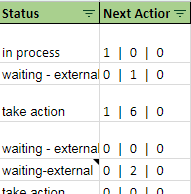
The formula is a simple “count” function that looks at those three tabs, and returns how many actions have that project ID (see how functional that project ID is?!). Why is this little column useful? Well, if you’re doing a review of your projects (which I do), you’ll want a quick way to identify which ones don’t have any activities in progress so you can ensure they get on your lists. A string of “0 | 0 | 0” tells me that there are no open actions for that project, so I had better put some in there or cancel or defer the project.

The Waiting For and Agendas Sheets

These two sheets are fairly straight-forward, and need little in the way of information. Mainly, it will be someone’s name, what I need from them, what project it’s for (named by — you guessed it — the project ID!), and notes about when I asked them for it (kind of like a log).

What determines if it’s on the “waiting for” sheet or the “agendas” one is basically the answer to the question: do I have a regular meeting with the person where I could bring this up? If the answer is “yes”, it goes on the “agendas” sheet. If the answer is “no”, it goes on the “waiting for” sheet.

The Incubator Sheet

Perhaps the most underrated — and also underutilized — idea to come from GTD is the incubator, or “someday-maybe”, list. I never quite knew how to use it until I heard an interview with David Allen where he talked about the fact that if he hasn’t done anything with a project from one weekly review to another, he puts the project in the incubator.

The idea here is simple: if you’re not engaging with a project regularly, then take it off your list of projects. It’s probably only causing clutter, and thus inducing psychological resistance to really diving into your projects and actions.

A major step in the weekly review is to look at the incubator and either move projects back into active status, keep them parked in the incubator, or delete them entirely. I try to do this as often as I can.

The Weekly Review Sheet

The weekly review process is critical to ensuring that your list of projects and actions are doing what they’re supposed to do — getting you the personal and professional life you want. In order to ensure that, you need to run through them all regularly (preferably weekly) in order to ensure that they are fresh.

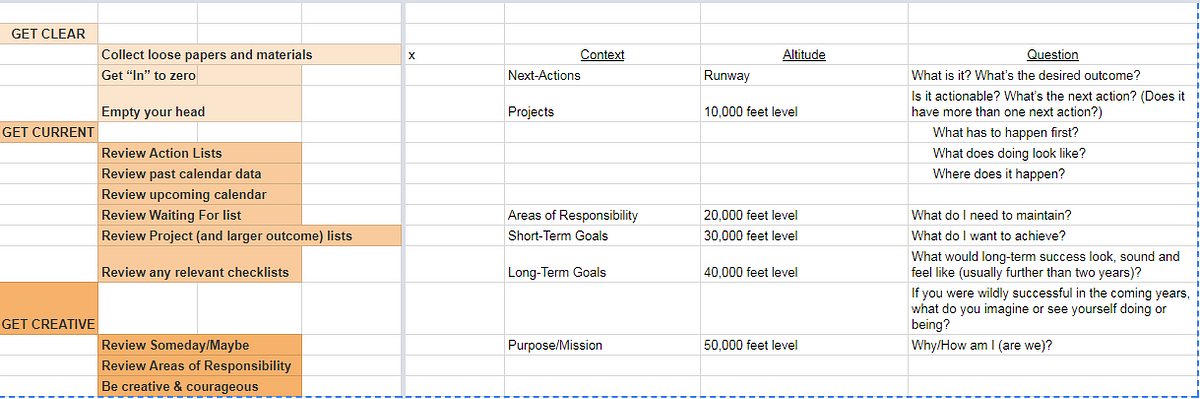
My weekly review sheet is basically a checklist of questions and points to examine. I add and subtract things, but overall, it’s a list of triggers to remind me of projects or tasks that need to happen. It also serves to ensure that my current projects and tasks apply to my goals. Below is a snapshot of one section of my weekly review sheet.
The Projects (Completed) Sheet

I have found myself on more than one occasion asking what the outcome of a certain project was. Sometimes even when I know what the outcome was — for example, that I abandoned it — I find it useful to know when I made that decision and why I did.

So now, I keep a sheet where I cut and paste projects that are done or killed (i.e. they’re not on the projects or incubator sheets). I keep a column where I explain the outcome, like when it was finished and when I sent the finalized signed document. Perhaps this is too much for some people, but I have found it quite useful.

Using the Workbook

I begin each day by opening my GTD sheet. I look at the action items I didn’t complete yesterday and move them to today or further out. I look at my projects list to prompt me for new action items to do today. As I check my email, I’ll mark off any items that I was waiting for that have been completed. I’ll also update notes on project statuses and move dates in or out based on new information. As needed, I’ll update agendas for certain projects as well, or delete agenda items when I no longer need to address things in standing meetings.

I do this on various devices, too. It’s not unusual to see me at home with all 3 devices open and looking at my GTD sheet and email. Whenever I’m on a plane, I make sure to update my GTD sheet and then use it on my iPhone to look at projects while I type notes or complete tasks on my laptop. I try to be as cross-platform with it as possible. It’s a big reason why I chose it in the first place.

Features in Google Sheets

Notes

I use Notes for several things. One is to start listing all the next actions for a given project that I can think of. Then, I can literally copy them from the note, and paste them into my next actions list with a date to target for completion.

I also use Notes for just what they sound like — to be quick notes. For my projects tab, I’ll put notes on the status of a project to log some major milestones or relevant status information.

You can use Notes in a variety of ways, and it’s as easy as right-clicking on a cell and selecting “insert a note”. It’s even easier on the iOS app, where it’s available upon selecting a cell.

Comments

Comments are pretty cool, but I’m still working out the best use for them. They autoformat hyperlinks, which Notes do not do. That has been useful for me on a few occasions. Also, the amount of comments in a sheet is shown in the tab as a parenthetical value. So theoretically, you could reserve comments for items where it would be important to see how many comments are on each sheet. For me, this is a work in progress.

Much like the Notes feature, you simply right-click on a cell and click “insert comment”. And the great thing about comments is that they allow for collaboration. Anyone with access to your sheet can comment on cells, and comment on your comments — like a conversation. Each commenter’s name is noted (or anonymous user designator) to allow for easier tracking.

My Humble Suggestion

I’ve used so many different task and project management programs for personal productivity that I have become a bit disillusioned by most of them. I have found that a spreadsheet allows me to work in a very agile but intuitive and organized way. Plus, it’s easily cross-platform.

For those either just beginning with personal productivity systems, or those who are looking for a fresh new tool to use, look no further than spreadsheets. They’re not just for number-crunchers!


The Better Humans publication is a part of a network of personal development tools. For daily inspiration and insight, subscribe to our newsletter, and for your most important goals, find a personal coach.


Second Arrow Syndrome: How We Multiply our Own Suffering, and How We Might Avoid It

Photo by Paul S Barlow

Spiritual traditions are big on fables. One of my favorites comes from the Sallatha Sutta in the Buddhist tradition.

When touched with a feeling of pain, the uninstructed run-of-the-mill person sorrows, grieves, & laments, beats his breast, becomes distraught. So he feels two pains, physical & mental. Just as if they were to shoot a man with an arrow and, right afterward, were to shoot him with another one, so that he would feel the pains of two arrows; in the same way, when touched with a feeling of pain, the uninstructed run-of-the-mill person sorrows, grieves, & laments, beats his breast, becomes distraught. So he feels two pains, physical & mental.

I find myself easily frustrated these days, and it has everything to do with making myself suffer because I’m suffering. I inadvertently double down on my suffering.

This happens to all of us: we get hit with arrows every day — arrows of disappointment, arrows of loss and sorrow, arrows of dissatisfaction. Then we feel bad about feeling bad, and we shoot ourselves with a second arrow. We feel bad, then we feel worse. We spiral, and exhaust ourselves.

But it doesn’t have to be this way.

The Problem is Pleasure

If I am really honest with myself, most of my stress, frustration, and lashing out comes from a feeling of discomfort. But it’s not the discomfort itself, it is my bad feeling about discomfort that creates problems.

I am so obsessed with pleasure and comfort, that I cannot even handle the thought of discomfort or pain. I contort myself in myriad ways to avoid them. And that is precisely the problem. Because in my push to chase pleasure and comfort for so long, I have robbed myself of one of the most beneficial traits that anyone can have: being able to accept and work through discomfort and pain.

And I am not alone. I am surrounded by fellow pleasure seekers, who’s inclination toward satisfaction and desire for continuous pleasure are being constantly reinforce by a deluge of media and marketing efforts. We swipe left and right, we refresh, and reframe. We skip past the waiting, we circumvent moments alone and moments of silent unstimulated introspection. We inadvertently block ourselves from becoming something more resembling whole.

A Step Toward a Solution: Favor Discomfort

The more I think about all this, the more I think that rather than pursue comfort and pleasure, I should favor discomfort. What I mean by that is that when I am presented with a choice to expend the effort to pursue pleasure or to allow pain and discomfort, I should choose the latter.

And this is not to punish myself, or to go full bore into the land of ascetic self-denial. It is merely to practice at something that I am currently terrible at doing. It is exercise, but exercise for my spirit. The hope is that by becoming more, well, comfortable with discomfort, I will not feel so on edge all the time. If I don’t feel on edge all of the time, I won’t do things I’ll later regret — which I only did thinking that they’d make me feel better.

In short, by becoming okay with discomfort, I can become a better person.

Because at the end of the day, the cycle ends up being the same. You feel badly for some reason or another. So you attempt to soothe yourself with something that makes you feel pleasure. But that pleasure is short-lived. And usually, that thing that you relied on for the pleasure was actually the kind of thing that harms you long term. It sets you back in achieving a long-term goal, or it breaks a promise to someone (or to yourself), or it is just plain unethical.

So really, it is in becoming okay with discomfort that we can come to be better people, and to achieve more. And we become more comfortable with the kind of things that others wouldn’t be. So we become stronger. And on this, we can build.

Only One Arrow

Going forward, I will try to embrace discomfort. I will make due with less, and toss away the urgency to try to soothe any little feeling of desire or deficit that I have. I will most certainly be hit by arrows, but I will not shoot myself with any.

This is not “being hard on myself” — if anything, it is the opposite. Most of the “second arrows” we are hit with are the direct result of too many desires — which have become expectations. When we expect something — especially something that will give us pleasure — and we don’t get it, we inflict even more pain on ourselves.

So the best way to avoid that second arrow is to pinpoint that moment when your desires become expectations. Desire all you want, but don’t let that desire turn into an expectation. All that expectation is is more weight on you, and it adds up. You continue to put weight on yourself — expecting too much from yourself and others. And if anything, that’s being hard on yourself. Learning to expect less — and even desire a bit less — is actually going easier on yourself. But that’s the weird thing: it’s actually really hard to go easy on yourself.

So do the hard thing, and go easier on yourself. You’ll have a much lighter spirit as a result.

How to Get Exponentially Better at Generating Ideas

credit: Samuel Zeller

A Framework for More Original and Productive Thought

It is impossible to overstate the importance that thinking has on our work and life. Being able to think well is the single most important factor in being more productive, less stressed, and achieving worthwhile goals.

The great tragedy is that when we’re busy (which we all always are), focusing on our thinking is the first thing we abandon. And this is, indeed, a tragedy. When we fail to set aside time to think — really think — about our work and our lives, we fail to live and work intentionally. When that happens, we fail to achieve the things that would truly fulfill us.

Even if we set aside time to think, if we don’t do it in the right way, we can still fail to harness the benefits of it. In order to do the kind of thinking that will boost productivity, engagement, and yield original ideas, we need the right framework. We can’t simply “think deeply” or “think differently”. We need to structure or way of thinking in a certain way. We need to think wide at times, and deep at others. We need to change the way we think about thinking.

So, thinking deeply is one thing, thinking broadly is another, and thinking differently is yet another. But in order to do that, we need to think freely. And doing that is not as simple as it may sound. I intend here to dive in to exactly what I envision that to be, and how to begin doing it.

Going Beyond “Deep”

I’m a fan of Cal Newport’s book Deep Work. There is a lot of great material in it. Among the heap of tips for doing great work is something called a “Roosevelt Dash”. The nut of the concept is this: when you want to do a task or project, you can force deep focus on it by taking the time you’d estimate it would take and reducing it substantially. Then just get to work, and don’t move away from that work until you’ve finished.

Using the dash effectively requires you to do a few things: take your deadline seriously, and remove yourself from the natural flow of distractions, hunger, thirst, stretching, etc. Basically, when you go, you go hard. This, Newport says, will force you to also go into a deep focus on your work.

I love this idea, but it doesn’t exactly work when you don’t have your work defined for you — when you need to come up with ideas. Here’s something that I realized in that regard: going deep is not the answer to coming up with cool new ideas. In fact, going into deep focus is antithetical to coming up with new ideas.

In short, it does no good to go deep if you haven’t gone wide.

Going Wide

Focus is great for most of the work that we do. That’s because most of our work is by and large already defined — we know what we have to do. There is a spectrum of how well-defined work is. Some is pre-packaged — read to just do. Other work requires a lot of thought and preparation before even beginning it. But usually — no matter the type of work you have in front of you, it has pretty clear constraints.

For example: You may not know exactly what the end-game is for the presentation on Q2’s profits, but the constraints are clear that it has to say something about Q2’s profits. Deep focus can help you here because you have an idea of where you’re going. Most destinations on the map are not live options . You’ve got a general location of your destination, you just need to find the route by which to travel there.

When we are just trying to drum up ideas, the map is totally open. Any place on it is a potential destination for us. The more we can align our thinking to reflect that, the better we’ll be at generating ideas. As I have heard David Allen say many times, trying to brainstorm with the focus of having a “good idea” is actually counterproductive. Simply put, aiming for a “good idea” is actually a terrible idea.

The Practice of FREE PLAY

So here’s a better approach: free play.

The concept is simple: wander around in as wide a mental space as possible, as freely as possible for some designated amount of time. Encounter as many thoughts as you can, noting as many as you can. As you end your time wandering, select the ideas you’d like to try on.

I’ve laid out a structured account of Free Play elsewhere, as it applies to teaching kids to think creatively. But the simple gist of it is that it is:

  • self-directed (not mandated by some goal, activity, or other person)
  • focused not on results but on exploration
  • imaginative, non-literal, and removed from demands of the rest of the world
  • involves an active, but unstressed (not under the gun) frame of mind

I intend to write just a little about this process now, with more to come later. Mostly, I’m doing this because I’m teasing out the idea of free play in practice, but also because it’s got a lot more to it. Here are some components worth noting.

Freedom is hard

To really reap the benefits of free play, you need to get your mind to be as free as possible. This is the most difficult part of the process — by far. Our minds are very good at retaining and juggling ideas, goals, desires, needs, etc. Ask anyone who’s ever attempted meditation, and they will tell you. Getting those things off of your mind is exceedingly difficult.

Thoughts, not ideas

The term “idea” carries a lot of weight. Usually, part of that weight is the weight of ownership. After all, the phrase “whose idea?” comes right to the fore when we talk about ideas. Thoughts, on the other hand, don’t seem to have this weight. We have thoughts all the time, but we don’t seem to equate them with a commitment or ownership. So when you’re looking to leverage free play, be sure to wander around encountering thoughts, rather than ideas.

Encountering vs. Having

In line with the use of the term “idea”, try to think not about having thoughts when your’e doing free play. Think instead about encountering thoughts. They’re not yours — you didn’t create them, and you’re not responsible for them. You can take or leave them, so act accordingly.

You’re “trying on” ideas

Most of us wouldn’t feel great buying clothes without trying them on. This is the way we need to look at ideas as well. After a session of free play, when you’ve got some thoughts recorded, keep a list of thoughts and ideas you’d like to try on. That’s the takeaway of doing free play. You’re looking for ideas to try on. That trying on period can be hours, days, months, or years. It all depends on what the idea is.

The great thing is that (to further stretch the clothing metaphor) you can take the ideas into a tailor to have them altered to suit you and your goals. Every person you bounce the idea off of (including yourself) can make alterations to it over time. But at the end, if you’re not happy with it anymore, you can leave it behind — no questions asked.


Make no mistake about it — thinking is the most misunderstood and underestimated work we do. But it is also the most important work we do. The more we can learn to do it better, the more productive we will be. Think wide, think freely — but most importantly, give yourself the right space in which to think. Your mind will thank you for it.

A Few Pieces of Simple but Useful Wisdom

Gathered during 34 years of building a life

I have been on this planet for just over 34 years now. During that time, I’ve built a modest but fulfilling life. I have many close friends and family to thank for helping me build it. I have many more people to thank who did not directly help me, but gave me advice that influenced me greatly along the way.

Here are a few pieces of wisdom that I gained from others — in no particular order.

Strive to make people comfortable

We as humans strive for comfort. It is when we feel comfortable that we will let down the defenses and the fronts, and be genuine and open. No matter what you are doing — whether building friendships or attempting to defeat rivals — making people feel comfortable is always a great strategy.

When people feel comfortable, they will be more open, more honest, more patient, more willing to try to understand others, and more likely to collaborate.

Another thing that happens when you make others feel comfortable is that you make the kind of impression that is hard to forget — an emotional one. Take it from Carl Buehner:

They may forget what you said — but they will never forget how you made them feel.

Answers are overrated

The smartest people I’ve ever had the pleasure of working with have tended to ask more questions than anything. Many times, I got the feeling they knew the answers, but they asked questions anyway.

One professor I had did this to an extreme. When I asked her why, she told me that 9 times out of 10, even when she knew the answer, there was something about the answer that she didn’t fully understand that asking the question helped solidify for her.

Answers themselves are rarely even answers anyway. They are rarely the whole story. Usually, answers show themselves to be merely the preamble to a deeper question, which we didn’t bother to ask before.

Everyone has reasons

People do terrible things all the time. People do shady or questionable things all the time. It is part of life. But everyone has their reasons, and to forget this is to miss an opportunity to better understand individual people and human nature as well.

I don’t mean that everyone’s reasons justify what they do — that’s just ludicrous. What I mean is that everyone had a reason that compelled them to do what they did — no matter how thoughtless it may seem to us. They may not always be aware of the reasons — but they are there. Sometimes the most valuable work we can do is to dig for them, in order to gain an understanding of them and — often times — of ourselves.

This too shall pass

Buddhists have a word in Pali: anicca — which underlies the entire buddhist philosophy. Essentially, it means “impermanence”. Nothing remains as it is forever. On top of that, most things fade away or change radically within a short period of time. This is especially true of feelings and circumstances.

However you are feeling right now, it will pass. It rarely seems like it, but it will. Some sadness may remain, but it will not be as sharp. Loneliness may loom, but each passing moment doesn’t have the same intensity as before. You may be elated at having gotten that raise, bought that house, etc. — but that will also pass.

People get tired, systems lose energy, heart rates slow back down. It is the nature of things. Remember that and take some comfort in it.

Everything in moderation — even Moderation

Yes, living in moderation is good. But moderation doesn’t really look like most people think it does. It doesn’t mean always having only 1.5 drinks, always eating less than 2,000 calories, and having only the serving sizes. It doesn’t mean getting 7 hours of sleep every night, and saving exactly 10% of your income every month.

Moderation looks more like eating that whole huge piece of cake a few times, having a bit too much to drink at that one party with friends you haven’t seen in years — where you end up staying up all night and only getting 3 hours of sleep. Sure, to a short-term viewer, that didn’t look like moderation, but moderation isn’t a short-term game. Don’t beat yourself up for going to extremes here and there. The middle is nowhere to live at each moment, but a good life is made by a middle falling into place over the course of years.

You can learn something from everyone you meet

Seriously. Everyone has traveled a different road, has a different set of experiences, different expertise, and thinks differently. Your failure to learn something from them is due only to a lack of time or a lack of trying on your part.

The more you structure your casual interactions with people around trying to learn something from them, the richer they will be. The benefits abound. You’ll learn more, connect more, and make a better impression on people.


I hope this helps. And even if it doesn’t, at least I got it all down in one place for me to look at later.

Did you find value in this piece? Consider subscribing to my weekly newsletter — Woolgathering. It’s one email per week, with great ideas to add value to your life and work.

We Are All Creatives: A Manifesto of Humanity in the Age of Automation

By recent estimates, something like 47% of jobs face the threat of being automated over the next 20 years. That means that what was once done by humans alone will now be done by a machines and algorithms.

As more of that 47% becomes a reality, all eyes are fixated on that other 53% — the stuff that we used to think was solely the realm of human capacities. If you go back as far as Aristotle and the early scientists, it was reason that made humans unique in the world. And until humans built machines that could use the same logic they do, that was true.

c/o McKinsey & Co.

Now it isn’t reason that sets humans apart. We learn to reason the same way that machines do; after all, we taught them how to do it. We are becoming sympatico in that respect. Only now, machines can already do it faster and more efficiently. They can take the inputs that we take, and make judgments more quickly — allowing for faster implementation of decisions, often without humans even being involved.

So what’s left for us humans? And how do we ensure that the remaining 53% of jobs keep their essential human elements?

Rationality is No Longer an Advantage, but Creativity Is

It used to be that reason was the uniquely human trait. It was what separated us from the other complex organisms. Since the advent of sophisticated computers, that trait seems to have been perfected by the machines. With computers being able to “think through” problems and solve them, reasoning has become the arena in which humans consistently come in second place.

That means that it is not rationality — logical thinking — but creative thinking where humans have the edge. We humble humans may be slowed down by tricky syllogisms, but only we can make up ideas from whole cloth. Only we can throw off the shackles of established thought.

Creativity is really an inclination more than anything. It’s a mode of thinking — one that refuses to take on assumptions without question, that looks for the new and untested rather than the traditional and accepted. Creativity involves embracing risk, venturing out into the deep end, past the ropes that others have set up to mark off the safe areas in which to swim.

But just to be clear here, the most creative people can often venture out past the boundaries without even realizing — or even caring. This is because some of the best creative work comes as the result of one thing: play.

The Power of Play

You are not a computer. You can color without a set of lines and instructions. The sky can be polka-dotted, the clouds can be striped. You can abandon rules and conventions — at least for a time. You can disrupt and ideate in a way that a programmed machine cannot.

So if you’re still reading this, remember and hold dear this edict:

I can create something new. I can wander for the sake of wandering. I have that uniquely human power.

We are All Creatives

I think that we assume a separation between those doing “creative work” and, well, everyone else. However, I have my doubts that there really is such a separation. Furthermore, I think that believing in such a separation may actually be harmful — to everyone.

We are all “creatives”.

There is a place in all of our work for creativity. Every kind of work can benefit from it. In fact, it is those jobs where we often don’t see a need for creativity that most badly need a creative touch. That elusive and desirable thing that so many in the business world chase — innovation — is often a direct result of creative thinking in the very places that no one expects it. This is because creativity is what makes us human.

So take the mundane job that automation might threaten, and ask what illogical and emotive tasks can be built-in. Ask what personal and emotional connections there are that can provide better interactions between people, better collaboration, and spontaneous advancement. They are there — you just have to think creatively.

Venture Outside the Lines

At least for the foreseeable future, computational thinking needs to color within the lines. There may be an increasing number of lines that it can color within, but the lines are necessary nonetheless.

We as humans have the ability to see the lines, understand them, and then venture far outside of them — to bring back ideas and connections that weren’t within the bounds of logical thought structures.

So use that power. Observe and note the lines — understand them — then color outside of them. Do so without regard for what the goal is — the goal is simply to wander. Everything else is secondary. I think you will find that enough of that wandering will yield some truly wonderful things. Those things can then be injected back into the humdrum activities of daily life for whatever goals you have adopted. Or perhaps, they will reveal entirely new goals toward which to strive.

Go forth and play. Know the rules and abandon them for a spell. Swim in that uncharted water, then return and tell us what you found.

The Powerful Mental Benefits of a Daily Morning Run, and How to Start the Habit

Until I was in my late twenties, I hated running. I played sports (off and on), I did some exercise, but I stayed far away from running anything longer than a distance of a few city blocks.

Running got me exhausted way too quickly. I can’t breathe well through my nose — mostly due to issues with my sinuses and septum. I have lower back issues. My knees crack constantly, and one of them had some pretty bad flare-ups of bursitis. All legitimate reasons to continue to stay away from running.

But for whatever reason, at about age 27, I decided to start running. I enlisted the help of the now well-known Couch to 5K plan, to get me able to run a long distance without needing a nap after a few minutes. I expected to become more physically fit, gain better respiratory endurance, and lose body fat.

Those things all happened. And I was able to finally run a 5K within a few months — posting a decent time. But way more important than all that were the mental benefits that I received from running.

Running clarifies your thinking by changing your mental environment

There have been very few times where I have gone out running and spent the rest of the day feeling mentally clouded and overwhelmed. When I’m running, my mind and body are both outside of the normal constraints of work and life. This provides two benefits that directly correlate to a change in how I think about things.

  1. I am physically away from the noise of emails, documents, task lists, and notes. I’m outside of the chair, and away from my computer — getting fresh air. I am forced to think about things at a high level, based on what is important to me at a fundamental level — not just what I say is a priority on a project list.
  2. I’m allowing my mind to roam without a specific agenda. The pressure is off. I can wander off the beaten path, and think through odd ideas. It’s effectively bonus time.

When it comes down to it, you only have to think about continuing to run, breathe, and ensure you don’t run into something. Sometimes, one or more of those things can demand most of your attention. And though that can get in the way of your thinking, it can actually serve as a really effective reminder to stay centered on what’s important to you.

Running builds mental toughness

This is probably the most Malcolm Gladwell-ish thing I’ll write, but the one trait that seems to display the most return on investment in helping people “make it” is perseverance. In fact, This American Life did a whole story about it vis-à-vis education. There is no more primal a challenge to take on than forcing your way through a tough run.

This applies whether you’re running 10-miles at a 7:00/mile pace, or just trying to run for 30 seconds straight on your first time out. If you are really challenging yourself, it hurts all the same; it weighs down on you just as heavily; you have to dig just as deep to find the fight to push through and keep going. When you do push through, it is glorious, it is validating, it is cathartic. You will recognize a very similar feeling when you go hard at a project, or bear down during a brainstorming session and stumble upon a great idea.

Running relaxes the mind

This may sound counter-intuitive, but bear with me. If you normally find yourself stressed, filled with anxiety, and feel depleted by the day’s end, hoping for a surprise coma to keep you from having to deal with the pile of sh…stuff on your desk tomorrow, try running.

Run hard. Run to beat your last record. You will feel exhausted. You will have left it all on the road (or the trail) so to speak. But somehow, after a shower and your coffee, you’ll feel like everything is a lot less loud and fear-inducing. I don’t expect you to take my word for it; go ahead and try it. Feel free to email me in all caps to digitally yell at me if you don’t feel the aforementioned effects.

Running Sets a productive tone for the Day

If you wake up while most of the world is still asleep, and get a solid effort in during a run (no matter what your pace or mileage), I defy you to not feel the wind of productivity at your back.

Running creates momentum, both physical and emotional momentum. The latter is so vital to being productive, because momentum is 80% of the battle in whatever you’re trying to get done.

It’s easier to get moving when you’ve already gotten moving. No easier way to do that than a morning run.

Running is simple to begin, difficult to keep doing, and very difficult to do well

There is no simpler sport than running. All you need in order to get started is your body. Even shoes and clothes are optional (though usually preferred).And yet it is one of the most difficult to do well.

There are no barriers to entry, no tools that need to be purchased and learned before one can even begin the process. There are no books to read, no equipment to buy, no apps to download, and no gyms to join. You can literally get up from where you are, walk out the door, and start.

As far as barriers to just doing a thing, running has the fewest of them. It should represent the procrastinator’s worst nightmare, because so long as a medical professional hasn’t told you not to, you can just start…now.

Once you are out there, the simplicity of the exercise gives way to the difficulty of pushing yourself past previous limits. The end point is so far away as you begin to fatigue, and yet all you can do is keep taking one step at a time. You can speed up or slow down, but either will cost you over time; you must be strategic in using your energy. There is a hidden economy at work in a run.

Running is the perfect metaphor

Running is often the basis for metaphors that are used when talking about perseverance, achievement, and strength. Think of it: “mad dash”, “hit the ground running”, “crossing the finish line”, and so on. If you’ve ever really pushed yourself on a run, you will know exactly why that is.

Each run can be a saga, a war; rising action, climax, denouement. Every set of emotions, and nearly every type of gut-wrenching adversity can be experienced during a good run. It can only help you to go out there and run after them — literally.

Maybe you’re not sold on running yet as a habit, and that’s fine; you can’t start a habit. You can start taking actions that build one, and that’s really all you can do. The habit happens when the actions become part of who you are. I happen to be a runner — and it has made a huge impact on my life.

How to Form The Habit

Obviously, you have to get out there and run the first day, in order to make it a habit. There’s no way around that. But I have found some practical tips to make it that much easier to make running a habit you can stick to.

Take it Ridiculously Easy to Start With

Start with a very easily achievable goal for your first few runs. Just try running for 10 straight minutes, or 1/4 mile — whatever you think is 50% less than what you could easily do. This ensures that you won’t be discouraged when you don’t meet aggressive goals — which happens to so many people trying to start running regularly.

Put Your Clothes and Shoes by the Door the Night Before

If I had to pick the easiest but most effective way to get a regular morning run going, it’d be this one. Whatever you need for running: clothes, heart monitor, headphones, shoes, etc — put them out the night before, so they’re ready to put on and go. It’s easy to do, and one less thing to keep you from getting out there.

Give Yourself a Buffer before the Run

I wake up about an hour and a half before the time I step out the door to run. I get up, make coffee, and do an hour of work, as well as eat a small snack. Why do I do this? Two reasons.

First, and most importantly, almost nobody feels like running when they first wake up. I feel sleepy, stiff, achy, and foggy. If I had to get myself up and running (literally) right away, I’d take a hard pass on it. So what I do instead is allow some time to enjoy some coffee, eat a quick snack, hydrate, journal, and take care of some emails. By the time I do that, I tend to be more awake and ready to do something other than sit and work.

Secondly, having time before the run helps you to keep nagging thoughts from taking away from your run. Check your email, make your to-do list — do whatever puts your mind relatively at ease, so that you can at least start out your run with a relatively calm mind.

Use a Playlist of Music that Physically Affects You

You know that song that when you hear it, it gives you chills, and you can’t help but feel energized by it? I have a whole Spotify playlist of those called “Run”. It’s 109 songs that give me little jolts of energy. Some are fast and heavy, some are groovy, some are slow. But they all make me feel something profound, and thus get me moving.

This isn’t the same as downloading some playlist that someone else curated, which is scientifically formulated to match the pace of your run. This isn’t about keeping tempo with an elevated heartbeat. This is about finding songs that personally get you energized — many of those would never show up on a curated “workout” playlist. An example from my list? “Swiss Army Romance” by Dashboard Confessional. It’s a slow emo song. No beat at all, because it’s just an acoustic guitar. But it has personal significance for me, and every time it comes on, I get chills. I push harder, I feel better. It works.


Running has amazing physical benefits. But the mental ones are even better. The only way to reap those benefits, though, is to just get out and run. I’ll be doing it until there’s ice on the roads. Join me, wont you?


The Better Humans publication is a part of a network of personal development tools. For daily inspiration and insight, subscribe to our newsletter, and for your most important goals, find a personal coach.

The Quiet Voice: On Listening to the Noise in Your Head, and Using it to Your Benefit

Close your eyes for a few seconds. You don’t need to go find a quiet place, in fact the less quiet the place, the better. Now just listen. What do you hear? No, not the droning of the world around you listen deeper. What’s going on in your head? Everyone has a voice or two (or three or ninety) in their head. They’re not voices you can literally hear, rather, they are the ones to which you listen — the ones you follow the directions of — as you go about your day and decide what you are doing.

There’s the one voice that reminds you what you have to get done today. There’s the one that tells you that you’re screwing up. There’s the one that insists that you’re an impostor, and don’t deserve any of the success you’ve achieved. There’s the one that tells you that you really haven’t achieved anything. But there there is another voice — one that often isn’t loud enough to be heard over the others. I call it the quiet voice.

What I propose is that we make time to listen to that quiet voice, because it has a lot to teach us. But the lessons are difficult to learn.

Tuning into yourself

I promise, I will try to make this piece as un-self-helpy and un-fluffy as I possibly can. But there is an element of this strategy that is about getting in touch with your deeper self. You can say you don’t have time for it, and on a superficial level, you’re right; none of us do — we’ve filled our schedules to the brim. We keep filling them, too; our cups overfloweth with things to do.

But at a deeper level, we have plenty of time to get in touch with our deeper selves. We have just chosen to fill that time with other things. The tragic irony is that so many of these other things with which we have filled our time would be much less taxing, or perhaps not even choices we’d have made, if we were really in touch with our deeper selves.

The deeper self simply is that “quiet voice”. But it’s not quiet because it doesn’t have anything to say, or because it is meek. It’s quiet because it it has subsisted, and will continue to, while all the other voices we hear shriek and holler themselves to death. We hear it in those rare moments when the volume on all of the filler in our lives gets turned down. It is so rare that we hear it, and even rarer still that when we do hear it, we understand it.

What are you saying to yourself?

The quiet voice is your bare identity. It is what you are after you strip away all of the social and status-based constraints and contortions. Below your career objectives, your religious rituals, your social obligations, and your biases tell you you should be — what are you in each bare present moment? What is that thing below all of the pretense, down below all of the promises you’ve made, and all of the strings that have been attached? What is that unencumbered nugget of existence you have buried inside of you saying?!

Answering this question is crucial for tapping into real personal growth because it’s the fountain from which all of the rest of your identity flows. It’s that part of you that connects with things right now, in the moment. It’s the part that makes the rest of your identity possible because it is where all of the passion — all of the fervor — originates.

Our modern existence finds us so at odds with what this voice is asking for, and we sense that every time we are stuck, and not sure where to go, or feel so weighed down by our daily navigations of the maze.

It takes a lot to get to that place where all of the normal buzzing and whirring of the social machine is stripped away. People enlist the help of meditation, exercise, journaling, and so many other things. But those tools must always allow for focus on the goal of digging down deep, lest they be only fancy tools with no real use.

The focus needs to be on getting into that space where the quiet voice lives. Down there, you can find just a flicker of real freedom — the freedom that comes from so many possibilities, from the ignorance about the cautions adopted throughout an adult life, ignorance about the judgments of uninformed critics. I see that flicker in my young daughter’s eyes, when she picks up toys, and begins to mix them together, unlocking new possibilities — embracing new enthusiasms.

Listen to Understand

Here’s the kicker though: just because you listen to the quiet voice, doesn’t mean you have to agree with it, or follow it’s urges. No, in fact there are a great many things that the quiet voice may say that seem despicable, that you’d never want to repeat — and that’s okay.

You need to confront those terrible things you hear and feel, to make your peace with them being there, or to begin the path to changing what your quiet voice says. Either process is fertile ground for inspiring creative work. The struggle to change or the struggle to make peace can be the struggles that sow the seeds of great art. But fear — whether fear of failure, fear of judgment, or fear of finding out what’s really down there — must not be allowed to win. When that happens, that light of possibility for true creativity, truly inspired work, dims once again.

I fear that I have failed to make this writing un-self-helpy and un-fluffy, but I am okay with that. I only promised that I would try, and try I did. Had I listened to the quiet voice initially, I probably would not have made such a promise. So it goes, but I hope that at least reading through this mumbo-jumbo helped you — that is my only real aim here. If it did help you, share it with others. Sharing is caring.

Some Unconventional Advice to Hungry, Passionate Creatives

A Meditation on Progress, Creativity, and Purpose

For a long time, I’ve been obsessed with a concept. The problem is, I’m not sure what to call it.

I am really into the beginning of things — the origins, patient zero, if you will. My favorite parts of autobiographies or historical narratives are the beginnings, where we get a glimpse into how things were right before the bigger arc of the story was set into motion.

That slow pre-build-up gives me a certain exhilaration that I find hard to describe. I would liken it to that feeling one gets in an open space outside, during mid-summer, when a dense wall of dark storm clouds is rolling in from the west.

You hear the thunder in the quickly approaching distance. You can see some sparse, quick flashes of lightning, and a slight but strengthening wind blows through every 30 seconds or so. Things are about to get crazy, but right now — right now it’s just that moment — the beginning.

I think that feeling is magical. Let me say that in a more useful way. I think that feeling wields a lot of power.

Don’t Create — Just for a Bit

To test this out, try a little exercise: open up a blank document, take out a fresh blank piece of paper, a white primed canvas, or what have you. Now meditate on the following:

  • This blank thing could be anything. The possibilities are endless. It could be something that’s been done before, or something that will blow the lid off of the world. Isn’t that pretty damn wonderful?
  • It is not a work in progress, with all of the burdens, commitments, and anxiety of expectation attached. It is all possibilities; none have been eliminated — all are in play. You can go anywhere from here.
  • How about basking in that wonder, for just a little bit longer than you’re used to? Don’t create anything, just bask in the possibilities.

All of this is just to say that there is value in a blank medium. That is because there is value in potential energy. There is value in that feeling that comes with being on the cusp of starting something.

Let that feeling help you realize the value of that potential energy that you have at the beginning of a creative venture. It’s a truly awesome reminder of the power that you have — the we all have — the power to create; to make something from nothing.

Value and Focus

My soliloquy above was an attempt to show exactly how a blank is already valuable. It’s valuable because it puts you face to face with your potential — your nearly unlimited potential.

Now obviously, you probably can’t just act as if a blank document, presentation, recording, or canvas is your newest work — that’s been done in pretty much every medium. But I think the point here is that there are two areas of focus when you’re working on creative stuff: the frame and the piece itself.

A frame is a wide concept, meaning that it can be so many things when it comes to creative work. The frame is the presentation — that which focuses people’s minds on what’s being presented. In a way, how you frame something is tremendously powerful — it’s a chance for you as the creator to further express what you’re trying to express by almost making people look at your work in a certain way, from a certain angle, in a certain progression.

That’s an important thing — don’t overlook it. You work hard on what you’re doing (I presume). So you shouldn’t just heave your idea off the ship of creating, mumbling here’s another one for ya under your breath.

A Trick? Maybe. But a Pretty Good One

If nothing else, this strategy (like some have been and more will be) is a trick to get your focus on something greater — the purpose of your work.

Think of it: if you focus on how your work is framed, on how others will be receiving it, you will have to grapple with the important question of what your work is all about. Focusing on the what and why of your work is of the utmost importance. It may radically change the work itself — and that’s fine. After all, you’re trying to do something worthwhile, aren’t you?

I’ll go ahead and take this opportunity to beat a favorite dead horse of mine:

Never be afraid to change, delete, erase, or start over — because in doing so, you are not eliminating progress. As a creator, your progress is made in the realm of ideas, not on paper.

This is another realm in which you must be fearless. You must not fearfully cling to what you’ve put down on paper. Hell, that paper (or digital document) is not the medium of your creation anyway. Your medium is in the realm of ideas — the realm of connection. Any progress you make as a cfreator will remain long after any types words, ink marks, or paint splatters fade away. Remember that, or forget it at your own peril.

Sometimes, it is truly what you DON’T create that is the most valuable.

Did you find value in this piece? Consider subscribing to my weekly newsletter — Woolgathering. It’s one email per week, with great ideas to add value to your life and work.

The Prisoner’s Dilemma of Online Content

How the content inflation caused by online marketing is hurting its future, and what we might do about it.

Last year, I signed up for the email list of a pretty famous writer/podcaster/internet personality. I liked the few articles that I read, and felt that I’d like to get some emails from him — pointing me to other useful information or just to keep updated on what he wrote.

Within 24 hours of signing up, I received 6 emails (not counting the opt-in/confirmation emails). Over the next week, I received an average of 3–4 emails per day from him (well, not him, more like his content management/automation system). They were dense with content. I saw no light at the end of the tunnel. I had to unsubscribe. I’ve now become very circumspect about what I sign up for.

That got me to thinking: have those of us in the “content” game (I hate that term, by the way) reached the point where our continued efforts to grow our audiences are now actually hurting all of us? I suspect the answer is “yes”.

My Leaning Out

I’ve recently started receiving fewer emails, by design. I’ve unsubscribed from all but a few newsletters and e-mail updates that I consider high-value. I’ve also eliminated a lot of the reading from RSS feeds that I do, unless I see the person or website as one that I consistently gain some value or enjoyment from.

At the same time, I’ve also recently gotten more involved in marketing. I have my own newsletter (Woolgathering) — which I spend a decent amount of time crafting each week. I write for publications on Medium, and like to make sure that people see the stuff I spend my time and attention writing.

But I get the sense that when it comes to content on the internet, and the marketing of it, we as content creators and marketers are caught in a form of the prisoner’s dilemma. This basically means that we will need to rely on trust in each other and the mechanisms of internet content to all reap the benefits of profiting from the attention of others.

The Dilemma Explained

The Prisoner’s Dilemma is a thought experiment that comes from Game Theory, and it helps to illustrate a tragic aspect of human reasoning. I taught Philosophy at the college level for about 5 years, and have always struggled to succinctly explain it to students, but here’s my best attempt.

Imagine two thieves — you and Carlos — are apprehended by the police and separated for individual interrogation. You each have two options: stay silent, or testify against your accomplice. If you both stay silent, you will both only get 6 months in jail. If one of you testifies and the other stays silent, the one who testifies goes free, and the one who stays silent gets 10 years in jail. If you both choose to testify against each other, you both get 5 years in jail.

As you can see, it would be best for you and Carlos to stay silent. Sure, you both get 6 months in jail, but you also avoid getting 5 years. But the problem is that you both fear that by staying silent, the other person will take advantage of the choice and testify against the other. So because you fear that, you both try to get the upper hand, and you both get 5 years. That’s far from a good outcome. For you, it’s the second worst outcome you could have gotten.

The Prisoner’s Dilemma is an illustration of a simple principle that plays out in certain instances where competition and cooperation are both options:

When we pursue the highest possible reward — which depends on some competitor getting the shaft — we end up making things worse for everyone. I see this happening with content now. The more we all feverishly push out content, to out-scream everyone else on the trading floor, the less people really hear anything. We yell louder and more often, people listen less and less. And so on ad infinitum.

How the Dilemma Applies to Online Content — In Two Interesting Data Sets

Compare the following 3 reports, from the Radicati Group, on how many emails are sent and received each day:

2014 email data & projections in billions, care of the Radicati group

2016 email data & projections in billions, care of the Radicati group

2017 email data & projections in billions, care of the Radicati group

Aside from just how staggering these numbers are, did you notice just how drastically the estimates went up from 2014 to 2017?

In 2014, the amount of emails sent per day by 2018 was estimated to be 227.7 billion. In 2016, that number was revised to 235.6 billion. That’s a 3.5% increase in the forecasted emails in a 2 year period — which would be notable in and of itself. But that rate is actually increasing. The 2017 edition of the study shows the projection for 2018 to be 281.1 billion emails. That’s an increase of over 23%, or 54 billion emails!

That’s just emails, but what about social media content in general? They say a picture is worth a thousand words, so here’s a quick thousand words about online content in general:

The sheer number of posts, emails, tweets, images, and hours of video posted every 60 seconds is more than we could possibly give full attention to.

Consider this:

  • the average blog post is about 750 words, which is about 4 minutes of reading time. If WordPress accounts for about 25% of text content on the internet (a generous estimate, I think) — that’s about 6,000 blog posts on the internet each minute. Which means there is 24,000 minutes worth of reading material published each minute online.
  • the average email is about 500 words, which is about 2 minutes of reading time, and there are 150,000 of them sent every minute! That’s about 300,000 minutes of emails sent every minute.
  • 1 hour of video takes 1 hour to watch (or if skimmed, maybe 20 minutes?). And there are 50 of those hours uploaded per minute!

In short, we’re generating exponentially more content each minute than we could consume in one day. And it is getting easier to create content more quickly, but no easier to consume it more quickly. The space between what we create and what we can consume is what accounts for what many call content shock.

http://cdn.business2community.com/wp-content/uploads/2014/01/economics-of-content2.jpg

The Nut of the Dilemma for Content Creators

I sit in marketing meetings with regularity. I also read a decent amount about marketing and content strategy (it’s pretty hard to avoid it, actually). The overwhelming majority opinion is that the more content, the better. More emails, more videos, more Facebook posts, more tweets, more instagram pictures, and so on.

But the more that all of us send emails, the more likely prospects are to go numb to what each company and person is trying to say. Noise becomes so loud that it drowns out more and more of the signal. But we keep making it easier to create more content more quickly. Because each of us have the primary interest of having our message heard, and we continue to see our peers churning out and ramping up content, we do the same. We fear that if we slow down, we’ll be on the wrong side of the prisoner’s dilemma. They’ll go free, and we’ll be in chains.

Like the prisoner’s dilemma, by all of us following our primary interest, we’re actually all doing worse for ourselves. But if we’d forego the possibility of huge gains, we’d make a better environment for all of us to get some attention, and thus better results. If we slowed the pace of content, and made it slower, more substantial, and more meaningful, there would be more time for consumers of it to consume it in a meaningful way. The numbness wouldn’t be so pervasive. Content overwhelm would be far less intense.

So What Can Be Done?

If we all agree to scale back how much of people’s attention we’re working to get (i.e., how much content we’re pushing, and how often we’re pushing it), we could stand to gain more of our target audience’s quality time and attention. Pie in the sky idea? Probably. Hard sell to marketing people? Most definitely. But the Prisoner’s Dilemma shows us that if indeed content shock is a real thing, it’s in our best interest to scale back. But there are two major problems.

First of all, we fear that by scaling back, we’ll be staying silent while everyone else is testifying against us. They’ll reap all the benefits, and we’ll be left in jail. It’s a real fear, and it’s the biggest hurdle to scaling things back. So long as this fear dominates, content will proliferate.

The second problem is that we have to be honest with ourselves about who our target audience is — and many are not. So, they blast out all sorts of emails, regurgitate content, and buy leads — all to try to just get as many subscribers and viewers as possible — even if they barely pay attention to you.

I’m not sure how to overcome either of these. I just write stuff on the internet. So maybe I’m part of the problem, right? Perhaps. But perhaps this particular piece of content can spark a realization in some of those who are tempted to push another few pieces out — just for the sake of pushing more out. Maybe don’t do that. Maybe just hone a draft, so it’s a bit more substantial. Maybe just take time to think about things. Maybe just have some quiet time. Really, it’s up to you. But for me, I’d like to spend some time thinking about an internet that is a little less like a loud, crowded city street, and more like a cozy corner of a library.

A guy can dream, right?

The Falsification Mindset: How to Change Your Own Mind

source: pexels

A simple practice to boost intelligence, avoid cognitive bias, and prove your own ideas wrong

In the middle of the 20th century, philosopher and professor Karl Popper found himself mystified by the beliefs and methods of the otherwise intelligent and rational people around him.

I found that those of my friends who were admirers of Marx, Freud, and Adler were impressed by a number of points common to these theories, and especially by their apparent explanatory power. These theories appear to be able to explain practically everything that happened within the fields to which they referred. Once your eyes were thus opened you saw confirmed instances everywhere: the world was full of verifications of the theory. Whatever happened always confirmed it.

Karl Popper

That last sentence should ring some alarm bells for many readers — it’s a very simple description of confirmation bias. Basically, when you gain a perspective or theory, you tend to interpret everything as confirming that idea. Whatever seems to contradict it is tossed aside or somehow contorted to fit our beliefs.

Popper saw this problem inherent in many theories — both in the physical and social sciences, and in other realms as well. After all, if we find evidence that seems to contradict our beliefs, we should be stopping to see if perhaps we need to abandon or modify our belief.

As a way to cure this ill of self-confirming theories and belief systems, he came up with what is now called falsificationism: the idea that a theory or belief system can only be scientific if it clearly lays out what specific evidence would prove it wrong.

Basically, if you’re going to claim that you know something, you have to be willing to admit that you could be wrong about it. More than that, you have to lay out what kind of evidence would prove you wrong. You have to make yourself falsifiable.

Why is falsification important?

My suggestion is that the spirit of Popper’s principle can help us become smarter and make better decisions — in both professional and personal realms. Adopting an attitude of falsifiability does a few key things:

  • it helps you to avoid many cognitive biases that can hinder intellectual growth and good decision making
  • it makes you a clearer thinker by forcing you to be specific about what you think you know, and what evidence you have
  • it boosts your creative thinking by making you naturally more receptive to new ideas and helping you more quickly process them

Our minds tend to run headlong toward safety and comfort. This is true with regards to physical safety and comfort —but it’s also true of intellectual safety and certainty. If we feel like we know something for sure — like we have a firm grasp of it — we want to hold on to that feeling.

Because we want to hold on to that feeling, we tend to manufacture certainty by either stopping the search for new information (fearful that it might endanger our feeling of certainty) or interpreting new information in a way that keeps supporting our feeling of certainty.

Those practices stifles creative thinking, intellectual growth, and personal growth. Here’s how thinking in terms of falsification can help you avoid this trap.

Putting the falsification mindset into action

The falsifiability mindset is all about thinking through the implications of beliefs, judgments, and decisions. It’s about curbing your craving for certainty. Adopting this mindset is as easy as picking up a simple practice.

For the decision that you’re making, take out a clean sheet of paper, and draw a line down the middle.

On the left side, write at the top “What I Believe to Be True.”

On the right side, write at the top “What Would Prove Me Wrong.”

That left hand side could be anything. It could be something personal and low-stakes, like I should buy the new iPhone model or something more substantial, like global warming is the result of human industrial waste interacting with the atmosphere.

The right side is where you will have to do a bit of thinking. That’s where this practice can yield dividends. Having to understand what would prove you wrong forces you to do 3 important things:

  • clarify what your actual belief is
  • confronts the possibility that you could be wrong
  • encourages you to tacitly commit to changing your mind under some specific conditions

An often-cited example of falsifiability: the statement that ‘all swans are white’ can be proven false by finding evidence of the existence of a single black swan. (Photo by David Cohen on Unsplash)

My personal falsification story

One of my strongest-held beliefs was that in order to be professionally fulfilled, I needed to be a professor of philosophy.

At age 30, I was ready to take the final step on that path and apply for PhD programs. I also found myself with a newborn daughter, a mortgage, debt, and a full-time job.

I spent 6 months writing and preparing applications, and was accepted into 3 different programs with funding. All were far away from home. It was decision time.

My wife and I had always talked about doing this in the abstract. But now, we had a baby, a mortgage, bills, and jobs. No matter which of the 3 programs I went to, we’d have to move at least a thousand miles away.

I had been promoted twice at my 9 to 5 job. Meanwhile, the job market in academia — specifically in humanities and philosophy — was brutal. About 50% of PhD students didn’t finish their program. Of those that did, it took at least 4.5 years. Upon completion, a tenured position was as rare: about a 20% chance within the first 5 years, and almost always hundreds of miles from the school where one obtained their PhD. And the median salary for a professor of philosophy was just about what I was making at my 9-to-5 at the time.

I was aware of most of those facts. But I was so certain about my belief that as each of them came up in discussions with my wife, I did what Popper described: I manipulated my belief to dodge the gravity of the new evidence.

At one point, my wife asked, exasperated, what would make me re-think my zeal about this professional goal I had. It was a good question, and it seemed like I had never thought of it before.

So I broke out a piece of paper, put a line down the middle, and on one side, I wrote my belief:

In order to feel professionally fulfilled, I need to accept one of these offers from a PhD program, quit my job, and move my family across the country.

On the other side, I wrote: what would prove me wrong?

The simplest answer to that question was that I would be proven wrong if I could do work that made me happy — without upending my current life for a PhD program. But I was so sure there was no way that was going to happen. My wife asked me to try to prove myself wrong by looking for ways that this could happen, however crazy they may sound. This took considerable effort to do, but it was the most transformative exercise I have ever done.

I sat down with that piece of paper, and I forced myself to pursue evidence and possibilities that contradicted what I so firmly believed. How could I still be happy doing anything else but taking this opportunity I saw in front of me? Well, I could do all of the activities that attracted me to being a professor:

  • thinking and writing about life’s big, interesting questions
  • teaching others to do the same
  • reading interesting and thought provoking stuff

Was there a way that I could do that stuff without cross-country move, the 4–5 years on grad school stipend, and the chaotic uncertainty of the academic job market?

The answer appeared to be yes.

I had recently started writing on the internet about the exact topics that I had always written about in the past. The online coaching and course-building phenomenon was already gaining traction. I could read and write about the interesting things I always enjoyed, as well as develop courses and teach others. And I could this without quitting my reliable source of income, moving my family across the country, or subjecting myself and my family to a brutal series of job hunts and inevitable cross-country relocations.

I began with a burning certainty in my belief. I challenged that belief by asking what would need to be true for it to be wrong. Once I wrote that down, I essentially committed to changing my initial belief if a certain condition was met.

By investigating what would falsify my belief, and whether those conditions might already exist, I was able to break out of the narrow mindset I had occupied for so long. By my calculations, it very likely saved me $400,000, along with saving immeasurable stress on my marriage.

How you can adopt a falsification mindset

Adopting the falsification mindset is simple. Like any exercise in thinking, it helps if you write it out, but that’s not totally necessary.

  • For any belief you have, ask what it would take for you to change your mind
  • Be specific about what evidence would make you change your mind
  • Seek out that evidence, and be willing to change your belief if you find it

For me, this was a game changer for an important life decision. But it also works for smaller beliefs and judgments.

Just ask yourself how you could be proven wrong — about any old belief you have. Are you researching a big purchase? If so, what discovery would cause you to cancel the purchase? Are you working toward a professional goal? If so, what new facts or experiences would convince you that this is the wrong goal?

We all have lots of hidden biases that can be examined this way.

If you really adopt the mindset, you should be able to see that your attitude will change — you’ll be more open-minded, and less likely to be dismissive of others or other sources of information. And in doing so, you should reap some serious intellectual benefits.


The Better Humans publication is a part of a network of personal development tools. For daily inspiration and insight, subscribe to our newsletter, and for your most important goals, find a personal coach.

The Enriching Effects of Humor as a Habit

I have a challenge for you: think back on all of the books, articles, and keynote speeches about self-improvement and growth you’ve consumed through the years. Now think of as many things as possible that they’ve identified as key traits for being successful.

Go.

Okay, stop. What did your list look like? Something like this, I imagine:

Optimism, resilience, grit, curiosity, emotional intelligence, empathy, passion, drive, listening….and so on.

Those are all valuable traits to have, for sure. But there is one tool that I think gets talked about less than it needs to be as an important part of the toolkit for success: a sense of humor.

Why do I think this? Well first, let me define what I mean by a sense of humor. A sense of humor involves a few things:

  1. The ability to stop — for an extended period of time — taking yourself seriously.
  2. The disposition to see people, events, actions, and institutions as imperfect, and subject to being laughed at when they present themselves otherwise.
  3. An appreciation for when the expected or desired order of things is not followed or is disrupted.

This is not a complete definition of a sense of humor, but it captures what I feel are the main components of it.

So why is a sense of humor important for success? Well, as a knock-on effect of merely realizing the above 3 things, you acknowledge the imperfection of both yourself, others, and various social constructs — like a company, industry, or government. When you realize the imperfection of yourself or something else, you are in a better position to make it better.

Beyond that, there are a few things that come with having a sense of humor that make success in life more easier to come by:

If you can laugh about it, you cannot be defeated by it

Things will go wrong for you at some time. You will make plans, and those plans will fall apart. You will come to rely on people or things, and they will fail to come through. It is part of life.

Stoicism has become popular recently thanks to its suggestion that we build a distance between things that happen to us and our reactions to them. What often makes us so emotionally distraught when things don’t go our way is our emotional attachment to certain outcomes. When they don’t happen, we are devastated.

Being able to laugh when things don’t go your way means detaching from your desires and dependencies just enough so that they don’t decimate you. It’s about a strategic emotional distance. Humor provides that distance, and maintains it.

A Sense of humor is a mark of intelligence

There is a decent set of research that shows a positive correlation between humor and intelligence. People who are able to make jokes about things tend to have a wider array of knowledge, and have made more connections between various areas in academia and business.

Caveat Emptor: Humor is Not Hurtful

A sense of humor does not mean getting a laugh at the expense of others. Everyone knows someone like this — the person who exploits social dynamics, insecurities, and pain of others for a laugh.

These people also tend to oversimplify nuanced things like psychological disorders or cultural beliefs in order to get easy laughs. Jokes that rely on those things are not indicators of a sense of humor, but rather a sign of intellectual laziness.

How to Make Humor a Habit

So how do you cultivate a sense of humor in daily life? I use a simple exercise: I think about myself and others as children on a playground, trying to do all the things children do on a playground: find a toy that’s fun to play with, find a person to play with you, dig in the dirt, go exploring, etc. Essentially, I think of every action and reaction as that of a young child on a crowded playground, just trying to make the most of things.

When I remember to adopt that view, the anger and the tantrums of others, as well as my own, become easier to laugh at a little. We get so frustrated sometimes, and we lash out — exactly like children fighting over a toy truck, or throwing sand because it’s not we enough to pack into a sand castle.

This isn’t to say that I minimize tragedy or misfortune. I wouldn’t do that to a child either. My 3 year-old daughter has breakdowns about things like blocks falling over, and I comfort her, and tell her “it’s all right. Blocks fall down all the time. We can rebuild, and it will be fun.”

But though I want to help her feel better, it is much easier to do that when I am not taking everything so seriously myself.

And that is the key. When you stop taking things so seriously, it’s the key to serious growth.

Did you find value in this piece? Consider subscribing to my weekly newsletter — Woolgathering. It’s one email per week, with great ideas to add value to your life and work.

Why You Should Take “No” for an Answer

Better Persuasion Through Acceptance

I was at a sales seminar about a year ago, when I heard a piece of advice so stereotypically salesy that I nearly did a spit-take: “you can’t be willing to take ‘no’ for an answer”. Sure it was actually not that candidly said, but distilled down, that was clearly the message being conveyed. I felt like I was being coached by Tom Cruise’s character in Magnolia.

Now, I’ve only done sales for a few years, at a few companies, but I just don’t buy this approach. I think not only should you be willing to take “no” for answer, but you should actually take that approach even further. You should accept the “no” and take advantage of it as an opportunity to teach you something about your approach, about the thing you’re selling, and about the market.
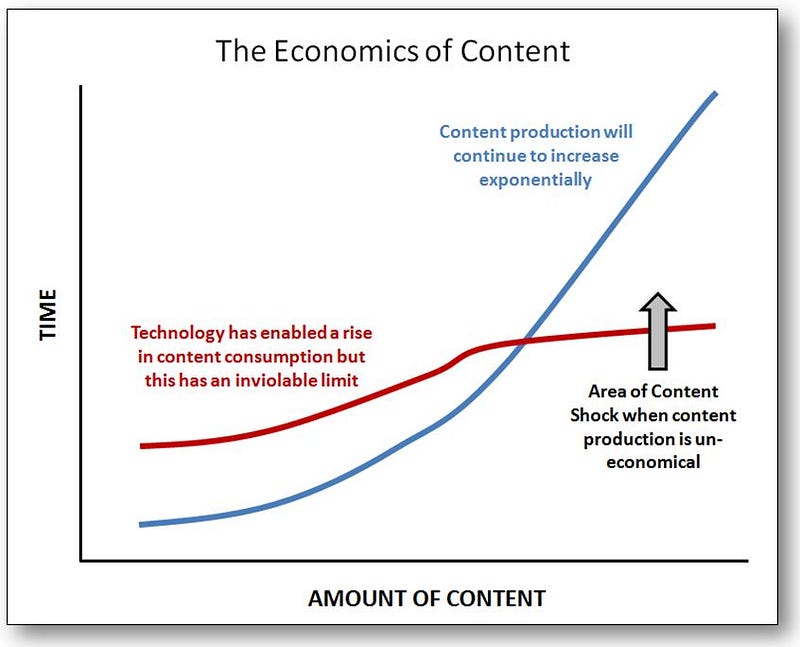
By the way, this doesn’t just apply to selling products or services for money. It applies to anything that you’re trying to convince someone of — any kind of persuasion. It’s easy advice to generalize: if you don’t hear the refusals you encounter loud and clear, you miss a great opportunity for growth — both personally and professionally.

How Did I Fall Short in Selling?

You’re not perfect. Neither am I. You should already know that. Somehow, though, when we get caught up in that quixotic quest to drive to drive growth in our business or product, we suspend that particular belief while we persist beyond the point of reason to just sell, damnit!

Doing that, however, has two unsavory effects. First, it can land a lot of customers who are not a great fit — ones who are skeptical and who may end up dropping whatever you’re selling like a bad habit very quickly or just never really appreciating what you’ve sold them.

Second, it can keep you from understanding what you might need to change about your approach. You can fail to learn things that could make otherwise skeptical customers actually be on your side.
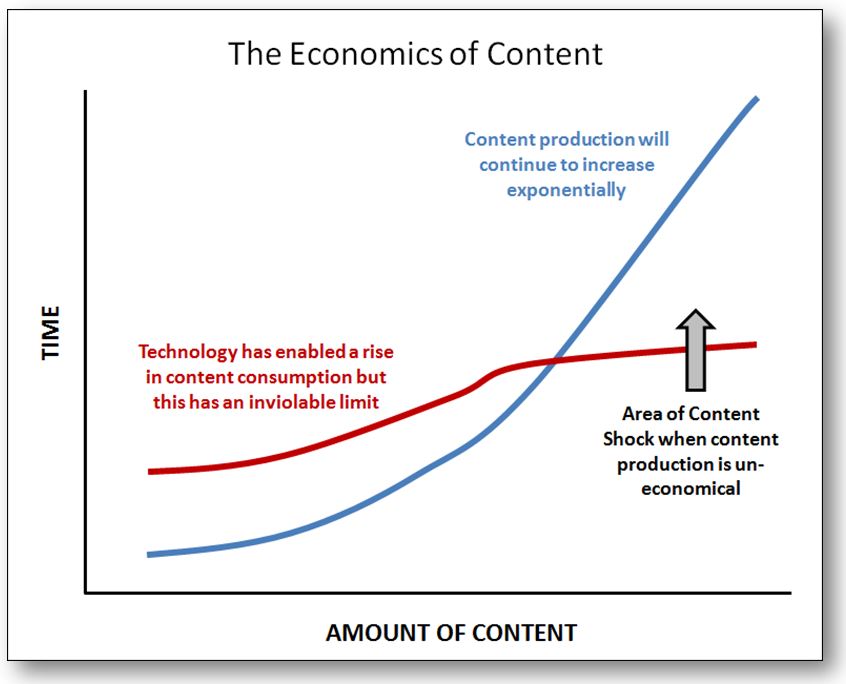
I won’t be the first (or last) writer on this topic to quote Simon Sinek, who said: “People don’t buy what you do; they buy why you do it. And what you do simply proves what you believe.”

I’ve found this to be true for the customers who stick with you. If they have truly bought in, you won’t have to constantly work to keep them. Meanwhile, customers who you roped in with the same old process will be looking for any reason to jump ship, or just never really be engaged.

You should always be looking to make your pitch the kind that gets customers to buy why. When it becomes clear that your approach is not working to close the deal, that doesn’t mean you should double down. It means that the why isn’t clear enough.

So don’t be afraid to take the opportunity to use their “no” as an opportunity to find out how your why isn’t quite getting to them — and what you can do to change that for them, or for future clients.

How is What I’m Selling Falling Short?

Your product or service is not for everyone.

Seriously, not everyone wants everything, at least not now. And some people will not be ready for what you’re selling right now. It could be because they don’t have a need for it, or it could be because you need to change something about it. A prospect telling you “no” is a great way to get data on what it is about your company, product, or service that could stand to be changed a bit.

A company that refuses to change itself and what it sells is a company that stands to miss a lot of potential growth. This is not to say that you should go making alterations to your product or service each time you get feedback.

Like I said, your thing — whatever it is — is not for everyone. But at least be willing to understand why you were turned down, so you can catalog the reasons, and look for trends that tell you something you may need to change. Many times it makes sense not to change anything — at least not now. But don’t underestimate the people in the marketplace. You do so at your own peril.

How is the Market Different Now vs. the Last Time I Made a Sale?

The worst thing you can do is to take a rejection of your sales pitch as a personal rejection. It rarely is. Remember, you’re selling to people who have various forces putting pressure on them. They have limited funds, they have expectations placed upon them for the things they purchase. That applies whether you’re selling B2B or directly to consumers.

In both cases, the biggest external factor that you need to work to understand is the market. When the market changes, it flows into the attitudes of the people who are saying “yes” or “no” to what you’re selling. It changes constantly — now more than ever, thanks to the amount of data flooding everyone’s decision-making process.

When you hear “no”, do a little digging to see if perhaps that “no” was actually more of a “the market for your product has been changing, and it made me re-evaluate things.”

You’ll want to understand how that happened, and take it back to either alter your product , or at least alter your approach. Again, you don’t need to change anything because of it. But refusing an opportunity to get that data is shortsighted.


Always Be Willing to Walk

The takeaway here is this:

Be willing to walk away from a pitch that doesn’t get you the business. But never be willing to walk away without a clear understanding of why it didn’t work.

Being super aggressive will quickly shut the window of opportunity to find that out.

Admittedly, this is harder to do for some business models, and you won’t always be able to get feedback on a “no”. That’s okay. It’s all about two things: (a) respect the potential buyer’s ability to make a decision (b) always be willing to learn from them when they say no — and respect if they are no longer willing to be engaged.

We’re all people who just want to be happy and do a good job — whether we’re buying or selling. Remembering that will help you go far. Forgetting it is going to make things a lot more difficult.

Did you find value in this piece? Consider subscribing to my weekly newsletter — Woolgathering. It’s one email per week, with great ideas to add value to your life and work.