Why I Fell in Love With Vedic Meditation: My Secret Weapon of Well-Being

credit: Pim Chu on Unsplash

How I finally found an absurdly easy form of meditation that hooks you immediately, and that you’ll want to do every day.

I first found out about meditation when I was 19. I was a college sophomore who had broken free of the chains of Midwestern white Christianity and ventured into the realm of Eastern thought. That’s when I discovered Buddhism in particular, and meditation in general.

As I read about meditation, and why Buddhists promoted it as a central part of their religion, I loved the idea of it. And that’s about as far as it went: I loved the idea of meditating, but the practice — not so much.

I can remember the first time I tried to do Zazen meditation (the preferred mode of Soto Zen practitioners). I sat down, closed my eyes, focused on my breathing, and attempted to not think of anything. It didn’t work. Then I remembered that I shouldn’t try to not think; I should simply not think — but not think about not thinking. Immediately, I found myself sweating, in pain, and anxious with self-criticism. I was pretty sure that’s not what Dogen (the founder of Zen) had in mind for meditators.

The Various Flavors of Disappointment

So Zazen didn’t go well for me. But there are so many types of meditation under the Buddhist umbrella; one of them had to be non-anxiety-inducing, and bring me the benefits that I had heard so much about.

I moved on to Vipassana, Metta, Walking Meditation, Mindfulness Meditation, and even some (admittedly bumbling) work with koans (where you meditate while mulling over an esoteric and paradoxical statement or question from a classical Zen text). It was basically one disappointment after another.

I then tried some of the secularized meditation apps, with guided meditations and breathing exercises. Some did help me feel a bit better, but the effects were neither profound nor lasting. I also didn’t see them as doing much more than harnessing the power of breathing to trigger a physiological response.

For all of the forms of meditation I’ve tried over the past 15 years — both spiritual and clinical — none of them left me with either of the three things that are vital to support the establishment of a habit:

  • some immediate positive reinforcement or small rewarding feeling
  • a view of how this will benefit me long-term
  • a lack of barriers to simply starting it each day

Enter the Dragon: Vedic Meditation

After having pretty much deferred a meditation habit to the bin of abandoned aspirations (along with running a marathon, and others), I managed to accidentally find the missing piece that I’d always been looking for to make meditation a regular habit. I was listening to a podcast, and heard Ray Dalio — bestselling author and noted hedge-fund manager — credit the practice of Transcendental Meditation for much of his ability to do what he’s done.

I had heard about TM before, but never given it a second thought. But this time, it stuck.The way he described it was so practical, down-to-earth, and easy, that it seemed like it was what I’d been looking for. Adherents of it tout all sorts of benefits, which have been documented by peer-reviewed scientific journals:

  • notably less stress and anxiety throughout the day
  • boosts in cognitive ability and creativity
  • better sleep
  • lower blood pressure

It sounded great to me. But here’s the rub: learning TM takes 4 days of 1.5 hour sessions and costs about $1000. Everyone insists that it’s worth it, but I’m always skeptical of things like that. So I did what everyone who grew up with Napster and CD burners would do: I tried to find a free version to try out.

What I found out is that TM is based on a very old form of meditation practiced by Yogis going back thousands of years: Vedic Meditation. It’s a dead-simple practice:

  • you do it twice a day, for 20 minutes each session
  • you sit down anywhere you can be somewhat comfortable and close your eyes
  • you relax yourself by breathing deeply a few times
  • you repeat a mantra (one short word that doesn’t have an English meaning) silently in your mind. Any time other thoughts come up, gently and non-judgmentally guide your mind back to the mantra.
  • be totally okay and neutral with whatever your mind is doing during the twenty minutes

For as simple as it is, it is just as effective. From the first time I did it, I felt super relaxed after the session, and well into the rest of my day. I found that — unlike other forms of meditation I’d tried over the years — I looked forward to doing the meditation.

By the second and third times I did it, I experienced what practitioners call “transcendence” — which I can best describe as that really cool feeling you get between laying down to sleep and actually being asleep — but it lasts for about 20 minutes! It doesn’t happen every time — and that’s not the goal. But when it does, it’s really nice.

What Vedic Meditation Does

The only goal during a session of Vedic meditation is to allow your body to relax as deeply as possible. And when I say deep, I mean deep. How deep? As it turns out, during sessions of Vedic meditation, you can tap into a state of relaxation that is more regenerative than sleep, in terms of reduced cortisol (the stress hormone) and
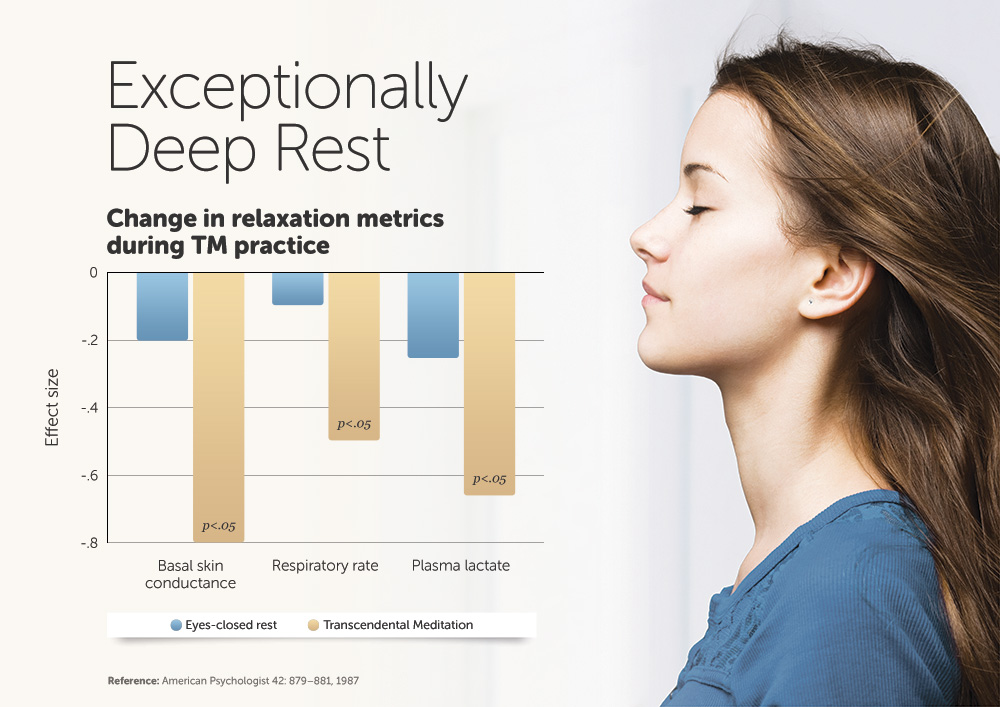
3 objective measures of restfulness (breathing, lactic acid production, and skin conductance).

From my own experience, I feel exactly what the data bears out (and, I might add, before I learned those data points). The afternoon session that I had on the day I began writing this article was after a particularly stress-inducing contract negotiation with a customer. Afterwards, I had a headache, I could feel my heart rate elevated, and I my mind was racing. I got back to my hotel room, sat on the couch, and did 20 minutes — just me, my mantra, and the timer to let me know when to stop. When I arose out of the session, it was as if I’d taken a nap for an hour or so — but without the grogginess I often feel after a nap.

The effects tend to last, as well. I’m not experienced enough yet (I only have a few weeks under my belt). But what I have noticed outside of the meditation sessions is the following:

  • a more consistent mood: lower highs and higher lows, which means…
  • …a more consistent energy level. Not bouncing off the walls, but not crashing, either.
  • less trouble focusing
  • I perceive more time between my felt emotional reactions and my physical actions. This means I can control angry outbursts or ill-thought-out reactions to stressful situations.

Skeptical? Great. Then Try It.

But please — please don’t take my word for it. That’s the beauty of this. You can try it for yourself. There is an app that I recommend to do this. I am in no way affiliated with it, but since it helped me start and sustain my habit, I think it’s only right to share it. It’s called 1 Giant Mind. That’s the only plug I’ll make.

Really, this article was almost as much to help me organize my thoughts about a new and beneficial practice that I’ve begun as it is to sell anyone else on it. So, if you have tried and failed at meditation previously, are interested in feeling better, and improving your physical health, and you can spare 40 minutes per day — try this.

Honestly, part of the foundation of this type of meditation is that it is — by definition — effortless. So you can’t even claim that you’re too lazy to try it (which is always my go-to excuse). If you did try it, and you’d like to let me know how it went, please feel free to email me. I’d love to hear your feedback.


Uncertainty, Discomfort, and What Makes a Good Life

credit: Tim Marshall on Unsplash

How a single sentence from a mentor made me re-think how I evaluate what it means to be strong and live well.

I have been studying philosophy for well over decade now, and I even taught the subject for half a decade. So I like to think that I’ve heard all of the best principles for doing the right thing and living a good life. But it wasn’t until I took a job as a full-time salesperson that I received the simplest and most profound analysis of what makes for a good life that I’ve heard to date.

I have a mentor at my day job who just recently became my official boss. He is helping me become accustomed to a life in full-blown sales — a life where you are almost like an independent contractor. You are judged on results, and your results are basically how many new customers you can get on the line and get to generate ongoing revenue for the company. It is simple, but as any salesperson can tell you, it can be difficult and frustrating at times.

For most other jobs in an organization, there is a process that you can follow, and if you perform all of the steps in the process, you’re doing your job well. But sales doesn’t have anything like that. Sure, there best practices, and suggested methods, but even those who follow them can come up short when it comes time to close the deal. And when that happens, they don’t get the sales, and they don’t get commissions. This should be no surprise, because sales is about human psychology. It’s about persuasion, collaboration, cooperation, trust, and all of the things about human interaction that are difficult.

In other words, the world of sales is riddled with uncertainty. And the thing about uncertainty is that it tends to make us humans uncomfortable. Which is why a particular piece of advice that my mentor gave me sticks with me to this day.

The quality of your life is directly related to the amount of discomfort and uncertainty you can handle.

It’s a ridiculously simple maxim, but boy is it ever true. Those two things: discomfort and uncertainty are the causes of some of the worst atrocities in human history. Wars, genocides, mass incarcerations, you name it — they tend to be caused by fear, a fear of what makes people uncertain and uncomfortable. This is true not just for groups of people, but also at the personal level.

The more extreme the discomfort (i.e., pain) and the more extreme the uncertainty (i.e., anxiety about what could happen), the more extreme the actions that we tend to take. But that is the opposite of how it should be. When we are uncertain and uncomfortable, we should refrain from taking swift action. We should refrain from lashing out in both word and deed (speech and action). We should take time to calm ourselves, and act from a place of calm, with an eye toward speaking and acting constructively. But that is difficult. In involves a lot of mental and emotional maturity and control.

Less Like Rock, More Like Water

For centuries, people have talked about strength as being the most sought-after quality to have. They use metaphors for strength that have to do with solidity, rigidity, and hardness. But with rigidity and hardness comes brittleness — the tendency to chip, crumble, and break beyond repair under the right kind of pressure.

But perhaps it is not strength — at least not in the classical sense — that we should seek.

In The Art of Peace — which is the short treatise that forms the foundation of the martial art Aikido — Morihei Ueshiba addresses the seemingly reflexive need we feel to attack in times of uncertainty or discomfort:

“If your opponent strikes with fire, counter with water, becoming completely fluid and free-flowing. Water, by its nature, never collides with or breaks against anything. On the contrary, it swallows up any attack harmlessly.”

Water has been used numerous times by Eastern writers as a metaphor for the kind of effortless way of moving and being effective, and it’s easy to see why. Water yields so easily to any pressure or movement, and absorbs it. But water also contains the unrelenting power to erode rock, knock down buildings, and move entire groups of living beings. If only we could be more like water — absorbing the challenges we face, and flowing around them — how much more effective could we be?

The Myth of Laziness

credit: Úrsula Madariaga

And How It Keeps Us From Being Great at Sales, Leadership, Parenting, and Pretty Much Everything Else

One of the things that we as humans are not so good at dealing with is when things don’t go the way we’d like them to. Buddhists have a word for the feeling we get when that happens: dukkha. It’s a shorthand for the nagging dissatisfaction and unease that follows the various disappointments of everyday life— and learning to cope with it is essentially the basis for the entire religion.

But this isn’t an essay about religion or spirituality. It’s an essay about something very different: the concept of laziness. It’s a concept that I’ve struggled with for a long time — partly because I’ve been accused of being lazy on more than one occasion, and partly because I have found myself believing that I was, in fact, lazy. But the more years I live, and the more I attempt and fail to finish various projects, the more I am becoming convinced of a simple hypothesis: there is no such thing as laziness.

A more conservative thesis would be this: calling someone lazy has no good practical application, and is itself a lazy thing to do. And moreover, the concept of laziness is actually an intellectual and interpersonal crutch. We use it when we can’t do the hard work of really communicating and attempting to understand others. Once we realize this, we can vastly improve how well we sell, lead, parent, and generally get along in the world.

“Laziness” is a Lazy Concept

Consider the dictionary definition of laziness: a disinclination to expend effort or energy. I simply don’t think that a person who has this as a personality trait truly exists. No one is really disinclined to expend effort or energy on everything. And in fact, some of those who others call “lazy” can be seen expending a lot of effort in order to avoid doing things.

At best, laziness is a relative term. All it means is that you’re unwilling to expend energy on certain things — namely, whatever the person calling you lazy is concerned with. In that case, what the concept of laziness comes down to is simply a mismatch in priorities. Someone sees X as a priority, and you don’t. So you don’t do X, or you do a sub-par job. Thus, you get called “lazy”.

Had you attached the same level of urgency to X, you likely would have moved heaven and earth to make X happen — in the same way that when you have to urgently go to the bathroom, you make the effort to find one.

What’s worse is that we who call others lazy are also — in effect — being lazy. We’re using a convenient label to explain a problem — one which puts a stop to any inquisition into why someone was lazy about something. Again, it’s not that the person is lazy and that’s why they didn’t complete the task. They didn’t perceive the urgency or importance. It seems like it would be valuable to find out why they didn’t. And who knows what other valuable nuggets of information you can turn up while looking for the answer to that question.

Transference: Getting Great at Sales, Leadership, Parenting, and Pretty Much Everything Else

More often than not, if we attempt to explore why someone was “lazy” and didn’t do what we asked, we’ll find the same thing to blame: our inability as humans to deal with the fact that people simply feel differently than we do about many things. We all experience this. Our urgent need to get on the next flight to Dallas is rarely ever matched by an equally urgent need in the ticket agent at the gate to find us such a flight.

And that’s where the real opportunity is missed when we just label people as “lazy”. We miss the opportunity to figure out how we failed to transfer the urgency and/or importance of the expectation we had. Often times, the reason for this failure is a lack of focus during conversations, or conversations that are too one-sided. Other times, the failure is simply a lack of connection, and thus a lack of importance placed by another on your relationship. It could be that the other person is simply overwhelmed, and cannot even bear to reprioritize once they settle on some arbitrary list of priorities.

There can be numerous reasons why someone didn’t do what you expected, but “they’re just lazy” is the laziest reason you could possibly use. And why use it when you could explore the real reasons, and possibly learn something about how to effectively help others to feel the urgency and importance that you do?

Those of us who can take the urgency and importance we feel and transfer it effectively to others truly excel at interpersonal activities: sales, leadership, parenting, public speaking, and so on. To some, it may seem like simply “motivating people” or “getting their asses in gear,” but it’s something much different — much more magical. It is a delicate art of carefully and completely transferring a perception and a felt value from one person to another, or many. That is no small feat.

So how do you do it? That’s a tough question. If I had to venture a guess, I’d say that it begins with simply being more tolerant of people, and more patient with them. It certainly also begins with refusing to explain people’s behaviors by using simplistic and general character traits. After all, when you paint people and their intricate minds with a broad brush, all you get is a blurry and uninteresting depiction of reality.

Rather than assuming laziness as a motive, assume some responsibility for failing to transfer the felt urgency and importance to them. Assume it was your fault (just to start with). Then ask questions to understand what their priorities are — which will give you insight into why your priority wasn’t one of them. Like I said earlier, even those who we label as ‘lazy’ expend energy on things — like their priorities. And when you can link their priorities to yours, well that’s half the battle of transferring your feelings of importance and energy to them. That’s alignment, and alignment gets things done! Again, calling someone lazy doesn’t get things done — at least not for long.

Motivation is a tricky thing. Those who don’t seem to feel it can be hard nuts to crack, but you’ll never crack them if you simply don’t try. So do yourself the favor of ditching the word “lazy”. Do the work of finding out why someone else didn’t do the work. You may just become better at the work that you do.

Fearless Thinking: A Manifesto for Intellectually Dark Times

Photo by Wil Stewart on Unsplash

In a time when we’re obsessed with gaining knowledge, we must not forget a more vital part of being intelligent.

After the 2016 U.S. presidential election, much has been made of bubbles. No, not the glorious soap and water creations that my 3 year-old loves to play with, but rather the intellectual and social shelters that we build for ourselves, in order to keep away from ideas that don’t conform to our point of view.

Some pundits argued that if experts in various fields had ventured outside of their respective bubbles, they could have (would have?) predicted what was regarded by many as a surprise outcome. But even after the dust of the election settled, a discussion commenced about intellectual bubbles —the self-imposed constraints on what media we consume, who we speak to, and what ideas we entertain. As the argument goes, the bubbles we live in become echo chambers, which merely multiply the frequency and amplify the volume of the same old ideas and messages over and over. No one’s mind is open, and everyone thinks in roughly the same way.

On one hand, I’m surprised that it took this long for a discussion about bubbles and echo chambers to emerge in wiser social circles, but the other hand, I’m not. And it’s not because I think that there’s anything wrong with society or people in general. It’s simply that in my years of being a hopeless polymath, I have come to notice a tendency that we humans have. We tend to gravitate toward the comfortable and the familiar. And while there are numerous writers and pundits out there pushing us to step out of our comfort zone when it comes to trying new activities, I don’t see nearly as many suggesting we do the same when it comes to new ideas.

Help Wanted: Devil’s Advocate (Part Time)

One of my favorite things to do since I was an adolescent has been to play devil’s advocate. I had one friend in particular who had very strong opinions about various issues, and he was not afraid to voice them. This put me in the position of being a defense attorney for the opposing viewpoint — whether I actually agreed with it or not.

We would literally walk around my neighborhood for hours on end, discussing and debating issues and ideologies. And when my home got its first dial-up connection when I was beginning high school, the debates would amplify as we began to fact-check each other. The debates would take twists and turns, with each of us changing our positions slightly based on new revelations or arguments brought up by the other side.

Though we argued passionately, and got angry at times, we stayed conscious of the purpose of the debate: it was about exploring the ideas. We stayed respectful of each other, and we retained the goal of understanding all the views expressed.

For me, I am certain that my time as the devil’s advocate gave me an appreciation of a very simple, but often overlooked fact. The practice of suspending disbelief and disapproval of ideas and opinions is one of the most valuable intellectual tools a person can have. I call it radical receptivity.

Radical Receptivity

Being radically receptive is open-mindedness but to the extreme. It’s not just about being open to new ideas — it’s more than that. You have to be willing to remain open to ideas that directly challenge your strongly held beliefs. And (so long as your physical safety is not in danger), you have to be willing to fully absorb those challenging ideas from others.

What’s even more — and where most people fall short — you have to suppress your urges to retort with your own dismissals of the challenging ideas. Rather, you have to do the opposite, and ask questions — with the goal of trying to piece together this other point of view in the most sensible way possible.

Am I saying that you can’t take a stand? No. In fact, this practice of staying radically receptive can actually make you more able to defend your own views because it allows you to construct the strongest possible (i.e., the most coherent) version of the opposing view against which to argue. In other words, you’re allowing your opponent to be strong and healthy, so there are no complaints about unfair play in the realm of debate.

The key to being radically receptive is what I call fearless thinking. It has been my approach to exploring the realm of ideas ever since my initial taking of the post of devil’s advocate. From where I stand, it has served me well, and I’ve seen it serve so man others well.

When I was teaching at a community college for several years, I advocated fearless thinking to my students as we debated deep philosophical issues (I taught philosophy — mostly ethics). The approach enabled me to help cultivate much richer conversations among a diverse group of students (ages, races, and socioeconomic backgrounds) — and kept intact respect between opposing sides in some heated debates.

Thinking Fearlessly

To think fearlessly is to think long, deep, and wide. What do I mean by those adjectives?

To think long means to focus not on the gossip or the current goings on — or on who is right or wrong about immediate facts. Rather, it’s about keeping with you a sense of history — its impact on what many view as novel and important current skirmishes — and an openness to the radical change that may take place in the longer future.

To think deep is to think beyond the initial explanations of things — to not simply take the short summaries of experts and pundits as either accurate or sufficient. It is to toss aside the vain and superficial day trip in search of knowledge in favor of the deeper and more arduous journey toward understanding. It is to ask why? more than once, because the first answer is so rarely either correct or complete.

To think wide is to acknowledge and search after the interconnectedness of things, people, and ideas. It is to refuse to accept the narrow categories of expertise, education, and intellectual training. It is to shrug off the suffocating walls of given ideologies, inherited spiritualities, and provided modes of learning. It is to expend the energy necessary to keep the fire of curiosity raging through the dark nights of shallow practical concerns. It is to retain and nurture the heart of an explorer — willing to venture into the unknown and uncomfortable landscape of ideas — and sit with that discomfort and uncertainty for a while.

In short, fearless thinking acknowledges that ideas are valuable and powerful. We cannot afford to discard ones that we are not immediately attracted to. We must leave room for considering them — even if it is to prove them wrong. We must take pains to entertain the ideas that repulse us — especially those ideas — because if we don’t make an effort to understand the views of those who make us feel strong emotions, we become that much easier to manipulate. And no one wants to be manipulated.

Go Forth and Seek

One of my favorite principles from any self-improvement book comes from Covey’s 7 Habits of Highly Effective People: Seek first to understand, then to be understood. In every conversation I have — no matter how benign — I try to check myself, and make sure I’m doing that. It forces me to ask questions — not so that I can reply with some thought of my own, but so that I can understand what I’m being told. It continues to amaze me how effective it is.

Is it easy to remain mostly dispassionate about ideas and points of view, seeking to understand and explore uncomfortable ideas? Of course not! But my oh my are the rewards ever worth it! Every time I practice fearless thinking, I fortify my body of knowledge, and I strengthen my position in the marketplace of ideas.

So my advice — especially in these ideologically challenging times — is this: go forth and seek. Seek to understand each other, seek to — as fully as possible — understand the most oppositional views to your own. Be charitable in your interpretation of others’ arguments — at least at first, as you explore them. And when you state your case, which should be after significant discussion, do so eloquently, respectfully, and with a persevering openness to new and challenging ideas.

Satisficing: A Way Out of the Miserable Mindset of Maximizing

credit: Vance Osterhout on Unsplash

Chasing after the best of everything actually keeps us from enjoying nearly anything. But it doesn’t have to be that way.

I was out to dinner with a co-worker recently. The restaurant was quite nice, and boasted a whole menu of dishes that sounded amazing. This was both of our first times there, and I was poring over the menu — going back and forth in my mind about what dish I should get. I wanted to get the quintessential dish to capture this place and its flavor. I wanted to nail it.

During that process, I couldn’t pay attention to the conversation going on between my colleague and our dinner guest. I heard what they were saying, and I wanted to join in, but I was hell-bent on making the most out of this dinner. My coworker, on the other hand, perused the menu for what seemed like less than a minute, and was ready to order.

When our meals came, I was happy to be able to eat, but as I tasted it, the worry crept up in the back of my head: could I have ordered a better meal? My colleague seemed pleased with his choice, and went on eating confidently. It was that quiet confidence in his choice that made me feel a bit silly about racking my brain to order “the best” dish. It seemed so important to me at the time, but in retrospect, it was absurd.

What I came to realize then and there is something that a few thinkers in the psychology community had come to realize already:

The drive to maximize the results of our choices often ends up limiting how much value we actually derive from them.

The more we demand of ourselves and others, the easier it becomes for the results to cause us stress and anxiety. What’s more, insisting on squeezing the most out of each choice makes it increasingly more difficult to be decisive — to be confident in your decisions. When you’re less decisive, you spend more mental energy on decisions, and thus have less of it to devote to the numerous other things that demand it.

The Dangers of the Maximization Mindset

The maximizing mindset can be summed up as the desire and inclination to try to get the most and the best out of decisions, interactions, and people. It’s a mindset that many high achievers in the business world champion. And here’s the funny thing: even the self-proclaimed minimalist is guilty of the maximizing mindset. The obsession with getting rid of things, having the least amount of stuff in one’s “daily carry”, and having the smallest house that can be packed up and taken the most places — it’s a maximizing mindset.

But there are 3 main problems with this mindset, and they negatively affect your quality of life. The problems are:

FOMO: fear of missing out
FOMO (the fear of missing out) makes anything you do less enjoyable, because you’re worrying that another choice could have gotten you more pleasure. That wouldn’t be a problem if you weren’t looking to maximize.

Paralysis: the inability to make decisions efficiently and effectively
When you’re looking to maximize, you can end up spending so much time deliberating which choice is going to yield the best results, that you create a lot of unnecessary stress & tension in the process of choosing, which sucks the joy right out of the whole process.

Stifling of Exploration: insisting on maximizing makes it difficult to simply explore — which is a hugely beneficial practice.
Focusing on the maximum return stifles a very beneficial process of human life: exploration. When we demand a certain level of return on our time and energy, we abandon the mindset of an explorer. And that mindset is more beneficial than many people realize — especially the most driven and ambitious among us.

The explorer — like the maximizer — wants to find something valuable at the end of the journey. But unlike the rest of us, the true explorer opens up to whatever she might find along the way, and chalks it all up as simply part of the journey. Truly opening up requires being somewhat detached from trying to get the best results; it’s a type of letting go. When you let go of trying to maximize, and simply let things unfold, wonderful things can happen.

Satisficing: A Smarter Approach

Rather than being maximizers, it often makes more sense to be a satisficer — or one who has a satisficing mindset. The word “satisfice” is a portmanteau of the words “satisfy” and “suffice”. The satisficer is not looking for the best or the most, rather, she’s looking for what will work, and allow her to go on living.

While it may seem like satisficing will just get you an average and lackluster life, that couldn’t be further from the truth. In fact, a study on worker satisfaction showed that though maximizers tended to get higher salaries, they ended up being less satisfied with their jobs.

Seem crazy? Sure, but the reason is straightforward: maximizers second-guess by nature. They devote so much time to pursuing the best that they can’t really be sure that they’ve gotten it. Perhaps they could have done better if only they had more time, or data. Satisficers see something acceptable, and move on. And they end up more satisfied than the maximizers — who eternally chase the elusive dragon of “the best”.

Satisficing in Action

As an example of satisficing in practice, imagine that you want to purchase a coffee maker. You go to different websites, pull up reviews, compare them, go to the store, look them over, and agonize about which of the few that you’ve narrowed it down to is going to deliver the best coffee brewing experience. When you do that — and you turn it over in your mind enough times — you train your mind to second-guess your decisions. And it robs you of some of the joy you can get when you do get something new, like a cool coffee maker.

A better option is to simply ask yourself: why am I getting a coffee maker? Likely, the answer is going to be: so that I can enjoy a good, hot cup of coffee every day to kick my morning off right. But do you need the best coffee maker in order to do that? Probably not. And even if there is a difference between the elusive best coffee maker out there, and the one you bought, how much will that difference really alter how well your life goes? If the answer is more than not much, then you’ve pinned way too much of your well-being on a piece of machinery.

The same goes for anything you can buy. Some amount of hand-wringing is acceptable, and maybe necessary, but anything more than a small amount is an indicator that you’re missing the forest for the trees. Simply choose what you’re leaning toward, and be okay with learning later on that it wasn’t the best. After the fact, the only difference it can really make is up to how much you choose to worry about it — and you simply choose not to worry about it.

Is it easy? For a person like me — who regularly spends what seems like an hour in the toothpaste aisle every few months — no, it’s not easy. But is it worth it to pick your battles when it comes to whipping out an intense and complex decision-making process? Absolutely. If you don’t, it’s a fast track to driving yourself (and your loved ones) insane.

The Takeaway: Choose Your Battles

Life is short, but it’s also composed of a lot of decisions. If you pursue any more than a few of them as battles where you have to get the best outcome, you may win some, but you’ll lose most. And the ones you win will likely have exhausted you — so you won’t even have the mental energy to enjoy what you’ve got.

The better way forward is to choose a few things that truly matter to you, focus on pursuing the best in those few areas, and let everything else ride. Whatever is good enough is fine with you. You’ve got bigger fish to fry. And maybe you don’t even have to fry the fish — sashimi is good enough.

Wu Wei: The Powerful Path of Non-Action

“A perspective shot from a kayak on a rippling lake with the sun setting on the horizon in the distance” by Joshua Ness on Unsplash

What the sages of the East can teach us about effort, strategy, and observation.

The thing about Eastern philosophies is that they are full of contradictions, but unlike in Western philosophies, contradictions are not seen as problems to solve. Rather, contradictions are embraced as illuminating — because well, reality is full of contradictions. Take this passage from the Tao Te Ching, probably the most contradictory of all Eastern works:

Look, and it can’t be seen.
Listen, and it can’t be heard.
Reach, and it can’t be grasped.

Above, it isn’t bright.
Below, it isn’t dark.
Seamless, unnamable.
it returns to the realm of nothing.
Form that includes all forms,
image without an image,
subtle, beyond all conception.

Heavy, right? And seemingly going back and forth contradicting itself. But with passages like this, the Eastern sages showed that they were onto something: life is full of contradictions, and the Eastern masters realized this. So rather than writing long paragraphs trying to reconcile these contradictions, the great minds of the East practiced a form of analysis more like poetry: put the contradictions together, and let them be — in words on the page — to allow us to reconcile them ourselves in that act of thinking that can’t be put into language, but can surely be felt.

The Way of the Sage: Non-Action

One of the most prominent contradictions in Eastern philosophy is the concept of Wu Wei found in Taoism. Loosely translated (as is usually the case with concepts from the East), it means “non-action” — doing less, and putting forth less effort. But don’t be put off by that, it’s not a philosophy of laziness or a lack of care.

A bit less loosely translated, Wu Wei describes not forcing things as a way of life. It’s about spending less time trying to manipulate situations, people, and environments to satisfy your desires, and spending more time aligning yourself to the natural flow of things. It’s about avoiding the paralyzing effects of overanalyzing, stressing out, and all of the things that come with a general need to control events and people. Quite simply, Wu Wei is an approach to existence that advocates an acceptance of the myriad things that are out of our control, a willingness to go along for the ride, and a readiness to act in the few instances where action will truly add value.

But that last part — acting in the few instances where action will truly add value. That is the difficult part. Knowing the difference between the few situations where some small action will add real value and the many situations where we feel anxious to act, but those actions will get us nowhere — that is all about receptivity.

What I mean by receptivity is an openness to the long view. It’s a forest-for-the-trees mentality. It manifests in the person who — during a heated argument with their partner — keeps in mind that this is but one valley, which will have accompanying peaks, and then realizes that it might not be worth trying to keep arguing so they can prove themselves right. It’s the investor who resolves not to emotionally withdraw their money from the market during a downturn. It’s the leader who listens intently to the emotional criticisms and anxieties of their team, and keeps calm enough to sift through that criticism for the problems that can be addressed and yield real improvement. It is the person who lets that silence in a conversation linger — and resists the urge to fill every single gap with more talking.

If that sounds a bit too esoteric, perhaps the manifestations of it are more apparent, and easier to think of. Consider some of the most memorable people you know — the type of people who when you met them, they drew you in for some reason. Not the people who were loud and opinionated and made a mark because they were simply obnoxious, rather the people who displayed that certain something — the strong, silent type, if you will. It’s the person who, when they spoke, you found yourself listening intently — drawn in by the person’s seeming collectedness and non-smug quiet confidence.

It’s Not Being Lazy, It’s Being Strategic

Again, Wu Wei is not about laziness and complacency. Rather, it is about conservation of energy — specifically, of mental and physical effort. Significant effort will always be necessary in order to get things done. However, we all fall prey to wasting effort (and time) on thoughts and actions that at the time we think add value, but in the fulness of time, we realize we were just spinning our wheels, ultimately to end up right back where we started. We do this because we often feel uncomfortable, and we want to act because we feel that doing something is better than just waiting, or sitting with that discomfort.

The Taosist masters warned against this. Sometimes, sitting with that uncomfortable feeling is exactly the thing to do. And in doing so, you’ll save a lot of energy for things that matter. As a bonus, you’ll also feel more comfortable and relaxed where others tend to feel tense, anxious, and make poor decisions because of it. When that happens, you gain an incredible advantage over many other people — people compelled to act when action is just not necessary.

Wu Wei is about relaxing into the states that we consistently encounter in reality: uncertainty, conflict, discomfort, desire, and so on. It’s about relaxing enough to see that there is not so big a difference between those states and their opposites that we so badly desire: certainty, peace, pleasure, and possession. They come on and pass as quickly, like waves on an ocean.

Still unsure? Allow me reconcile the concept of Wu Wei with modern productivity advice. Wu Wei is about outsourcing your work to the world. There are rhythms and cycles in reality. If there are things that happen in those rhythms and cycles that you are trying to do yourself, sync up with those cycles. There’s a quote by Paul Rudd’s character in a relatively unknown film called P.S. which sums this up pretty nicely:

Find the pattern...

Find the pattern, and put yourself in a position of profit

when the pattern repeats itself.

People spend a lot of time and energy both ignoring and fighting against natural patterns — patterns of nature, patterns of markets, patterns of energy, patterns of behavior, and so on. But rather than fighting against those patterns, find a way to use them. Like Aikido teaches, it takes much more energy and yields much less success to try to stop your opponent’s momentum and reverse it by force. It is much less taxing, and much more probable that you’ll succeed if you use your opponent’s momentum against him. The only energy you use is the energy of observation, planning, and waiting.

Take This Home With You

Mastering Wu Wei is as easy as standing back and observing — even for a little bit. Note the patterns you see. Start with your own moods, thoughts, and behaviors. You will be surprised just how many patterns there are. When you do that, you can figure out how to use your own momentum to create value for yourself with less work.

Having mastered leveraging your own patterns and momentum, you can move on to other things. And the other patterns in life — they are likely to be much easier to understand once you understand your own psychological patterns. You observe, you plan, you act, and you profit. And in the end, it’s almost as if you didn’t even do anything; things just kind of unfolded naturally. Again, from the Tao Te Ching:

…the sage acts by doing nothing,
Teaches without speaking,
Attends all things without making claim on them,
Works for them without making them dependent,
Demands no honor for her deed.
Because she demands no honor,
She will never be dishonored.

In Defense of Distractions

credit: Jose Aljovin

An Essay on the problems with fetishizing focus, and the forgotten magic of things that pull us away from our tasks.

When I first got roped into the world of productivity and personal development literature, I became obsessed with an idea: distractions. If you were to make an analogy between that world and zealous religion, distractions would be the great Satan.

What’s keeping you from quitting your soul-sucking job to start your own billion-dollar business? Distractions. What’s keeping you from having six-pack abs and winning cross-fit competitions? Distractions. What’s keeping you from meeting the person of your dreams? Distractions.

And while distractions can certainly aggravate us sometimes — and they certainly pull us away from other things — do we need to be so contemptuous of them? What do we gain by eliminating distractions? I think that question has been answered time and again. But I propose a different one: what do we stand to lose by eliminating distractions?

After all, distractions are only problematic if there’s no possible way that what is pulling you away from what you’re doing won’t bring value to you. And how can we — in our infinitesimally small foreknowledge — know the full extent of what is and isn’t going to bring value to us? I don’t think we can.

Furthermore, when we fetishize focus in the way that we have come to do, we begin to construct minds that are more rigid and narrow. We train them to block out things other than what we are trying to focus on. What we end up with is a mind that is less receptive to things other than the task at hand. It is like a muscle always tensed and always doing the same exercise. It becomes very good at that one exercise, and at tensing up in that certain way, but because it gets no reprieve from that, it becomes much less flexible and agile.

Don’t Miss the Magic

Might I suggest this: perhaps an extreme aversion to distraction might just be a manifestation of a special kind of narcissism. It’s the kind of inflated sense of self that says no idea, no plan, no vision is worthy of my attention unless I say it is beforehand — no one can convince me to look elsewhere.

Okay, high-performer, I hear you: in order to achieve your goals, you need to stay focused on them and driven. But think about how you became so driven in the first place. You didn’t emerge onto this earth with a pre-installed sense of passion for something. You lived, you dilly-dallied, you stumbled upon something that moved you. By all accounts, that thing began as a distraction. And for billions of other people, that thing is a distraction — it’s not their thing. That’s a kind of magic, isn’t it?

Well that magic happens on a smaller scale every day — or at least it can, if you let it. That magic is distraction.

Distraction is a fantastic and magical way that the world reminds your mind and your heart that there are a myriad other things out there that can bring value to your life and work. But that magic goes away if we force ourselves into the narrow dark and sound-proof tunnel of focus. In the short term, it’s a tool that can get extraordinary short-term results. But in the long-term, that hyper-focus might just dim the light of creativity, innovation, and a broader vision.

My humble suggestion is this: work to focus on things that you need to do now, but don’t beat down that wandering, distractable mind. It might wander off now and then, and it might bring you back a bunch of dirty rocks. But every once in a while, if you polish a few of them — one could be pure gold.

The Incomparable Power of Mornings

An Existential Tribute to the Profound Act of Getting Up

When I was in college, I slept in as much as I could. I stayed up late, and tried to savor the night, as if something or someone was going to take them away from me at some point — and I had to savor every last morsel on the plate of my life. Someone did eventually take the nights away. It was me. I took them away because nothing worthwhile happened for me late at night. What I had been missing was the mornings.

You see, when I would stay up late, and walk around that college town, I would get this feeling like I was the world’s benevolent father — patting it on the head compassionately, as I put it to bed for the night. I was the wise one. Those who slept were missing out on something magical.

But what I failed to realize is that it’s just not true. The world wasn’t really going to sleep. And if I was the benevolent father, quietly closing the door after a kiss on the head, the world was a mischievous child, waiting until I wasn’t looking, so it could wake up and quietly sneak out for all sorts of unsavory business. I thought I was wise and reflective at night. Really, I was tired and foolish.

The thing about the night is that people stay up. It’s easy to stay up. You simply don’t go to sleep. It’s maintaining the status quo. There’s no struggle; there’s no declaration; there’s no redemption. Aided by momentum, you just continue what you have been doing for many preceding hours. And you do it until you give in to sleep. Sure, there can be something to that. I won’t deny it. It’s endurance — you’re running a marathon, you’re outlasting others, and you might just be doing something worthwhile during that time. But in the end, you’re running with the wind at your back. And the end of the race ends with you collapsed and unconscious.

Mornings, on the other hand — mornings are different. The thing about mornings is that you have to get up for them. You have to open your eyes and make a decision. You make a decision to assert yourself, to include yourself in the commotion of the day. You make the choice to join into what others have already begun, and start something of your own.

I don’t just wake up, I wake up before dawn. At first I did it because I had to, in order to get other things done that I had committed to. But it has become a necessity. I feel as if I would do it even if I didn’t have to work for a living. I would still get up before the sun, before the world, and just sit and exist.

When I wake before the sun does, during the shift change of the animals — nocturnal ones heading back home, and diurnal ones shaking off the shackles of sleep — I truly do get a jump on things. I feel like I gain momentum. I don’t even have to do anything in the sense of being productive.

Come to think of it, waking up early in the morning — it’s not about being productive. It’s about existing. It’s about making the choice, and displaying that choice in the dim light of the receding moon and the still-drowsy sun.

I hold my tired body up by two wobbly arms as I wait for my coffee to brew, and I breath in the most meaningful air of the day. That air goes deep down into my lungs. The oxygen molecules from that breath get embedded deeply within me. They stay with me until the day’s end, and can only be coaxed out by the impact of my body going horizontal.

The world is a bit slower in the morning. It’s like a steam engine, just beginning to chug along — slow, but deliberate, and powerful. And like a locomotive, once it gets going, it’s impossible for anything smaller than it to stop it. And my friends, we are all smaller than the world. We are all smaller than the day. The best we we can do is to hop on while the train is moving more slowly, so that we can move along toward wherever we’re going.

That is why the morning — in a totally different way than the night — is a more spiritual time. It’s a deeper time. Things closed are just now opening back up. Things once fast yesterday are still slow. Things so looming and frightful yesterday afternoon are now — bathed in the stillness and emerging light of dawn — are less daunting.

This morning — like every other morning — we begin again. We have so much in front of us. What will it be? What will we be? Hope springs eternal — in the steam pillowing off of a fresh cup of coffee. And into what image, dear friends, will you sculpt that hope?

The Interest Principle

When I was a kid, my dad was fond of giving folksy advice to help me “make it” — to go far in my professional life. He didn’t go to college, so I definitely should. He took the first decent-paying job that came his way and never weighed his options, so I should be more measured and follow my passion. To his credit, he worked his ass off to give me the kind of education and opportunities that would allow me to do those things. I think it’s served me well — despite my meandering and error-riddled way of getting where I am.

One piece of advice he was fond of giving was this: if people like you, you can get pretty far in whatever direction you’re trying to go. I have kind of stumbled ass-backwards into confirming this. I get along pretty well with nearly everyone I meet. Because of that, I have been able to forge a path for myself — personally and professionally — where I receive good opportunities for advancement, and live a life that makes me pretty happy to get up in the morning (though perhaps a little earlier than I would otherwise choose, at times).

But there’s a piece of the puzzle that isn’t covered under the umbrella of getting people to like me. You see, getting people to like you is one thing. If people like you, they tend not to give you a raw deal. They’ll tend to be straight with you (in most cases), and if they can help you without really having to strain themselves, they probably will. That alone is helpful. But it’s one of two steps to harnessing the power of rapport and relationships to build a life you can be excited about.

The other piece is the step beyond getting people to simply like you, it’s getting people interested in you. Like I said, if you can get people to like you, they will tend to do what they can conveniently do in order to help you. But if you get people interested in you, you can tap into some basic human emotions to form some truly constructive relationships, building a foundation for growth. If people merely like you, they will avoid harming you and help you if it’s not too much work to do so. If people like you and take an interest in you, they will tend to go further to help you. They will go out of their way. They’ll pick up the phone even when they’re busy, they’ll answer your email before others, they’ll stay for another drink after a polite dinner, and so on.

So if there’s anything like a formula for building the kind of personality that fuels personal and professional growth, it’s captured by what I like to call the interest principle. It has two parts:

  1. Get people to like you: be interested
  2. Get people to take an interest in you: be interesting

Getting People to Like You: Be Interested

It’s a pretty simple operation, really. I start with casual conversation. I get in some light-hearted jokes early on, ask questions that get people talking about the stuff they like to talk about (whatever that may be), and find ways to relate to them on their own terms. When it goes well, it really works. People like talking to me, so they like me. And I like talking to them, so I like them. It’s not a trick, it’s not a tactic, it’s just a simple social behavior that also happens to allow you to get people to help you achieve your goals — be it making a sale, getting a promotion, ordering off-menu — whatever your angle may be.

It’s not the kind of thing that works with everyone — some people just don’t want to form a rapport with people outside of their circle of friends. But by and large, it works. The only thing is that you can’t fake it — that’s key and I can’t stress it enough. I have met a fair amount of people in my travels that seem to be employing a method of getting people to like them (perhaps they’ve read How to Win Friends and Influence People, but absorbed only the bullet point summary). They smile, but it’s measured and manufactured. They try too hard to make a joke, treating the other person’s laughter as a kind of currency they’re trying to extract, rather than something meant to warm their hearts. That might work on some percentage of people, and it might work in the short term. But like any form of insincerity, it’s not the real thing, and many people can — after a time — pick up on that.

So the key to getting people to like you is to be sincerely interested in them. And this is something for which there is no script. It’s something that you do by changing your mindset. You have to be curious about the other person, and not in a way where you’re looking for secrets, motivation, or things to leverage and manipulate for your own gain. You have to be curious about what makes them happy, what they see as their purpose, what they’re like when they’re with their most trusted confidant. Curiosity like that usually stems from a curiosity about human nature, ethics, spirituality, and deeper questions of that nature. So be interested in those things. You should be interested in them for your own enrichment anyway, and once you are, you pretty much can’t help but be interested in what they mean for other people.

Getting People Interested in You: Be Interesting

Having people like you is one thing, and it’s certainly helpful. But when people are interested in you, it’s a step beyond where most smooth social operators can get — and because of that, it’s a huge advantage. Beyond that, it makes for better relationships than those based on simple courtesy.

Getting people to take an interest in you happens in one of two ways — depending on where you fall in the social/professional order relative to that person:

  • If the other person is younger than you or lower in the professional order, give them reason to want to learn how you’ve achieved what you have. It’s a mini version of a mentor/mentee relationship.
  • If the other person is a peer — be it in age or rank — give them reason to want to find out what your journey is like. How is it similar to or different from theirs? What common hurdles are you facing, and what is your approach to overcoming them?
  • If the other person is older/higher in the professional order, give them reason to want you to succeed, so they will do what they can to help you. The best way to do this is to be sincere, but honest, about your lack of experience and your hunger to know more.

A note of clarification: being interesting is not the same as what the seduction community calls peacocking — being quirky, weird, or eccentric. People do sometimes use the word “interesting” to describe someone odd, but that’s simply a misnomer. They clearly mean that person is weird, and I’m a bit curious as to why they’re so weird, but I don’t really want to interact with them.

People are interested in those with depth, who are thoughtful and multi-dimensional — people with nuance. But how do you become that kind of person? It’s simpler than you think. You simply need to be curious, or to put it another way — you need to be interested in things. Be sincere about learning and enriching yourself. Gain varied life experiences, with various kinds of people. Listen to different kinds of music, read various kinds of books. The broader your body of knowledge and experience, the more people you can connect with, and the more you can multiply their interest in you.


The thing about people is that we are creatures guided by our interests. When things pique our interest, we make efforts. We perk up our ears. We read a few more paragraphs. We listen longer. We give the benefit of the doubt. We pursue, we connect. And if our interest is rewarded with even more things of interest, the cycle continues. If you can plug yourself into that cycle of interest, the benefits are great and sustained. Be interested, be interesting, then be better.

The Tragic Stigma of Help

How we perpetuate a myth that keeps so many of us poor, overwhelmed, depressed, and alone.

A few years ago, I was a member of a leadership development group in the not-so-prosperous post-industrial Midwestern town where I live. Every other Friday, the group — made up of mid-level management people at local firms — would get together at a different location to learn about the local economy. We learned about business development in the area, about leadership qualities, education, non-profits, and civic involvement.

On one occasion, we visited a food bank that serves about 15 counties in the area — meaning somewhere over 1 million people. The person representing the food bank revealed to us something that I found stunning and counter-intuitive. He said that where the food bank falls short is not where most people think it does.

The food bank — like most other food banks around the country — has plenty of food — plenty. In fact, each year, they throw away tons (literally, tons) of food that goes unclaimed. They also have plenty of volunteers to help process the food — during most times of the year. In short, supply — be it food or labor power — is not the most pressing issue. The most pressing issue is demand.

The real problem the food bank faces, he said, is that tens of thousands of people in poverty are not using the food bank. That’s right. The most salient problem for the food bank in this poor metropolitan area is that a good portion of the poor population is not taking the free food. For whatever reason, people are just not showing up to the pantries to get food. They don’t come out to get food from the food trucks that the pantries support regularly. They simply choose not to ask for help.

Why is that? Why would so many people who could obtain free food, and who would unquestionably benefit from doing so, just not do it — and either go hungry or pay for food instead?

Sure, some of it can be attributed to laziness. That explanation can be deployed to explain some portion of pretty much any problem. But using laziness to explain the root cause of a problem is itself lazy and also irresponsible. So what else is there that makes people who need food and have little or no money, choose not to take it?

We Suffer From an Affliction

I don’t blame most of those people for not reaching out for free food. I understand. Though I’ve never had to go hungry myself, I understand their affliction because I too suffer from it. Millions of people of all socioeconomic backgrounds suffer from the affliction. It’s an affliction that can ruin relationships, destroy careers, and cripple communities.

This affliction is the refusal to ask for help.

The affliction is a widespread cultural phenomenon that preys upon millions of people — both rich and poor, young and old, working and unemployed. It has deep roots, and it keeps people who could otherwise be successful from realizing their potential. But why does this affliction persist? Why is it so damned hard to ask for help — especially when help is available?

Part of the problem comes form our national discourse here in the U.S. No matter how liberal we become socially, there remains an undercurrent of rugged individualism. It began as the 20th century began — with the “rags to riches” stories of Horatio Alger. Even as the depression hit in the 1930s, people were urged to “pick themselves up by the bootstraps” and get out of abject poverty by their own willpower and gumption.

These days, the message we receive is the same, but the mode of delivery is different. We continue to be sold Algeresque stories, but instead of scrappy young boys from the slums, we get college dropouts who built computers and apps in their parents’ garages. We are presented with wondrous stories of entrepreneurs starting and selling companies within a year or two for billions of dollars. To compound that, we are also bombarded by articles that urge us to adopt certain habits, read certain books, or take certain courses — the implication being that we too can learn to rise like those revered few have risen— alone.

It’s all very beautiful and inspiring. But it’s a beautiful, inspiring lie.

I hope we’re not all too naive to realize that this is just ideology repeating itself. None of these new paragons of success did it on their own — nobody ever has. Not Jobs, not Bezos, not Zuckerberg, not Musk. They all had help — tons of it.

No one who has succeeded at anything ever did it without asking for and receiving, help. This is how it is, and how it always has been. But somehow we continue to pass through the centuries and conveniently forget it. That has to change. It only benefits the select few who already have success, fame, wealth, and influence. It buries the rest of us in self-sustained social obstacles and baseless self-doubt. The more the public at large upholds a stigma against those who ask for help, the more we’ll repeat the cycle of terribly large numbers living and dying in poverty, living without realizing their potential — wasting away.

How Do We Change This?

So I ask you, if you’re still reading: how can I help you? How can you help me? How can we help each other? How can we convince everyone that giving and receiving help is a good thing?

Charity is not a bad word, it is help for those who don’t have enough to repay. That’s it. Forget the Protestant Work Ethic. This is the 21st century, and we should be okay providing for those who are in trouble — whether we get anything back or not. And it’s not an issue of political ideology.

We have shown — whether we’re left or right-leaning, that we are mostly okay throwing billions of dollars at companies that never make any money, and fall away into obscurity. Why then should we act so stingy when it comes to providing housing, food, health care, and education to people. I doubt that the mythical “welfare queens” spent anywhere near as much money as the various startups that have failed spectacularly in the VC funding era.

We’re making progress on a range of issues relating to society and professional development. But I don’t see that same progress in making it okay to ask for and acknowledge help. The attitude of stingy judgmentalism remains as strong as ever — even as those who themselves judge receive help regularly. In turn, those who need help are shamed into not asking for it. We can’t be afraid to ask for help, but more importantly, we can’t continue to feed into the stigma associated with asking for it.

Here’s the kicker, though: simply helping others is not going to fix this. In fact, depending on the context, it may make things worse. What needs to happen is a combination of two things:

  • people in influential positions, who are recognized as successful, need to emphasize the help they had to get there
  • people who help others, need to drive home the point to those they’re helping that the transaction taking place does not indicate the receiver’s lack of strength or ability — it’s simply help, which we all have gotten from time to time

If you’re a manager, you can do these things today, with the people you manage. If you’re a community leader, you can do this today by publicly addressing the points above. If you’re a parent, you can talk to your children about all the help you needed and received, and ensure your kids know that it is part of your job to provide that to them.

If you think you didn’t really receive help, and you did it on your own — you’re part of the problem. What you can do is sit down, spend 10 minutes listing your accomplishments (the ones you think you did on your own), and ensure that there was no one who took a chance on you, listened to your pitch, gave you the benefit of the doubt, or cleared the way at all for you. Because if there was — guess what? You got help!

If we can prioritize those things, perhaps we can change our attitude about giving and receiving help. Perhaps the help we do give can become more effective. It’s a crazy idea, sure. But it might just be crazy enough to work.

Anapanasati: The Subtle Art of Being Here, Now

credit: Cassandra Hamer

A simple, ancient practice that you can do anywhere, anytime, and get back the control you need to make better decisions.

We humans are living in a hopeless time-warp. Our minds have a serious aversion to existing in the present moment. We may be sitting at dinner with our family, but our mind keeps jumping forward to that meeting we have at the office tomorrow, or to last week, when we had that big fight with our significant other. We live a split existence; our body is in the present moment, but our mind is either in the past or future.

And this split existence is at the root of some of the most difficult and nagging problems we have. One of those problems is the problem of self-control. When our bodies are in the present moment and our minds are fixed on some other time, we become out of touch with our bodies. When we become out of touch with our bodies, we give up the reins of control over them.

As we spend more time away from our bodies — so to speak — that distance between mind and body multiplies. We lose the opportunity for a deep knowledge of what our bodies are telling us, and how our mind and body relate to one another. When we lose that, we can feel anxiety, stress, hopelessness, and various other emotions that all share the common theme of weakened control over how we behave.

It tends to manifest in the same ways: you’re distracted and stressed; you have a lot to do, and a lot on your mind, so you venture over to the pantry and open the pack of cookies. Before you know it, you’ve eaten 3 of them. But you barely even feel satisfied. You walk into a meeting at work, thinking of all of the things that you need to do today, tomorrow, for the rest of the week. You drift in and out of paying attention during the meeting. You shift and squirm uncomfortably in your seat. Before you know it, the meeting is over, and you don’t even remember what happened in it. You feel more stressed, and it’s not even time for lunch yet.

A Way Forward

But there is something that can help. In the Buddhist tradition, they call it anapanasati, which roughly translates to “awareness of breath”. It may sound simple — almost too simple to do much of anything, but that’s kind of the point. Some of the most effective modes of change are so simple and obvious that they continue to be overlooked, until they’re not.

In a wonderful essay on the topic of anapanasati, Ajahn Sumedo says of the practice:

The rhythm of our normal breathing is not interesting or compelling, it is tranquilizing, and most beings aren’t used to tranquility. Most people like the idea of peace, but find the actual experience of it disappointing or frustrating.

The gentle rhythm of the breath, being slower than the rhythm of thought, takes us to tranquility; we begin to stop thinking.

It’s true, most of us are not used to tranquility, to peace. We may think we are, but most of us think that peace and tranquility are the same as a state of pleasure — being happy or feeling really good. But when most of us think of those feelings, they involve stimulation, activity (especially mental activity), and excitement. But peace and tranquility are not happiness or pleasure. They are feelings of quiet and stillness. They are the mental equivalent of a calm and glassy lake on a mild morning without wind.

And that is the point, the stillness of a mind concentrating on that fundamental bodily activity of breathing is the stillness that builds connection between mind and body. That connection between mind and body is the bridge to a connection between a person and the present moment.

When you can be fully in the present moment, connected — by mind and body — you can more effectively assert yourself. You can say “no” to tempting sugary treats. You can say “no” to zoning out and being preoccupied. And when that happens — when you’re not split between preoccupation with the past or future, and being conscious of the present — you will leave behind that feeling that accompanies missing moments of your day. You will have fully experienced the minutes and hours as they unfolded. No more “where has the day gone?” moments of anxiety.

More Than Just Breathing

The practice of anapanasati is not simply about attention to breath. It may begin that way, and any time you find yourself losing control, that is the touchstone: just collapse your attention into your breath.

But anapanasati evolves into the practice of cultivating a mindset — a way of approaching your own mind — a better and more compassionate way. Sumedo, again, elaborates:

We are training the mind like a good mother trains her child. A little child doesn’t know what it is doing, it just wanders off; and if the mother gets angry with it and spanks and beats it, the child becomes terrified and neurotic. A good mother will just leave the child, keeping an eye on it, and if it wanders she will bring it back. Having that kind of patience, we’re not trying to bash away at ourselves, hating ourselves, hating our breath, hating everybody, getting upset because we can’t get tranquil with anapanasati

In this way we’re not trying to become perfect all at once. We don’t have to do everything just right according to some idea of how it should be, but we work with the problems that are there. If we have a scattered mind, then it’s wisdom to recognize the mind that goes all over the place — that is insight. To think that we shouldn’t be that way, to hate ourselves or feel discouraged because that is the way we happen to be — that is ignorance.

Simple Steps

Now you have a basic understanding of what this practice is and what it can do for you. Now for the how. Here’s a list of simple steps to help deploy the practice of anapanasati, in order to get the most out of it.

  1. Close your eyes and inhale deliberately by using your diaphragm and belly. Then exhale at first sharply, but gradually easing.
  2. Open your eyes and allow your breath to happen without you directing it.
  3. Feel each inhalation and exhalation. A helpful way to start doing this is to imagine your stomach as a balloon, expanding and contracting as you breathe in and out.
  4. As you experience other thoughts pop into your head, simply note them with a smile (either an actual smile or a mental smile) — the same kind of smile that you’d used to acknowledge an innocent child in public. Be careful not to get angry or anxious about thoughts “intruding”. Just let them be.
  5. Gently bring your focus back to your breathing, leaving alone any thoughts that have popped into your head. It’s helpful to imagine yourself allowing your intrusive thoughts to stay with you, but as an audience, watching you focus on your breathing, peacefully — as if to say “here’s how to do it.” It sounds weird, but it works.

Do this regularly throughout the day, as you remember to do it. It’s especially helpful right before you begin eating a meal, or as you wash your hands after having gone to the bathroom. Even practicing for 30 seconds in between meetings or at a stoplight in your car can be extremely effective. It serves to punctuate your day with the kind of presence and receptiveness that can help you feel more like you have experienced the day, instead of another hectic day having gotten away from you.

As you practice anapanasati more and more during your normal days, you should notice a feeling of a bit more control over your actions. You’ll be less likely to find yourself with a mouthful of cake that you don’t quite remember putting there, and more likely to find yourself a bit less stressed out.

The Shultz Hour: How 60 Minutes Per Week Can Yield Tremendous Returns

A 3-part Blueprint for Making the Most of an Hour of Reflection

As the legend goes, George Shultz — who was Secretary of State under President Ronald Reagan — would take an hour each week to lock himself in the office with only a pad of paper and pen. No interruptions, no tasks at hand to work on, just thinking. The aim was simply to steal some time away from the din of activity that makes up most of the week, and spend some time in deep reflection.

The practice is similar to David Allen’s suggested practice of a weekly review — where you review all of the “stuff” parked in your personal productivity system to understand what needs attention and what doesn’t. Shultz himself apparently only had a pad of paper and a writing instrument. He would sit with those simple tools and reflect — make sense of the things that happened, and things that had yet to happen. It often began simply by being alone with his mind, and allowing it to go wherever it went.

That kind of unstructured mental activity taps into what psychologists call the default mode network— a network in the brain that goes to work when the mind is not directed at a specific purpose. It has been talked about synoymously with day-dreaming or “zoning out” But it’s much more nuanced than that. In fact, the default mode network has been shown to be responsible for processing the various events that have taken place in one’s life, and making sense of them — assigning meaning, and making connections.

Taking time to leverage this default mode network — to let the mind settle and wander away from specific tasks — can yield much more value than trying to put it in a stranglehold of focus. That is at the foundation of the Shultz hour: get away from the two biggest stressors on your mind that can sap productivity:

  • bombardment by external stimulus (emails, calls, “urgent” issues) and
  • forced focus (as in: “I need to force myself to just do this damn task).

Structuring the Shultz Hour

Here I lay out a way to straddle that line between freedom and focus, between spontaneity and structure — to take one hour per week and squeeze the juices of peak productivity out of it. Think of the results of this Shultz hour like orange juice concentrate: it may look like just a little bit, but it’s strong enough to provide the basis for 5x its volume in juice. In the same way, spending 1 hour reflecting and prioritizing — when done correctly — can provide the concentrated power of decisiveness and clarity of vision that will power you through the trials and tribulations of the remaining 167 hours of the week.

Here are a few best practices in constructing a Shultz Hour of your own. They are guideposts, meant to be followed only inasmuch as they prove productive for you. The goal of the Shultz Hour is simple: to spend an hour with little to no distractions, and end the hour feeling way more in control of your where your life is going. Measure everything about the hour against that yardstick, and adjust accordingly.

1. Clear Your Mind Through Journaling

We spend all week attempting to bury many of our thoughts, and this is usually helpful in getting us to focus on what we’re trying to work on. But those thoughts don’t usually go away on their own. They’re in your head for a reason, and unless that reason is addressed, they’re likely to stay there — which can only serve to sap your mental capacity.

In fact, psychologists have a name for these things rattling around your mind: unconstructive repetitive thoughts. They’re defined as negative thoughts that occur frequently and involuntarily, while distracting from other cognitive activities. Some studies point to a cognitive decline — both in the short and long term — from the continued presence of these URTs.

The first step in getting into a more reflective mode is to gather as many of these URTs as possible, and lay them out in front of you — on paper. A great way to do this is to simply sit and try not to think of anything — like you would during meditation. Inevitably, you’ll have thoughts and feelings. As they come, simply record them, then move on. Do this for 5–10 minutes, or until the URTs are not coming to you as quickly.

By the end of this exercise, you should have an array of thoughts, feelings, obligations, worries, doubts, etc. The first time you do it, there may be a lot of them. In subsequent instances, there should be fewer of them, but still enough to move on to the next exercise.

Your initial run-through might produce quite a bit of stuff. Keep rolling as long as things keep coming to you. I tend to aim for about 1 notebook page. Here’s a pull from one last month:

page from a mind-clearing session last month

As you can see, there’s quite a mix of stuff. Things I feel the need to do, questions that are on my mind. People to touch base with, etc. Most of these don’t relate to open projects on my list. They may end up there after a session, but that’s not the goal. The goal is to get it recorded, so I can extract meaning from it in the next two steps.

2. Reflect On Your Relationships

If you look at the majority of the URTs you have, most of them will originate from a relationship of some kind. There are two kinds of relationships:

  • intrapersonal (the one you have with yourself) and
  • interpersonal (the ones you have with others)

Both are important, and both create stress that affects your cognitive ability and productivity. You need to be able to devote the time and energy to build and sustain those relationships — which is what this second part of a Shultz Hour is all about.

Relationships consist of three major things that push and pull at us: desires, expectations, and commitments. We desire things of ourselves and others, and they desire things of us. We expect things of ourselves and others, and they expect things of us. What is perhaps the most important: we commit to things — both to ourselves and others, and we perceive that others have committed things to us.

Many of the things on your list of thoughts from the first exercise will represent one of the three components of a relationship, or will be the direct precursor to one. In other words: when you try to relax and not think of anything in particular, your mind will likely express the stress it’s under through a repetitive involuntary thought — which is likely the expression of some desire, expectation or commitment it perceives.

From that list of thoughts, examine them through the following lenses:

  • To whom in your life do they relate?
  • What do they represent: a desire, expectation, or commitment?
    Really challenge yourself here. Even emotions are often related to some desire you have — and if it’s a desire, it’s usually of someone, or a group of people.
  • Everything that doesn’t seem relate to those 3 things, put it aside for the time being.

With a list of desires, commitments, and expectations in tow, begin to look at whether the desires commitments, and expectations match up with each other for each person, and each topic.

For instance, I have a question in my page shown above about how much time I should spend hunting — meaning how much time do I need to allocate at my day job for finding and trying to land new customers. I’m new to the sales role in general, and that wasn’t made clear to me. So it’s on my mind, and it’s been bugging me in the background. Taking the above questions, I formulate how it fits in to relationships in my life:

  • Who: me, my direct manager, the director of sales, my team
  • What: expectation from director of sales, but it’s not clear what that expectation is. My manager is okay with me going slowly and working on current customer relationships, as well as managing my team. However, the director of sales sees me as a new resource to work toward our aggressive sales goal. If I can’t do that right away, I need to work to manage that expectation. His desire will likely always be that I devote significant time to hunting new prospects, but the expectation needs to be managed.

In essence, if there is a mismatch between what people desire from one another, expect from one another, and what has been committed to, there is some stress in the relationship. The same is true intrapersonally. If there is any mismatch in your desires of, expectations of, and commitments to yourself, then your relationship with yourself will be strained.

With a clear vision of what the desires, expectations, and commitments are that are on your mind — as well as how in sync they are — you should get a sense for goals and actions related to them.

3. Commit To Creative Solutions

You have now dumped as much of the nagging thoughts and feelings from your head as possible, outlined the inventory of your relationships. Now it’s time to make sense of it all.

For me, this is the most invigorating part of the process. Specifically, in my relationships with coworkers, I see gaps in perception, in what’s desired and what’s committed to, and I can’t help but concoct a possible avenue to take in order to change things. I get creative, I gaze into space and think through how various scenarios might play out. I formulate a few actions to take over the week, and see what they do.

Following the example above, I decided that I’d make it a point to bump into the director sales the next time we were both in the office, and start a conversation. The simple goal would be to feel out what his expectations were of me — as well as what he’d relayed to the leadership of our company. Then, I’d drop some hints about what my current workload was like, and what I believe are reasonable expectations. I was able to do that, and it made me feel a whole lot better. In subsequent sessions, no questions or concerns came up as I dumped my nagging thoughts out on paper.

I offer a process here, but the key is this: stay unencumbered. Don’t look at your task list, open projects, or anything else. Focus on what came out of your mind during this session. There will be new stuff — important stuff — that wasn’t on your official to-do list. That’s probably because some of the most important stuff we should be doing scares us to death when we put it on an official to-do list. That’s because we haven’t thought it through — how it relates to other priorities and relationships in our lives, or what it means to us. Here’s your chance to do that.

Though this is the final step, it is the beginning of another cycle. Your plans contain hypotheses, which you test by carrying them out. If they blow up, then you didn’t have a complete understanding of the situation. You reflect on that this week. You think about what you might have missed, form new hypothesis — lather, rinse, repeat. It is the seedbed of personal growth, and so long as you keep watering it, the saplings should continue to sprout.

The 12 Steps for the Rest of Us: General Principles for Becoming a Better You

Image Credit: Samuel Wong

The original 12 step program was tailor-made for those suffering from addiction. But the general lessons behind them are relevant for nearly everyone.

Years ago, I was close with a handful of people in the recovery community — people attempting to put their lives back together after they were impacted by drug and alcohol abuse. It caused me to take a look at the methods that organizations like Alcoholics Anonymous, and its related organizations, use to help people repair damage to their lives and attempt to stop using substances that for so long were part of their everyday lives.

At the basis of recovering from addiction is the phenomenon known as the 12 steps of recovery. The steps are meant to address the spiritual basis of a problem that has always proven to be so very difficult to address through science and medicine. The inventors of the 12 steps — Dr. Bob Smith and Bill Wilson — intended to fight the crippling problem of addiction from its ground zero: the individual’s spirit.

But the spirits of those afflicted with alcohol and drug addition are not the only ones in need of help through this life. We all need help. And this help can come in the form of more general and widely applicable 12 steps. That’s what I offer below: 12 steps for the rest of us. 12 principles to follow in order to simply become better than you were yesterday — and eventually become the best you that you can be.

1. Admit that you are powerless.

You’re powerless over so much, and the failure to recognize that you are powerless is at the root of so many of life’s most robust and devastating anxieties. In fact there is hardly a worse feeling than when something goes terribly badly, and you feel that you could have controlled the outcome.

But the truth is, there are many things that you are — for the most part — powerless over. The weather, the actions of others, gravity, traffic. You name it, and you can’t control it; at most, you can merely contribute — and not all that much. Simply accept that.

But don’t confuse quantity with quality. While there may be few things that you can control, those few things can make all the difference in your life, and the lives of those around you. Focus on your behavior, your attitude, and the choices you make daily, and excercise your control over them to the best effect you can. However, accept that once you’ve done that, you’re effectively tossing your actions and choices up into the spinning vortex of everyone else’s choices and actions — over which you have no control.

That should help you approach things in a more balanced way, and be a lot less stressed as a result.

2. Believe that only something greater than yourself can help you become better than you are.

Steve Wozniak — co-founder of Apple, and legendary figure in computing — once summed up the motivating factor in his journey by saying:

“I didn’t do any of this for the money, I did it because I wanted to bring good computers to the world.”

If you are self-centered, self-serving, and self-involved, the odds of actually becoming a better person are pretty low. Rather, devoting yourself to service — serving someone or something bigger than just your own desires — not only will the rewards be greater, but the motivation will be more persistent.

3. Make a decision to turn your will over to something greater than yourself.

Make the decision that you are no longer operating in each moment to just fulfill your momentary desires — to simply follow your will. Make the decision that your will is now taking a backseat to a greater purpose. Make that decision today. Make it tomorrow when you wake up and don’t feel like following through. Make it each moment when you feel like doing something else.

4. Make a searching and fearless moral inventory of yourself.

What do you regret? What do you wish was different? How have you fallen short, or how do you continue to fall short? Get that stuff down on paper, so it’s there for you to make your peace with. This is how you see yourself, so either work to accept it, or work to change it.

5. Admit to your shortcomings

Write in a journal — a daily one if you can. Work through the things you feel badly about, and label the emotions you feel. Then open up about them to others. Join a forum online, talk with a mentor, see a counselor, or confide in your partner or good friend. Once you have voiced these things to someone else, you can begin to benefit from having a perspective other than your own. You will also feel much better having those things out in the open.

6 & 7. Prepare for Progress

The days come and go at the same rate they always have, and that will continue, no matter what you do or don’t do. If you’re going to leverage those days for effective change, you have to have a system in place to ensure that whatever greater thing or purpose you’re submitting yourself to — you can work toward it.

Here, things like an organizational system, a morning routine, a coach or mentoring meeting, and other things that put you in a better position to do better things by default. Left to our own devices, we human animals tend toward momentary pleasures, comfort, and convenience. The only way to overcome that inclination is by submitting to a principled way of living. That can only be done if you make the appropriate preparations.

8 & 9. Get right with the people of your life

Until the robots and algorithms start running the world, anything worth doing ultimately relies upon people. That goes for both your personal life and your professional one. The more there are unresolved or unspoken issues between you and others, the more friction there is keeping you from achieving what you and others set out to do. So get right with the people you live, love, and work with.

The process isn’t too difficult. Start with an admission of some way that you’ve messed up, and apologize for it. Then ask how you can make things right, or talk about how you’re working on whatever trait caused you to mess up. Have a conversation where you ask someone else about how they’re doing — specifically how they’re feeling. Establish a rapport, build a reputation as someone straightforward, sincere, and understanding. Guard that reputation with your life.

10. Keep track of what you’re doing well, and what you’re not, and promptly focus on the latter

If you don’t write down your goals, dreams, commitments, and other important objectives, your odds of meeting them decreases drastically. Even the act of recording those things gives you the feeling of greater control over your own destiny. Don’t believe me? Try it.

At some regular interval, it never hurts to just write about what you’re doing well, and what you’re not. Then think about how to fix the things you don’t like, deprioritize things that don’t concern you any more, and plan to improve. So many of us are brought up to believe that somehow becoming a good person should be automatic, but that’s absurd. Being a good person, and improving, is real work. And any work worth doing is worth planning out. Planning involves thinking, and the best way to think about something is to write about it.

I want to clarify here: “focus” doesn’t mean ruminate. When you slip, see if you can get back up, or ask for help. The sooner you do it, the more people will be willing to help you, and the better you’ll feel.

11. Set aside time to collect, reflect, and project.

Life comes at you pretty quickly, and if you’re not careful, it can leave you just as quickly. Taking a set period of time — an hour is best — each week to step away from everything, quiet the mind, and reflect, will repay you in exponential dividends.

This is why an hour on Sunday for Christians has been such a boon. It’s a fringe benefit that the hour of worship in a totally different environment also helps to re-calibrate the mind from a week of bombardment, and center it on values and relationships (even if it’s only the relationship between a person and themselves).

Take the time regularly to withdraw from the commotion of work, and think about things. Collect your thoughts, feelings, and experiences. Reflect on what they mean. Project an image of what you’d like the future to be like, and work toward that image. Allow it to change each week, as your life in general changes. Make that a habit.

12. Use what you’ve learned to help others

The worst form of greed is the hoarding of knowledge. Those who learn but don’t bother to share or teach are leeches. Don’t be a leech. Don’t simply accumulate knowledge without bothering to share it with others, and help them do the same. It’s not even that difficult to do. It’s actually part of the learning process. The period of time during which I learned the most was the 5 years when I was teaching others. The times at my day job when I learn the most are when I’m trying to train or help others. The best and most self-educating writing I do is when I am attempting to provide information and insight to others.

Question, learn, share, repeat — ad infinitum.

Did this piece of writing add value to your life? Consider subscribing to my weekly newsletter, Woolgathering. It’s my attempt at pulling together the threads in the loom of ideas to weave a better, more productive life

How to Run GTD in Google Sheets

An Online Guide to Running Your Life With a (Fairly) Simple, Yet Powerful, Web-based Spreadsheet

I’ve been a fan of David Allen’s Getting Things Done for years now. It changed the way I approach not only work, but life. Breaking things down into projects, next actions, or reference — and separating things into what I’m committed to doing now or what I am okay with doing later has been key in getting to where I am today.

But I always struggled with how to implement it from a software standpoint. You see, a piece of software is a tool. And as most developers can tell you, if you don’t love the application that you use to do X in, your chances of staying engaged in the process of getting X done go down significantly. In that sense, the right tool (or here, the right application) can make all the difference.

I tried numerous apps as the tool for running GTD in my life, and I always found something in their mechanics that kept me from really loving them. So I was less than engaged with my personal productivity system — which is a big problem.

I’ve been using spreadsheets for a while now at my day job, and gotten pretty handy with them. But it wasn’t until recently that I put together my love of and proficiency with spreadsheets and my love of GTD and personal productivity. The result is something that might just be powerful enough (because it’s simple enough) to run a GTD implementation cross-platform and in the cloud, with the fewest pitfalls.

For anyone who has struggled with implementing GTD in the various personal productivity apps, this might be the solution for you. I know it was for me. I now have a workflow and tool that I am confident in. For anyone trying to hone their productivity, you know that’s more than half the battle.

The workflow using my GTD Google Sheet

I have joined forces with the cool folks at Skillshare, and created a course on running GTD in Google Sheets. It comes complete with a powerful template that you can use to start running your own GTD system in Google Sheets today.

Just click this link to get started. It will allow you to try out Skillshare for 3 months for just $0.99 — which gives you access to all of their classes. I’ve already used Skillshare to take courses on things from learning coding, getting educated on blockchain technology, and time-blocking. That’s probably the best ROI on a dollar that I’ve ever gotten.

The course consists of 12 video lessons (with screencasts, template, and workflow document) that I crafted to give you the best crash course in both GTD methodology and running it effectively in a spreadsheet. Check it out, and let me know what you think (info@mikesturm.net)!

Taking Back Your Time and Attention

credit: stevepb

We lock our doors to protect our homes and possessions, but what about the two things that are even more valuable — our time and attention?

There are certain things we do to guard against theft of things we value. We lock our doors when we leave our homes. We may set up an alarm system. We may ask our neighbor or a friend to watch over our place when we’re away for long periods of time.

The point is, we don’t want to lose the things we value, and so we safeguard them. It’s about more than the possessions, though. We also don’t want people intruding upon our personal sanctuary — our private space. Even extroverts have their own personal private space. It is as basic an instinct as there is.

But there are two things that, though they are valuable, we don’t tend to guard all that well: time and attention. Though I think that nearly everyone acknowledges that these things are important, we often fail to act accordingly.

Here are some classic daily thieves of your time and attention. Consider them tiny thieves sneaking in through the open windows of your mind:

That last two are beasts when it comes to stealing your time. If you don’t believe me, ask yourself this: how often do you find yourself not going down the list of your action items in order —but rather just doing whatever pops into your head (or worse, whatever pops into your inbox)? How often do you find yourself doing something that isn’t even on your to-do list? Lastly, how often do you find yourself multitasking by choice?

Studies on multitasking have confirmed something that we may know, but tend to ignore:

Although switch costs may be relatively small, sometimes just a few tenths of a second per switch, they can add up to large amounts when people switch repeatedly back and forth between tasks. Thus, multitasking may seem efficient on the surface but may actually take more time in the end and involve more error….even brief mental blocks created by shifting between tasks can cost as much as 40 percent of someone’s productive time.

40%!!!!!! That adds up to just over 6 hours per day, 45 hours per week, and 2,330 hours per year stolen away by multitasking. It’s like allowing thieves to roam into your pad and steal nearly half of your possessions.

We Simply Can’t Help Ourselves

But why is this? Why do we lock our houses, vehicles, and possessions securely, but do little to keep our time and attention from being stolen away by every little thing?

When was the last time you sat working on some project as you watched TV? What about when you pulled out your phone during a conversation because you felt it buzz? Do you find yourself checking your email while you’re working on something, without taking a defined break — with a hard start and stop — you just wander over to it? What about your feeds on Facebook, Twitter, or other social media services? These are all instances of theft.

But here’s the thing: they’re actually worse than mere theft. It’s more like being swindled by a con man. You’re willingly giving up your time and attention — and for what? For the false promise of some momentary pleasure? It’s worse than you think. The notifications and distractions play a role in dual systems in our brains:

these two systems, the “wanting” (dopamine) and the “liking” (opioid) are complementary. The wanting system propels you to action and the liking system makes you feel satisfied and therefore pause your seeking. If your seeking isn’t turned off at least for a little while, then you start to run in an endless loop…It’s easy to get in a dopamine induced loop. Dopamine starts you seeking, then you get rewarded for the seeking which makes you seek more. It becomes harder and harder to stop looking at email, stop texting, or stop checking your cell phone to see if you have a message or a new text…Dopamine is also stimulated by unpredictability. When something happens that is not exactly predictable, that stimulates the dopamine system. Our emails and twitters and texts show up, but you don’t know exactly when they will, or who they will be from. It’s unpredictable. This is exactly what stimulates the dopamine system.

We’re getting high on distractions, and it’s messing with a system that has for thousands of years kept us alive and thriving. But these highs, of course, come with brutal lows.

A handful of studies have shown that once you shift your attention off of your work for even a minute, it can take as much as 23 minutes to focus on that work again. That hit you get from responding to those notifications is accompanied by a huge cost: you lose your attention, and as a result you lose time.

Adjusting Your Frame of Mind

For those doing critical or creative work, this grand larceny of our time and attention can be a self-imposed death sentence. Momentum is so key to the kind of thought demanded by strategic or creative projects — none of us can afford afford to break it. But breaking it is so damned easy; and it keeps getting easier the more we do it.

The flood of information coming in through social media networks and news feeds has embedded in it the premise that what it contains is important — making us feel like we’re missing out on vital information. But are we? Do we need to know everything that is happening — as it’s happening? Probably not.

You don’t need to know all of the new developments, all of the updates. Ask yourself: are you interested in making news, or making history?

I’m not going to suggest what so many overly bold and dismissive writers before me have done, and suggest that you quit social media. I won’t suggest you stop watching TV, stop consuming news, and just read the great books all day long. I think that’s overkill.

For most of us, a cognitive hermitage away from the world is not the answer. It does you no good to block out the entire world. You still need the world; you wouldn’t make any sense without it. A worthwhile goal is to make sure that the converse is also true — that the world wouldn’t make any sense without you in it.

So once again, it’s about developing a process for guarding your time and attention. Some best practices (which I keep trying, yet failing to fully follow):

  • Establish windows of time to check your social media accounts (and do nothing else — so it’s guilt-free).
  • Keep and constantly review a list of your projects and tasks.
  • Keep and safeguard a calendar (which means not putting items on it that don’t have to be done on that day and/or at that time).

These are simple suggestions, and when followed, they’re effective. But simple does not mean easy. I struggle daily with these, but knowing that they’re live options helps me get back on track from time to time.

It’s Not Really About Consent

credit: Giuseppe Milo

Especially when it’s supposedly about consent

Though I have political viewpoints, I tend to restrain myself from writing about them online. And one may think that entering into the discussion about the #metoo movement is political — but it’s not.

There is nothing political about sexual transgressions. It is a moral issue — where morality requires that you respect the sexual boundaries of your fellow humans, and those boundaries involve whether or not they want to have sex with you.

This piece of writing started off as a comment on one of the many stories flooding the internet about Aziz Ansari’s immoral sexual conduct. As I was writing it, it occurred to me that I have a few thoughts about sexual morality that I haven’t seen clearly laid out in what I’ve read thus far within the deluge of editorials about sexual assault, harassment, and other terrible goings on. Being a writer by nature, I decided to write out said ideas. My hope is that they give even a few people (let’s face it, mostly heterosexual men) pause, so that they may reflect on their response to the public discussion about sex and consent.

I have seen, in the wake of stories like the one about Ansari, a reaction from many men of throwing their hands up — being unsure what they are supposed to do in order to get clear consent from a woman to sex. The claim is that it’s just a sexual minefield out there, and that men are not mind readers — that women need to be clearer about saying “no, I don’t consent to this sex you’re trying to have with me.” But that’s kind of an odd thing to say, isn’t it? It’s odd because it presupposes a very transactional view of sex. Almost like having sex is a business deal, a sale that men are closing as they take their pants off in the presence of a lady who is also perhaps disrobing.

Is that where we are as people? Is sex just a transaction? Is it a deal devoid of a feeling of collaboration and emotional safety?

Surely, some people — as articles on millennial sexual habits tell us — prefer to keep the long-term attachments out of sex. They prefer casual sex. But that doesn’t change anything, really. It seems that even if you don’t plan on seeing the other person after having sex with them, the act of having sex still demands a connection while you’re with them — the kind of connection that wouldn’t allow you to be oblivious to the other person’s feelings.

If you are being intimate with someone — and sex is about as intimate as it gets — you should be connected to them in that moment in such a way that you can detect how they’re feeling about the encounter. You should be able to feel — emotionally — whether or not they want to do this.

To me, that’s the kicker right there. It’s not even really about consent. It’s about connection. It’s about caring enough to be observant, and pausing when you observe reluctance or that connection beginning to fade.

If you’re having sex with someone, you should — at least at that moment — be connecting with them. I mean, you’re asking this person to open up their body’s most intimate parts to your touch, but you don’t want to bother to be receptive to their intimate feelings? That’s just disrespectful, and unfair.

And for crying out loud, err on the side of caution! There’s no harm whatsoever in pausing for a second when you’re not sure of the vibe and saying simply “hey, are you okay? Let’s slow our roll a bit here.” The worst case is that you look a bit sappy. The worst case with going the other way is that you literally violate someone.

To me, the price of admission for a sexual encounter is that you muster up enough care for the other person that you pay attention to their emotions and be sensitive to them. 99% of the time, when you do that, it will be laughably easy to detect if the other person would rather not be doing it. If anyone — men or women — are claiming that somehow, such a thing is too much to ask, I feel genuinely sad for the state of humanity.

Why Your Comfort Zone Might Be the Secret to Developing Powerful Habits

credit: Ashley Batz

How striving for comfort might just be the best thing you can do to advance yourself, conventional wisdom be damned.

You’ve likely heard someone tell you before that the only way to improve is to get outside of your comfort zone. But interestingly enough, while people sure are eager to tell you where you shouldn’t be (i.e., your comfort zone), they don’t tend to tell you where you should go.

I want to argue that rather than heading out of our comfort zone to some vague place, we actually run toward comfort. Rather than comfort being the enemy of productivity and self-improvement, it’s actually a secret ally. Comfort is a basic human motivator, and something to embrace and leverage. The best way to do that is through something that — when used to solidify better habits — can yield sustainable results: ritual.

Ritual: the Gateway to Habit

In all of the productivity literature I’ve read, there are numerous hacks and tricks invoked — all promising to deliver huge and immediate gains in productivity. And many of them will do just that. The problem, though, is not immediate and huge gains tend to leave just as quickly as they came.

What we’re all really after is sustained productivity gains. Only habit will deliver those. A fancy trick, or flashy new tool might make you feel great about yourself and your process for a while — until you fall back into your old habits. This is true in any realm of one’s life, from relationships to work, and beyond.

What really reaps benefits, what really cements progress, is the solidification of habits. Those who have good habits do well. Those who have bad habits do not. I think that often times, we get distracted from that simple truth by the (extremely) short-term peaks that we see when we begin using a new app to track our tasks, or get a new notebook with a cool new pen. Those peaks fade at the exact same rate as the excitement about the new tools and methods do. We then find ourselves back in the old habits that we find comfortable.

I want to be clear here about the term “comfort”. It does not mean satisfaction, contentment, or happiness. All ‘comfort’ really means is whatever one is used to. Heroin addicts are used to either pain and sickness or euphoria, and no middle-ground. Abused children are used to violence and trauma. The list goes on and on. The point is, people are extraordinarily adaptable beings, and they do adapt to being comfortable with terrible and damaging situations.

The Formulaic Nature of How Comfort Drives Us

Humans are chasing comfort. And while it is true that some great results come from stepping away from comfort, that’s not entirely true. What we’re really doing when we abandon comfort is trading away comfort in one realm in order to get comfortable in another.

There’s actually a fairly simple formula behind this:

  • People crave comfort
  • Comfort comes from familiarity — from being able to predict what is going to happen, and watching it unfold as predicted.
  • Ritual makes this familiarity concrete. It literally lays out how to make sure everyone knows what’s going to happen, exactly when, and exactly how.

It stands to reason, then, that rituals are the secret to progress. Rituals are the ornamentation or decoration of habits. They’re the signs, symbols, or integrating tools of habits. The habit may be a morning run, but the ritual includes what you eat or drink when you wake up, what playlist you use, the route you take, and all of that other stuff involved.

My argument is simple: without a ritual built around it, your habit is much weaker, and therefore has much less of a chance to be effective and sustainable.

If you are unhappy, chances are the following things are true: there are already rituals in place, but they are bad ones. You’ll need to slowly cut and paste within the existing rituals of your life to transform them into good ones. Swap out the unsavory activities for ones that help make advancements toward your goals. There is no easy way to do this, but the focus is much smaller than on just “making changes”.

The real “trick”, if there is one, is to really grab on to the ritual. In order to do that, you have to insert something that you look forward to — usually something sensory. For instance, for the last 3 years or so, I realized that if I wanted to stay physically fit — given the other goings on in my life — I’d have to work out early in the morning. The necessary wake-up time is about 4–5 am.

At first, waking up that early was completely paralyzing to think about, but it became easier if it allowed me time to listen to the radio and make myself a cup of coffee, as well as fiddle around on the computer. These things are not the primary activity — working out is. However, they are part of the ritual — a part that provides immediate gratification to that version of me that was weakest as I began building the ritual. Now, 3 years in, if I don’t wake up at 4 am on Monday, Wednesday, or Friday, something feels off. I begin to feel uncomfortable.

That comfort then, continues to drive me. It was supplied by a ritual — one based on comfort. After practice, it became internalized — along with the originally uncomfortable habit — and then became part of what is comfortable and familiar. Comfort effectively leveraged yields more comfort. Lather, rinse, repeat…improve.

Strive for Comfort

To put a bow on what I’ve laid out above, I’m going to offer a very unconventional maxim. At least, it’s unconventional for the personal development space: leverage comfort to your advantage.

I’m constantly hearing attempts at motivation that tell us to push outside of our comfort zone. To an extent, this is good advice, but it is only part of the story. If you are constantly outside of your comfort zone, you will wear yourself out, because human beings crave comfort. We crave it because we need it. It gives us a place to rest and recharge. Regular intervals of safety and comfort give us the chance to be confident, loose, agile, and prepare for the next charge forward.

So rather than striving to go “outside of your comfort zone,” strive for a new comfortable — a new normal — but do so in steps. This is the cut and paste method I mentioned above; take an already comfortable ritual in your repertoire, and cut out a small part, replacing it with something that makes a healthier ritual. After a short time, do the same with another aspect of the ritual, until the ritual is now a healthy one — meaning that it is working toward a goal of yours.

Take a look at your existing habits, and the rituals associated with them. Which of those rituals can you transplant (cut and paste) onto a habit you want to build? In other words, how can you make a currently uncomfortable and unfamiliar activity more comfortable and familiar? If you can answer this, you have won half the battle for motivation and habit-building. The rest is simply showing up for the ritual.

Wabi-Sabi: Beyond Minimalism, and into a Unique Mode of Mindful Simplicity

On the Perfection of Imperfection, Graceful Humility, and the Understated Benefits of Acceptance

When I was growing up, I would regularly go to my friend Paul’s house. His bedroom was down in the basement, but in order to get there, you had to walk through a little hallway with an old trunk sitting there — which doubled as a bench where you could take your shoes off. As I took this trip more and more times, I came to look forward to seeing that trunk.

It was old canvas trunk with a wood frame. It had discolorations, scuff marks, and areas where the canvas was a bit tattered and the wood chipped. Not long ago, I happened upon what looked like a brand new version of that same trunk — with fresh, bright canvas and new, polished and unblemished wood frame. The brass was bright yellow and shiny, each rivet plainly visible. It was striking. But it couldn’t hold a candle to that old trunk in Paul’s house.There was something about that old trunk, something that made it exponentially more pleasing to behold than a shiny new trunk.

This isn’t an anomaly. The “worn-in” aesthetic has been finding its way into various arenas over the past few decades. In the late 90s/early 2000s it was the “distressed” clothing movement. As the 2010s came around, antiques and repurposed building materials became the go-to in many interior designers’ repertoires. Things that are old and look it give us a different kind of feeling — one that shiny new things just can’t replicate.

But what’s behind this? Well, it’s not just marketing, and though it seems trendy, the concept itself is not going away. In fact, the concept has less to do with clothing and design, and more to do with a different approach to living — one that focuses on simplicity, imperfection, and relaxation. This approach is called wabi-sabi.

And the thing about Wabi-Sabi is that it isn’t just an aesthetic. In fact, the aesthetic part of it is just a superficial representation of something deeper and more meaningful — something that, when embraced, can guide us toward a simpler and more fulfilling way of living.

What is Wabi-Sabi?

The term Wabi-Sabi consists of two concepts combined into one. Each word has its own rich meaning, but they come together to form a unique concept that explains the warmth that radiates from certain things (or people) that embody it.

Wabi
Wabi is a term that means something like “peace or quiet fulfillment with intentional simplicity”. At one time, it was used to describe the monks of Japan in the 14th century. They had simple robes, often worn and a bit tattered. They lived in simple housing, did their rituals with little adornment and pageantry, and thus exemplified a mode of existence that was respected for its simplicity and tranquility.

Wabi has come to be associated with a kind of minimalism and humility. People are often described as wabi when they exemplify a deep understanding of and comfort with who they are, and don’t crave or long to be anything else.

Sabi
Sabi (which conveniently rhymes with its partner word) connotes the graceful and quiet dignity of something (or someone) persisting through time. It mostly applies to objects, but it can easily be extended to a person as well. It’s the green oxidation on the Statue of Liberty, the whiskering on a pair of old jeans, the dark seasoning on a cast-iron skillet.

Sabi has as its root an embrace of the buddhist teachings about impermanence, and an acceptance of the decoration of time and existence. And that’s the thing about sabi: it can’t be built-in to something or fabricated; it must be earned over time.

“Wabi-Sabi”
Bringing the terms together, wabi-sabi is about a simple, humble, and gracious existence — fully understanding and embracing both yourself and the undeniable truth of impermanence. It finds representation in anything that accepts the fortunes or misfortunes of time, and bears them all with unfaltering dignity and grace.

In objects, you can see it in the presence of imperfections and evidence of use and wear. The objects have clearly been used, cared for, and kept. They could never be mistaken for new, but that’s precisely the point. They have gone through unique use cases, and are thus now unique — and distinguishable from others like them, produced long ago.

In people, you can see it in simple jeans and an old t-shirt, scuffed old shoes, salt-and-pepper hair groomed neatly, but not obsessively, and an understated, but undeniably genuine smile. There is an understated grace and wealth of experience, a comfort, and lack of aggressive desire and ambition (not a total lack of ambition, just that aggressive kind of ambition — the one that usually manifests in a bone-crunching handshake).

Reading all this, you might be confused and think that wabi-sabi would be permissive of neglect, and a wistful lack of care. Nothing could be further from the truth. In fact, wabi-sabi is all about care and appreciation. Things that show the patina of time are not the same as things that show a lack of care and upkeep. Neglect of things — whether material or otherwise — shows itself in particular ways. Those ways are different than how the simple wear from time shows itself. Appreciation also shows itself in important ways, and appreciation is a big part of what wabi-sabi is all about.

How Can Wabi-Sabi Change Your Life for the Better?

We each want to be the best version of ourself that we can be. That’s the point of reading anything like this piece of writing. But there seem to be infinite different routes promising to get there.

To me, wabi-sabi is a way of getting back to basics. Consider it like minimalism for those who are tired of hearing about minimalism. It’s not an obsession with getting rid of things, taking pictures of your daily carry or tiny house. It’s not an ostentatious series of Instagram posts showing your nearly empty desk. It’s the antithesis of all that.

Embracing wabi-sabi is as easy (or as difficult) as understanding and accepting yourself — imperfections and all. It’s about being compassionate with yourself as you are, and building on whatever that is — not feverishly trying to rebuild yourself in order to pose as something else entirely.

If this sounds a bit vague, it’s because it is. Perhaps a quote from a fantastic piece at the Utne Reader can say it better than my own words:

Bringing wabi-sabi into your life doesn’t require money, training, or special skills. It takes a mind quiet enough to appreciate muted beauty, courage not to fear bareness, willingness to accept things as they are — without ornamentation. It depends on the ability to slow down, to shift the balance from doing to being, to appreciating rather than perfecting.

And there it is. Quiet your mind, understand, accept, and appreciate. That is as simple as it gets. Unfortunately, it can (and often does) take a lifetime to cultivate.

Appreciation is a lost art. It’s like gratitude, but much richer and more powerful. It requires a deeper understanding — the kind that comes through experience, work, and use. The more we can become appreciative of the things, people, and experiences that weave the tapestry of our lives, the better those lives will be, and the better we will be.

So go forth and be both wabi and sabi.


The Better Humans publication is a part of a network of personal development tools. For daily inspiration and insight, subscribe to our newsletter, and for your most important goals, find a personal coach.

3 Principles for 2018

credit: Davidson Luna

My yearly alternative to goals and resolutions for the new year — 2018 version.

Last year, rather than making a list of resolutions and goals, I gave myself 3 principles to put into practice for the year. Those principles were simplicity, patience, and compassion. I did my best each day to keep them in mind. I ran each of my various goals and projects through them to ensure that what I was doing conformed to those 3 principles. I believe that by and large, it was beneficial.

Focusing on principles rather than resolutions or goals makes a lot of sense to me, for a few reasons.

  • Principles are deeper and more attached my sense of self
    While goals can be powerful motivators, they are by definition temporary. They are also based on desires — and mostly the desire to achieve or gain, rather than to be — and continue to be a certain way. Principles and values, on the other hand, are deeper. They are more permanent, and meant to be that way. Whatever sense of self you have — it tends to be vacuous without principles. What our principles are define who we are, and ideally, who we are defines what we do (and refuse to do). So while goals will always have a place in my new year’s planning, principles will always win out — as the deeper, more foundational things always should.
  • Principles provide for powerful decision-making
    If well thought out, principles also provide a built-in decision-making process for pretty much any choices you have to make throughout the year. When you have to decide whether or not to do something, or decide what exactly to do, simply ask yourself if any options conflict with any of your principles. If the answer is “yes”, than you ought to eliminate that option from your decision-making process. That is the power of principles.

Coming up With Principles

It’s highly unlikely that you don’t have any principles or core values. You may not have spelled them out, or distilled them down to basic concepts — but they’re very likely there. You can follow a simple process to come up with a list of your principles. It’s as simple as asking a few questions.

  • what matters to me (or what do I really care about?)
  • what do I spend my free time doing?
  • what trait(s) would I have if I were the best version of myself that I could envision?
  • when I think of someone I admire, what trait or traits do they have that I’d like to have?
  • what concepts have I read about or heard of recently that appeal to me and stimulate my thinking and energy?

The answers to these questions should reveal some of your values and principles to you. Then you can simply run through that list and pick 3 that jump out at you as likely to provide great benefit to you, if you were to focus on them. Even if you already subscribe to them and put some emphasis on them, a renewed focus on putting them at the forefront of your thinking this year can provide a great benefit.

If nothing else, laying out some principles for yourself provides the benefit of simplicity. It simplifies your thinking and your decision-making. It simplifies your view of progress over the course of a year. If you’re doing things that conform to your principles, you’re doing well. If not, you need to get back on the path. It’s that simple.

This Year’s Principles

So without further ado, I give you my 3 principles for 2018. I will review these every day, and while I tend to keep a daily journaling habit, I will reserve one day per week to journal just about how I’m doing in sticking to these 3 principles.

Presence

Be fully present for time with others and for work being done. Be absorbed in the present moment as much as possible.

Am I allowing other thoughts to pull me away from where I am now? Am I giving my full attention to what and/or who is in front of me now?

So often, I am pulled away from conversations and interactions with others by nagging thoughts and things that just pop into my head. As a result, I fail to listen well (or at all). I lose out on learning new things, and getting to really know people. More importantly, I am letting life pass me by without having really lived it.

Life is lived in each moment. When I am spending each moment preoccupied with moments other than the present, I am failing to live life. The tragedy is that unchecked, a lack of being effectively in the present is only realized far in the future — when the present is the past, and you don’t remember having really lived that past, and you don’t really have a future in which to change. I don’t want to end up that way. So I will choose to be present — beginning this year.

Service

Act first in service to others and in service of worthwhile goals. Don’t simply pursue fleeting impulses and urges.

Is what I am doing now in service of others? If not, is it in service of a worthwhile goal that I have committed to?

As I reflect on how I spend my time, I see that a lot of it is spent on myself. I do a lot of work on my own projects, I tweak my own systems, re-organize my stuff, exercise, read things that interest me, and so on. I also tend to simply follow my impulses, and do things with little thought as to whether it’s a wise use of my time or energy. It often leaves me short on time, frustrated, distracted, and fragmented.

This year, I will work on being service-oriented on two fronts:

  • I will emphasize work in service of others whenever I can. This includes my family, colleagues, friends, and strangers.
  • I will emphasize making my actions ones that serve a worthwhile goal — i.e., one that I have given thought to, and laid out for myself. I will do this as opposed to allowing myself to follow any old impulse or interest that strikes me.

Openness

Be open about feelings, desires, expectations, and motivations. Communicate proactively with people who have a vested interest in me and/or my activities.

Am I being open and honest, or am I masking or hiding my feelings, desires, motivations, or reasons? Am I being sincere and forthcoming?

One of my biggest shortcomings is that I am not great at proactively communicating with people. This is true in my work relationships and my personal ones. I tend to keep things inside — thinking that either no one wants to know all the details of my feelings and thoughts, or I simply don’t pay much attention to how people might be viewing me.

As a result, I’ve been more closed off than I’d like. People don’t know me as well as they should, and I find myself having to explain my actions (or lack of action) way too much after the fact. I also miss out on help that I could be getting, or really rich conversations that could strengthen relationships. Lastly, I end up not even knowing myself as well as I’d like — because when it comes to gaining a greater knowledge of yourself, there is no substitute for talking over things with other people.

My focus this year will be on being as open as I can be. That may mean being vulnerable — something I have a great fear of — but I need to be okay with that. I did read Daring Greatly, and it made a lot of sense to me — but I never implemented Brené Brown’s advice. This year, I will. I will work to be more open, and cultivate deeper relationships — with others and myself.

A One Word Wish for 2018: Restraint

My single hope for all of us this coming year: take a step back.

Perhaps the most disturbing story I heard in 2017 was the story of Geary Danley. In the hours after the mass shooting in Las Vegas on October 1, 2017, the internet was abuzz with people relaying information and weighing in on what happened.

Now that the dust has cleared, we understand that Stephen Paddock cracked the window of the 32nd floor room at the Mandalay Bay hotel at which he was staying, and proceeded to open fire on attendees of the Route 91 Harvest music festival across the street. He had at least 17 guns in his room, and thousands of rounds of ammunition, which he used to ultimately kill 59 people and injure more than 500 more, before ultimately taking his own life.

But in the early hours of Oct 2nd — before even police and the FBI had anything close to complete information — a man named Geary Danley and his family were receiving death threats. Several news outlets and groups of people on Twitter an social media outlets were identifying Danley as the shooter in Las Vegas. He was not even in Las Vegas at the time. His only connection to the shooter was that he was the ex-husband of Marilou Danley — the woman said to be dating Stephen Paddock at the time he opened fire on the crowd in Las Vegas.

The Sickness

Ultimately, the truth came out about what happened in Las Vegas, and Geary Danley’s name slowly left the conversation. But in the hours before it did, he and his family faced a terrible onslaught. And the cause was as pervasive as the supply of weapons used to kill the concert-goers that night in Las Vegas: quick action.

There are times when quick action is called for. In fact, the first responders and security personnel on hand at the Route 91 Harvest Festival that night in Las Vegas needed to take quick action. There were lives at stake — many each second — and taking quick action to get people to safety was essential. But where quick action was detrimental was in acting as if the identity of the perpetrator of the shooting was established, and spreading that information to tens of thousands of people.

Those who read about and spread the name of Geary Danely acted too quickly — and acted when no action was necessary. They fell victim to a symptom of what I believe is the most dangerous and progressive social ill we are seeing today: a lack of restraint.

We have become utterly terrible at restraining ourselves — in an increasing number of arenas.

  • We are failing to restrain ourselves in our consumption of food and drink.
    More people — as a percentage of the world’s population — are obese now than at any time in history. Diseases related to poor diet are quickly on the rise, and more food is now thrown away than at any other time in history.
  • We are failing to restrain ourselves in our consumption of media.
    We compulsively check our phones, newsfeeds, the television — for updates, new stimuli. It fragments our attention, and saps our capacity to focus on singular tasks. It keeps us from being fully present and from fully absorbing the moments we’re in. We are forever living in the recent past or the very near future — lingering on notifications gone by or longing for ones yet to come.
  • We are failing to restrain ourselves from reacting too quickly.
    Not only do we consume the data and information at a breakneck pace, but we then act on it too quickly. Increasingly, this is leading to ill-informed or completely misinformed decisions. Through constant checking of apps and social media, we’re also training our brains to crave the dopamine shot of fresh stimulus — which we get from notifications and news.
  • We are failing to restrain ourselves from emotional escalation in reacting to others.
    In so many ways, we have amplified each others’ hunger for outrage. It is no longer enough to be slightly taken aback some world news. We must be outraged, we must reject everything — allow no exceptions, admit of no nuance. We are made to feel that we must judge completely and judge quickly — things that are actually totally incompatible.

The Remedy: Restraint

My sincere hope is that 2018 can be a year of restraint. I hope that rather than quick, clumsy, and thoughtless reaction to every stimulus we each experience, we allow some time to pass, collect our thoughts, reflect, and act with some semblance of thoughtfulness. I hope that we do not follow the example of the President of the United States and his staff — who use Twitter as a means to quickly and thoughtlessly shout at the world. In short, I hope that we practice restraint.

Restraint has so many benefits — both at the personal and societal level. When a person restrains themselves, first and foremost, they allow time to pass between stimulus and response — between impulse and action. That space is important because it allows for some natural settling and subsiding to occur. When my 3 year-old daughter purposely disobeys me, and throws her food on the floor, my initial impulse is to yell loudly and bang on the table. But I have learned to take just a second or two before I act, to allow the sharpness of my initial impulse to dull a bit — which it always does. My eventual reaction is more calm and measured — more purposeful, and thus more effective in the long term.

That natural effect of restraint is so important — but so easy to simply forego. But we should not take that easy way out. Simply not acting right away — taking time to literally do nothing before choosing to act — brings tremendous benefit. Psychologist Alison Bonds Shapiro talks about restraint this way:

“Restraint arises naturally in the pause between actions. We breathe in and before we breathe out, there is a pause. Our bodies know how to pause, to stop and wait before taking action. In that pause we have the space to become aware and consider the results of a particular action before we choose to take it. That’s all we need for restraint, the ability to pause and become aware. When we stop and notice, we have the opportunity to experience what it’s like when we are not blinded by greed. We wait. We consider. Then the action we do take is based in a deeper awareness of what is beneficial to us. There is no rush. There is only relaxing into the pause.”

I am under no illusion that this will be easy. In fact, I know that it won’t be. I know that restraint is difficult; but that is not uncommon for habits that have the potential for such lasting benefit. But I can hope.

I can hope that in 2018, we will take a step back, take a deep breath, and just slow our collective roll. I can hope that we will simply not tweet that tweet, not post that screed on Facebook, not give our hot take on the recent whatever-the-news-is.

I can hope that in slowing our roll in the year to come, we can slow the roll of this generation — which has been doing things notoriously quickly. And perhaps, we can slow the roll of the generation succeeding us, and so on. History is already moving quickly enough that we usually can’t focus our eyes on the significance of the present. The more we can take a pause and let things sink in, the better off we will be.

Here’s to a 2018 where even if we do a little bit less, we end up accomplishing more.